Top 7 high-performance optics picks for AI infrastructure links
AI clusters fail in predictable ways when transceiver choices do not match distance, switch behavior, and power budgets. This article helps data center and network engineers select high-performance optics for leaf-spine and AI fabric connectivity using IEEE-aligned link expectations and vendor field realities. You will get a ranked shortlist, a spec comparison table, and troubleshooting patterns seen in production.
Updated: 2026-05-01. I cite standards and vendor documentation where applicable, and I include operational constraints like DOM support, temperature margins, and optic power draw under sustained load.
400G QSFP-DD for main AI fabric trunks (single-mode)
For spine uplinks and large east-west aggregation, 400G QSFP-DD single-mode optics are common when you must extend beyond typical multimode reach while maintaining low oversubscription. In practice, engineers often target 400G FR4 or 400G LR4 style links depending on fiber plant and latency goals.
Technical details that matter: wavelength plan, lane count, and whether your switch uses a compatible electrical interface for QSFP-DD. Verify DOM alarms for temperature, laser bias current, and optical power so you can catch degradation early.
Best-fit scenario: In a 3-tier AI fabric with 32-leaf racks and 48-port 400G spines, you might run 60 to 200 m single-mode links for aggregation. Choose single-mode variants if your dark fiber spans longer distances than multimode can reliably support.
- Pros: High capacity per port, strong compatibility with modern AI fabrics, good reach on single-mode.
- Cons: Higher module cost than short-reach multimode, requires careful fiber certification.
200G QSFP56 for cost-optimized scaling on multimode
When you need more ports per rack but still want high throughput, 200G QSFP56 multimode optics can be a pragmatic middle ground. Many deployments use OM4/OM5 with validated reach, typically driven by budget and fiber availability rather than pure performance.
Key specs to check are nominal wavelength, supported fiber type (OM4 vs OM5), and whether the module is rated for your environment’s temperature range. Also confirm that your switch optics support the exact transceiver type and that vendor firmware does not block “incompatible” optics profiles.
Best-fit scenario: In a GPU training cluster where you have OM5 backbone runs of 70 to 120 m between top-of-rack (ToR) switches and a mid-tier aggregation layer, 200G multimode can reduce cabling complexity versus higher-speed single-mode options.
- Pros: Better $/GbE than some 400G single-mode choices, efficient port density.
- Cons: Multimode reach is sensitive to launch conditions and fiber quality; strict certification matters.
100G QSFP28 SR/DR for mature AI edge and mixed fabrics
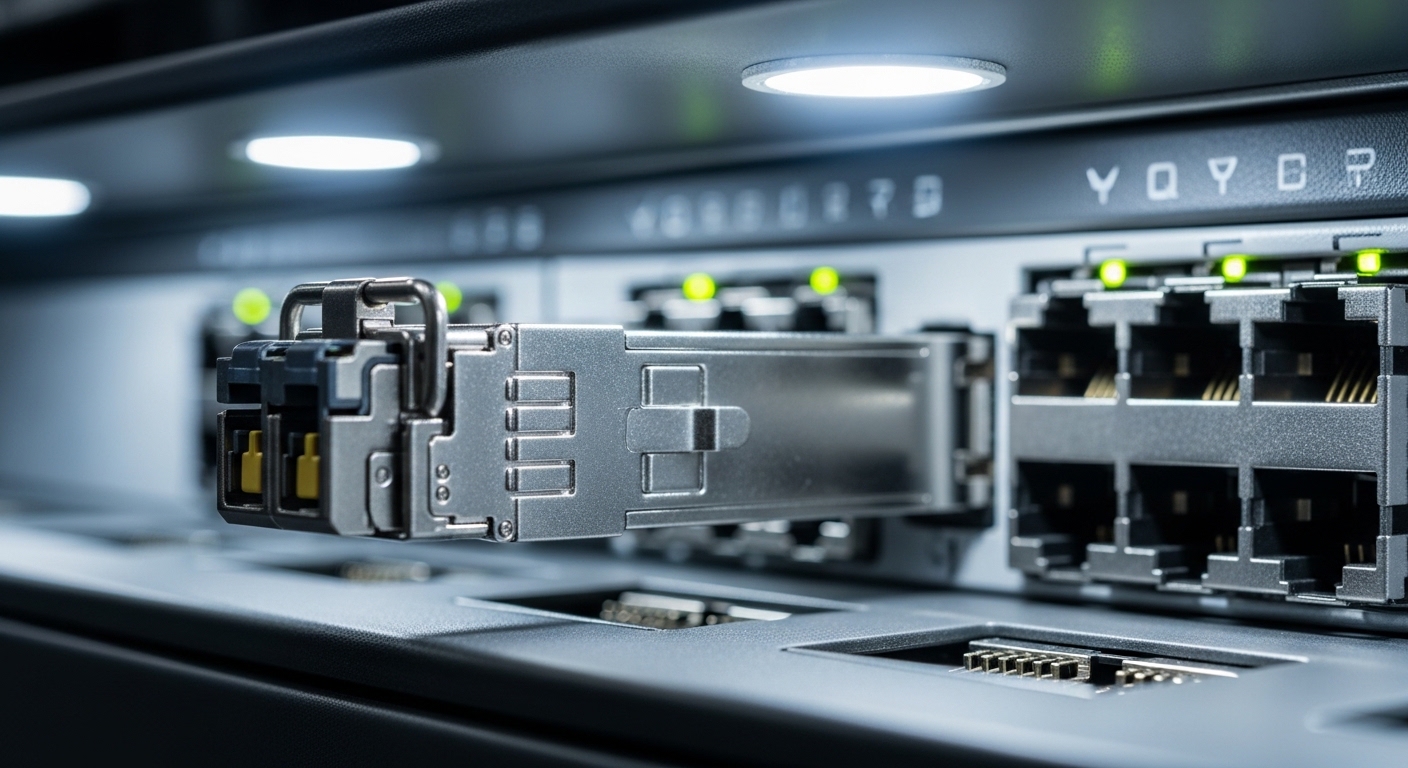
100G QSFP28 remains valuable in mixed environments where older switches coexist with newer AI hardware. For short links, SR (multimode) and DR (single-mode) variants can support predictable throughput while leveraging existing cabling.
Selection hinges on reach and fiber plant: SR typically targets OM4/OM5, while DR targets single-mode distances. Confirm that your switch supports 100G breakout modes if you are using adaptive port configurations.
Best-fit scenario: In a hybrid AI edge deployment, you may connect inference servers to a ToR switch over 300 m single-mode for DR, while internal management networks use SR over OM4 for sub-100 m runs.
- Pros: Broad ecosystem compatibility, lower migration risk for mixed hardware.
- Cons: Not ideal for the densest spine uplinks; power per bit can be worse than newer 200G/400G.
25G SFP28 DAC/AOC for ultra-short GPU-to-switch runs
For very short distances (often within the same rack or adjacent row), 25G SFP28 direct-attach copper (DAC) or active optical cable (AOC) can outperform fiber optics in operational simplicity. In AI racks, cable management and install time are as important as raw link budgets.
Engineers should validate the maximum reach for the exact DAC/AOC part number, the expected power consumption, and whether the switch supports the cable’s EEPROM profile. Also check whether the link is “always-on” in your thermal design; high ambient temperatures can reduce margin.
Best-fit scenario: In a rack with 1 m to 7 m runs between GPU servers and a top-of-rack switch, 25G DAC can reduce installation time and avoid connector cleaning in dense cabling.
- Pros: Fast deployment, fewer connector variables, good for short-reach.
- Cons: Limited reach; some AOCs have strict compatibility lists and fragile optics windows.
10G SFP+ LR/SR for management, telemetry, and low-risk segments
Not every AI infrastructure link needs maximum bandwidth. 10G SFP+ LR/SR is often used for out-of-band management, telemetry aggregation, and storage-adjacent services where stability beats peak throughput.
While 10G is not a performance headline, it is an operational workhorse that simplifies troubleshooting and reduces risk when you must run stable, long-lived links. Verify temperature rating and ensure DOM (if present) integrates with your monitoring stack.
Best-fit scenario: In a facility where you run management VLANs across multiple cages, you might use 10G LR for 10 km class runs between core management switches and OOB concentrators.
- Pros: Mature support, low operational surprises, excellent for long-lived infrastructure.
- Cons: Not suitable for high-throughput training east-west traffic.
800G QSFP-DD (or OSFP-class) for next-gen spine scaling
As AI clusters scale, some fabrics adopt 800G optics to reduce oversubscription and simplify spine port counts. The primary practical concerns are interface compatibility, power draw, and whether your switch supports the optic’s exact electrical/optical mapping.
Engineers should demand vendor documentation that specifies supported link rates, FEC requirements if applicable, and DOM alarm thresholds. In the field, the most common “performance” issue is not raw bandwidth; it is mismatched optics profiles or unsupported DOM event handling that causes alarming or link instability.
Best-fit scenario: In a next-gen fabric where two spines serve 64 leaves with 800G uplinks, you may target 2 km to 10 km class distances depending on single-mode plant quality and budget.
- Pros: Fewer ports, higher aggregate throughput, improved scaling efficiency.
- Cons: Higher cost, stricter compatibility constraints, more demanding cooling and power budgeting.
“Matched” high-performance optics with DOM, vendor validation, and OM5 discipline
The last pick is not a single transceiver format; it is a selection strategy. “Matched” high-performance optics means choosing modules that are validated by the switch vendor (or at least explicitly supported) and ensuring DOM telemetry is compatible with your monitoring and alert thresholds.
In real deployments, the ROI often comes from reduced downtime and faster mean time to repair (MTTR). If you cannot reliably read DOM temperature and optical power, you lose the ability to distinguish fiber issues from laser aging.
Best-fit scenario: For AI fabrics with aggressive maintenance windows, you may standardize on a small number of module SKUs and enforce OM5 fiber certification practices so that any replacement can be deployed without re-optimizing link budgets.
- Pros: Better operational reliability, faster troubleshooting, lower swap risk.
- Cons: Potential vendor lock-in; third-party optics may require extra validation.
High-performance optics spec comparison you can use in procurement
Use the table below to compare the most common AI data center optics categories. Because exact performance depends on switch implementation and fiber certification, treat these as “planning specs” and confirm with your optics compatibility matrix.
| Optics type | Typical data rate | Fiber type | Wavelength band | Reach class | Connector | DOM support | Operating temperature (typ.) |
|---|---|---|---|---|---|---|---|
| QSFP28 SR | 10G to 100G | OM4/OM5 multimode | 850 nm | ~70 m to ~300 m (model-dependent) | LC | Common | 0 to 70 C (module-dependent) |
| QSFP28 DR | 25G to 100G | Single-mode | 1310 nm | ~500 m to ~2 km (model-dependent) | LC | Common | -5 to 70 C (module-dependent) |
| QSFP56 200G SR | 200G | OM4/OM5 multimode | 850 nm (nominal) | ~70 m to ~120 m (validated design) | LC | Common | 0 to 70 C (module-dependent) |
| QSFP-DD 400G LR4/FR4 | 400G | Single-mode | ~1310 nm | ~10 km (LR4) or ~2 km (FR4) class | LC | Common | 0 to 70 C or wider |
| 800G QSFP-DD / OSFP-class | 800G | Single-mode (often) | Multi-lane (varies) | Multi-km class (model-dependent) | LC or MPO (varies) | Common | -5 to 70 C (module-dependent) |
Standards context: IEEE 802.3 defines PHY behaviors and link requirements for Ethernet optical interfaces, while transceiver form factors and management follow industry conventions. See IEEE 802.3 and vendor datasheets for the exact lane mapping and DOM behavior. [Source: IEEE 802.3, vendor datasheets]
Selection checklist for high-performance optics in AI networks
Before ordering, engineers should run a structured checklist that matches the actual failure modes seen in production.
- Distance vs reach budget: Use fiber certification results (link loss, end-to-end attenuation, and worst-case connector loss). Do not assume “rated reach” equals your install.
- Switch compatibility: Confirm the exact module family is supported by your switch model and software release. Validate whether the switch enforces optic vendor IDs.
- DOM and monitoring integration: Ensure DOM thresholds and alarm events map to your NMS/telemetry. If you use threshold-based alerting, confirm units and scaling.
- Operating temperature and airflow: Verify module temperature range against measured inlet temperatures at the port side, not just the room average.
- Power and thermal budget: Compare module power draw and the switch’s total transceiver power envelope per line card.
- FEC and electrical interface expectations: Some high-rate optics require specific FEC modes; confirm with switch documentation.
- Vendor lock-in risk and spares strategy: Decide whether to standardize on OEM optics, supported third-party optics, or a mixed approach with pre-validated spares.
Pro Tip: In many AI fabrics, the fastest root-cause isolation comes from DOM telemetry trends. If optical power drops gradually over weeks while error counters climb, suspect laser aging or dirty connectors; if errors spike immediately after a move, suspect a single bad patch, not the optics vendor.
Common mistakes and troubleshooting tips
Below are failure modes that field teams repeatedly encounter when deploying high-performance optics for AI workloads.
Assuming multimode reach without OM5-aware certification
Root cause: Engineers use generic “70 m works” expectations while ignoring worst-case patch cord loss, modal bandwidth assumptions, and connector cleanliness. Multimode links are sensitive to launch conditions and fiber grade.
Solution: Require end-to-end certification (including link loss and polarity correctness). Use OM5-appropriate test results and standardize on validated patch cord lengths.
Optics profile mismatch with switch firmware
Root cause: Some switches strictly validate transceiver EEPROM fields or enforce compatibility checks. A supported-looking optic can still fail to initialize or run at reduced performance.
Solution: Validate against the switch vendor optics matrix for your exact switch model and software version. Test one spare in a staging rack before scaling.
Misinterpreting DOM alarms and error counters
Root cause: Teams alert on the wrong DOM threshold (temperature vs laser bias) or correlate optical power drops to the wrong layer. This leads to unnecessary swaps of healthy optics while the real issue is fiber contamination.
Solution: Align alert thresholds with the vendor’s DOM calibration guidance. Pair DOM data with interface error counters (FEC/PCS where available) to distinguish “fiber dirty” from “laser aging.”
Thermal hot spots at high density
Root cause: Airflow short-circuiting or blocked baffles increases transceiver inlet temperature. High-performance optics may pass initial link tests but degrade quickly under sustained load.
Solution: Measure inlet temperatures at the module face. Enforce cold-aisle containment and verify fan profiles after any rack maintenance.
Cost and ROI note for AI deployments
Pricing varies by data rate, reach class, and whether you choose OEM modules or