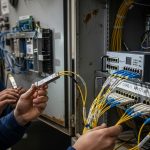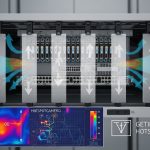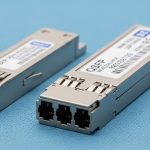
In 5G rollouts, baseband units, radio units, and transport gear all depend on tight timing. When synchronization drifts, you can see higher packet loss, degraded HARQ behavior, and costly truck rolls. This article explains how a G.8273.2 timing transceiver in Class C mode influences synchronization quality, what engineers should verify during installation, and how to troubleshoot the most common failure modes. It is written for field engineers, NOC operators, and network architects who must make timing work under real constraints like temperature swings, patch-panels, and mixed vendor optics.
What “Class C” means for a G.8273.2 timing transceiver in 5G
G.8273.2 defines timing performance for equipment that provides synchronization over packet networks, with classes that target different deployment sensitivities. In practical 5G transport designs, Class C is often chosen when the network must meet a defined holdover and wander tolerance but does not require the most stringent performance class reserved for the most critical synchronization domains. A G.8273.2 timing transceiver typically embeds the physical layer optics plus timing-related behavior so the upstream timing chain stays within a defined budget. The key idea is that the transceiver is not just a serializer/deserializer; it participates in how timing is transferred, regenerated, and stabilized.
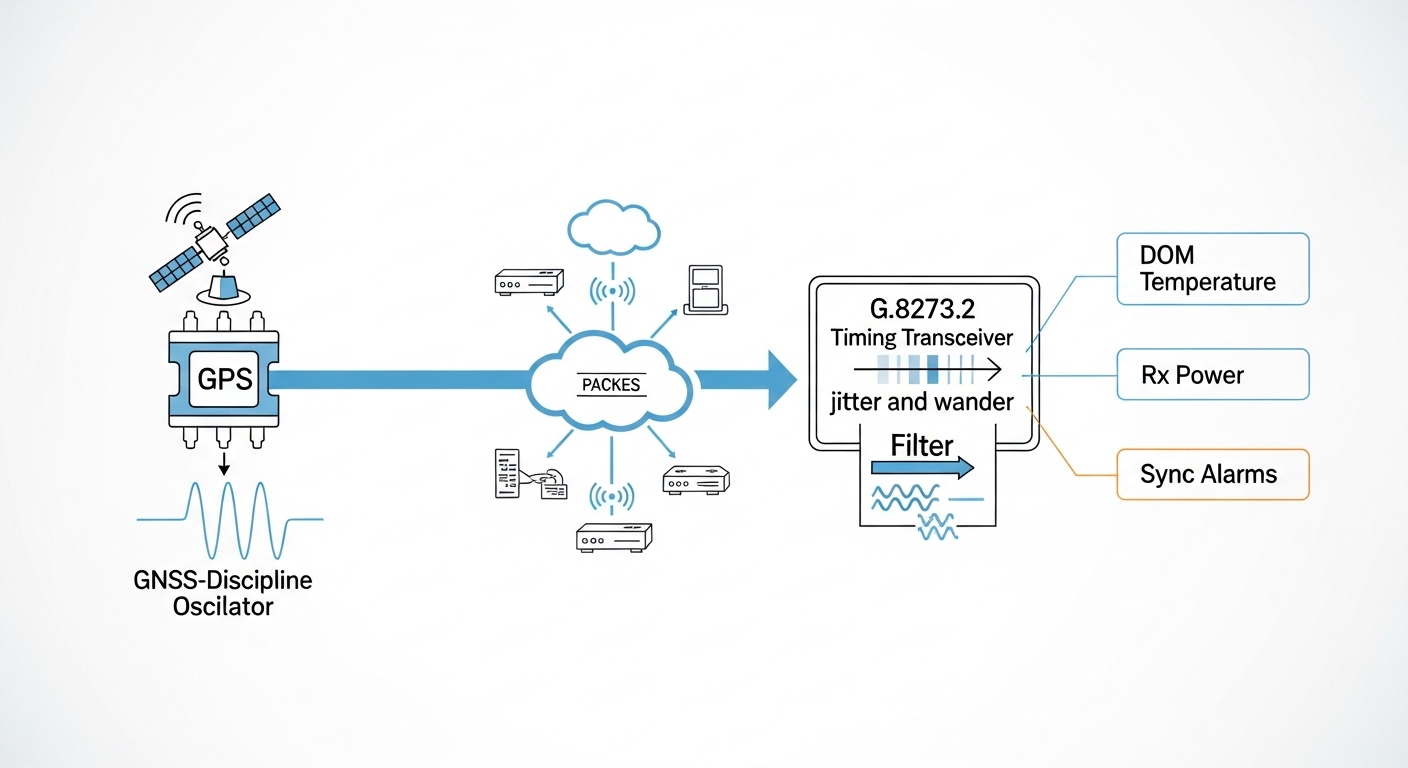
In a 5G site, timing usually originates from a GNSS-disciplined oscillator, a Stratum 1 reference, or a higher-level synchronization source, then propagates through fronthaul or midhaul transport. If the transceiver’s timing characteristics are out of tolerance, the system may still “lock,” but the resulting phase noise and wander can increase. That can push radios and baseband processors closer to their receiver tracking limits. For engineers, the question becomes: does the transceiver keep timing within the allowed SyncE or PTP boundary conditions for your specific topology and fiber plant?
Where the transceiver sits in the timing chain
Most deployments follow a chain like: reference source to timing distribution equipment, then to Ethernet switches/routers, then to optics, then to radio/baseband endpoints. The G.8273.2 timing transceiver typically connects an Ethernet interface that carries either synchronization information or traffic that is time-sensitive. Even when you use SyncE (Ethernet frequency synchronization) or PTP (Precision Time Protocol), the optics and their electrical/optical conversion can affect jitter transfer and stability. The transceiver’s specified timing parameters are therefore part of the system’s end-to-end synchronization budget.
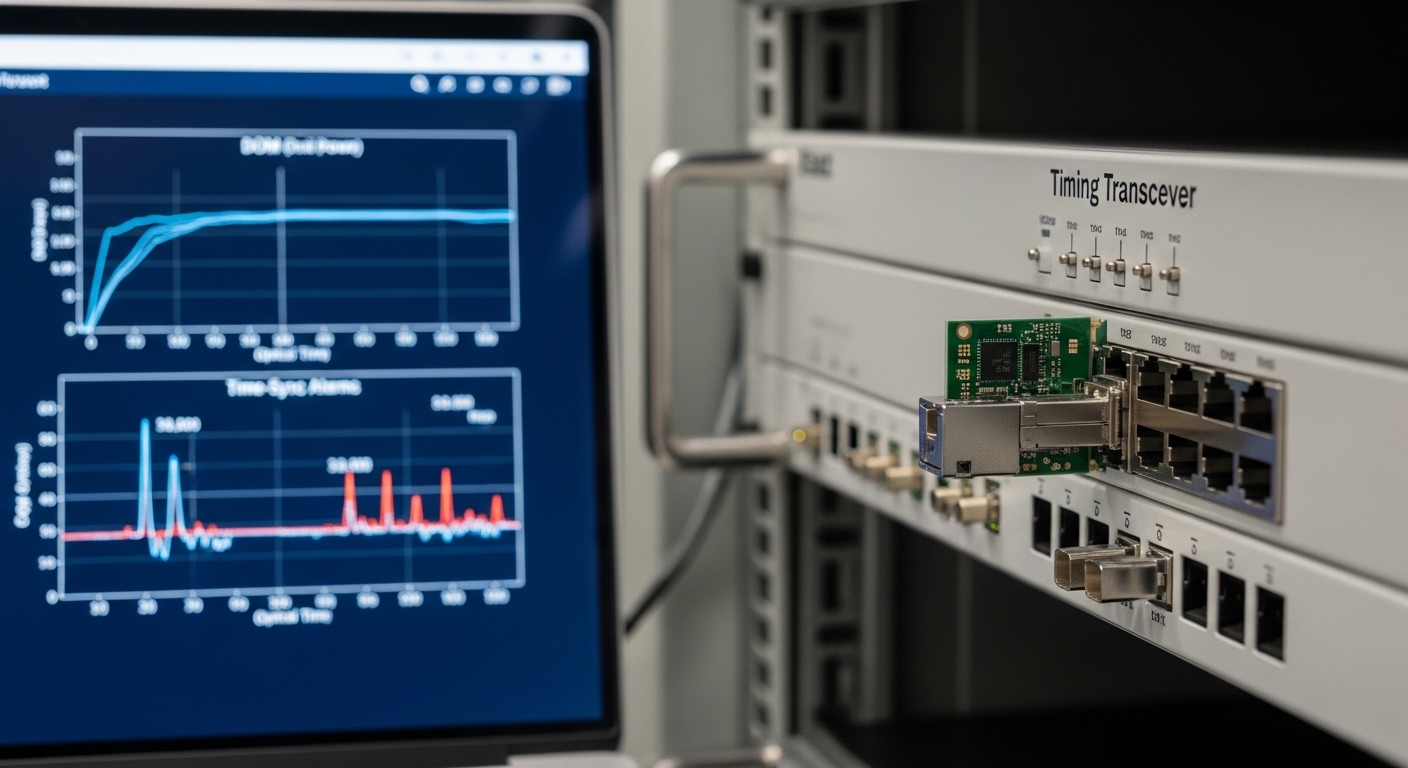
Pro Tip: Treat the transceiver as a timing component in your budget, not a “dumb cable replacement.” In field audits, teams that only validate link up/down miss wander and jitter transfer issues that show up after temperature cycling or after the patch panel is reconfigured. Start by validating DOM readings and optical power levels, then correlate with sync alarms.
Specs that matter: reach, wavelength, temperature, and timing behavior
When selecting a G.8273.2 timing transceiver for Class C, you need to map timing requirements to physical and environmental constraints. Wavelength and reach determine what fiber plant you can use; connector type determines installation quality; temperature range determines whether performance degrades at the top of the enclosure. Timing-related specifications are often vendor-specific, but they typically include jitter transfer characteristics, wander tolerance, and stability under operating conditions. You should request the vendor’s timing performance documentation for the exact model, not just the general product family.
The most common practical approach is to align three layers: (1) IEEE Ethernet PHY capability (data rate, modulation, link budget), (2) synchronization transport method (SyncE frequency synchronization or PTP), and (3) timing transfer class expectations under G.8273.2. If your network runs at 10G, 25G, or 100G Ethernet rates, ensure the transceiver supports the intended line rate and that the switch ports are configured correctly for the synchronization mode. For 5G transport, you also must ensure the transceiver’s operating temperature matches the radio cabinet conditions, which can exceed room temperature during summer peaks.
Representative technical comparison (example models)
The table below compares typical optical and environmental specs from well-known SFP/SFP+ and QSFP transceiver families used in timing-sensitive Ethernet. Timing parameters vary by exact vendor model, so use this table as a physical baseline and confirm timing documentation for G.8273.2 Class C compliance for your specific part number.
| Transceiver (example part) | Data rate | Wavelength | Reach (typical) | Connector | DOM | Operating temp | Notes for Class C timing use |
|---|---|---|---|---|---|---|---|
| Cisco SFP-10G-SR | 10G | 850 nm | ~300 m (OM3) | LC | Yes (commonly supported) | 0 to 70 C | Verify timing characterization and supported port modes in your switch. |
| Finisar FTLX8571D3BCL | 10G | 850 nm | ~300 m (OM3) | LC | Often supported | -5 to 70 C (varies by spec) | Confirm exact DOM and timing performance for the Class C claim. |
| FS.com SFP-10GSR-85 | 10G | 850 nm | ~300 m (OM3) | LC | Yes (varies by SKU) | -40 to 85 C (varies by SKU) | Check compatibility with your switch vendor and timing requirements. |
| Typical 25G SFP28 SR (vendor-specific) | 25G | 850 nm | ~70 m (OM4; typical) | LC | Yes | 0 to 70 C or wider | Higher-rate timing can be sensitive to jitter; validate with your sync alarms. |
For authority and baseline timing context, consult the standard itself and vendor timing application notes for G.8273.2 behavior. [Source: IEEE 802.3] and [Source: ITU-T G.8273.2] provide the framing, while transceiver vendors provide the operational parameters you need to implement within your network’s sync budget. For additional background on PTP and SyncE behavior in Ethernet systems, see [Source: IEEE 1588 (PTP)] and [Source: ITU-T G.8262 (timing over packet networks background)].
Temperature and optical power: the field variables
In real sites, the enclosure can see rapid temperature swings, and fiber patch cords can introduce additional loss or reflection. A timing transceiver can meet optical link margins today and fail timing stability later if the laser bias, receiver sensitivity, or internal clock recovery behavior changes under stress. Engineers should log DOM values such as Tx power, Rx power, laser bias (if provided), and module temperature during commissioning and during peak heat days. If you see Rx power close to the minimum threshold, you should expect higher receiver uncertainty and more jitter sensitivity.
Deployment scenario: Class C timing transceivers in a leaf-spine 5G transport
Consider a regional 5G transport network with a 3-tier topology: access nodes at the cell site, aggregation switches in a metro cabinet, and a core/edge cluster in the data center. Each cell site uses two 10G Ethernet links to a metro aggregation switch for redundancy. Suppose you have 48 ToR-style 10G ports feeding transport VLANs, and you carry SyncE or PTP-assisted timing across the same switching fabric. You deploy a G.8273.2 timing transceiver Class C on each uplink, using SR optics over OM3 fiber patching.
Now add realistic constraints: average fiber length is 180 m from site patch panel to aggregation patch, with measured insertion loss that varies by 1.5 dB between runs due to re-termination. Enclosures in summer reach 55 C and can spike to 62 C when ventilation is blocked. During commissioning, engineers verify link margin and record DOM values at Tx around -2 to -4 dBm and Rx around -6 to -10 dBm depending on the vendor’s SR budget. After a mid-year maintenance window, a patch cord is swapped, and a timing alarm appears. Because the transceiver was treated as a timing element, the team correlates the alarm with a DOM shift and a jitter/wander symptom, then fixes the patching before the issue propagates into radio performance.
How timing issues show up operationally
In NOC dashboards, you may see synchronization alarms like “holdover,” “time source unstable,” or “timing quality degradation.” At the radio layer, you might see increased re-transmissions or reduced throughput during certain mobility patterns. The root cause often traces back to timing path impairments: optical power margin, port configuration mismatches, or a transceiver that behaves differently under temperature stress. Class C selection is not “good enough by default”; it is good enough only if your network stays within the expected transfer and holdover behavior.
Selection criteria and decision checklist for engineers
Engineers typically choose a G.8273.2 timing transceiver Class C by balancing optical feasibility, switch compatibility, and synchronization performance evidence. The checklist below is how teams should structure a selection decision so you can justify it in change control and avoid surprises during acceptance testing.
- Distance and fiber type: confirm reach for your wavelength and fiber grade (OM3 vs OM4 vs OS2). Use measured loss, not just nominal spec.
- Switch port compatibility: verify the exact switch model supports the transceiver type and that the port is configured for the intended speed and FEC settings (if applicable).
- Timing documentation for Class C: obtain vendor timing performance evidence tied to G.8273.2 Class C, including jitter/wander transfer metrics relevant to your sync method.
- DOM support and monitoring plan: ensure the transceiver provides DOM and that your monitoring system ingests it consistently. Plan thresholds for Tx/Rx power and temperature.
- Operating temperature range: match the transceiver’s rated range to real enclosure conditions, including ventilation failures and sun exposure.
- Operating voltage stability: check whether the site uses stable DC feeds; transceiver performance can be sensitive to power ripple and brownout behavior.
- Vendor lock-in and interoperability risk: confirm whether third-party optics are accepted by the switch firmware and whether they preserve timing alarms and DOM parsing.
- Acceptance test procedure: define what you will measure during commissioning (link margin, DOM stability over time, sync quality indicators).
For standards alignment, remember that Ethernet PHY and management behavior are governed by IEEE 802.3, while timing over packet networks is shaped by ITU-T recommendations. Your transceiver choice is the intersection of those domains, so your test plan should cover both link-level and timing-level observability. [Source: IEEE 802.3], [Source: ITU-T G.8273.2].
Common mistakes and troubleshooting in the field
Even with a correct part number, timing failures can emerge due to operational mistakes. Below are concrete failure modes with root causes and fixes that teams commonly encounter when deploying a G.8273.2 timing transceiver Class C in 5G environments.
Link comes up, but sync quality degrades after temperature rises
Root cause: the transceiver is operating near or above its specified temperature range, causing internal clock recovery behavior to shift and increasing jitter/wander transfer. Sometimes the enclosure ventilation is blocked, or the module is placed in an airflow dead zone.
Solution: confirm module temperature via DOM, compare against the vendor’s rated range, and add airflow or relocate the module. Re-run synchronization tests during the hottest time window, not only at commissioning.
Optical power margin looks acceptable, but timing alarms persist
Root cause: patch cord replacement or connector contamination introduces intermittent reflections or localized loss that may not immediately drop the link. The link budget can still pass, while timing jitter increases due to receiver uncertainty.
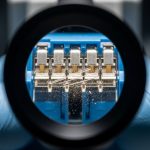
Solution: clean connectors using approved fiber cleaning procedures, inspect with a fiber microscope, and re-measure Rx power at the exact interface. Correlate timing alarms with DOM changes and optical events.
Switch configuration mismatch causes subtle timing behavior differences
Root cause: the port is not configured as expected (speed negotiation behavior, FEC mode, or transceiver compatibility quirks). Some platforms handle third-party optics differently, which can affect PHY behavior even when the link is nominal.
Solution: standardize port profiles, lock the speed mode where possible, and use the vendor’s compatibility list for optics. During troubleshooting, compare behavior between a known-good transceiver and the suspect unit on the same port profile.
DOM thresholds are not aligned to your monitoring system
Root cause: monitoring uses incorrect unit assumptions or overly tight thresholds, generating noise that hides real timing issues. Engineers may then ignore the only early warning signals.
Solution: calibrate thresholds based on measured commissioning distributions, implement rate-of-change alerts for Tx/Rx power, and create an incident correlation view between sync alarms and optical DOM telemetry.
Cost and ROI: what you realistically pay for timing stability
Pricing varies significantly by data rate, reach, and vendor ecosystem, but rough field ranges for optics often look like: OEM-branded 10G SR modules may cost around $80 to $250 each, while certified third-party alternatives may fall near $30 to $120. Higher-rate modules (25G/100G) can increase cost materially. The ROI is not only about initial purchase price; it is about reducing truck rolls, avoiding radio performance degradation, and preventing repeated commissioning cycles due to timing instability.
For TCO, include: labor time for acceptance testing, downtime risk during maintenance, cleaning/inspection costs for fiber, and failure rates under temperature stress. Third-party optics can be cost-effective, but the risk is compatibility drift after firmware updates and inconsistent DOM/timing behavior. A practical approach is to qualify one third-party model per switch platform and keep a small stock of known-good units for rapid replacement during timing incidents.
When you select a G.8273.2 timing transceiver Class C, request evidence for timing compliance and run a short acceptance test that includes temperature cycling and a sync-quality observation window. That is usually cheaper than chasing intermittent alarms in production after the network is live.
FAQ: G.8273.2 timing transceiver Class C for 5G teams
What is a G.8273.2 timing transceiver used for in a 5G network?
It is an optics module selected to meet timing transfer expectations defined by G.8273.2, typically used on Ethernet links that participate in synchronization distribution. In 5G, this helps keep timing stable across baseband and radio sites, reducing the chance of sync alarms and timing quality degradation.
How do I verify Class C compliance for the exact transceiver model?
Ask the vendor for the model-specific timing documentation that references G.8273.2 Class C performance metrics. Then validate in your environment by monitoring sync alarms and DOM telemetry over time, including at elevated temperatures.
Can I mix OEM and third-party optics on the same switch?
Sometimes yes, but compatibility is platform-dependent. You must confirm switch firmware support, DOM parsing behavior, and any timing-related PHY behavior differences. For risk control, qualify the specific third-party part number on the exact switch model and port profile.
What optical measurements should I log during commissioning?
Log DOM values for Tx power, Rx power, and module temperature, and capture their stability over a multi-hour window. Pair these with synchronization quality indicators so you can correlate any timing alarm with optical or thermal changes.
Why can the link stay up while timing still fails?
Ethernet link training can succeed even when jitter, wander, or receiver uncertainty increases. Timing-sensitive workloads may be affected before the link reaches a threshold that would cause a physical-layer outage.
What is the fastest troubleshooting path when a sync alarm appears?
Start with DOM telemetry and optical power margin at the exact interface. Then verify port speed and configuration match expectations, clean and inspect connectors, and compare against a known-good transceiver on the same port profile.
G.8273.2 timing transceiver Class C selection is ultimately about aligning optics, environment, and synchronization behavior so your 5G timing chain stays stable under field stress. Next step: review your current sync budget and run a targeted acceptance test plan using DOM telemetry and sync alarm correlation, then document it in your change record via timing transceiver for future audits.
Author bio: I am a network reliability writer who has supported synchronization rollouts using real optics telemetry, switch port profiling, and fiber plant measurements. I focus on actionable verification steps and failure-mode analysis that field teams can execute under time pressure.