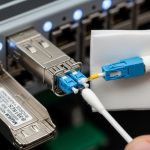
Telecom teams love flexibility until the floor manager asks why 2,400 ports won’t negotiate uptime at 2 a.m. This article helps network architects and IT directors run a fixed optics comparison against pluggable optics when designing transport, access, and aggregation. You will get practical constraints (optical reach, temperature behavior, DOM telemetry, and spares strategy) plus a decision checklist you can actually defend in governance reviews.
Architecture reality check: fixed optics vs pluggable optics
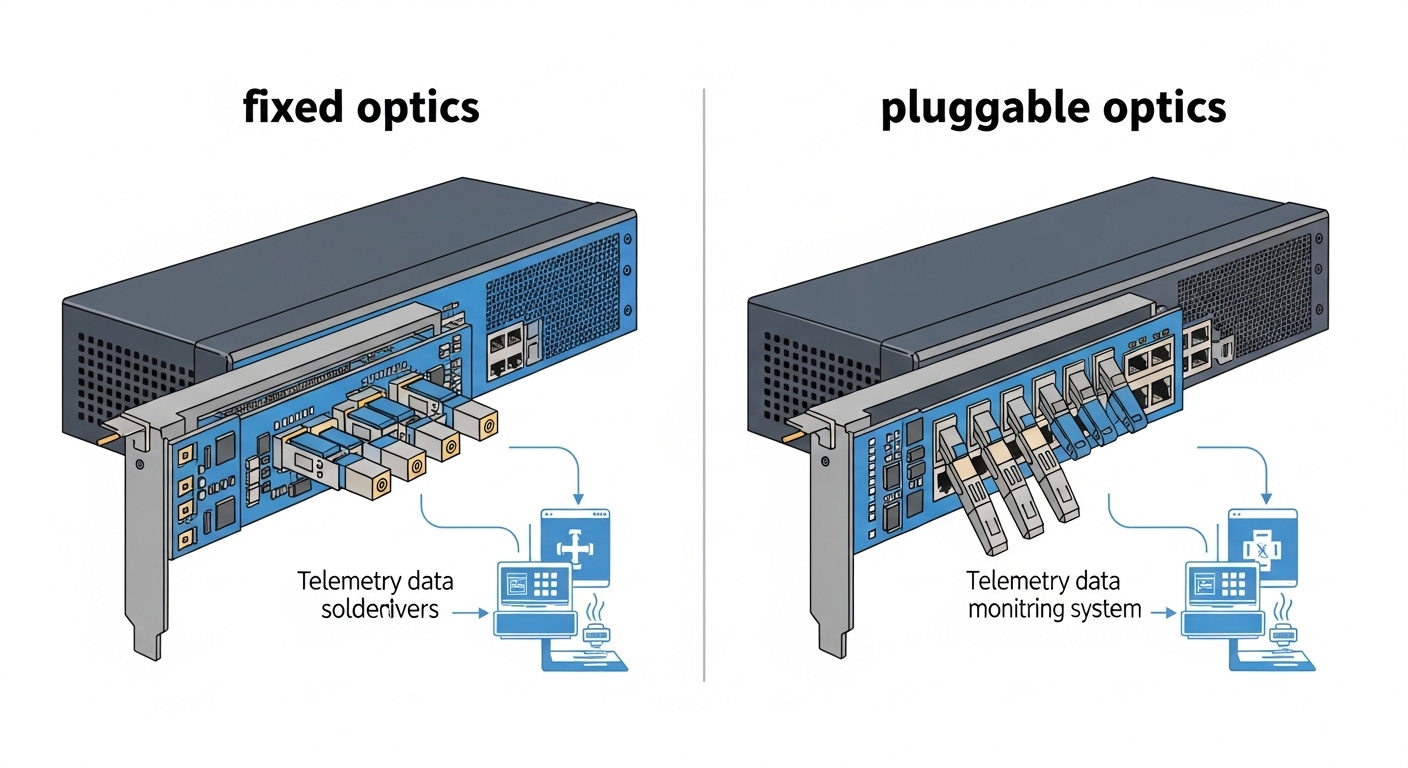
Fixed optics mean the transceiver optics are integrated into the line card or transponder chassis; pluggable optics use standardized form factors (SFP, SFP+, QSFP+, QSFP28, CFP2, etc.) to swap modules without replacing the board. In telecom, the difference is less about “can it work” and more about operational blast radius, inventory complexity, and how quickly you can perform maintenance while meeting service-level commitments.
From an enterprise architecture lens, fixed optics tend to reduce variations in the field: fewer SKU permutations, fewer transceiver compatibility edges, and tighter control of optical parameters. From a telecom operations lens, pluggables can win when you need multi-reach or multi-vendor support, but you must govern module sourcing and validate every optics vendor against your switch or router software bill of materials.
Standards still matter: IEEE 802.3 defines Ethernet PHY behaviors (including 10GBASE-SR, 10GBASE-LR, and higher-rate variants), while vendor datasheets define the exact optics and electrical interface expectations. For fiber cabling, ANSI/TIA-568 and related TIA fiber channel practices influence insertion loss and link margins; optics can be perfect and your link still fails if the plant is… artisanal.
Key technical specs to compare before you buy
The fastest path to regret is comparing optics by marketing reach alone. Compare wavelength, connector type, launched power, receiver sensitivity, DOM telemetry support, and temperature range. Below is a representative snapshot you can map to your vendor portfolio during a fixed optics comparison.
| Spec | Common fixed optics example | Common pluggable optics example |
|---|---|---|
| Data rate | 10G/25G/40G/100G (platform-dependent) | 10G SFP+, 25G SFP28, 40G QSFP+, 100G QSFP28 |
| Wavelength | Typically SR (850 nm) or LR/ER (1310/1550 nm) | SR: 850 nm; LR: 1310 nm; ER: 1550 nm |
| Reach class | Fixed to a specific optic type per port | May be multi-reach via different module SKUs |
| Connector | Usually LC on the chassis face | LC typically for SR/LR optics; varies by package |
| DOM / telemetry | Often supported but vendor-controlled | Varies; check for A0/A2 DOM compatibility |
| Optical power & sensitivity | Defined by the line card optic budget | Defined by each module datasheet; must match platform |
| Temperature range | Specified for the platform environment | Commercial vs industrial variants; confirm for field |
| Serviceability | Replace chassis/line card or use spare boards | Swap module; often faster for single-port faults |
For concrete optics examples you will actually see in deployments, consider SR 850 nm pluggables like Cisco SFP-10G-SR, Finisar FTLX8571D3BCL, or FS.com SFP-10GSR-85. These are not “universal truth,” but they illustrate the typical module ecosystem you must govern if you choose pluggables. For fixed optics, you will instead validate the line card optic budget and verify it against your fiber loss and aging assumptions.
Real-world deployment scenario: leaf-spine with strict uptime
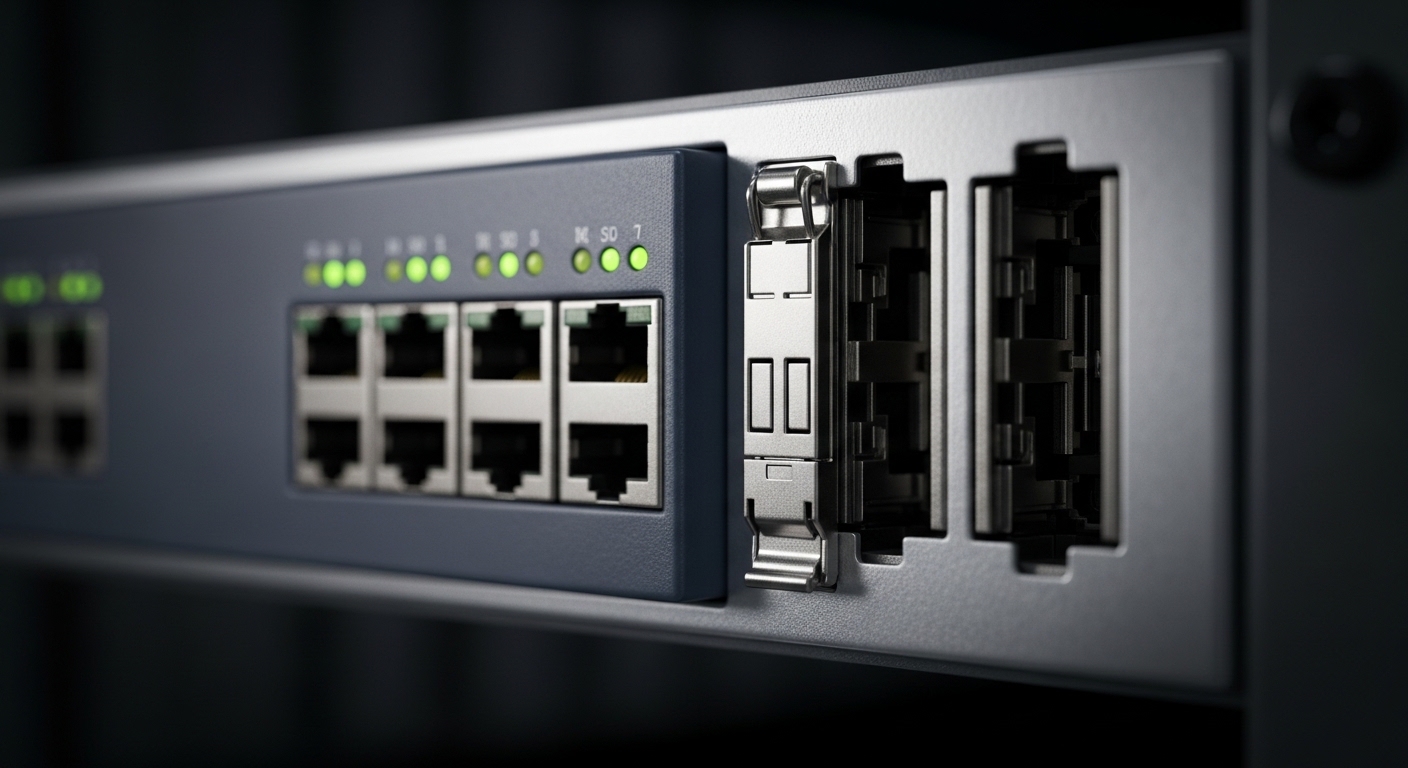
In a 3-tier data center leaf-spine topology with 48-port 10G ToR switches feeding a pair of spine routers, imagine 96 total ToR uplinks across two buildings. The transport uses OM4 multimode fiber for SR, with an engineered link budget of roughly 2 dB margin after connector losses and patch panel aging. The operations team wants to minimize “optics roulette” during maintenance windows.
They choose fixed optics on the spine for deterministic behavior: each port has a known SR optic design, validated with the platform optics calibration and verified in acceptance testing. For the edge ToR, they allow pluggables to support mixed-reach requirements between rows. In the first year, the fixed optics group reports fewer compatibility-related incidents because the optics are not swapped by third-party spares; the pluggables group reports more “module not recognized” events until the team tightens its transceiver qualification process.
Pro Tip: In many platforms, “DOM reads fine” does not guarantee “link budget is safe.” Always validate the received optical power and error rate under your real BER test plan (traffic load plus temperature swing), because DOM can still report values while the link is operating closer to the margin than engineering assumed.
Selection criteria checklist for architects and IT governance
Use this ordered checklist during a fixed optics comparison to avoid debates that end with hand-wavy spreadsheets.
- Distance and reach class: SR vs LR/ER, plus actual fiber plant loss from TIA measurements.
- Budget and total cost of ownership: module SKU count, spare strategy, and failure replacement workflow.
- Switch or router compatibility: vendor support matrices, software release constraints, and optics qualification.
- DOM and telemetry requirements: confirm DOM support type and how it maps into your monitoring stack.
- Operating temperature and environment: commercial vs industrial optics behavior, especially in hot aisles.
- Vendor lock-in risk: pricing leverage, warranty handling, and ability to use qualified third-party optics.
- Change management governance: who can swap optics, approval workflow, and audit trails.
- Maintenance model: line card swap speed versus module swap speed, plus spare board availability.
Common pitfalls and troubleshooting tips
Even great designs fail when the field acts like a science experiment. Here are frequent mistakes, root causes, and fixes.
-
Pitfall 1: “It links up at first, then degrades.”
Root cause: insufficient optical margin due to higher-than-expected plant loss, bad patch cords, or connector contamination.
Solution: re-clean and re-check connectors, verify fiber attenuation with OTDR or calibrated power meters, and confirm the optics budget versus the worst-case channel. -
Pitfall 2: “Pluggable module not recognized.”
Root cause: module vendor not on the platform compatibility list, or software/firmware mismatch affects identification and parameter negotiation.
Solution: use vendor-supported part numbers or qualified third-party modules; align firmware to the platform’s optics compatibility guidance. -
Pitfall 3: “DOM shows normal but errors spike.”
Root cause: monitoring captures DOM telemetry, but the system is operating near BER knee due to margin reduction from temperature or aging.
Solution: run a controlled traffic test, collect interface error counters under sustained load, and compare measured receive power to datasheet sensitivity with headroom. -
Pitfall 4: “Fixed optics blocks your reach change requests.”
Root cause: you planned SR only, then later needed LR for a cross-building segment without redesigning the optics plan.
Solution: stage the architecture: keep pluggables where reach agility is likely, and lock fixed optics where the topology is stable.
Cost and ROI note: what actually moves the needle
Pricing varies wildly by vendor, rate, and warranty terms, but practical ranges often look like this: OEM fixed optics line cards cost more upfront than adding pluggable modules, while pluggable optics can seem cheaper per port but increase inventory SKUs and qualification labor. Total cost of ownership typically includes: spare inventory carrying costs, technician time to locate the right module, and downtime during maintenance windows.
In my experience, the ROI hinge is operational friction. If your team has a mature transceiver qualification process (including DOM validation, BER testing, and connector hygiene discipline), pluggables can reduce downtime because a single bad module is swappable. If governance is immature or you anticipate frequent service events, fixed optics can lower mean time to restore by reducing compatibility variance and simplifying spares management. Either way, include failure rate assumptions from vendor warranties and your own historical incident data in the business case.

FAQ
Is fixed optics comparison mainly about price, or about reliability?
It is mostly about operational reliability and governance. Price matters, but the bigger driver is how predictable optics behavior is when technicians swap parts under real-world conditions. Fixed optics reduce variability; pluggables can improve MTTR if spares and qualification are well-managed.
Can we mix fixed optics and pluggable optics in the same network?
Yes, and many architectures do exactly that. A common pattern is fixed optics on stable aggregation points and pluggables at access edges where reach or vendor flexibility changes more often. The key is consistent monitoring, consistent fiber hygiene, and a documented optics compatibility matrix.
What about DOM telemetry and monitoring integration?
DOM support varies by platform and by module type, including how values map to your monitoring tools. For governance, confirm which DOM fields are exposed (temperature, bias current, optical power) and whether your polling thresholds match expected operating ranges. Then validate alarms with real traffic, not just a link-up event.
Do IEEE 802.3 standards guarantee optics will work?
They guarantee PHY behavior at the protocol and signaling level, not the exact optical budget or vendor-specific implementation details. Link success depends on datasheet budgets, connector cleanliness, fiber plant loss, and platform compatibility. Always validate against your acceptance test plan.
Are third-party pluggables a safe cost saver?
They can be, but only after qualification. You need to test module identification behavior, DOM telemetry correctness, and BER/packet error performance across temperature. Also check warranty handling and the platform’s explicit compatibility requirements.
Author bio: I have designed and operated telecom and data center optical networks, including acceptance testing with calibrated power meters and BER traffic validation. Currently I evaluate architectures by cost, uptime risk, and governance controls so teams can scale without turning optics into a weekly drama.
If you are planning the broader architecture, review network transceiver governance. That will help you define qualification, monitoring, and change-control rules for both fixed optics and pluggables.