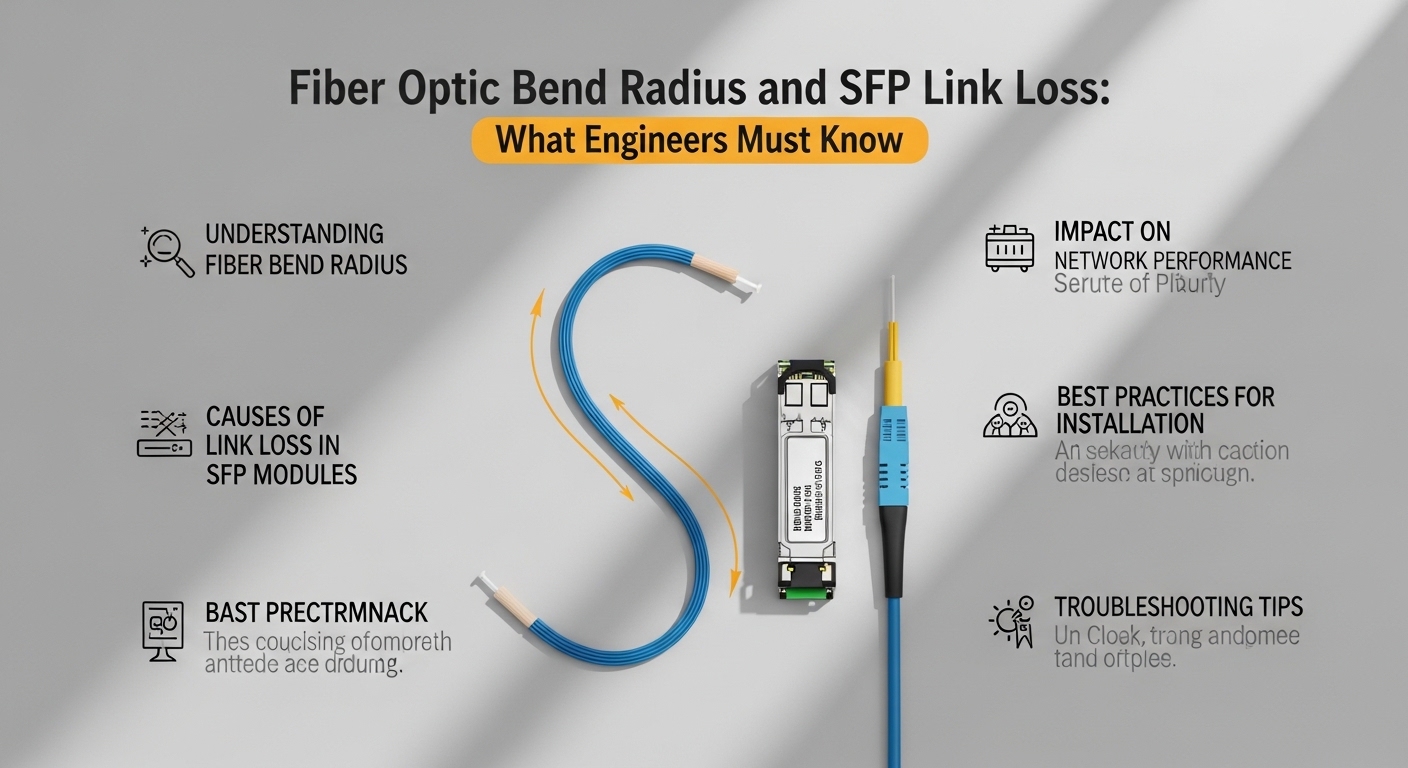
In many SFP deployments, the first symptom of poor fiber handling is not a dead transceiver, but a marginal link that flaps under temperature swings or after a rack move. This article helps network engineers and field technicians understand how fiber bend radius SFP behavior drives optical link loss, how to select compliant optics, and what to check when diagnostics look “mysterious.” You will get practical decision criteria, common failure modes, and an ROI view for reducing truck rolls.
Why fiber bend radius changes SFP link loss
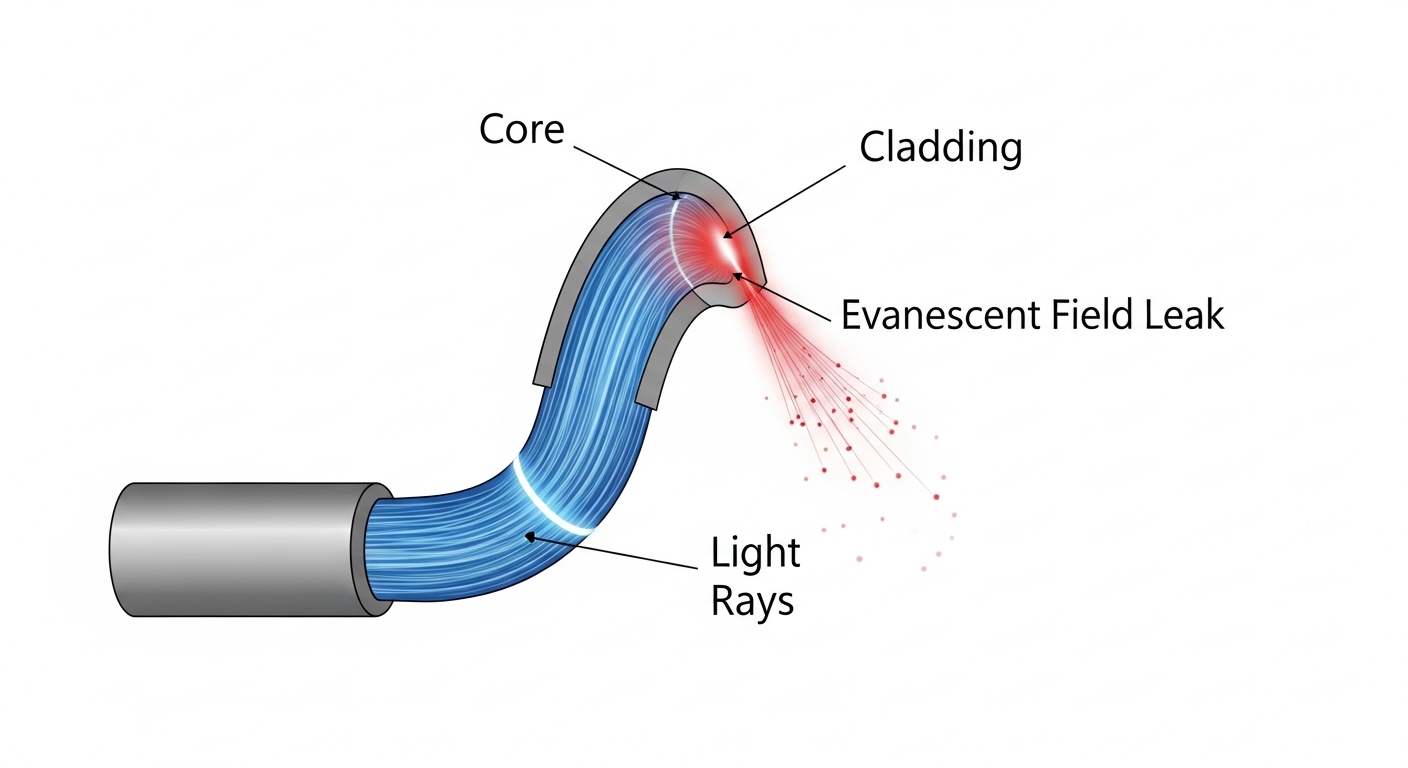
Most SFP optics use glass multimode or single-mode fiber where light is guided by total internal reflection. When the fiber is bent too tightly, the evanescent field increases and some optical power “leaks” into the cladding, raising attenuation. Over time, repeated micro-bends from cable management—especially near patch panel strain relief, Velcro ties, and cage doors—can produce higher insertion loss than the link budget assumes.
IEEE 802.3 performance targets do not explicitly “solve” bend loss; they assume installed cabling meets specified parameters. Vendor datasheets for SFP transceivers typically specify optical budgets (e.g., transmitter power, receiver sensitivity) and may include a note that system performance depends on cabling compliance. For bend-sensitive links, the key is protecting the fiber from exceeding the manufacturer’s minimum bend radius during routing and after installation. Source: IEEE 802.3
What “minimum bend radius” really means in the field
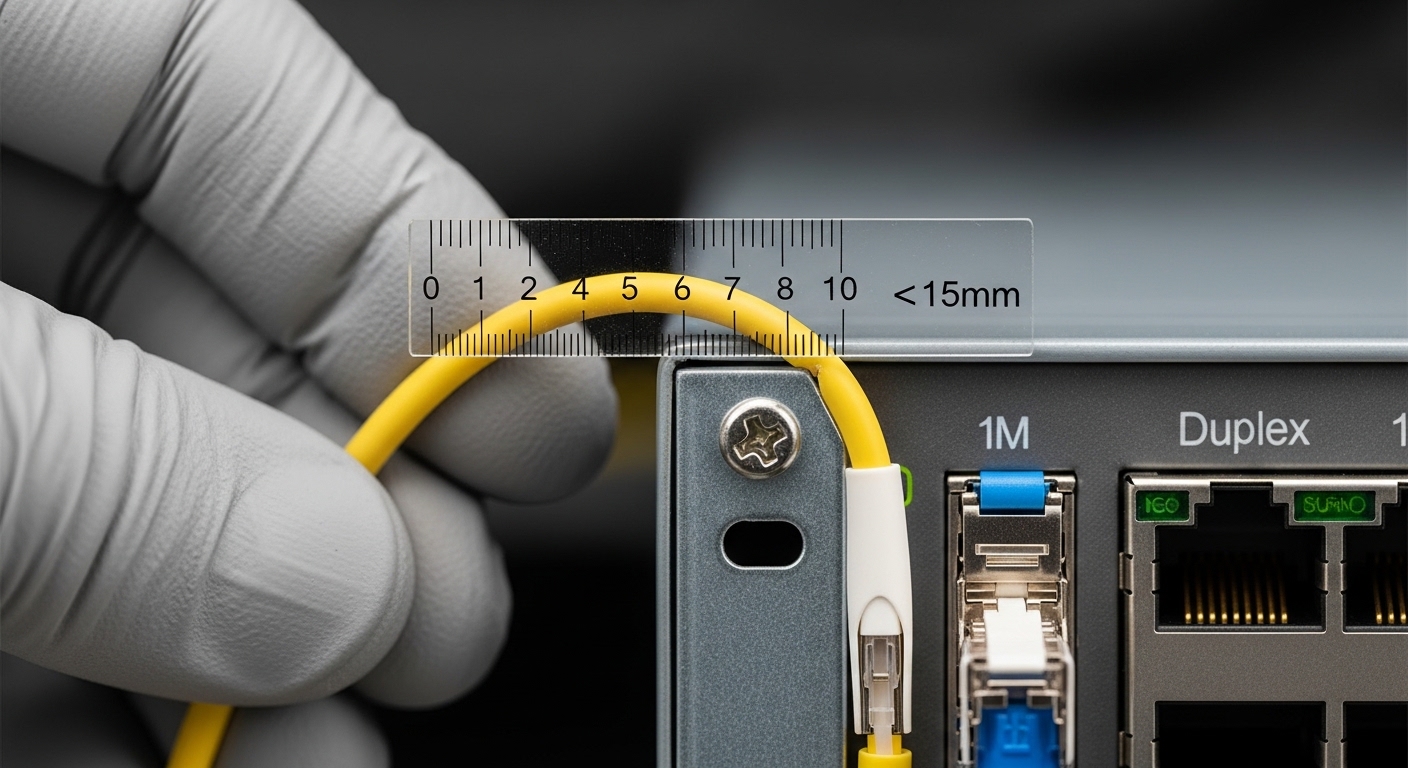
Minimum bend radius is usually given for “installation” and “storage,” often in millimeters. A typical rule of thumb is that single-mode fiber tolerates tighter bends than multimode in some cases, but real systems vary by fiber design and jacket stiffness. In practice, the effective bend radius can be smaller than your eye suggests due to cable tray edges, tight door hinges, or patch cord curvature at the SFP cage.
Key SFP and fiber parameters that interact with bend loss
To predict whether bend loss will break a link, you need both the optics and the fiber/cabling environment. SFP models differ in wavelengths, reach classes, and optical power levels. Even when the SFP is “rated” for a certain distance, the link can still fail if the installed cabling adds unexpected attenuation from bends, connectors, or dirty endfaces.
| Parameter | Example SFP (typical) | Why it matters for bend radius |
|---|---|---|
| Data rate | 10G (SFP+) | Higher rates often have tighter receiver sensitivity margins. |
| Wavelength | 850 nm (MM) or 1310/1550 nm (SM) | Mode behavior and bend sensitivity differ by fiber type. |
| Reach class | 10G SR: ~300 m typical on OM3/OM4 | Bend loss consumes part of the optical budget before reach limits. |
| Connector | LC duplex | Connector insertion loss plus bend loss can compound quickly. |
| DOM / monitoring | Digital Optical Monitoring | DOM helps detect rising attenuation trends after rerouting. |
| Temperature range | Commercial vs industrial SFP variants | Temperature changes can worsen marginal links and expose bend issues. |
In deployment work, engineers typically start with a link budget spreadsheet: transmitter launch power (from the SFP datasheet), receiver sensitivity, and allowances for fiber attenuation, connectors/splices, and safety margin. Then they add a “cabling handling risk” factor for bend-sensitive routes—especially when fibers are repeatedly reworked or routed through tight patch panel geometries.
Concrete spec examples you can reference
For real optics, you may see 10G SR SFP+ parts such as Cisco SFP-10G-SR or Finisar FTLX8571D3BCL; third-party options like FS.com SFP-10GSR-85 are also common. Always verify the exact DOM support, optical power, and compliance notes in the specific datasheet you install. Source: Cisco product documentation [Source: vendor SFP datasheets]
Deployment scenario: where bend loss shows up first
Consider a 3-tier data center leaf-spine topology with 48-port 10G ToR switches, each ToR using SFP+ SR optics to connect to an aggregation layer via 100 m OM4 trunks. After an equipment refresh, a technician reroutes patch cords to free a cable trough, creating consistent tight curvature within 10–15 mm near the patch panel corner. Two days later, only links in that row flap: link counters increment, and DOM shows receive power drifting downward by several dB compared to unaffected ports.
The root cause is usually not the transceiver itself, but the installed geometry: the effective bend radius near the LC transition, combined with connector insertion variance and dust, pushes the system past its margin. A field fix is to re-terminate or re-route so the fiber stays above the minimum bend radius for that specific cable assembly, then inspect connectors and clean with proper tools.
Selection criteria checklist for bend-safe SFP links
Use this ordered checklist when selecting SFP optics and planning fiber routing, especially for high-density racks and frequent maintenance windows.
- Distance and link budget margin: include connectors, splices, and a safety margin for handling variability.
- Fiber type and bend radius requirement: confirm the cabling manufacturer’s minimum bend radius for installation and long-term routing.
- SFP compatibility and optical class: ensure the SFP wavelength and reach class match the fiber (MM vs SM, OM3 vs OM4).
- DOM support: prefer SFPs with reliable DOM so you can trend receive power after moves.
- Operating temperature: choose commercial vs extended/industrial variants aligned to the environment.
- Connector and cleaning workflow: LC cleanliness affects loss as much as bend handling; plan tools and procedures.
- Vendor lock-in risk: compare OEM vs third-party TCO, including warranty and known compatibility with your switch vendor.
Pro Tip: In troubleshooting, measure receive power trends over time with DOM. If receive power steadily degrades after a cable rework but the fiber length is unchanged, assume a routing-induced bend or connector stress point rather than “random” optical aging.
Common mistakes and troubleshooting tips
1) Tight bends at the patch panel corner. Root cause: fibers are pressed around a sharp edge or cable management bracket, reducing the effective bend radius. Solution: reroute using proper bend radius guides, slack management, and strain relief; verify with the cable vendor’s minimum bend radius spec.
2) Cleaning skipped after re-termination. Root cause: microfilm or dust on LC endfaces adds insertion loss that combines with bend loss. Solution: clean with lint-free swabs or approved cleaning cartridges, inspect with a fiber microscope, and re-seat connectors.
3) Assuming “it links up once” means the path is healthy. Root cause: marginal links can pass initial training but fail under temperature changes or higher traffic. Solution: monitor link error counters, check DOM thresholds, and validate against your link budget with margin.
4) Mixing fiber types or incorrect patch cords. Root cause: OM3 vs OM4 or wrong wavelength optics can create unexpected attenuation and modal effects. Solution: label and verify fiber type in the patching scheme; confirm SFP model wavelength and reach class.
Cost and ROI note: preventing truck rolls
Budgeting for bend-safe handling often costs less than repeated maintenance. Typical SFP+ 10G SR optics price ranges vary by OEM vs compatible third-party models; many deployments see OEM parts costing meaningfully more, while third-party optics can reduce purchase cost but may increase compatibility or warranty risk. TCO should include field labor, downtime risk, cleaning supplies, microscope inspections, and the probability of repeat failures after cabling changes.
If a bend-related issue causes even a single extended outage or multiple dispatches, the “savings” on cheaper optics can be wiped out quickly. Investing in proper routing hardware, bend radius compliance, and DOM-capable SFPs often pays back within a few maintenance cycles.
FAQ
Q: What bend radius should I follow for fiber bend radius SFP links?
A: Follow the cabling manufacturer’s minimum bend radius for both installation and long-term routing. If the optic is rated for a reach class but the cabling assembly violates its bend spec, the link can fail even when the fiber length is within budget.
Q: How can DOM help if I suspect bend loss?
A: DOM can show receive power trends. If receive power drops after a reroute while transceiver model and port remain unchanged, bend or connector stress is a strong suspect.
Q: Are single-mode SFPs less sensitive to bend issues?
A: They can be less sensitive in some cases, but bend loss still occurs and depends on fiber design, jacket stiffness, and the actual routing geometry. Always validate against the cabling bend radius requirement.
Q: Can bend loss look like a dirty connector problem?
A: Yes. Both increase insertion loss, and both can produce similar symptoms like flapping links and reduced received optical power. Use a fiber microscope after any change, then correlate with routing changes and DOM trends.
Q: Should I buy OEM or third-party SFPs to reduce failures?
A: