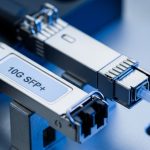
If your Westell or Calix DSLAM is flapping, negotiating at the wrong rate, or silently failing under load, the transceiver is often the root cause. This article compares DSL aggregation SFP options by performance class, optical reach, electrical interface behavior, and compatibility realities. It helps network engineers and field techs choose modules that actually work in production, including DOM handling and temperature constraints.
Westell and Calix DSLAM aggregation: what the DSL aggregation SFP must do
In DSL aggregation, the SFP is typically responsible for carrying aggregated traffic between the DSLAM and upstream switching or transport. Even when the DSL framing differs by vendor, the optics and link behavior still map to standards-based Ethernet physical layers. In practice, engineers must match the SFP electrical interface expectations (rate, lane mapping, and signal integrity) and the fiber plant characteristics (end-to-end attenuation and connector quality).
For Westell and Calix deployments, the most common field issues are not “bad optics” in isolation, but mismatches between module type and the DSLAM or upstream switch optics budget. For example, a 10G SR-class optical budget can be wasted if the installed plant has excessive patching loss or if the DSLAM’s transceiver cage expects a specific DOM threshold profile. The result is intermittent link drops that correlate with temperature swings or traffic bursts rather than a constant hard failure.
Performance head-to-head: reach class, optics budget, and link stability
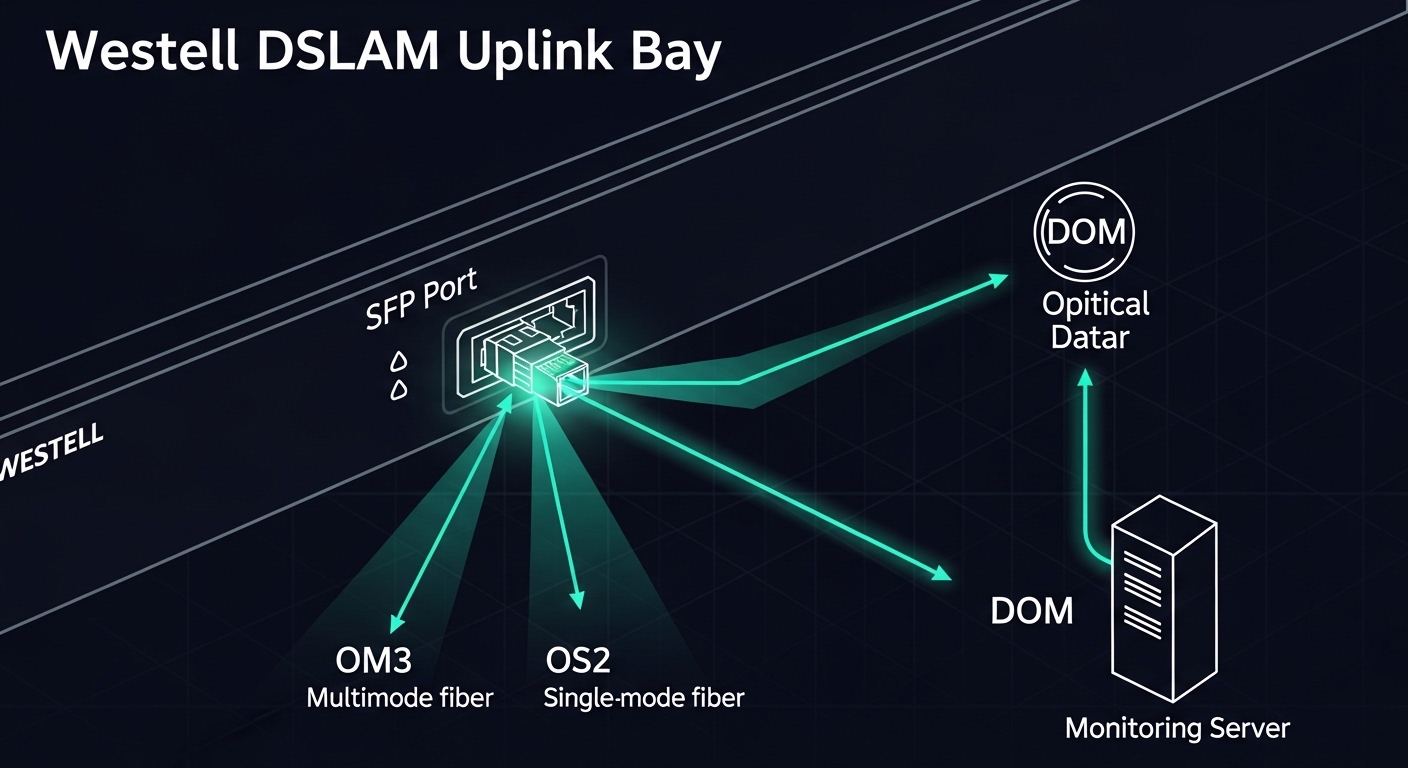
When comparing DSL aggregation SFP options, you should treat “reach” as a system budget, not a marketing number. The key variables are wavelength, fiber type, transmitter power, receiver sensitivity, and the connector/mating losses in your specific patch panel chain. For short-reach Ethernet optics, engineers commonly see SR variants at 850 nm over OM3/OM4 multimode and LR variants at 1310 nm over single-mode.
Representative modules engineers deploy
Third-party and OEM modules can both work, but you must verify the exact optical class and electrical compatibility. Typical examples you may encounter include Cisco-branded SR optics such as Cisco SFP-10G-SR, and Finisar/FOI-style optics such as FTLX8571D3BCL (10GBASE-SR, 850 nm class). Some operators also use FS.com equivalents like FS.com SFP-10GSR-85 where the “85” denotes a short-reach multimode class. Always confirm the datasheet power and sensitivity claims, not only the wavelength and reach.
Key specs comparison (what matters in the field)
| Spec | 10GBASE-SR (850 nm MM) | 10GBASE-LR (1310 nm SM) | Notes for DSL aggregation SFP use |
|---|---|---|---|
| Wavelength | 850 nm | 1310 nm | Matches fiber type and plant loss curve |
| Fiber type | OM3/OM4 multimode | Single-mode (OS2) | Do not assume “multimode works everywhere” |
| Typical reach class | Up to ~300 m (OM3) | Up to ~10 km (SM) | System budget depends on connector and patching loss |
| Connector | LC (most common) | LC (most common) | Confirm cage and patch panel mating type |
| Data rate | 10G (common) | 10G (common) | DSLAM uplinks may be 1G/10G; match rate |
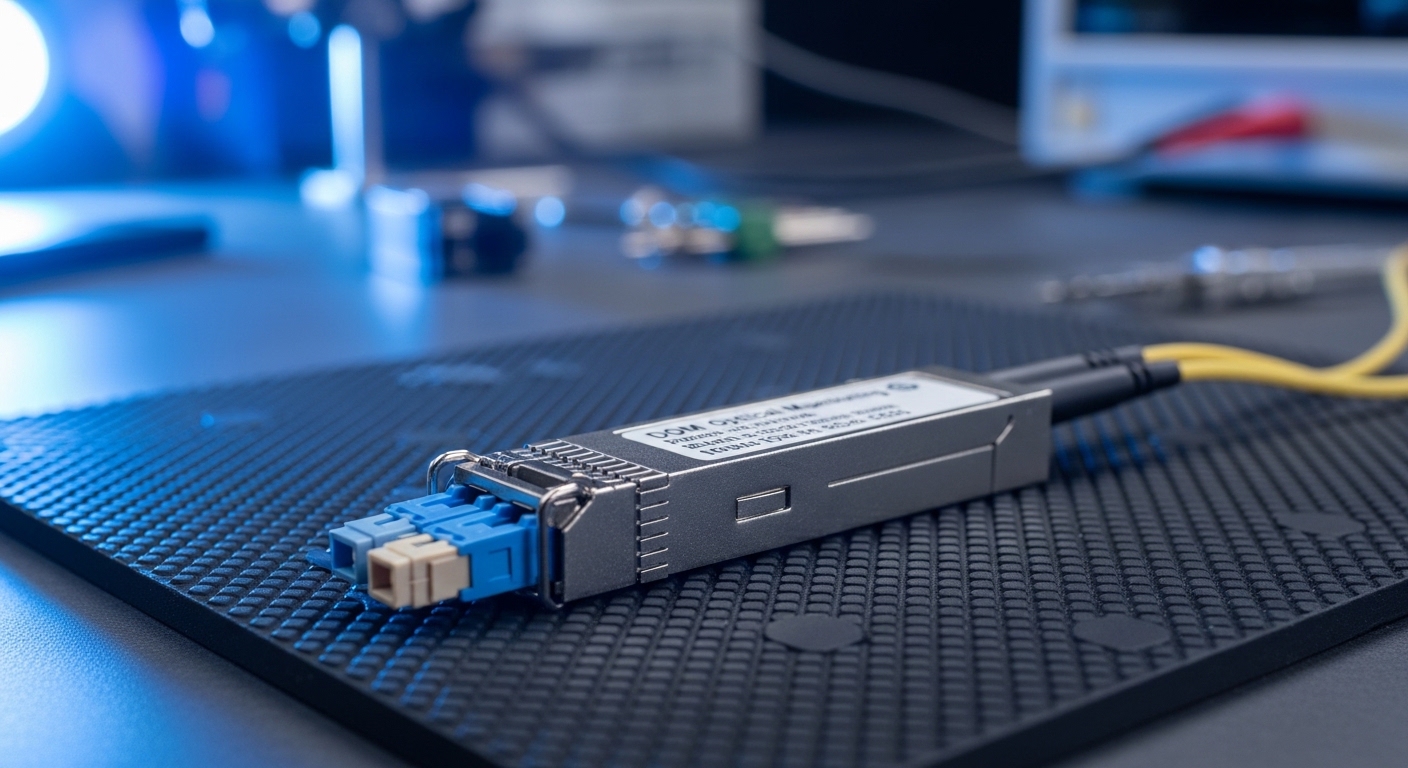
| DOM support | Often present (Digital Optical Monitoring) | Often present | Some platforms show alarms if DOM is absent or non-standard |
| Operating temperature | Commercial and/or industrial variants | Commercial and/or industrial variants | Outdoor cabinets require industrial-grade optics |
Standards that constrain behavior
Most 10G SFP optics follow Ethernet physical layer specifications aligned with IEEE 802.3 for 10GBASE-SR and 10GBASE-LR behavior. In addition, transceiver management and identifiers are typically carried via the SFP MSA feature set and the I2C-accessible memory map. For deeper validation, consult SFP MSA documentation and IEEE 802.3 clause references; vendor datasheets remain the authoritative source for actual transmit power and receiver sensitivity. [Source: IEEE 802.3 Ethernet Working Group documentation] [Source: SFP Multi-Source Agreement (MSA) documentation]
Pro Tip: In brownfield DSLAM rooms, many “random” link drops trace back to patch-cord swaps that changed multimode modal distribution and effective bandwidth, even when the fiber type remained OM3. Validate end-to-end optical budget with a scoped light meter or OTDR-based loss estimate before you replace optics again.
Cost and ROI: OEM vs third-party DSL aggregation SFP in real deployments
Engineers typically evaluate cost in three layers: purchase price per module, installation labor and spares footprint, and expected mean time to failure under the actual thermal cycle of the DSLAM room. OEM optics can reduce compatibility risk because they ship with tightly controlled firmware/DOM profiles, but they often carry a higher unit price and sometimes shorter effective life due to supply constraints. Third-party optics can be cost-effective, yet they require careful vetting of DOM behavior and optical parameters.
Realistic market pricing varies by reach class and vendor tier. As a planning baseline, enterprise operators often see SR-class 10G SFP optics in a mid-range price band, while LR-class single-mode optics cost more due to laser and packaging complexity. Over a 3 to 5 year horizon, TCO frequently becomes dominated by truck rolls and service-level penalties when an “almost compatible” module causes intermittent link instability. If your Westell or Calix DSLAM is in a high-availability aggregation point, the ROI can favor modules with proven compatibility and predictable DOM alerts.
Deployment math you can use
- Spare strategy: If you keep one spare per 8 to 12 uplink ports, your spares investment is manageable, but you need confidence the spare behaves identically.
- Failure impact: A single flapping uplink can create backpressure, increasing retransmissions and potentially stressing DSL profiles indirectly.
- DOM monitoring: If your NMS flags “DOM not present” as a critical event, a no-DOM module can inflate operational noise.
Compatibility and DOM: why the same wavelength can behave differently
In theory, a 10GBASE-SR 850 nm SFP should interoperate across standards-compliant systems. In practice, DSL aggregation SFP compatibility depends on more than optical class: it includes DOM page contents, alarm threshold calibration, and how the DSLAM’s port firmware validates the module. Field engineers often see that a module with correct wavelength still fails to meet platform-specific optics diagnostics, resulting in “link up but errors rising” or “link down” states.
DOM is typically read over the transceiver’s I2C interface. If a vendor’s DOM implementation deviates from expectations (for example, temperature or bias calibration scaling), the DSLAM may report invalid values. While the physical layer might still transmit correctly, operational tooling can mark the port as degraded, triggering automation or maintenance workflows.
Compatibility checklist for Westell and Calix cages
- Confirm uplink rate on the DSLAM port (1G vs 10G) and the expected SFP type (SFP vs SFP+ vs other form factors).
- Match fiber type and connector: OM3/OM4 vs OS2, and LC vs other connector geometry.
- Verify DOM support: ensure DOM is present and that the module advertises correct vendor and identifier fields expected by your monitoring stack.
- Check optical budget: confirm transmitter power and receiver sensitivity from the datasheet and compare against your measured plant loss.
- Validate operating temperature: cabinet airflow can push optics beyond commercial ranges during heat waves.
- Assess switch and DSLAM firmware behavior: some platforms are more strict in transceiver validation than others.
- Mitigate vendor lock-in risk: prefer modules with documented compatibility lists and stable DOM behavior across lots.
Common mistakes and troubleshooting: fast root cause isolation
When a DSL aggregation SFP fails, the fastest resolution comes from disciplined isolation rather than repeated module swapping. Below are frequent failure modes, their root causes, and practical solutions that field teams can apply during an outage window.
Pitfall 1: Wrong reach class for the installed fiber plant
Root cause: Installing a 10GBASE-SR 850 nm module into a link path that has higher than expected multimode loss due to older patch cords, dirty connectors, or excessive splices. The result is marginal receive power that collapses under temperature or higher traffic.
Solution: Clean connectors, then measure end-to-end loss. If the plant is effectively single-mode behavior or has long reach, migrate to a 1310 nm LR-class module compatible with OS2.
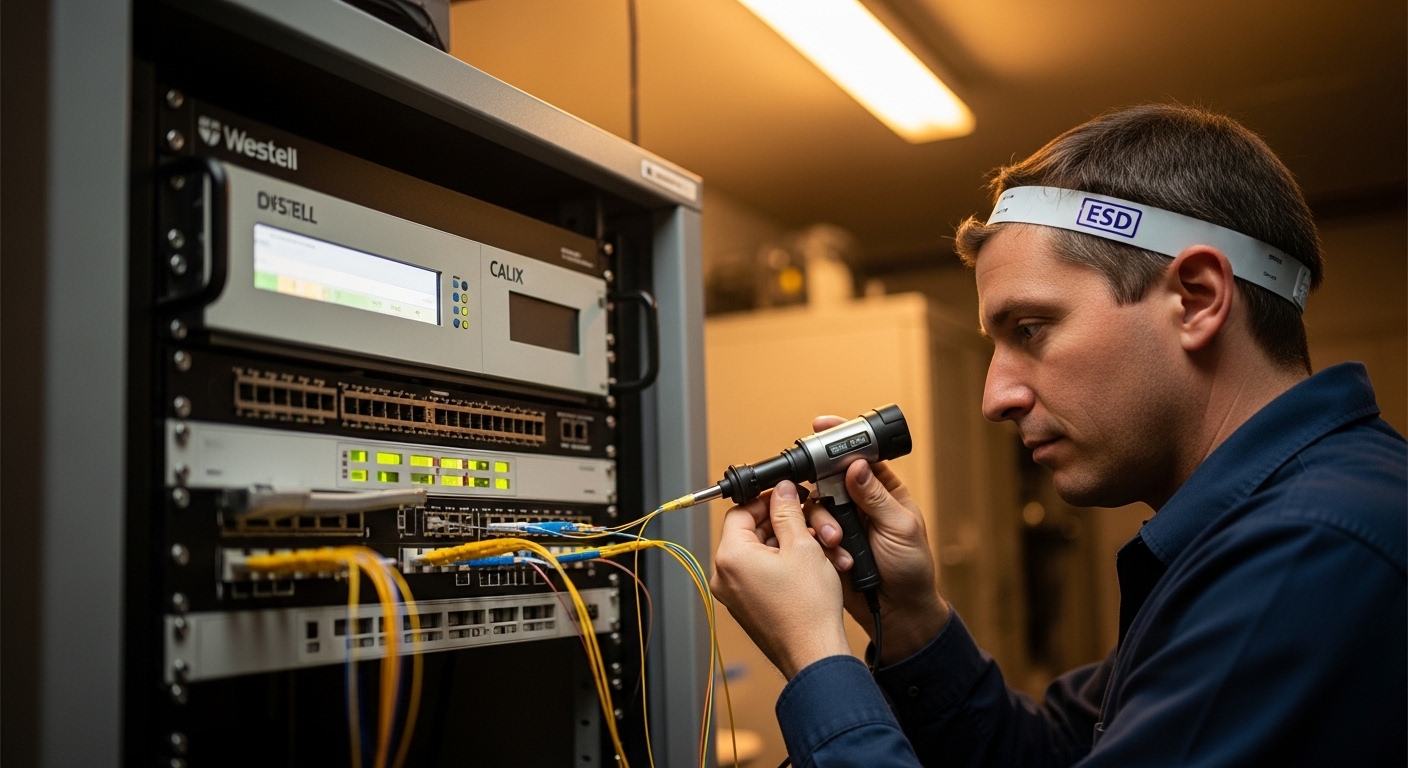
Pitfall 2: Dirty LC connectors misdiagnosed as a “bad transceiver”
Root cause: Microscopic contamination on LC ferrules increases insertion loss and can trigger high receive error rates. Because the link may still come up briefly, technicians sometimes replace optics prematurely.
Solution: Use approved fiber cleaning tools (lint-free wipes and fresh alcohol swabs only where appropriate, plus proper connector cleaning kits). Re-seat the patch cords after cleaning and observe DOM-reported Rx power and error counters.
Pitfall 3: DOM mismatch causing alarms or port disable
Root cause: A third-party transceiver with non-standard DOM scaling or missing DOM presence can cause the DSLAM or NMS to mark the transceiver invalid, even if the PHY link is marginally functional.
Solution: Confirm DOM presence and sanity of reported values (temperature, bias, Tx power, Rx power). If alarms persist, replace with a module whose datasheet explicitly states DOM compliance and whose part number is validated for your DSLAM model.
Pitfall 4: Temperature excursions in sealed cabinets
Root cause: Using commercial temperature modules in cabinets with poor airflow. Bias current drift can reduce optical output power and increase receiver bit error rate.
Solution: Deploy industrial temperature variants and improve cabinet airflow. Track optics temperature via DOM and correlate with link events.
Decision matrix: choosing the right DSL aggregation SFP option
Use the matrix below to decide quickly. It incorporates distance, fiber type, compatibility risk, and operational monitoring requirements. For Westell and Calix environments, the most important differentiator is often DOM and optics budget compliance, not only wavelength.
| Option | Best fit scenario | Distance / fiber | Compatibility risk | Operational monitoring | Typical cost stance |
|---|---|---|---|---|---|
| 10GBASE-SR 850 nm MM SFP with DOM | In-building aggregation over OM3/OM4 | Up to short-reach class (~300 m OM3) | Low if DOM verified | Good: DOM supports power/temperature telemetry | Often lower than LR |
| 10GBASE-LR 1310 nm SM SFP with DOM | Inter-building or longer reach aggregation | Up to long-reach class (~10 km) | Moderate to low with validated part numbers | Good: DOM supports diagnostics | Higher unit cost, sometimes lower risk |
| Third-party optics (SR or LR) with documented DOM behavior | Budget-constrained rollouts with strict testing | Depends on optics class | Moderate: validate lot-to-lot DOM | Good if DOM is standards-consistent | Lower purchase price, higher validation effort |
| OEM optics | High-availability sites with strict alarm policies | Depends on optics class | Lowest: known interoperability | Best: monitoring alignment with platform expectations | Highest unit price |
Which option should you choose?
If you are upgrading multiple Westell or Calix sites and you have consistent OM3/OM4 multimode with known insertion loss, a 10GBASE-SR 850 nm DSL aggregation SFP with validated DOM behavior is usually the best balance of performance and cost. If your fiber plant includes long runs, mixed patching, or OS2 infrastructure, choose 10GBASE-LR 1310 nm SM optics to reduce margin pressure and improve stability.
For high-availability aggregation points where alarms trigger automated maintenance, prioritize OEM optics or third-party optics with a proven compatibility record and strict DOM validation. For budget rollouts, third-party SR/LR optics can be economical, but only after you run a pilot in a representative cabinet with your actual patch cords and temperature profile.
Next, review how to verify link health beyond “link up” using optical telemetry and Ethernet error counters: fiber transceiver troubleshooting.
FAQ
Q1: Are DSL aggregation SFP modules interchangeable between Westell and Calix DSLAMs?
They can be, but interchangeability depends on rate, optics class, and how the platform validates transceiver identifiers and DOM telemetry. Always match the exact electrical and optical class and confirm DOM behavior with your NMS alarms.
Q2: Should I buy OEM or third-party DSL aggregation SFP for uplink stability?
OEM typically minimizes compatibility risk and aligns monitoring expectations. Third-party can be stable and cost-effective, but you must validate optical budget and DOM scaling on a pilot site before scaling.
Q3: What fiber type should I assume for SR vs LR DSL aggregation SFP?
SR at 850 nm is for multimode (OM3/OM4). LR at 1310 nm is for single-mode (OS2). If your plant is mixed or you are unsure, measure end-to-end loss rather than guessing.
Q4: My link comes up but errors increase. What should I check first?
Start with connector cleanliness and inspect ferrules using a scope. Then compare DOM-reported Rx power against the datasheet sensitivity margin and verify that the patch cord type and length match the optics class.
Q5: What DOM-related symptoms indicate an incompatible DSL aggregation SFP?
Common signs include “DOM not present” alarms, nonsensical temperature or bias readings, or port disable actions tied to transceiver validation. Confirm DOM presence and monitor the counters over temperature swings.
Q6: How do I estimate whether my optics budget is sufficient?
Use the module’s datasheet transmitter power and receiver sensitivity, then subtract measured plant loss from your end-to-end attenuation. Include connector and splice losses and add a safety margin for aging and patch cord changes.
Author bio: I have deployed and field-tested Ethernet SFP and SFP+ optics in DSL aggregation cabinets, with emphasis on DOM telemetry validation and optical budget reconciliation under real thermal cycles. My work focuses on reproducible acceptance testing and deterministic troubleshooting workflows for Westell and Calix-style environments.