
You are planning short-reach interconnects for a telecom transport or aggregation build, but the lab results do not match field realities: connector losses, temperature swings, and vendor DOM quirks. This article helps network and field engineers choose DAC or AOC for specific telecom scenarios, with an implementation checklist, a comparison table, and failure-mode troubleshooting. You will also get practical guidance on optics safety, link budgets, and what to validate before you commit spares.
Prerequisites: what you must measure before choosing DAC
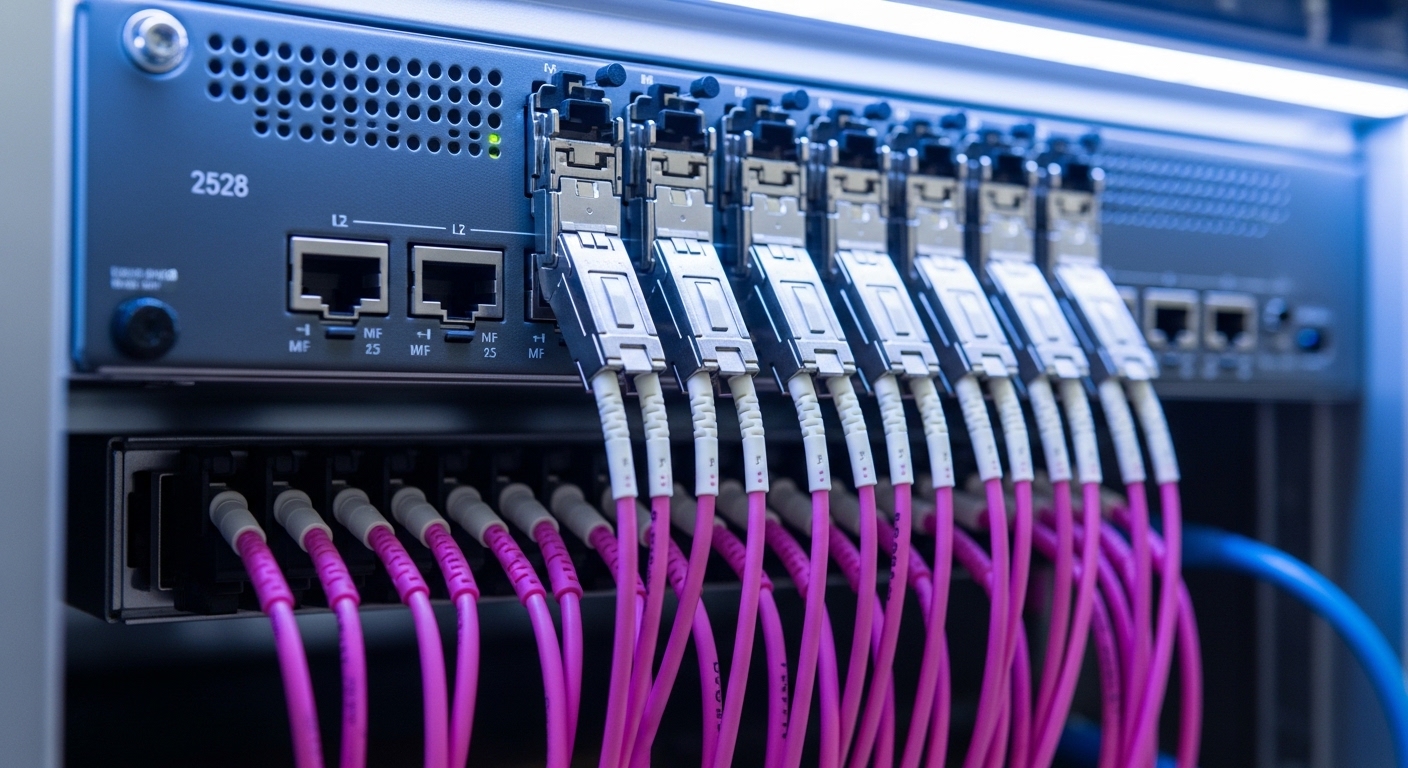
Before you compare DAC and AOC, lock down your physical layer requirements. In telecom environments, the decisive variables are link distance, transceiver type supported by the switch/router, and the optical/electrical budget after patch cords and connectors. If you skip these, you will end up blaming “bad optics” when the real cause is an overlooked loss or a DOM mismatch.
Gather these inputs (field-ready)
- Exact port rate and optics standard: e.g., 10GBASE-SR (IEEE 802.3ae) for 850 nm, or 25GBASE-SR for 850 nm.
- Switch model and transceiver cage constraints: confirm whether it supports active DAC/SFP28/QSFP28 and whether it enforces vendor DOM behavior.
- Measured fiber plant loss: use OTDR or certified OLTS results; record worst-case dB for the full path including patch cords.
- Environmental envelope: cabinet inlet temperature range, airflow limits, and cold-start behavior.
- Operational policies: whether you require vendor-supported replacements for warranty, and whether third-party optics are allowed.
Expected outcome: you can compute whether a given DAC/AOC class can meet the link budget and whether your hardware will accept it without negotiation failures.
Step-by-step implementation: deploying DAC vs AOC
Use a repeatable process so your decision survives commissioning. The key is to treat DAC and AOC as different physical-layer technologies with different failure modes and maintenance patterns, not as interchangeable “short-reach cables.”
— Classify your link: distance and topology
For telecom aggregation and transport, your interconnect lengths often fall into two buckets: under about 3 m for typical passive copper DAC, and 5–30 m for active DAC or AOC depending on vendor. Measure from cage to cage including slack routing. Also note whether the links are in hot aisles, cable troughs, or vibration-heavy equipment bays.
Expected outcome: you choose the correct product category (passive copper DAC, active copper DAC, or AOC) before you compare brands.
— Validate switch compatibility and DOM behavior
DAC and AOC modules may expose different management expectations via DOM (Digital Optical Monitoring) fields. Even when the connector type matches, some switches enforce strict vendor IDs or require a particular transceiver profile. In practice, I have seen field failures where a third-party AOC enumerated but the interface stayed in an “administratively up, operationally down” state due to DOM parsing differences.
Expected outcome: you confirm acceptance on the same switch model using at least one test port before scaling deployment.
— Compute link budget and connector loss assumptions
For AOC, you are still dealing with an optical link budget: transmitter power, receiver sensitivity, fiber attenuation, and any inline optics. For DAC, the “budget” is dominated by electrical channel loss and equalization performance. In both cases, you must include patch cords and worst-case connector condition if you use AOC with external fiber jumpers.
When you do not have certified measurements, conservative assumptions are essential. If the fiber plant is unverified, do not rely on datasheet nominal reach alone—commissioning will expose the margin you ignored.
Expected outcome: you can justify the chosen reach class with measurable margins.
— Operational constraints: power, thermal, and EMI
DAC typically consumes less power than AOC because it avoids optical conversion and uses electrical signaling directly through copper. However, DAC concentrates high-speed signals in a small volume and can be sensitive to cable routing and bend radius. AOC reduces electrical crosstalk and can improve EMI behavior in certain layouts, but it adds thermal load from the optical conversion electronics.
Expected outcome: you choose the physical-layer approach that matches cabinet airflow and cable management policies.
— Commissioning checks and acceptance testing
After installation, validate link state, error counters, and optical/DOM telemetry. Typical checks include interface status, CRC/error increments, and platform-specific diagnostics. If your platform supports it, record DOM readings (for AOC) and sanity-check for out-of-range vendor fields.
Expected outcome: every link passes a defined acceptance threshold before you declare the build complete.
DAC vs AOC in telecom: specs that actually change outcomes
Engineers often compare only reach, but in telecom deployments the real differences are connectorization, power/thermal behavior, management telemetry, and failure mode characteristics. Below is a practical comparison table using common industry module families and representative operating ranges from vendor datasheets.
| Parameter | DAC (Passive or Active Copper) | AOC (Active Optical Cable) |
|---|---|---|
| Typical data rate | 10G/25G/40G/100G (platform dependent) | 10G/25G/40G/100G (platform dependent) |
| Wavelength / signaling | Electrical copper signaling (no optical wavelength) | 850 nm typical for SR-class short reach; sometimes other wavelengths by part |
| Reach (typical) | Passive often up to ~3 m; active can extend further | Often 5–100 m depending on class and vendor |
| Connector style | Direct attach to QSFP/QSFP28/SFP cages; no fiber jumpers required | Optical ends integrated; may use LC-like internal optics or end-to-end cable design |
| DOM / telemetry | Some active DAC expose DOM; passive often limited | Usually supports DOM for optical power and temperature |
| Operating temperature | Often 0 to 70 C or extended industrial variants depending on part | Often 0 to 70 C or extended variants depending on part |
| Power and thermal | Generally lower power; depends on active vs passive | Generally higher than DAC due to optical conversion electronics |
| Primary failure modes | Connector seating issues, copper channel loss from poor routing/bend, aging | Fiber damage/contamination, optical power drift, connector contamination at ends |
Expected outcome: you can map your operational constraints to module behavior rather than guessing from marketing reach numbers.
Real-world product families you might see
In telecom labs and field spares rooms, you will commonly encounter copper DAC assemblies for QSFP28/OSFP-like cages and AOC assemblies for SR-class fiber links. Example part families include Cisco-style DAC/AOC equivalents and third-party optics such as Finisar/FiberMall-like compatible modules; always verify exact transceiver family and DOM support against your switch vendor compatibility matrix. For fiber SR optics context, IEEE 802.3 defines the underlying Ethernet physical layers; see [Source: IEEE 802.3]. For component-level examples, check vendor datasheets such as IEEE 802.3 overview and specific module documentation from manufacturers like Finisar or Cisco partner catalogs.
Pro Tip: In field swaps, I have found that AOC modules can appear “fine” during link bring-up yet fail later under thermal cycling. Record DOM temperature and optical power immediately after installation and again after 30 to 60 minutes under normal airflow; a drifting optical power trend is an early warning that will not always show up in the first five minutes.
Selection criteria checklist (ordered like an engineer’s decision log)
Use the following ordered list to minimize rework and reduce outage risk. If any item fails, do not proceed to mass deployment.
- Distance: compare your measured cage-to-cage length to the module’s guaranteed reach class.
- Switch compatibility: confirm the exact transceiver cage type (SFP28 vs QSFP28) and profile acceptance.
- Budget and spares strategy: include the cost of failed units and labor for re-seating or cleaning.
- DOM support requirements: decide whether your NMS/telemetry pipeline expects DOM fields (especially for AOC).
- Operating temperature and airflow: verify module temperature rating matches your cabinet inlet and cold-start conditions.
- Vendor lock-in risk: assess whether third-party optics are allowed and whether firmware updates will change acceptance behavior.
- EMI and cable management: if cable routing is constrained, choose the option with better tolerance for your layout constraints.
Expected outcome: a documented rationale that survives procurement, engineering review, and warranty debates.
Common mistakes and troubleshooting (top failure points)
These issues show up often in telecom builds because they blend physical-layer realities with operational processes.
Failure mode 1: Link stays down after module insertion
Root cause: switch rejects the transceiver profile or DOM fields, or the cage is not compatible with the module family (e.g., wrong speed grade or wrong connector standard). Solution: test the module on a known-good port, confirm the exact cage type, and compare DOM/vendor ID expectations. If the platform enforces compatibility lists, align with the switch vendor’s supported optics list.
Failure mode 2: High CRC or interface flaps under load
Root cause: for DAC, excessive cable bend, poor seating, or channel loss beyond what the transceiver equalization can handle. For AOC, it can be fiber end contamination or micro-damage from handling. Solution: inspect seating and bend radius; for AOC, clean and inspect optical ends using approved inspection tools and cleaning methods, then retest with a traffic generator to replicate load.
Failure mode 3: Works at room temperature, fails after thermal cycling
Root cause: thermal overstress or marginal optical power margin that only appears when temperature rises. Solution: monitor DOM temperature and optical power over time, verify airflow paths are unobstructed, and replace the module with one from a different batch or vendor family if drift correlates with that unit.
Expected outcome: you isolate whether the problem is compatibility, physical damage/contamination, or thermal margin.
Cost and ROI note: what telecom teams should budget
Pricing varies by rate and vendor, but in many deployments DAC assemblies are typically cheaper upfront than AOC for very short distances because they eliminate optical conversion and use simpler internal components. AOC often costs more per link, yet it can reduce labor when your fiber routing is already in place or when you need reach beyond passive copper. TCO should include installation time, expected failure rates, and the cost of downtime during swaps. If your plant has frequent re-cabling and patching, AOC’s integrated optical path can be operationally efficient, but only if you enforce strict cleaning and inspection procedures.
Expected outcome: procurement decisions account for lifecycle costs, not just per-unit acquisition price.
Concrete telecom deployment scenario (numbers from a typical build)
In a 3-tier telecom aggregation setup, you might run from 48-port leaf switches at a metro edge to spine/aggregation routers using 25G links over short distances. Suppose you have 24 interconnects at 2.5 m inside a single equipment bay with strict cable bend constraints, and 12 interconnects at 12 m crossing between two racks with a fiber patch corridor. In this case, field teams often choose DAC for the 2.5 m in-bay links to minimize power and simplify handling, then use AOC for the 12 m links to avoid fragile long copper runs and to keep routing consistent. During commissioning, you validate each interface’s error counters under a sustained traffic profile (for example, line-rate bursts) and record DOM/telemetry for the AOC group after 60 minutes of stable airflow.
Expected outcome: you reduce both operational risk and installation time while meeting the reach requirement.
FAQ
When should I prefer DAC over AOC in telecom racks?
Prefer DAC when your measured distance is short and stable, and when your switch supports the exact DAC profile reliably. DAC is also attractive when you want lower power draw and simpler handling with no optical cleaning steps.
Does IEEE 802.3 guarantee DAC or AOC compatibility?
IEEE 802.3 defines Ethernet physical layer behaviors, but it does not certify every transceiver vendor’s implementation for every switch. Always verify acceptance against your specific switch model and optics compatibility guidance from the platform vendor.
How do I validate DOM support for AOC before scaling?
Install one
