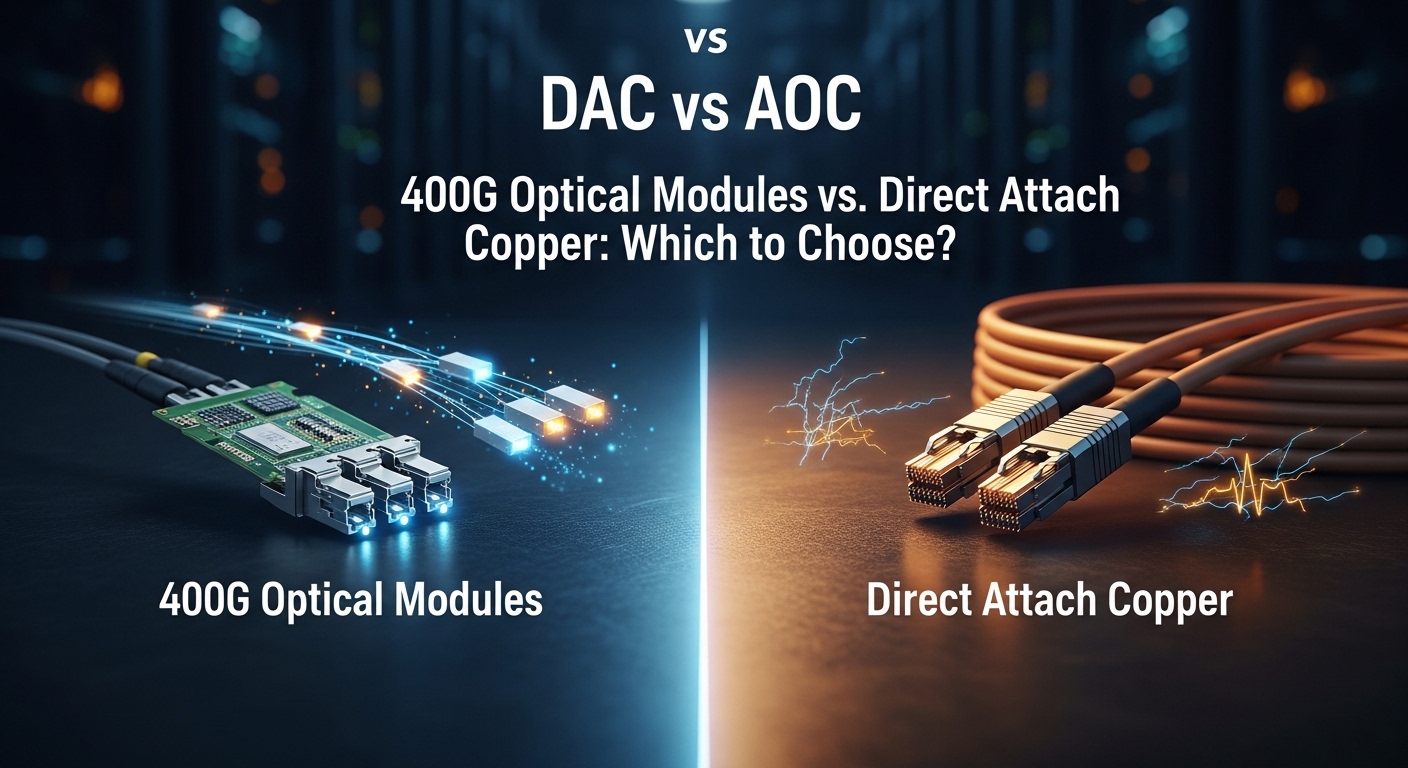
A 400G rollout can stall for a simple reason: your rack plan says “short reach,” but your switch budget says “optics only.” This article helps network engineers and field techs decide between DAC vs AOC for 400G interconnects—especially when you are mapping leaf-spine, ToR-to-aggregation, or server-to-spine links inside a tight physical footprint. You will get practical selection rules, a spec comparison table, and troubleshooting steps that match what you see during live deployments.
Why 400G DAC vs AOC decisions fail in the first week
In real deployments, the choice is rarely about theoretical reach—it is about what your switch ports can actually drive, what your patching plan allows, and how your team measures link margin. Direct Attach Copper (DAC) is passive or semi-passive and typically uses copper traces from the transceiver connector; Active Optical Cables (AOC) move the signal over fiber and add electronics in the cable. When engineers pick DAC for “all short links,” they sometimes ignore port power limits, cable length tolerances, and optics budget behavior under temperature swings.
When AOC is chosen too broadly, teams can also hit operational friction: patch panel density, bend radius during installation, and vendor-specific firmware or DOM expectations. The result is a predictable pattern: links come up in the lab, then flap in the field after thermal cycling or during re-cabling.
How DAC and AOC work in 400G ports (what matters to field engineers)
DAC in 400G: electrical path and port constraints
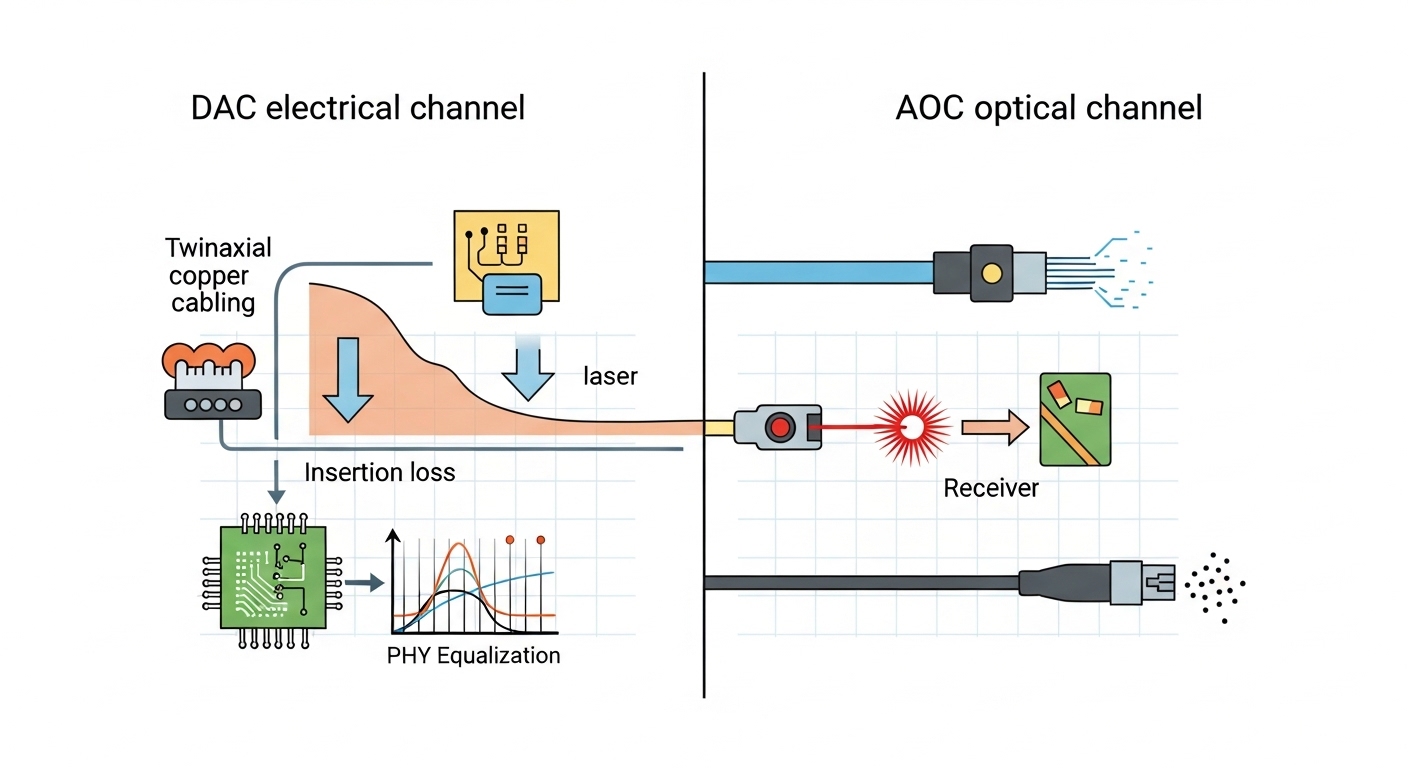
400G DAC typically uses a high-speed electrical interface between the switch and the adjacent device over copper conductors inside a twinax cable. Depending on vendor, it may be labeled as a “direct attach cable” with integrated connectors (common for QSFP-DD / OSFP ecosystems) and may support DOM-like telemetry. The key operational limits are insertion loss versus frequency, connector quality, and the switch PHY’s transmitter equalization range. If the cable is too long for the specific port’s channel design, the PHY may train but still fail to maintain BER targets.
AOC in 400G: optical path and installation realities
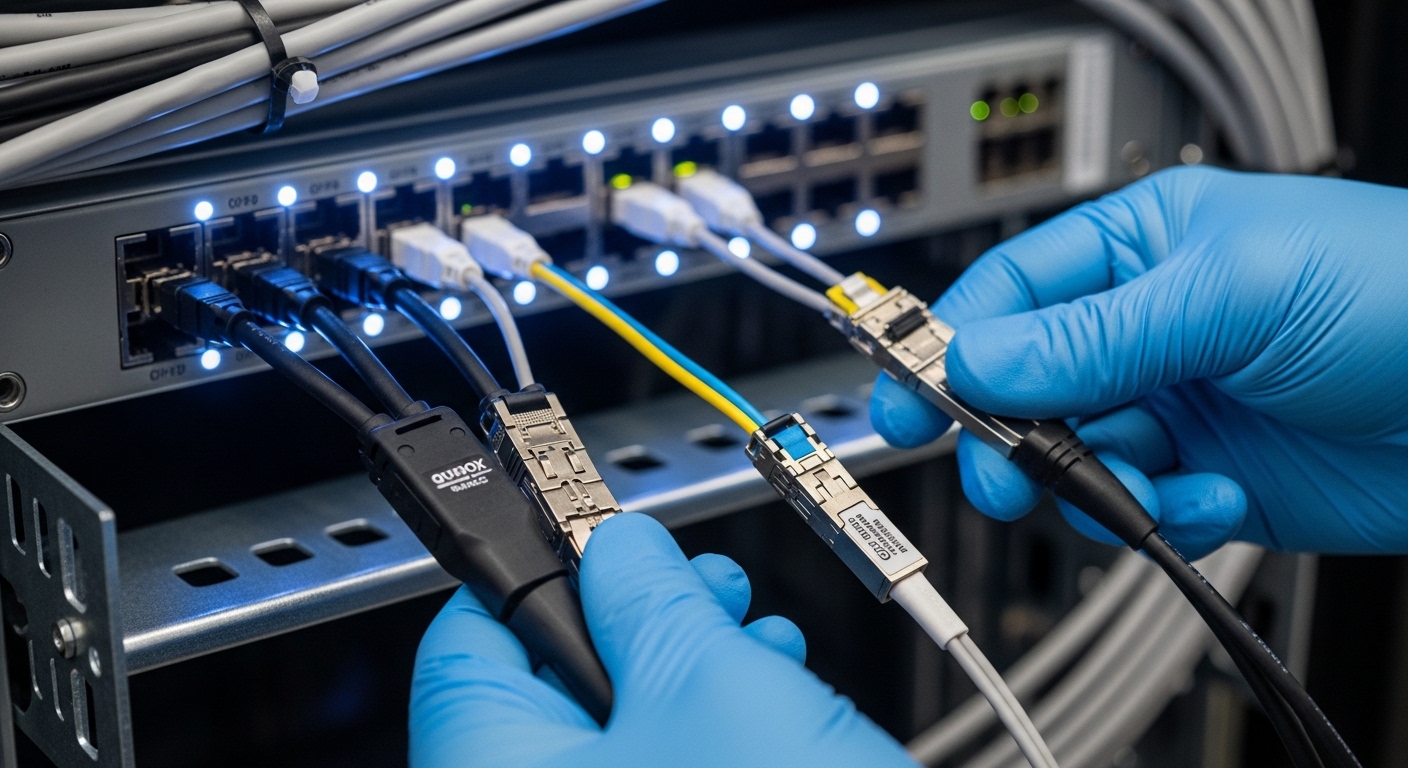
400G AOC is an active cable that includes optical transmitters and receivers, converting electrical signals to optical and back across fiber. It generally offers better tolerance to electromagnetic interference and can reduce signal integrity headaches when racks are noisy or cable routing is constrained. However, AOC introduces a physical fiber handling workflow: bend radius, patching compatibility, and fiber cleanliness. In many sites, the real failure mode is not the optics—it is dust and micro-scratches that degrade optical power until the link becomes marginal.
Pro Tip: In the field, the fastest way to avoid “mystery link flaps” is to validate each port’s supported cable type and length against the switch vendor’s compatibility matrix, then confirm temperature and power supply headroom at the time of link bring-up. Many 400G PHYs will negotiate at room temperature but drift after the chassis warms by 10 to 20 C.
400G spec comparison: wavelength, reach, power, connectors, temperature
Below is a practitioner-level comparison for the kinds of 400G optics you will commonly encounter when you are deciding DAC vs AOC. Exact numbers vary by vendor and connector format, but the operational trends are consistent.
| Category | Typical 400G DAC | Typical 400G AOC |
|---|---|---|
| Signal transport | Electrical over twinax conductors | Optical over multimode or single-mode fiber |
| Nominal reach | ~1 to 5 m (common short links) | ~20 to 100 m (varies by fiber type) |
| Wavelength | N/A (copper) | Common: 850 nm for MM; 1310/1550 nm for SM |
| Connector ecosystem | Often QSFP-DD / OSFP style cable assemblies | Often integrated AOC connector assemblies; may map to QSFP-DD/OSFP form factors |
| Power draw | Lower than AOC; depends on semi-passive design | Higher than DAC; includes optical Tx/Rx electronics |
| DOM / telemetry | Often optional; verify support for your switch | Usually includes DOM; verify DOM behavior and alarms |
| Operating temperature | Typically 0 to 70 C (or extended variants) | Typically 0 to 70 C for datacenter; extended options exist |
| Installation sensitivity | Less fiber handling; more sensitivity to cable length and bend at connectors | More sensitivity to fiber cleanliness and bend radius |
To ground this in real hardware behavior, engineers often compare known 400G optics and cable families from major vendors and compatible module ecosystems. For optical reach and specifications, consult vendor datasheets and standards behavior described in IEEE link-layer expectations and optical module interfaces, such as IEEE 802.3 for Ethernet physical-layer requirements and module interface guidance from vendors. [Source: IEEE 802.3] [[EXT:https://standards.ieee.org/standard/]]
400G deployment scenario: leaf-spine with mixed rack spacing
Picture a 3-tier data center leaf-spine topology with 48-port 400G ToR switches feeding 16-port 400G spine systems. The leaf switches sit 2 meters from the spine in the same row, but the cable tray path forces a practical routing length of 4.5 to 7 meters for some links due to column obstructions. During the first wave, the team installs 400G DAC for “same-row” connections and AOC for “tray-routed” links. In week one, DAC links on the far end of the tray plan show higher retransmits and occasional link resets after power-supply load increases.
The root cause is not “bad DAC” in general; it is that those specific DAC lengths exceed the switch PHY’s equalization comfort zone once the chassis reaches steady-state temperature. Meanwhile, the AOC links remain stable but require strict fiber cleaning during patching: one dusty MPO/MTP transition causes optical power to drop enough to push the link into a marginal state. The fix is to re-route the longest copper runs to shorter lengths where possible and to standardize a fiber cleaning workflow for AOC terminations.
Selection checklist: distance, switch compatibility, DOM, temperature, lock-in risk
Use this ordered decision list. It is designed to reduce rework and minimize link bring-up surprises.
-
Distance and routing reality
- Measure end-to-end path length including slack. For DAC, treat the labeled length as optimistic; plan margin for connector insertion and tray routing.
- If routing forces more than the typical short-link range, lean toward AOC.
-
Switch port compatibility matrix
- Confirm the exact cable type and length are supported for your switch model and port speed mode.
- Do not assume “QSFP-DD compatible” means “works at 400G on every port.”
-
DOM and telemetry behavior
- Verify whether DOM alarms and thresholds match your monitoring stack.
- Check that the switch reads status without excessive “unknown module” events.
-
Operating temperature and airflow profile
- Confirm the cable assembly rating and that airflow is consistent across the rack.
- If your design has hotspots, run a staged bring-up: validate links after 30 to 60 minutes of steady load.
-
Budget and Total Cost of Ownership
- Include re-cabling labor, downtime risk, and replacement lead times.
- Optical cleanliness processes and spare kits for AOC may add operational cost.
-
Vendor lock-in and interoperability risk
- DAC and AOC compatibility can be vendor-specific due to PHY tuning and firmware assumptions.
- If you plan multi-vendor procurement, test with a pilot set before scaling.
Common pitfalls and troubleshooting tips (DAC vs AOC)
These are the failure modes teams report most often during 400G rollouts. Each includes a root cause and a field-tested solution.
Pitfall 1: DAC links flap only on the “longest short runs”
Root cause: The DAC length exceeds the port’s effective equalization margin under steady-state temperature and power-supply load. The link may train initially but BER rises enough to trigger resets.
Solution: Shorten the run if possible, or move those ports to a different cable length SKU that matches the switch vendor guidance. Re-check port configuration: ensure you are actually running the intended 400G mode and that breakout settings did not change PHY behavior.
Pitfall 2: AOC links come up but degrade after patching
Root cause: Fiber end contamination, especially at MPO/MTP transitions or dirty mating connectors. Optical power drops enough to push the receiver into marginal operation.
Solution: Implement a strict cleaning workflow: inspect with a microscope, clean both ends, and re-seat connectors. Record optical diagnostics (Rx power, Tx bias where available) immediately after cleaning to confirm the improvement trend.
Pitfall 3: “Works in the lab” but fails in production due to airflow and heat soak
Root cause: Cable assemblies and transceiver electronics operate near the edge of their thermal envelope. In production, airflow patterns differ after adjacent modules are populated.
Solution: Perform a burn-in or staged validation after the rack reaches steady-state. Measure ambient and module temperatures where your vendor provides tooling, and avoid placing high-power modules beside ports that share constrained airflow.
Pitfall 4: Compatibility surprises from DOM and monitoring thresholds
Root cause: DOM interpretation differs across vendors; your monitoring system may flag alarms even when the link is nominal, or it may mask real degradation due to threshold mismatches.
Solution: Validate telemetry mapping with a known-good baseline transceiver/cable pair. Adjust monitoring thresholds only after you confirm stable optical/electrical metrics for at least 24 hours under representative load.
Cost and ROI note: what you actually pay beyond the purchase price
Pricing varies heavily by connector format, vendor tier, and volume, but field expectations are consistent. In many markets, a 400G DAC twinax assembly is often cheaper upfront than an equivalent AOC, while AOC costs more due to integrated optical electronics. Typical 2025 street pricing (ballpark, varies by region and contract) can land around $200 to $600 for short-reach 400G DAC assemblies and $500 to $1,500+ for 400G AOC assemblies depending on reach and fiber type.
Total cost of ownership includes labor for re-cabling, time-to-troubleshoot, and spare strategy. DAC can reduce operational complexity because it avoids fiber cleaning, but it may increase replacement events if length selection is too aggressive. AOC can reduce signal integrity risk over longer tray routes, but it adds a process cost: cleaning tools, inspection time, and possibly extra spares for patching transitions. If you model downtime at even $1,000 to $5,000 per hour of operational disruption, the ROI often favors the option that minimizes bring-up risk for your specific topology and airflow environment.
For compliance and performance expectations, keep your procurement tied to vendor datasheets and the relevant Ethernet physical-layer requirements described in [Source: IEEE 802.3]. For vendor-specific electrical/optical characteristics, rely on the module datasheets for the exact part numbers you plan to buy.
FAQ: DAC vs AOC for 400G buyers
Is DAC always better for short 400G links?
Not always. If your run length is near the upper bound or your switch port has conservative equalization settings, DAC can become marginal and lead to resets. In those cases, AOC can be more reliable even for “short” physical distances.
Do DAC and AOC both support DOM telemetry?
Many do, but support and alarm behavior differ by vendor and cable family. Always verify with your switch model’s compatibility list and test one link in a staging rack before scaling.
What is the biggest operational difference during installation?
DAC is mostly a straightforward cable management task. AOC requires fiber handling discipline: connector cleanliness, inspection, and bend radius control. If your team cannot reliably standardize cleaning, DAC may reduce risk.
How do I choose between MMF and SMF for AOC?
It depends on the reach target, existing fiber plant, and connector conventions in your racks. Many datacenters use multimode for shorter spans, while single-mode is common for longer or where fiber standardization favors SM. Confirm with the AOC datasheet and your patching infrastructure.
Can third-party DAC or AOC reduce cost without increasing risk?
It can, but compatibility is not guaranteed across every switch model and firmware revision. Plan a pilot: validate link stability, telemetry correctness, and thermal behavior before committing to a large procurement.
What should I check first when a 400G link fails?
Start with port configuration and supported cable type/length. Then check physical seating, cable condition, and—if AOC—fiber cleanliness and optical diagnostics. Finally, confirm thermal conditions after the rack reaches steady-state.
If you want a practical next step, map your rack plan to the checklist above and run a small pilot with the exact cable SKUs you intend to purchase. For broader context on the tradeoffs between optical modules and copper interconnects, see 400G Optical Modules vs Direct Attach Copper
Author bio: I design and validate high-density network cabling and transceiver strategies from the viewpoint of the field engineer who must bring links up reliably under real thermal and airflow constraints. I focus on user experience for operators too: clear compatibility checks, measurable acceptance criteria, and troubleshooting paths that reduce downtime.