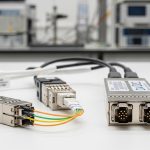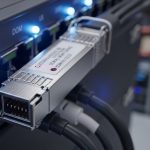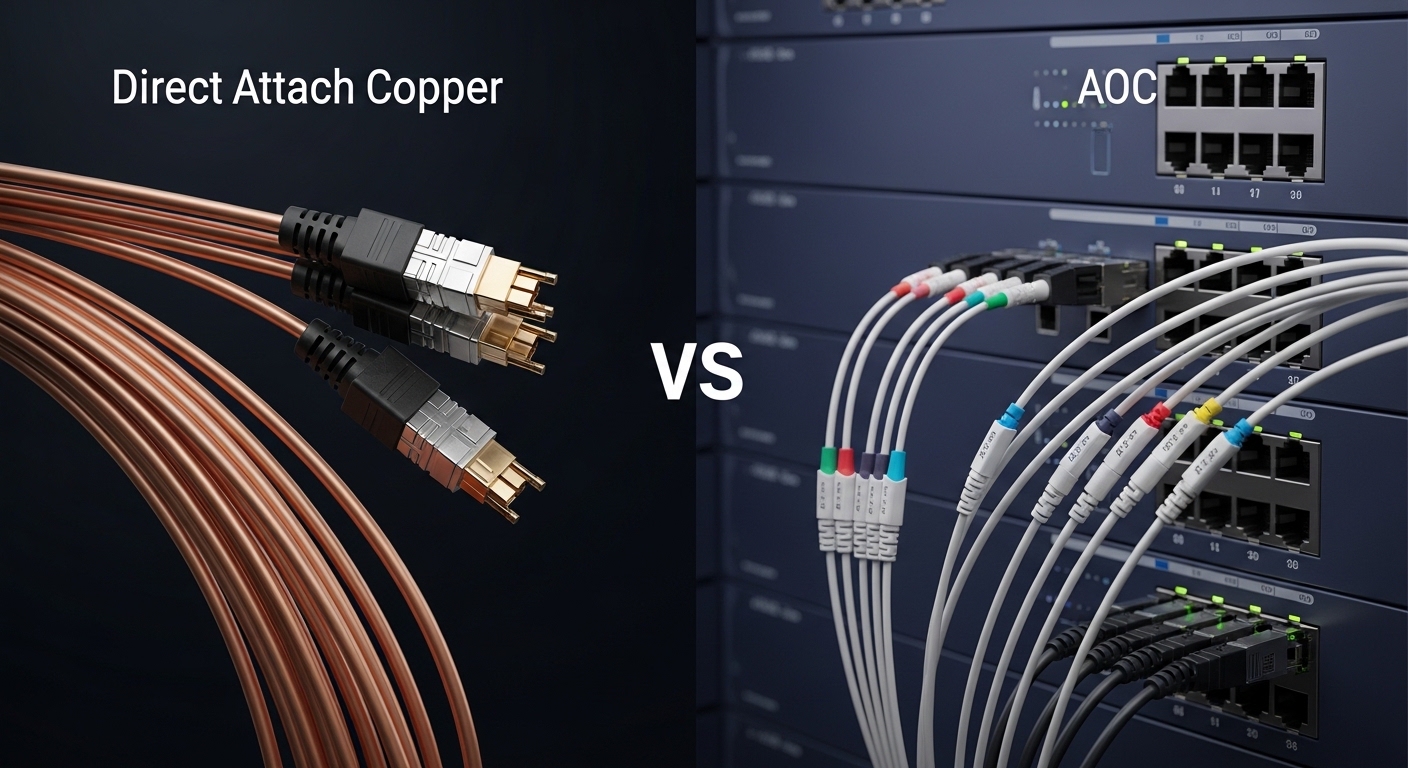
In modern 400G networking rollouts, the choice between Direct Attach Copper (DAC) and Active Optical Cable (AOC) can make or break your schedule. This article helps data center and campus engineers decide quickly by comparing performance, power, compatibility, and operational risk. You will get practical selection criteria, a decision matrix, and troubleshooting patterns observed during real deployments.
DAC vs AOC in 400G networking: what changes at 400G line rates?
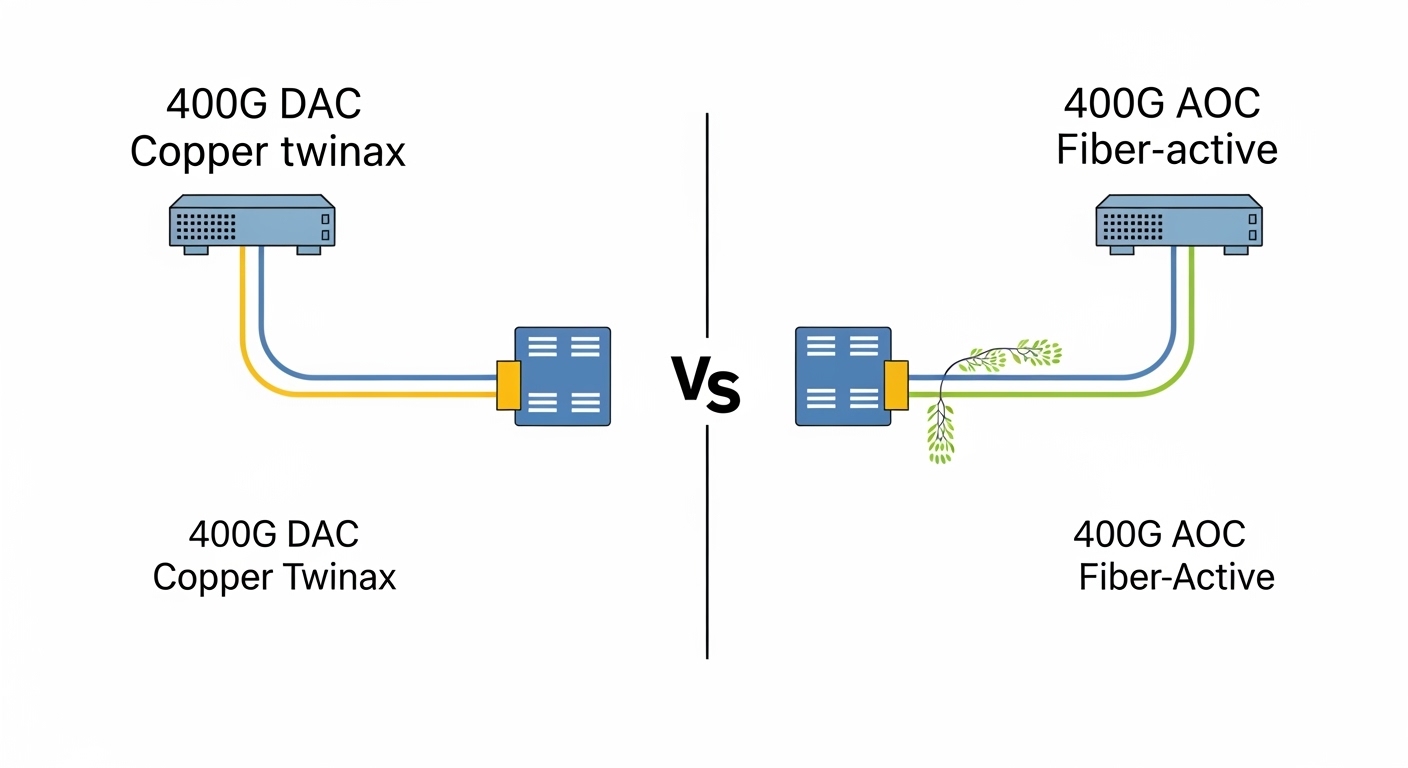
At 400G, the physical layer becomes less forgiving: signal integrity, connector cleanliness, and thermal behavior matter more than at 100G. DAC typically uses copper twinax to carry electrical signals directly from the switch to the adjacent transceiver port, while AOC converts electrical to optical at each end, then transports photons through fiber inside a cable assembly. In practice, DAC is usually best for short reaches like top-of-rack to leaf-spine within the same row, while AOC extends reach and reduces electrical losses and EMI concerns.
Technically, both options are designed to meet the electrical and optical requirements associated with 400G Ethernet deployments, commonly aligned with IEEE 802.3 physical layer concepts (notably through 400GBASE-style implementations). For DAC, your critical factors are insertion loss, return loss, and equalization behavior in the host PHY and cable. For AOC, your critical factors are optical budget, fiber attenuation, lane mapping, and whether the module supports the host’s expected management interface (for example, DOM via I2C/MDIO-like mechanisms).
Pro Tip: If your switch vendor supports both DAC and AOC, validate using the vendor’s compatibility matrix and then run a port-level BER check under load. Many field failures are not “bad cables,” but mismatched host firmware equalization settings that only show up after traffic ramps.
Performance and reach tradeoffs: signal integrity, power, and latency
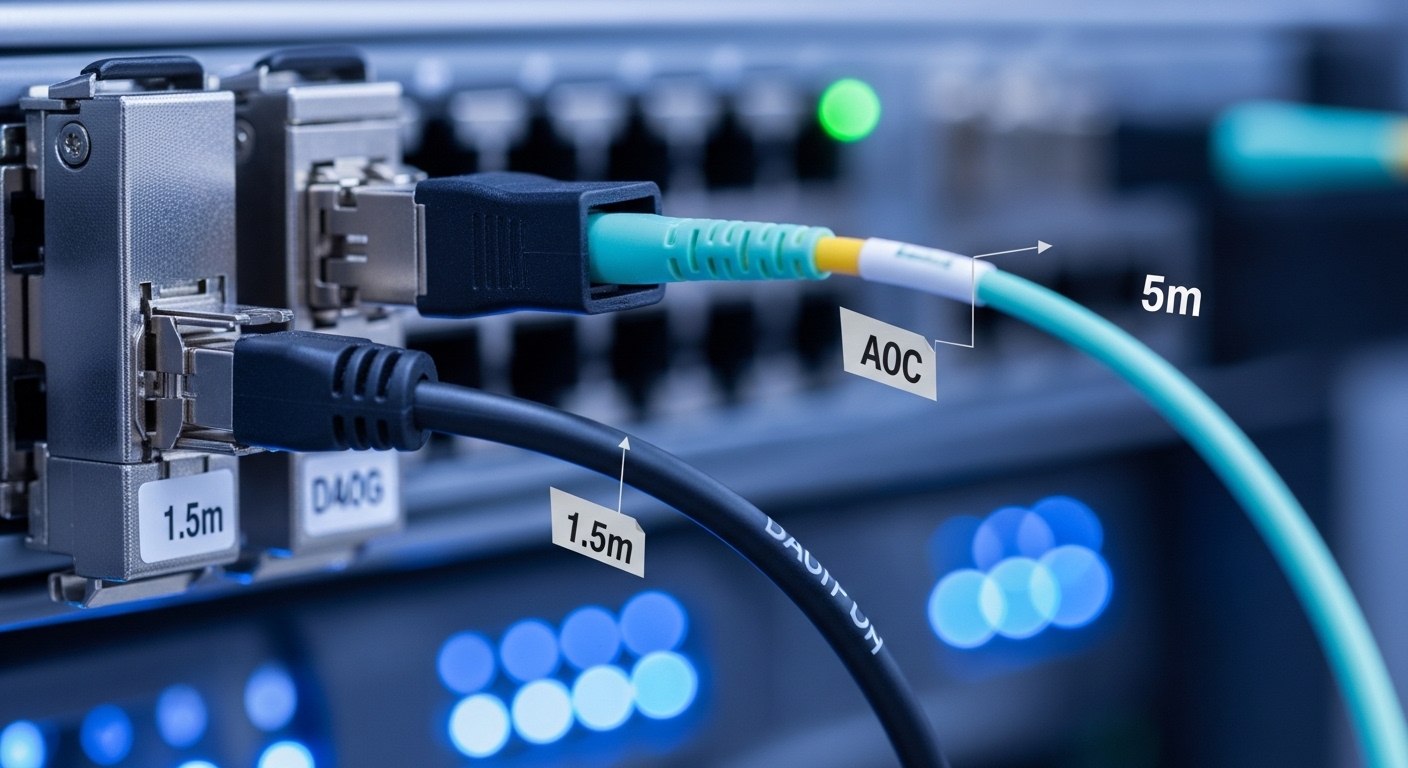
Performance at 400G networking is dominated by reach and loss budgets rather than raw bandwidth. DAC is constrained by copper attenuation and crosstalk; typical “works reliably” reaches are often in the 1 to 3 m range for many 400G DAC SKUs, though exact limits depend on the switch PHY generation and cable construction. AOC can reach farther, commonly around 10 to 100 m depending on optical design and fiber type, because the optical link tolerates higher attenuation than copper.
Typical spec snapshots you should compare
Use the vendor datasheet for your exact part number, but the table below summarizes the kinds of ranges engineers see for 400G networking deployments. Treat these as starting points, not guarantees.
| Spec | 400G DAC (Twinax) | 400G AOC (Active Optical Cable) |
|---|---|---|
| Target data rate | 400G (QSFP-DD / OSFP style depending on platform) | 400G (QSFP-DD / OSFP style depending on platform) |
| Wavelength / optics | Electrical over copper (no optical wavelength) | Typically multi-lane optics, commonly centered around 850 nm for short-reach designs |
| Reach (typical) | 1 to 3 m (varies heavily by host and vendor) | 10 to 100 m (varies by AOC SKU) |
| Connector style | Direct attach twinax ends into the host transceiver cage | Fiber inside cable assembly with transceiver ends into host cage |
| Power (link-level) | Often lower than AOC, but depends on cable equalization and host support | Consumes power due to optical conversion electronics; higher than DAC |
| DOM / monitoring | Varies by SKU; some support digital diagnostics (DOM) | Often supports DOM more consistently, but confirm per part number |
| Operating temperature | Varies by product; confirm 0 to 70 C or -5 to 85 C variants | Varies by product; confirm matching thermal range to your environment |
On latency, both DAC and AOC are typically dominated by switch forwarding path and serialization rather than the physical cable itself. However, in high-frequency trading or latency-sensitive designs, engineers still measure end-to-end microbursts and see small differences due to retimers and link training behavior. For most enterprise and cloud fabrics, the practical difference is reach and operational stability, not sub-microsecond latency.
Compatibility and validation: avoiding “it works in the lab” failures
Compatibility is the biggest hidden variable in 400G networking. DAC and AOC must match the host transceiver cage form factor and the expected electrical signaling. Many platforms use a specific connector class (commonly QSFP-DD or OSFP for 400G), and the host PHY may require particular coding, pre-emphasis behavior, and training sequences.
In real deployments, I have seen teams buy “correct-looking” 400G DACs that were actually tuned for a slightly different host generation. The symptom was intermittent link flaps during traffic ramp, not during idle checks. With AOC, compatibility issues often show up as DOM mismatch, link instability at cold temperatures, or unexpected error counters under sustained load.
What to check before you buy
- Switch model and firmware: confirm the exact platform and firmware release that will run the link.
- Transceiver form factor: QSFP-DD vs OSFP (and whether your switch supports that cage type for 400G).
- Reach class: ensure the DAC length or AOC reach matches your actual port-to-port distance with margin.
- DOM support: verify whether the cable reports diagnostics your NMS expects (temperature, bias current, optical power, link alarms).
- Operating temperature: data center cold aisles can vary; confirm your SKU supports the real inlet range.
- Vendor lock-in risk: some OEM optics work only with OEM firmware; third-party compatibility varies by platform.
- Optical cleanliness and fiber type (for AOC): confirm patching and handling rules if you use AOC with external fiber segments.
For external references, review Ethernet physical layer requirements in IEEE 802.3 and vendor transceiver electrical/optical guidance in datasheets. Also consult your switch vendor’s optics compatibility guidance. [Source: IEEE 802.3 Ethernet Working Group], [Source: Cisco Optics Compatibility documentation], [Source: NVIDIA/Arista switch optics guidance where applicable].
Cost and ROI for 400G networking: where the budgets actually go
DAC is often cheaper per link at short reach because it is simpler: no lasers, no photodiodes, and fewer active components. AOC costs more upfront due to the active optical conversion electronics, and it can draw additional power. The ROI, however, depends on how many links you can keep within your reach budget and how often you expect to troubleshoot or replace optics.
In typical market pricing, engineers commonly see DAC pricing in the rough range of $50 to $250 per link for short 400G twinax SKUs (OEM and third-party vary widely). AOC often lands in the rough range of $200 to $600 per link depending on reach (for example, 10 m vs 30 m vs 100 m) and whether it is OEM-branded or third-party. TCO also includes power and operational overhead: AOC can add measurable watts at scale, and power plus cooling can matter when you deploy thousands of 400G ports.
Cost calculus you can run in a procurement spreadsheet
- Capex: per-link price times number of required connections.
- Opex: estimated link power and cooling multiplier (your facility’s PUE and fan/CRAC characteristics).
- Failure and returns: third-party variability can increase RMA rate if compatibility is not validated.
- Downtime cost: time to swap a failing link and verify counters.
Common mistakes and troubleshooting patterns in 400G networking
Even when you select the right category (DAC or AOC), field issues often come from operational details. Below are frequent failure modes with root causes and practical fixes.
Link flaps during traffic ramp
Root cause: Host firmware equalization or training mismatch with the cable’s electrical characteristics. This can happen when a DAC SKU is technically “400G compatible” but optimized for a different PHY generation.
Solution: Update host firmware to the version recommended by the switch vendor, then retry with the vendor-approved part number. If you must use a third-party cable, test in a burn-in loop and confirm stable link state before scaling.
Higher-than-expected CRC or FEC-related counters with clean optics
Root cause: For AOC, fiber stress or connector handling issues can create intermittent optical power degradation. For DAC, insufficient bend radius or cable strain can increase crosstalk and insertion loss.
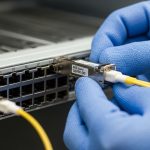
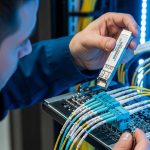
Solution: Reroute to meet bend radius recommendations, avoid tight cable loops near airflow obstructions, and inspect connectors under proper lighting. For AOC, treat the cable like fiber optics: careful handling, no twisting, and consistent airflow clearance.
“Works at room temp, fails in cold aisle”
Root cause: Temperature range mismatch. Some cables are validated for limited operating conditions, and active electronics in AOC can behave differently at low inlet temperatures.
Solution: Confirm the transceiver/cable operating temperature spec and compare it to your measured inlet temperature distribution. Add margin by choosing a SKU with a wider temperature rating.
DOM alarms ignored until a maintenance window
Root cause: Engineers sometimes monitor only link-up events and ignore DOM thresholds like laser bias drift, receive power warnings, or internal temperature trends.
Solution: Set up alerting on DOM warning states (not just critical alarms). In many environments, warnings precede failures by days, and early intervention prevents multiple-port outages.
Decision matrix: DAC vs AOC for 400G networking deployments
Use this matrix to decide quickly during design and procurement. It is not a guarantee, but it reflects how teams typically optimize for reliability and schedule.
| Criteria | DAC scores higher when… | AOC scores higher when… |
|---|---|---|
| Distance | 1 to 3 m target links with minimal patching | 10 m to 100 m or longer intra-rack/inter-row runs |
| Budget | You need the lowest per-link cost for short reach | You can justify higher per-link cost to eliminate extra fiber infrastructure |
| Operational risk | Switch and cable are validated and within thermal envelope | You need better EMI tolerance and reduced copper loss sensitivity |
| Monitoring | DOM is supported and integrated into your NMS | DOM is required and more consistently available across SKUs |
| Facility constraints | Low cable management complexity, short routing paths | You must route through congested areas where copper twinax is difficult |
Which option should you choose?
If you are deploying 400G networking inside the same row or between adjacent racks with short, fixed distances, choose DAC for simplicity and cost efficiency. If your design includes longer runs where copper attenuation and routing constraints become painful, choose AOC to extend reach and improve link stability.
For a concrete rule of thumb: start with DAC when your measured distance plus installation slack fits the DAC length class, and start with AOC when you need margin beyond that class or when you expect frequent cable moves during staging. In both cases, validate with the exact switch model and firmware, confirm DOM expectations, and run a controlled traffic ramp before you scale to full capacity.
FAQ
Is DAC or AOC better for 400G networking inside a rack?
For typical intra-rack or adjacent-rack distances, DAC is often the better first choice because it is simpler, usually cheaper, and quick to validate. If your routing forces tight bends or you need slightly longer reach than your DAC class supports, AOC can reduce signal integrity and EMI issues.
What switch compatibility checks matter most for 400G networking?
Verify the transceiver form factor your switch supports (QSFP-DD vs OSFP), then cross-check the vendor compatibility matrix for your exact switch model and firmware. Also confirm whether the cable supports DOM and whether your monitoring stack expects specific diagnostic fields.
Do I need DOM support for DAC or AOC?
Operationally, DOM is strongly recommended because it enables early warning via temperature, power, and alarm thresholds. If your NMS only alerts on link-down events, you may miss early degradation signals that precede failures.
How do I troubleshoot high error counters on 400G links?
Start by checking DOM warnings and verifying the link is stable under a sustained traffic load. Then inspect cable handling (bend radius, strain relief, connector cleanliness) and compare with a known-good reference cable on the same switch port.
What is the biggest cost risk when choosing DAC vs AOC?
The biggest cost risk is not the per-link price; it is downtime and RMA churn caused by compatibility gaps. Mitigate this by buying only part numbers validated for your switch and by running burn-in tests during pilot deployment.
Real-world deployment scenario: where this decision shows up
In a 3-tier data center leaf-spine topology with 48-port 400G ToR switches and 16-port 400G spine links, a team migrating from 200G used DAC for leaf-to-spine within the same row and AOC for cross-row runs. Measured port-to-port distances were 1.2 m for the DAC paths and 18 to 25 m for the cross-row paths after accounting for slack and cable routing. During pilot, DAC links remained stable with zero link flaps under a sustained 95% utilization traffic test, while AOC links required stricter connector handling and DOM alerting but avoided repeated copper-related instability. The team scaled only after confirming firmware compatibility and enabling DOM-based thresholds.
Update date and sources
Update date: 2026-05-01. For standards and vendor guidance, consult IEEE 802.3 physical layer references and the optics compatibility documentation for your switch vendor. [Source: IEEE 802.3 Ethernet Working Group], [Source: Switch vendor optics compatibility guides], [Source: Vendor transceiver and cable datasheets].
Next, map your rack layout and measured distances to the reach classes, then run a pilot with one DAC SKU and one AOC SKU to validate firmware training and DOM behavior using 400G networking-focused acceptance tests.
Author bio: I have deployed and validated 100G to 400G optics in production fabrics, including pilot rollouts with DOM alerting and BER-focused port checks. I focus on PMF through fast validation: measure link stability under load, then scale only what passes.