
In 400G networking rollouts, the link choice often decides whether your project stays on schedule or turns into a compatibility and burn-in exercise. This article helps data center and campus network teams choose between Direct Attach Copper (DAC) and Active Optical Cable (AOC) for 400G optics, focusing on practical constraints like reach, switch support, power, and operational risk. You will get a decision checklist, a troubleshooting section, and a cost-and-ROI lens grounded in how transceivers behave in the field.
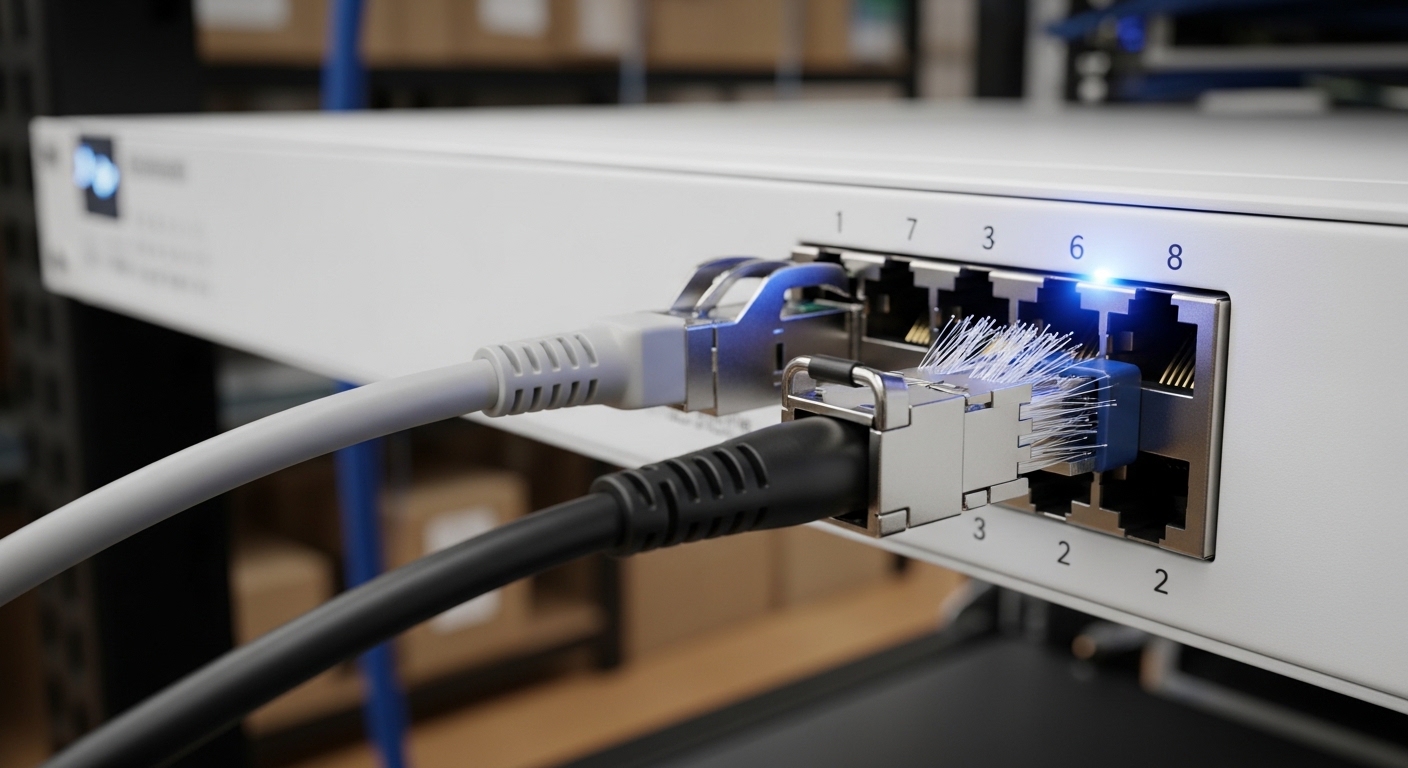
DAC vs AOC in 400G networking: what changes at 400G speeds
At 400G line rates, both DAC and AOC can meet electrical and optical performance targets, but they differ in medium, latency behavior, and failure modes. DAC uses copper conductors inside the cable assembly, which typically suits short reaches (often around 1 to 3 meters depending on vendor and connector type). AOC converts electrical signals to optical at each end, making it better for moderate distances and environments where EMI control is difficult.
In most modern deployments, the switch side expects a specific pluggable form factor (commonly QSFP-DD for 400G) and a defined electrical interface. AOC assemblies typically present as an optical transceiver to the switch, while DAC assemblies present as a copper transceiver. Compatibility depends on the switch vendor’s supported optics list, including optical/electrical calibration and Digital Optical Monitoring (DOM) behavior where applicable. [Source: IEEE 802.3 Ethernet Working Group]
Typical 400G link characteristics you should map to your topology
- Reach and routing: DAC is easiest for top-of-rack to adjacent equipment; AOC is often chosen when you must route around cable trays or avoid tight bend radii for copper.
- Power and thermal: both options can fit within QSFP-DD power envelopes, but real power draw varies by vendor and whether the link uses advanced equalization.
- Operational risk: DAC faults often show up as intermittent link drops due to connector stress; AOC faults often trace to fiber end cleanliness or damaged optical interfaces.
Pro Tip: If you are mixing vendors for 400G networking, plan a week-long burn-in with your exact switch firmware. Equalization and compliance testing are not purely “spec-driven”; they can be influenced by firmware retimers and how the platform reads DOM during link bring-up.
Specs comparison: DAC and AOC options that commonly appear in 400G builds
Below is a practical comparison using representative modules and cable assemblies you might encounter when selecting 400G networking optics for QSFP-DD-capable switches. Always confirm the exact reach rating and DOM behavior in your vendor’s compatibility matrix, since “400G” alone is not sufficient to predict interoperability.
| Option | Example parts | Data rate | Wavelength / medium | Reach | Connector / form | Operating temp | DOM |
|---|---|---|---|---|---|---|---|
| DAC | Cisco QSFP-DD 400G DAC (varies by length) FS.com SFP/QSFP-DD 400G DAC (varies by meter) |
400G Ethernet | Copper | ~1 m to ~3 m (vendor dependent) | QSFP-DD plug | 0 to 70 C typical (verify) | Often supported (verify per SKU) |
| AOC | Finisar/FS AOC 400G QSFP-DD (model varies) FS.com 400G AOC QSFP-DD (varies by length) |
400G Ethernet | Multi-lane optical | ~10 m up to ~100 m (SKU dependent) | QSFP-DD plug | -5 to 70 C or 0 to 70 C typical (verify) | Usually supported (verify per SKU) |
For standards context, 400G Ethernet is governed by IEEE 802.3 and related optical reach and interface requirements. For electrical and optical link behavior, vendor datasheets and switch OEM compatibility lists are the deciding documents in real rollouts. [Source: IEEE 802.3 Ethernet Working Group]
Deployment scenario: choosing DAC vs AOC in a leaf-spine 400G fabric
Consider a 3-tier data center leaf-spine topology with 48-port 400G ToR switches feeding 12-port 400G spine uplinks. The ToR-to-spine distance averages 6 to 8 meters across overhead trays, and the site has persistent EMI issues near power distribution units. In this environment, teams often use AOC for the 6 to 8 meter runs and reserve DAC for short server-to-ToR or adjacent equipment where cable lengths stay under about 2 meters. This split reduces optical cleanliness risk on long runs while avoiding copper reach limits and routing friction.
Operationally, you can measure the ROI: if a DAC link fails due to connector stress, replacement is fast but may require careful reseating and re-testing. If an AOC link fails due to fiber contamination, the fix is still straightforward—cleaning and re-inspection—but it can add downtime if you do not have standardized cleaning kits and procedures. The best choice depends on which failure mode you can prevent faster in your team’s workflow.
Selection criteria checklist for 400G networking link media
Use this ordered checklist during procurement and pre-staging:
- Distance vs reach rating: confirm the exact SKU reach for your temperature and link budget assumptions.
- Switch compatibility: validate against the switch vendor optics list for QSFP-DD 400G (including firmware version).
- Connector and cable handling constraints: DAC is sensitive to bend radius and connector seating; AOC is sensitive to fiber end cleanliness and physical strain.
- DOM and monitoring: verify whether the platform reads alarms, temperature, and optical power correctly for your specific AOC or DAC SKU.
- Operating temperature range: match module rating to aisle airflow profiles; derate if your site runs hot.
- Vendor lock-in risk: consider whether your future spares strategy will depend on one OEM’s compatibility list.
- Serviceability and spares: stock spares by length and type; label and test before staging in the rack.

Common pitfalls and troubleshooting tips for DAC vs AOC at 400G
Even with correct part numbers, 400G networking issues typically fall into a few repeatable categories. Here are concrete failure modes and how to address them.
- Pitfall 1: Link flaps immediately after insertion
Root cause: DAC connector not fully seated or cable assembly stressed during installation.
Solution: reseat both ends, verify latch engagement, and inspect for micro-bends near the plug. Run a loopback test if your switch supports it, and confirm link training logs. - Pitfall 2: AOC shows “no link” while the port appears healthy
Root cause: fiber end contamination or damaged optical interface (scratches, dust, or strain).
Solution: clean both ends using lint-free wipes and approved cleaner, inspect with a fiber microscope if available, then re-seat the QSFP-DD. Re-test after cleaning before replacing spares. - Pitfall 3: Works in one firmware version, fails in another
Root cause: firmware-specific electrical equalization, auto-negotiation quirks, or DOM interpretation differences.
Solution: validate optics after each firmware upgrade in a staging environment. Keep a rollback plan and document which optics SKUs are certified per firmware. - Pitfall 4: Reach mismatch assumed from “looks short” cable length
Root cause: excessive slack loops, tight routing, or temperature-induced performance degradation reducing effective margin.
Solution: measure actual installed length including slack, follow bend-radius guidance, and keep cable runs within the datasheet reach for your environment.
Cost and ROI: where DAC wins, where AOC pays off
Pricing varies by length, vendor, and certification status, but realistic budget ranges for 400G networking are often roughly: DAC assemblies tend to cost less per link than AOC for short reaches, while AOC costs more but can reduce labor when routing constraints or EMI rules make copper difficult. Total cost of ownership (TCO) should include spares strategy, downtime risk, and technician time for cleaning versus reseating.
In many operations, DAC is the ROI winner for sub-2 meter runs because it is cheaper and faster to swap. AOC can be the ROI winner for multi-meter or EMI-sensitive paths because it reduces rework from cable routing constraints and can maintain link stability where copper equalization margin becomes tight. Vendor OEM optics lists may increase upfront procurement cost, but they often reduce the probability of “mystery incompatibility” that burns engineering hours.
FAQ
How do I know whether my 400G networking switch supports a specific DAC or AOC?
Check the switch
