In 400G networking upgrades, the smallest cabling choice can drive the biggest outcomes: link stability, airflow constraints, and total installed cost. This article helps data center and network engineers decide between DAC (direct-attach copper) and AOC (active optical cable) for short, moderate, and dense top-of-rack and spine links. You will get a field-ready comparison, a decision checklist, and troubleshooting patterns seen in live deployments.
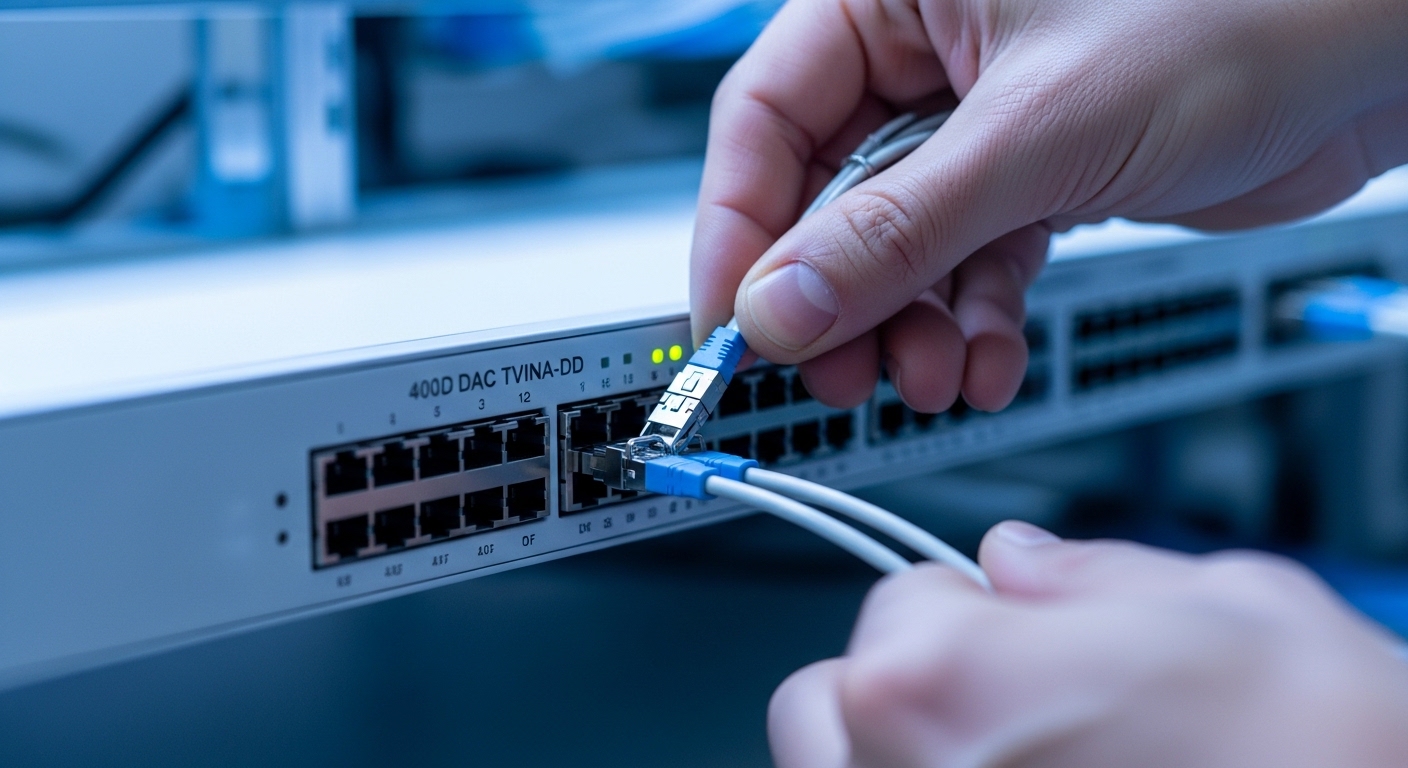
DAC vs AOC for 400G networking: what changes at the physical layer
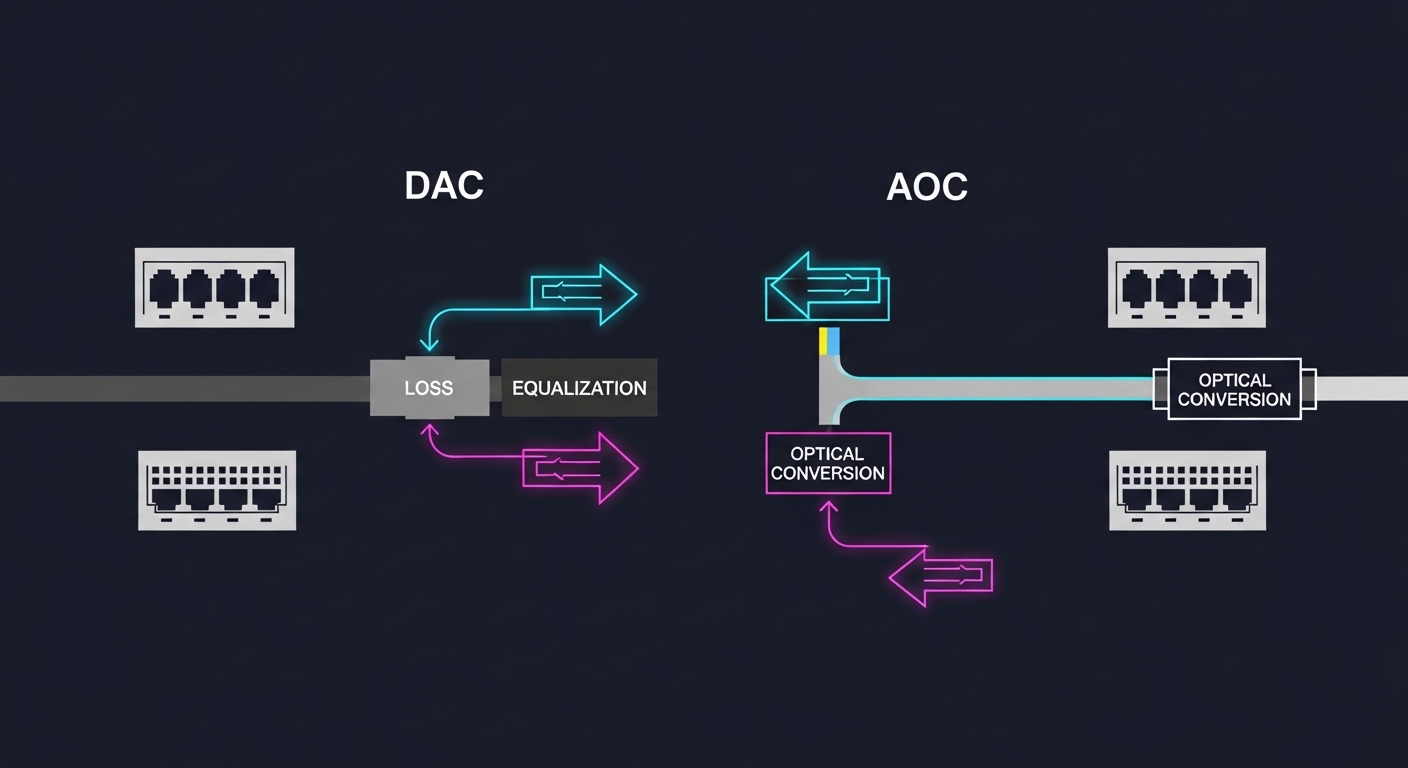
Both DAC and AOC can carry 400G Ethernet over short reaches, but they differ in how they meet the electrical-to-optical boundaries inside the cable assembly. A DAC uses copper transmission with no external fiber plant; typical designs are 24 or 28 AWG twinax inside a molded connector housing. An AOC converts electrical signals to optical in the cable ends, then transmits over fiber, which can reduce electromagnetic interference and ease channel loss at higher speeds.
In practice, the key trade is channel budget and environmental tolerance. DAC is usually simplest for in-rack or short haul (for example, 1 m to 3 m class), where connector insertion and copper loss are manageable. AOC tends to perform better when you need flexibility across cable trays, want improved immunity to EMI, or must navigate tight routing where copper bend radius and jacket strain become recurring failure points.
Core performance characteristics you must compare
For 400G networking, you typically evaluate the optical or electrical channel budget, connector type, and whether the transceiver supports the same electrical interface as your switch. On the standards side, 400G Ethernet is defined through IEEE work building on Ethernet PHY frameworks; vendor implementations commonly align with IEEE 802.3 clause structures for 100G/200G lane stacking and 400G PCS/PMA behavior. For cabling, rely on the switch vendor transceiver compatibility matrix and the transceiver module specification (for example, QSFP-DD electrical interface and management behavior as documented by the vendor datasheet).
When engineers compare DAC vs AOC, they often focus on “it works” at first boot, then discover link flaps later due to marginal channel conditions. The right approach is to treat the decision as a link budget exercise: loss, jitter tolerance, retimer/equalization behavior, and thermal drift inside the cable assembly.
Head-to-head comparison: reach, power, connector, and operating limits
Use the table below as the starting point for 400G networking cabling decisions. Actual limits vary by vendor and length SKU, so treat this as a planning baseline and then validate against your switch vendor’s compatibility list.
| Spec category | 400G DAC (twinax) | 400G AOC (active optical cable) |
|---|---|---|
| Typical use case | Short intra-rack connections | Short to moderate rack-to-rack with fiber-style routing |
| Common lengths | 1 m to 3 m (varies by SKU) | 2 m to 10 m (varies by SKU) |
| Connector form factor | QSFP-DD or similar high-density pluggable | QSFP-DD or similar high-density pluggable |
| Wavelength / media | No optical wavelength; copper twinax | Multilane fiber, typically 850 nm class for short reach |
| Power (planning range) | Lower than AOC in many deployments; often ~1 to 5 W class | Higher due to active optics; often ~3 to 8 W class |
| EMI tolerance | Good in controlled racks; sensitive to poor grounding/routing | Generally better due to optical isolation |
| Thermal / operating range | Commonly 0 to 70 C (verify SKU) | Commonly 0 to 70 C (verify SKU) |
| DOM / monitoring | Usually supported via I2C/MDIO management in module (vendor-dependent) | Usually supported; optical power and diagnostics available (vendor-dependent) |
Concrete examples that field teams often reference when sourcing include 400G QSFP-DD DAC and AOC assemblies from major transceiver suppliers; for optics-based AOC you will see 850 nm multi-fiber designs similar in lane behavior to short-reach optics. If you are also evaluating standalone optics, 10G/25G short-reach SFP or QSFP modules like Finisar and FS.com models (for example, Finisar FTLX8571D3BCL class optics for 850 nm) show the typical optical diagnostic patterns and power ranges, even though your 400G cabling assembly will be QSFP-DD class with higher lane counts.
Cost and TCO in 400G networking: where DAC wins and where AOC wins
Procurement price is only the first line item. Over a 3 to 5 year horizon, the total cost of ownership (TCO) depends on replacement rate, operational time for swaps, power draw, and whether you can standardize on one vendor across racks.
In many data center rollouts, DAC is cheaper per connection and simpler to stock for short distances. However, DAC can incur higher field labor when routing is constrained or when repeated insertions occur during moves/adds/changes. AOC typically costs more upfront but can reduce rework when cables must bend around obstructions or when EMI and grounding are major concerns.
Operational cost levers you can quantify
- Power: AOC’s active optics can add several watts per link. Multiply by link count. Example: if you have 200 400G links and AOC costs ~3 W extra per link vs DAC, that is ~600 W additional steady-state draw, plus cooling overhead.
- Failure mode economics: Copper twinax failures often correlate with mechanical stress, connector wear, and bend radius violations. Optical AOC failures often correlate with accidental fiber end damage or strain at the cable heads.
- Spare strategy: If you can standardize one length class and one vendor, you reduce spare SKUs and RMA friction.
Realistic pricing varies by region and vendor channel, but engineers commonly see DAC assemblies priced lower than AOC assemblies for the same reach class. Budget for transceiver and cabling as a combined “link asset” and include labor for installation, labeling, and post-change link verification.
Pro Tip: When you mix DAC and AOC in the same switch model, do not assume identical “link up” behavior under all temperature conditions. In field burn-in, teams often find that marginal copper channels pass at room temperature but start showing CRC errors after a hot-aisle ramp. The fix is to standardize cable length within a tight tolerance and validate with sustained traffic while monitoring interface counters.
Compatibility and optics management: avoiding surprises in 400G networking
The most expensive failure is the one that passes basic tests but fails under load, or fails because the switch refuses the module. Compatibility is not just physical fit; it is electrical interface negotiation, supported speeds, and management behavior.
For 400G networking, confirm your switch’s port type (for example, QSFP-DD 400G capable ports), verify that the vendor supports DAC and AOC on those ports, and check whether the module requires specific firmware levels. Many switch vendors publish a transceiver compatibility list and specify supported vendor IDs, DOM behavior, and alarm thresholds.
Decision checklist (ordered, field-first)
- Distance and routing: Choose DAC for very short, straight routes; choose AOC when you need more slack across trays or around obstacles.
- Budget: If you are link-cost constrained, start with DAC for in-rack distances and use AOC only where routing or EMI makes DAC risky.
- Switch compatibility: Verify the exact module type (DAC vs AOC), connector form factor, and vendor support in the switch matrix.
- DOM and monitoring: Ensure the module provides the diagnostics you need (optical power, temperatures, and fault flags) and that your NMS can ingest them.
- Operating temperature: Validate in the real airflow profile. If you run near the top of the rated range, prefer a cable type with better margin.
- Vendor lock-in risk: If you anticipate future expansions, minimize proprietary module constraints by standardizing on widely supported part families.
Compatibility artifacts to request from suppliers
- Datasheet with operating range, connector type, and power consumption range.
- DOM/diagnostic support description (what alarms exist, what thresholds are typical).
- Length tolerance statement and recommended installation bend radius guidance.

Common mistakes and troubleshooting tips for DAC vs AOC in 400G networking
Most 400G networking cabling incidents come from predictable errors. The goal is to isolate whether the fault is mechanical, compatibility/negotiation, or signal integrity under load.
Pitfall 1: Link up, then CRC or FEC-related errors under traffic
Root cause: Marginal channel loss or insufficient equalization margin for DAC length, especially after routing stress or temperature rise. For AOC, mis-seated connectors or micro-bending at the cable head can also create intermittent degradation.
Solution: Reseat both ends, ensure full latch engagement, and run sustained traffic while monitoring interface counters (CRC, symbol errors, and any vendor-specific PHY error metrics). If errors correlate with specific lanes or ports, test alternate cable lengths or swap with a known-good assembly.
Pitfall 2: Repeated module insertion leading to connector wear
Root cause: Hot swapping attempts or repeated removals during troubleshooting can damage connector contacts or degrade spring pressure, causing intermittent link behavior.
Solution: Follow the switch vendor guidance for insertion/removal. Plan swap operations to minimize cycles: pre-stage spares, document port mappings, and verify with a single controlled test before further changes.
Pitfall 3: Exceeding bend radius or tugging on AOC fiber heads
Root cause: Cable heads are strain-sensitive. Over-tight bends or pulling during installation can stress internal fibers and active optics alignment, causing early-life faults.
Solution: Install using gentle curves, secure the cable with proper cable management, and avoid tension at the transceiver head. If you must route around obstructions, route with slack and use a tray that does not pinch the cable jacket.
Pitfall 4: Using unsupported third-party modules on specific switch firmware
Root cause: Some switches enforce transceiver compatibility rules, and firmware updates can change negotiation behavior or DOM parsing. A module that works on one firmware revision may fail on another.
Solution: Align module sourcing with the switch compatibility matrix and validate after firmware upgrades. If you use third-party optics/cables, confirm DOM field support and alarm semantics with the vendor or supplier.
Which option should you choose for 400G networking?
Choose based on your operational constraints, not just the initial price tag. Below is a pragmatic recommendation by reader type.
| Reader type | Best default | When to switch |
|---|---|---|
| In-rack leaf-spine with short, straight runs | DAC | Switch to AOC if routing requires sharp turns, EMI is problematic, or you need longer reach. |
| Data centers with dense cable trays and frequent re-cabling | AOC | Use DAC only for the shortest segments that stay within bend and strain limits. |
| Teams optimizing power and rack thermal headroom | DAC | Adopt AOC selectively when it avoids rework or reduces link errors during hot-aisle ramp. |
| Procurement managing multi-vendor risk | Start with DAC where compatibility is proven | For ports with strict compatibility or tight reach, use AOC only with matrix-approved part families. |
If you want a simple rule: use DAC for short, controlled routes where you can enforce cable management discipline; use AOC when you need routing flexibility, better EMI isolation, or extra margin for channel conditions. Next, validate your chosen part family against your switch model’s compatibility list and run a post-install traffic soak with error monitoring.
FAQ
Q: Can DAC and AOC both support 400G networking on the same switch?
A switch may support both, but support is not universal across all port types and firmware versions. Always confirm the transceiver compatibility matrix for your exact switch model and port configuration, then validate with sustained traffic.
Q: What reach should I plan for when choosing DAC vs AOC?
Plan DAC for very short links where routing is straightforward, commonly in the 1 m to 3 m class depending on vendor. Plan AOC for longer or more flexible routing where you need additional slack, often 2 m to 10 m depending on SKU.
Q: How do I verify that a link is truly healthy after installation?
Go beyond “link up.” Run sustained traffic at line rate for a defined window and monitor CRC counts, PHY errors, and any vendor-specific error counters exposed via your switch CLI or telemetry system. Reseat and replace the cable if counters move under load.
Q: Are DOM diagnostics equally useful for DAC and AOC?
Often both provide diagnostics via module management, but the depth and alarm semantics vary by vendor and cable type. Confirm which fields your NMS can ingest and what alarms correlate with early degradation for your specific module family.
Q: What is the most common cause of intermittent 400G link drops?
In field cases, it is frequently mechanical: connector mis-seating, connector wear from repeated swaps, or stress from bend radius violations. A secondary cause is compatibility mismatch with firmware or unsupported third-party module behavior.
Q: Does AOC always cost more and offer no downsides?
AOC typically costs more and uses more power due to active optics. The trade is improved routing tolerance and EMI isolation, which can reduce rework and link instability in dense deployments.
For next steps, align your cabling plan with port capabilities and standardized part families; use 400G networking cabling compatibility to map module requirements to your switch model and reach targets.
Author bio: I have deployed 400G networking cabling in live leaf-spine data centers, validating link health with sustained traffic and telemetry-driven error analysis. I write from field experience with QSFP-DD optics, twinax DAC assemblies, and active optical cable installations under real airflow and change-control constraints.