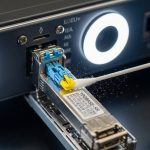
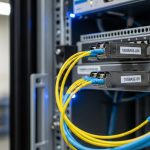
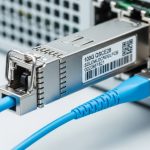
AI rollouts fail for predictable reasons: budgets get set for compute, but the fiber budget quietly decides whether GPUs can talk at line rate. This article helps network and facilities teams run a practical cost analysis for fiber infrastructure supporting AI applications, comparing transceiver choices, optics reach, and installation realities. You will get engineer-grade selection steps, a specs comparison table, and troubleshooting patterns from real deployments. This is not legal advice, but it is operational guidance aligned with common standards and vendor datasheets.
Where the cost analysis actually changes for AI fiber
For AI clusters, the fiber design is not just “how many ports.” It is how often you expand, how easily you can swap optics, and whether you can keep latency stable under growth. In many leaf-spine topologies, AI traffic is east-west and becomes sensitive to oversubscription, failure domains, and link margin. A cost analysis should therefore include optics BOM, spare inventory, installation labor, and downtime risk, not only the transceiver unit price.
Start with the link budget and operational envelope. Most enterprise and data center Ethernet optics map to IEEE 802.3 specifications for optical interfaces, while the exact reach and power budget come from vendor datasheets. For example, 10G SR-class links typically use MMF at 850 nm and are distance-limited by fiber grade and launch conditions, while long-haul options use SMF at 1310 nm or 1550 nm depending on the transceiver.
In practice, AI networking often pushes you toward higher density and faster rates (25G, 100G, and beyond). That raises the importance of connector type (LC vs MPO/MTP), transceiver form factor (SFP+, QSFP28, QSFP56), and DOM support for monitoring. If your switches require a specific vendor-coded compatibility list, the “cheapest” optic can become the most expensive in labor and downtime.
Key optics choices: reach, wavelength, power, and connector
Below is a comparison table you can use as a baseline for cost analysis. It is not exhaustive, but it highlights the parameters that usually drive procurement and engineering tradeoffs: wavelength, reach class, data rate, connector, temperature range, and typical DOM presence.
| Module example (form factor) | Data rate | Wavelength | Reach class | Fiber type | Connector | Typical DOM | Operating temp (typ.) |
|---|---|---|---|---|---|---|---|
| Cisco SFP-10G-SR (SFP+) | 10G | 850 nm | Up to 300 m | OM3/OM4 MMF | LC | Often supported | 0 to 70 C |
| Finisar FTLX8571D3BCL (SFP+) | 10G | 850 nm | Up to 300 m | OM3/OM4 MMF | LC | Supported on many SKUs | 0 to 70 C |
| FS.com SFP-10GSR-85 (SFP+) | 10G | 850 nm | Up to 300 m | OM3/OM4 MMF | LC | Varies by listing | 0 to 70 C |
| Typical QSFP28 100G SR4 (vendor-dependent) | 100G | 850 nm | Up to 100 m (SR4 class) | OM4 MMF | MPO/MTP | Common | 0 to 70 C |
For AI workloads, SR on MMF is attractive for indoor spines and ToR links because it avoids expensive SMF plant and simplifies patching. The limitation is reach: a 100G SR4 optics budget is often shorter than 10G SR, so your cable plant and fanout design must be planned accordingly. If you need longer distances inside a campus or between buildings, you will likely move to SMF optics, which changes both optics cost and installation risk.
Authority notes: Optical Ethernet requirements are described in IEEE 802.3 for optical interfaces, while exact reach and power class requirements are defined by each module’s datasheet. For standards context, see IEEE 802.3 overview. For vendor-specific reach and DOM details, consult the specific transceiver and switch datasheets from the manufacturer you plan to deploy.
Deployment scenario: AI cluster fiber in a 3-tier data center
Consider a 3-tier layout: 48-port 10G ToR switches feeding 2 aggregation layers, with an AI rack that uses 8 servers at 2 x 25G each (for 16 x 25G links total). In a realistic deployment, the ToR-to-aggregation distance is 45 m of OM4 MMF including patch cords and slack loops. You budget optics for 16 active links plus 4 spares per switch tier to cover failures during business hours.
If you choose 10G SR optics for the ToR tier initially, you may use SFP+ LC modules like Cisco SFP-10G-SR or compatible 850 nm SR SKUs, and you keep patching simple. When you later upgrade the AI servers to 25G or 100G, you may need QSFP28 or QSFP56 optics (often MPO/MTP), plus updated breakout and fanout hardware. A cost analysis that ignores the fanout and panel rework can understate total cost by 20% to 40% in fast-moving AI programs.
Operationally, DOM monitoring reduces time-to-repair when a link flaps. Field teams typically check real-time parameters (laser bias current, received power, and temperature) and compare them to vendor thresholds. If your optics are non-DOM or unsupported by the switch, you lose visibility and may revert to slower swap testing, which increases downtime cost.
Pro Tip: During acceptance testing, measure actual received optical power at the transceiver interface and record it. Later, when an AI link degrades under heat or after a patch panel move, your historical baseline helps you distinguish “aging fiber/dirty connectors” from a failing optic faster than swapping modules blindly.
Selection checklist for cost analysis in AI fiber programs
Use this ordered list to keep your cost analysis grounded in engineering constraints and compatibility reality.
- Distance and reach budget: verify OM4 grade, connector losses, and patch cord lengths; confirm the transceiver’s specified reach for your target.
- Data rate and form factor: match SFP+, QSFP28, or QSFP56 to the switch port type; avoid “almost compatible” adapters unless the vendor explicitly supports them.
- Switch compatibility and optics verification: check the switch vendor’s supported optics list and any firmware requirements for DOM.
- DOM and monitoring needs: ensure your optics expose alarms and thresholds your NMS can ingest; otherwise, factor added troubleshooting labor.
- Operating temperature and airflow: compare module operating range to your rack’s thermal map; AI racks often run warmer during training.
- Vendor lock-in risk: compare OEM optics vs third-party; include the cost of failed compatibility tests and any RMA friction.
- Spare strategy: define how many spares you keep per tier and whether spares must be pre-qualified with your switch model.

Common pitfalls and troubleshooting patterns
These are frequent failure modes that skew cost analysis by causing rework, delays, and extra labor.
- Pitfall 1: Choosing SR optics without validating fiber grade
Root cause: OM3 vs OM4 assumptions mismatch the datasheet reach; patch cords may be older or exceed loss budgets.
Solution: pull fiber test results (OTDR/optical loss) and confirm end-to-end link margin before ordering optics; standardize patch cord specs. - Pitfall 2: Connector contamination on high-density MPO/MTP links
Root cause: dust or micro-scratches drastically reduce received power, especially with tighter budgets at 100G+.
Solution: enforce cleaning procedures with approved wipes and inspection tools; verify with power readings after every maintenance event. - Pitfall 3: DOM incompatibility leading to “link up, no visibility”
Root cause: third-party optics may not provide DOM data that your switch expects, or firmware may block certain transceivers.
Solution: qualify optics in a staging rack with the exact switch model and firmware; update maintenance runbooks to include DOM checks. - Pitfall 4: Thermal mismatch in AI racks
Root cause: optics are rated for specific temperature ranges, but airflow patterns change with GPU load.
Solution: validate module temperature in situ; improve airflow management and confirm the optics operating envelope.
Cost & ROI note: OEM vs third-party optics and total cost
In many AI data center projects, a realistic unit price range for 850 nm SR optics (10G class) can vary widely by vendor, contract, and volume, and it is common to see third-party modules priced lower than OEM. However, TCO is often dominated by installation labor, qualification time, and downtime risk rather than the optics purchase price alone. If third-party optics fail compatibility tests, the “savings” can disappear quickly through expedited shipping, extra swaps, and delayed milestones.
A practical ROI approach is to model expected failure and troubleshooting time. For example, if your operations team spends an extra 30 to 60 minutes per incident due to missing DOM or slower swap testing, you should quantify that labor cost against the optics price delta across your fleet. Many teams also include a spare buffer: keeping pre-qualified spares for each switch line card reduces downtime at the cost of holding inventory.
FAQ
Q: What should my cost analysis include besides transceiver price?
Include patch panels, fanout hardware, installation labor, cleaning/inspection consumables, spares, and the cost of downtime during swap and qualification. For AI programs, also include the rework risk when you upgrade data rates.
Q: Is 850 nm SR always the cheapest fiber option for AI clusters?
It is often cheap