When a wireless backhaul link drops at a cell site, the root cause is often the cell tower fiber transceiver in the SFP cage: wrong optics, bad fiber type, or thermal stress inside the radio enclosure. This article helps field engineers and network planners choose the right SFP-based optics for tower-to-hub connectivity, with practical checks for power, reach, and compatibility. You will also get troubleshooting patterns from real deployments and a final ranking table to speed up purchase decisions.
Top 7 cell tower fiber transceiver picks for SFP wireless backhaul
In tower environments, you typically need SFP optics that match the switch/router SFP port, support the right fiber (single-mode vs multimode), and survive wide temperature swings. Below are seven common “works in the field” options, organized by wavelength and typical reach for backhaul. Each item includes best-fit scenarios plus pros and cons to keep procurement realistic.
10GBase-SR (850 nm) multimode SFP for short tower hops
Key specs: 10.3125 Gbps line rate (10G Ethernet), 850 nm wavelength, typical reach up to 300 m on OM3 and up to 400 m on OM4 (depends on link budget and patch loss). Connector is usually LC, and DOM is common on enterprise-grade modules. Best-fit: sites where the radio-to-aggregation run is short and you can control patch cord quality.
Deployment scenario: In a regional build-out, a contractor ran OM4 from a tower top radio cabinet to a nearby hut within 180 m using pre-terminated trunks and managed patch panels. The SFP-10G-SR side worked reliably after replacing two high-loss jumpers and keeping bend radius within spec.
Pros: cheaper optics than long-reach single-mode, easier to validate with test gear on short links. Cons: limited reach; sensitive to end-face contamination and excessive splice/patch loss.
Example modules: Cisco SFP-10G-SR, Finisar FTLX8571D3BCL, FS.com SFP-10GSR-85.
10GBase-LR (1310 nm) single-mode SFP for standard backhaul
Key specs: 1310 nm, 10G Ethernet, typical reach up to 10 km over standard single-mode fiber (SMF), LC connector, and generally low dispersion sensitivity. Best-fit: when you have tower-to-hub distances in the 2 km to 10 km range and want robust performance with manageable optics cost.
Pros: strong compatibility, widely supported by vendor switches, good reach for typical metro backhaul. Cons: requires true SMF and correct fiber plant labeling to avoid silent mismatch.
Common module examples: vendor-matched LR10 SFPs and third-party SFP+ LR modules with DOM.
1GBase-LX (1310 nm) SFP for budget legacy radio links
Key specs: 1310 nm LX optics, 1.25 Gbps line rate, reach often up to 10 km depending on module class. Best-fit: older microwave radios or aggregation gear where the radio interface is Gigabit Ethernet and you want lower power draw.
Pros: lower cost per port, easier power and thermal margins in compact enclosures. Cons: not suitable for 10G upgrades; you cannot “oversubscribe” bandwidth by optics choice.
10GBase-ER (1550 nm) single-mode SFP for long-distance tower rings
Key specs: 1550 nm, 10G Ethernet, typical reach up to 40 km (module-dependent), LC connector, often requires careful link budget planning for splitter loss. Best-fit: ring topologies where you have longer spans or where intermediate passive components add attenuation.
Pros: reach headroom without exotic gear. Cons: higher cost; you must validate dispersion and aging margin, especially with older plant.
Field note: I have seen ER links fail not because of optics, but because the fiber plant was actually OM3 in the middle span due to mislabeling during construction.
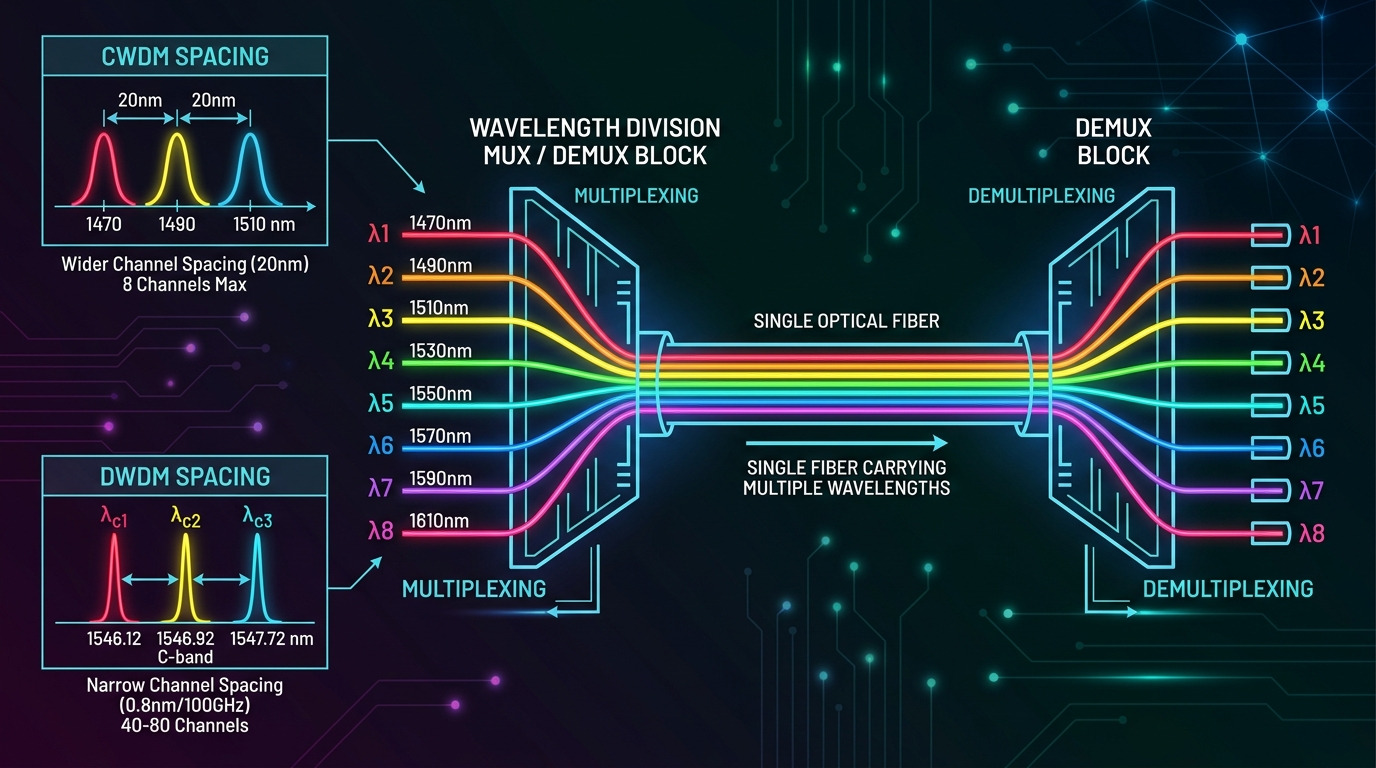
CWDM-style SFP (wavelength-specific) for dense ring multiplexing
Key specs: multiple wavelength options (channelized), 1G or 10G depending on platform, typically paired with a CWDM multiplexer/demux. Best-fit: sites where you are forced to reuse fiber strands by carrying several services on one strand pair.
Pros: increases capacity without new fiber pulls. Cons: more components means more insertion loss and more points of failure; channel plan mistakes can waste entire deployments.
WDM CWDM planning
SFP with strong DOM support to reduce tower-site “guessing”
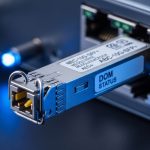
Key specs: digital optical monitoring (DOM) exposes TX power, RX power, and laser bias current. Many modules also provide temperature and voltage. Best-fit: when you need remote diagnostics from the aggregation switch and want faster fault isolation during storms or after truck rolls.
Pros: faster MTTR using threshold-based alerts; helps confirm whether a link issue is optical vs Ethernet. Cons: DOM telemetry depends on switch support; some third-party optics may show “unknown” fields.
Pro Tip: In tower audits, I prioritize checking DOM-reported TX/RX power trends over a week. Sudden RX power drops often point to connector contamination or patch cord replacement needs, while gradual drift can indicate aging optics or fiber stress from repeated cabinet door vibration.
Temperature-rated SFPs for outdoor cabinets and radio enclosures
Key specs: extended temperature operation is critical for outdoor cabinets. Many telecom-grade modules target -20 C to 70 C or wider; verify the module’s datasheet rather than assuming “it works outside.” Connector remains LC, but the enclosure airflow and dust protection matter as much as the optics rating.
Pros: fewer thermal-induced link flaps; better survival during summer sun and winter wind. Cons: higher unit cost; if the enclosure HVAC is failing, rated optics may still be stressed.
Comparison table: what to standardize for cell tower fiber transceiver procurement
| Option | Data rate | Wavelength | Typical reach | Fiber type | Connector | DOM | Temperature range (verify) |
|---|---|---|---|---|---|---|---|
| 10GBase-SR | 10G | 850 nm | 300 m to 400 m | OM3/OM4 multimode | LC | Common | Standard to extended |
| 10GBase-LR | 10G | 1310 nm | up to 10 km | SMF | LC | Common | Extended recommended |
| 10GBase-ER | 10G | 1550 nm | up to 40 km | SMF | LC | Common | Extended recommended |
| 1GBase-LX | 1G | 1310 nm | up to 10 km | SMF | LC | Varies | Verify |
Reference: IEEE 802.3 for Ethernet over fiber physical layer families; vendor datasheets for reach and DOM behavior. [[EXT:https://standards.ieee.org/standard/802_3 IEEE 802.3 standard]]
Selection criteria and decision checklist for tower backhaul
- Distance and link budget: include splice loss, connector loss, and any splitter or mux insertion loss.
- Correct fiber type: confirm SMF vs OM3/OM4 and verify core diameter and end-face cleanliness. .wpacs-related{margin:2.5em 0 1em;padding:0;border-top:2px solid #e5e7eb} .wpacs-related h3{margin:.8em 0 .6em;font-size:1em;font-weight:700;color:#374151;text-transform:uppercase;letter-spacing:.06em} .wpacs-related-grid{display:grid;grid-template-columns:repeat(auto-fill,minmax(200px,1fr));gap:1rem;margin:0} .wpacs-related-card{display:flex;flex-direction:column;background:#f9fafb;border:1px solid #e5e7eb;border-radius:6px;overflow:hidden;text-decoration:none;color:inherit;transition:box-shadow .15s} .wpacs-related-card:hover{box-shadow:0 2px 12px rgba(0,0,0,.1);text-decoration:none} .wpacs-related-card-img{width:100%;height:110px;object-fit:cover;background:#e5e7eb} .wpacs-related-card-img-placeholder{width:100%;height:110px;background:linear-gradient(135deg,#e5e7eb 0%,#d1d5db 100%);display:flex;align-items:center;justify-content:center;color:#9ca3af;font-size:2em} .wpacs-related-card-title{padding:.6em .75em .75em;font-size:.82em;font-weight:600;line-height:1.35;color:#1f2937} @media(max-width:480px){.wpacs-related-grid{grid-template-columns:1fr 1fr}}