
In modern SDN optical transport, the biggest failure mode is rarely the fiber or the optics link budget; it is the mismatch between what the network controller believes is installed and what is physically present in the pluggable. This article helps data center network engineers and optical field teams implement automated provisioning SFP workflows that align transceiver identity, speed, and telemetry with T-SDN Transport SDN practices. You will get practical selection criteria, a troubleshooting checklist, and cost/ROI expectations grounded in real deployments.
Why automated provisioning SFP matters in optical SDN
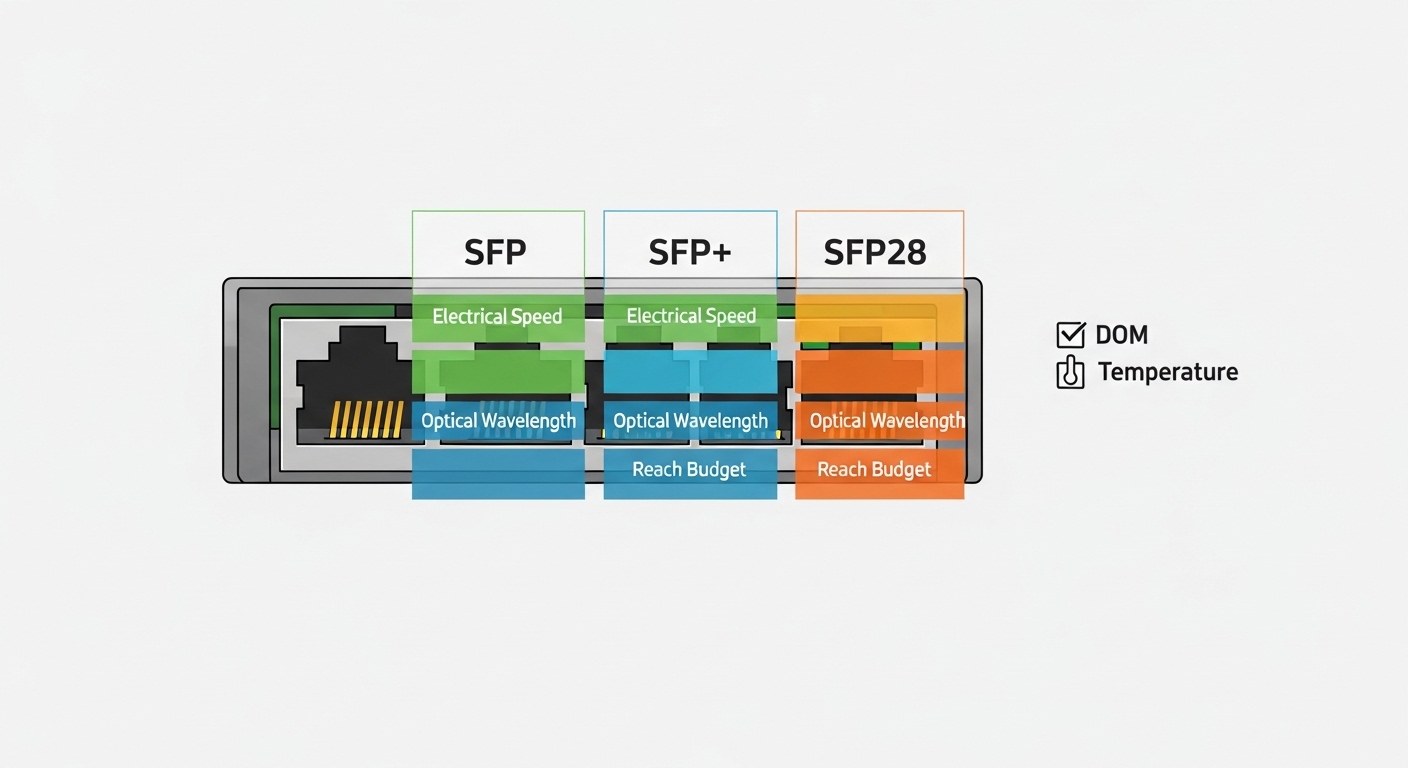
In transport SDN, an orchestration layer typically pushes provisioning intent to OTN or Ethernet switching fabric, then expects transceiver modules to match the intended optics profile. With automated provisioning SFP, the workflow reads module identity and capabilities from the transceiver (typically via the I2C management interface) and maps those capabilities to controller policy before enabling the port. This reduces “wrong optics” incidents, shortens change windows, and improves drift detection when modules are swapped during maintenance.
In practice, T-SDN Transport SDN patterns often combine: (1) controller-side inventory, (2) transceiver EEPROM interrogation for serial and capability data, and (3) telemetry ingestion for power, temperature, and laser bias monitoring. The controller can then enforce guardrails such as “only allow 10G-SR profiles on these ports” or “block activation if DOM reports out-of-range bias current.” For standards context, the physical layer and DOM behavior are aligned with IEEE optical transceiver management expectations, including IEEE 802.3 optics enablement and vendor EEPROM layouts. [Source: IEEE 802.3 working group documentation]
Pro Tip: In the field, the fastest way to validate an automated provisioning SFP pipeline is to intentionally hot-swap a known-good module with altered EEPROM fields (or a different part number) while logging controller decisions. If the controller does not refuse or re-provision the port based on EEPROM capability mismatch, you likely have only “inventory reads” but not “policy enforcement” wired into the activation path.
Core components: what automation actually reads and enforces
Automated provisioning SFP usually depends on three technical building blocks: (1) module identity and capability discovery, (2) controller-to-switch port policy, and (3) telemetry validation after link bring-up. The identity portion commonly uses the transceiver EEPROM content (manufacturer, part number, serial, nominal wavelength, supported data rate, and diagnostics support). Capability enforcement requires the switch to expose transceiver-present events and allow the controller to gate port activation.
Telemetry validation uses Digital Optical Monitoring (DOM) registers. Typical DOM values include laser transmit power (mW), received optical power, temperature (C), laser bias current (mA), and supply voltage. Engineers then compare these against thresholds derived from vendor datasheets and operational targets. If your controller only reads identity and never checks DOM during or after activation, you may still pass an incorrect optics profile that “looks compatible” but is electrically or optically marginal.
Data plane vs control plane timing constraints
Automation must account for the time it takes for the switch ASIC to initialize the pluggable interface and for the laser to stabilize. In many deployments, activation gating should include a short wait for DOM “valid” flags before declaring success. If you enable the port too early, you may observe transient optical power readings that trigger false alarms or, worse, allow a marginal module to carry traffic.
Standards and compatibility notes
While the SFP form factor is standardized at the mechanical and electrical interface level, DOM register maps and threshold recommendations vary by vendor. Avoid assuming that every “compatible” third-party module uses identical DOM scaling or alarms. For optical reach and wavelength, rely on the IEEE 802.3 relevant optics definitions and the vendor datasheet for the exact SKU. [Source: IEEE 802.3 optics specifications and transceiver requirements]
Key automated provisioning SFP specs to compare
Not all SFP modules are equal for SDN automation. Your controller logic needs consistent identifiers, predictable DOM behavior, and a clear compatibility story with switch firmware. Use the table below as a practical comparison baseline for typical 10G SFP/SFP+ optics used in leaf-spine and aggregation tiers.
| Parameter | 10G SR (850 nm MMF) | 10G LR (1310 nm SMF) | 10G ER (1550 nm SMF) |
|---|---|---|---|
| Typical data rate | 10.3125 Gb/s (SFP+) | 10.3125 Gb/s (SFP+) | 10.3125 Gb/s (SFP+) |
| Wavelength | ~850 nm | ~1310 nm | ~1550 nm |
| Reach (typical) | Up to 300 m OM3 (varies by vendor) | Up to 10 km | Up to 40 km (varies by vendor) |
| Fiber type | Multimode (MMF) | Single-mode (SMF) | Single-mode (SMF) |
| Connector | LC (most common) | LC (most common) | LC (most common) |
| DOM support | Common: temperature, Tx/Rx power, bias | Common: temperature, Tx/Rx power, bias | Common: temperature, Tx/Rx power, bias |
| Operating temperature | Commercial often 0 to 70 C; some extended options exist | Commercial often 0 to 70 C; some extended options exist | Commercial often 0 to 70 C; some extended options exist |
| Automation impact | Requires controller to map MMF profile to port policy | Requires wavelength/reach policy plus DOM validation | Requires stricter DOM thresholds and link budget verification |
Example SKUs you may see in the field include Cisco SFP-10G-SR and Finisar FTLX8571D3BCL for 10G SR, plus FS.com SFP-10GSR-85 as a third-party SR option. Treat these as reference points only; always verify DOM register behavior and switch compatibility on your exact switch model and firmware. [Source: vendor datasheets for Cisco, Finisar, and FS.com]
Selection criteria checklist for automated provisioning SFP
When you standardize automated provisioning SFP across an SDN environment, the goal is repeatability: the controller should make the same decision every time for the same installed module. Use this ordered checklist during procurement, lab validation, and change control.
- Distance and fiber plant reality: confirm OM3/OM4 grading for SR, and confirm SMF attenuation and connector polish for LR/ER. Automation cannot fix a bad link budget.
- Switch compatibility and firmware behavior: verify that your switch exposes transceiver-present events and allows DOM reads without vendor lockouts. Validate with your switch model and exact firmware.
- DOM support quality: confirm required DOM fields exist and that scaling matches your controller expectations (Tx power units, bias current units, alarm thresholds).
- EEPROM identity stability: ensure part number and vendor fields are consistent across production lots; automation logic often keys off these identifiers.
- Policy enforcement capability: confirm the controller can gate port activation based on EEPROM capability and DOM “valid” states, not only inventory display.
- Operating temperature and airflow conditions: choose commercial vs extended temperature optics based on enclosure thermal profiles; misfit causes DOM drift and premature failures.
- Vendor lock-in risk: evaluate OEM vs third-party. Third-party can reduce CapEx, but increases validation and may trigger compatibility issues after firmware upgrades.
- Failure mode strategy: define how the system reacts to missing DOM, out-of-range power, or inconsistent EEPROM reads. Decide whether to hard-block or soft-warn.
Real-world deployment scenario: leaf-spine SDN with automated optics gating
Consider a 3-tier data center leaf-spine topology with 48-port 10G ToR switches at the access layer, 100G uplinks at aggregation, and an SDN controller managing policy. Each ToR has 24 active 10G access links and 24 spare ports for staged migrations. The operator deploys automated provisioning SFP so that when an engineer hot-swaps an SFP+ module during a maintenance window, the switch reads EEPROM capability and DOM, then reports a structured transceiver profile to the controller. The controller only enables the port if the profile matches the intended policy: for example, “10G SR 850 nm over OM3” for all server-facing ports. If a module with an LR 1310 nm profile is inserted by mistake, the controller blocks link activation and logs an audit event before any traffic flows.
Operationally, the team targets a change window of under 10 minutes per row by avoiding manual “plug-and-pray” testing. Telemetry also supports drift detection: if Rx power falls below a defined threshold within a week, the controller flags a likely connector contamination issue and routes a ticket to the field. This reduces mean time to detect (MTTD) optical degradations and prevents silent performance issues.
Common mistakes and troubleshooting tips
Even with automation, optics incidents happen. The key is to distinguish identity mismatches from physical-layer issues and DOM interpretation problems. Below are common failure modes with root cause and practical fixes.
Port stays down after insertion: DOM valid never clears
Root cause: the controller expects DOM “valid” bits or specific register fields that the module or switch firmware does not provide as expected. Some third-party modules expose DOM with different scaling or missing fields.
Solution: in a lab test, read raw DOM registers via the switch management plane and confirm units and presence flags. Update controller parsing rules or adjust policy logic to support the exact module DOM profile. If needed, standardize on modules whose DOM maps match your controller templates. [Source: vendor transceiver DOM documentation and switch CLI/SDK behavior]
Automation enables the port but link quality degrades: wrong reach assumptions
Root cause: the EEPROM capability might indicate “10G SR,” but the fiber plant is effectively out of spec (e.g., OM3 vs mis-graded cabling) or the link budget fails due to excessive patch loss. Automation that only checks identity will not catch this.
Solution: incorporate DOM-based post-activation checks (Rx power and bias current trends) and set thresholds aligned with your link budget. Also verify fiber attenuation with OTDR or certified testing results before blaming the transceiver. Use standardized loss budgets per your cabling spec and vendor guidance. [Source: ANSI/TIA cabling standards references]
Intermittent alarms after firmware upgrades: EEPROM keying breaks
Root cause: controller logic keys off EEPROM fields such as vendor name or part number. Firmware upgrades may change how the switch reports transceiver identity, or third-party vendors may revise EEPROM formatting across production lots.
Solution: implement robust matching using multiple attributes (part number + wavelength + nominal reach + DOM capability presence). Add a compatibility test step during firmware rollout: insert a known module and confirm controller decisions match expected policy.
“Wrong module” detection not triggering: policy enforcement not wired
Root cause: the system is reading EEPROM data for display but not using it to gate port activation. Engineers then see traffic attempt failures rather than clean blocks.
Solution: verify that port administrative state transitions depend on controller policy outcomes. Confirm in logs that the activation request is denied when EEPROM capability mismatches intended profile.
Cost and ROI note for automated provisioning SFP
CapEx varies widely by vendor and whether you choose OEM or third-party optics. In many enterprise and mid-market deployments, 10G SFP/SFP+ optics often land in the rough range of $30 to $120 per module depending on reach and whether you buy OEM. OEM modules may cost more, but they reduce compatibility friction and validation cycles. Third-party modules can lower unit cost, but you should budget for lab testing and ongoing compatibility checks after firmware upgrades.
TCO improves when automated provisioning SFP reduces truck-rolls and change-window overruns. For example, if a single optics-related incident causes a 2-hour outage plus dispatch time, the ROI from better gating can be realized quickly. Power consumption differences are typically minor at the module level; the dominant savings come from reduced failed activations, faster troubleshooting, and fewer repeat visits triggered by “wrong optics” swaps.
FAQ
What does automated provisioning SFP actually automate?
It automates reading transceiver EEPROM identity and capabilities, then enforcing controller policy for port activation. In mature setups, it also validates DOM telemetry after bring-up and blocks traffic if readings are inconsistent with expected optics profiles.
Can I use third-party SFP modules with automated provisioning?
Yes, but you must validate DOM scaling, EEPROM identity fields, and switch firmware compatibility. If your controller relies on strict part-number matching, third-party EEPROM formatting changes can cause policy mismatches.
How do I confirm the automation is enforcing policy, not just inventory?
Hot-swap a deliberately mismatched module and observe whether the port remains administratively blocked or transitions to up state. You should also see an audit log event correlating EEPROM capability mismatch to the denial decision.
What telemetry signals are most useful for optical health checks?
Rx optical power, Tx optical power, laser bias current, and temperature are the most actionable. Bias and Rx trends help detect aging or contamination before BER or higher-layer retransmissions become visible.
What is the biggest operational risk when rolling out automated provisioning SFP?
The biggest risk is controller logic assuming DOM register maps or scaling that do not match the deployed optics fleet. Mitigate this by running a structured validation matrix across switch firmware versions and the exact set of optics SKUs.
Do I need to change my cabling standards or fiber testing process?
You should not bypass fiber certification. Automation reduces wrong-module events, but it cannot correct patch loss, connector contamination, or incorrect fiber type. Keep OTDR or certified test results in your change records and tie them to controller thresholds.
Automated provisioning SFP is most effective when identity discovery, policy enforcement, and DOM validation are treated as one end-to-end workflow rather than separate features. Next, align your transceiver SKU matrix with your SDN controller’s policy model using optical transceiver compatibility as your planning anchor.
Author bio: I have deployed optical transceiver automation in SDN transport environments, integrating EEPROM/DOM telemetry into port activation policies and operational alerting. I focus on measurable uptime outcomes, compatibility validation, and field-ready troubleshooting playbooks.
