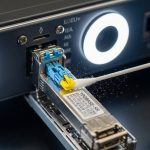
Buying for an 800G AI network is where “it should work” meets “why is it flapping at 2 a.m.” This guide helps procurement and field teams compare OSFP 800G optics, validate interoperability, and avoid supply-chain surprises. Expect practical selection steps, a spec comparison table, and troubleshooting patterns seen in AI fabric and hyperscale environments.
What OSFP 800G modules need to match in an 800G AI network
In an AI fabric, OSFP 800G optics are typically used to connect leaf-spine tiers, GPU server racks, or AI TOR switches. The key is not just lane count and reach; it is also how the module reports capabilities (DOM), how it negotiates link parameters, and whether the switch ASIC expects a specific electrical interface profile. IEEE and vendor guidance matter here because the optics must satisfy the host’s transceiver requirements and the optical link budget must survive real cabling loss.
Procurement sanity checks before you request quotes
- Form factor and port pitch: Confirm OSFP mechanical compatibility with the exact switch model and breakout rules.
- Data rate profile: Ensure the module is truly 800G (not an 8x100G “marketing cousin”) and that the host port supports the same encoding mode.
- Optical reach class: Match the intended run length and patch-panel loss, not just the nominal “max reach.”
- DOM support: Require DOM presence and verify which sensors are exposed to the switch.
- Operating temperature: AI facilities can have aggressive airflow profiles; confirm module spec range vs your measured bay temperatures.
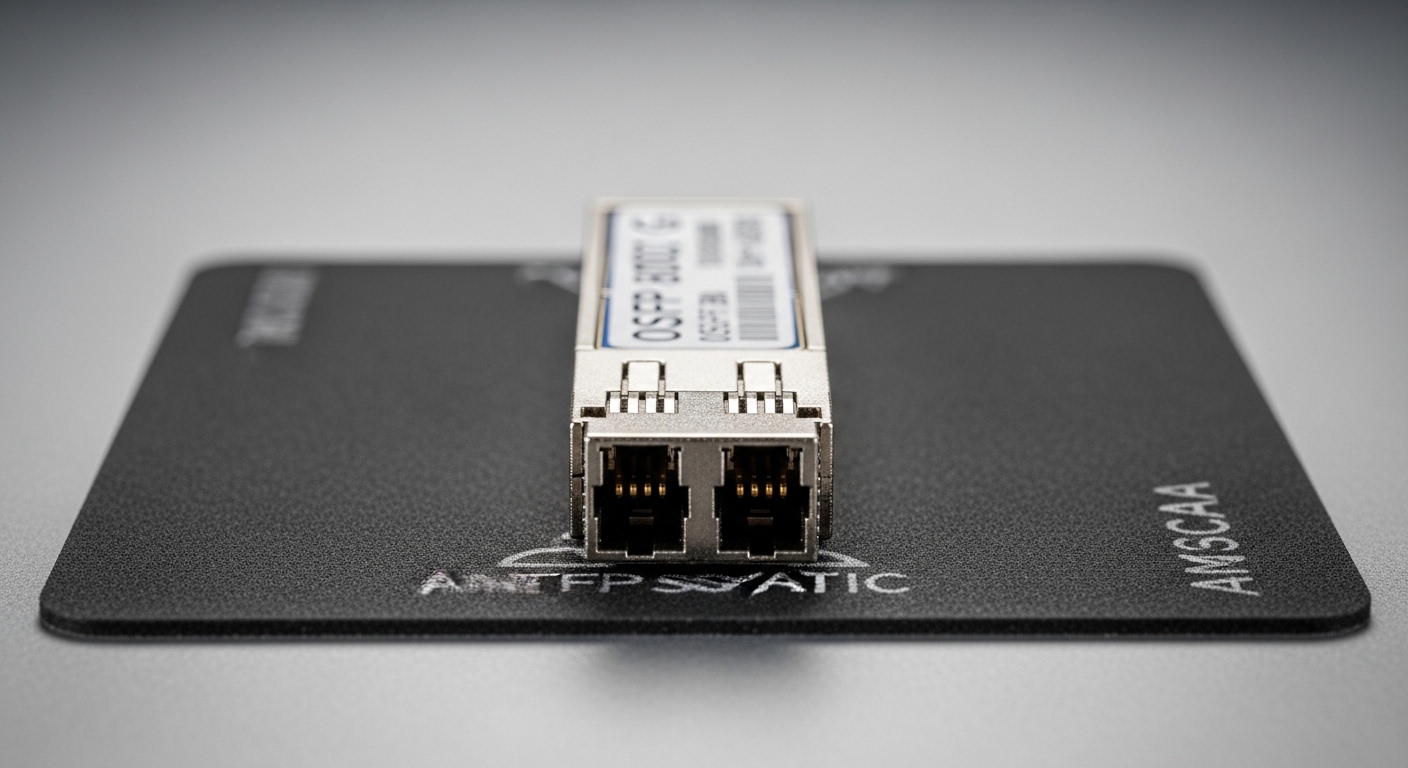
Spec comparison: OSFP 800G optics you will actually choose between
Teams usually compare multiple OSFP 800G optics families by wavelength plan, reach, connector type, and average power. The tricky part: two modules can both claim “800G SR” style capability while using different lane mapping, dispersion tolerance, and power envelopes. That is why procurement should demand the vendor datasheet plus the switch compatibility matrix when available.
Common OSFP 800G classes and what they typically imply
- Short-reach multimode: Often used inside data halls and between adjacent rows; depends on OM4/OM5 and cabling loss.
- Reach-extended options: Needed when fiber routing includes long patch cords, overhead trays, or extra consolidation points.
- Single-mode variants: Used for longer intra-campus runs, but require strict cleanliness and connector discipline.
| Spec area | OSFP 800G SR (typical multimode) | OSFP 800G reach-extended (OM4/OM5 tuned) | OSFP 800G LR/longer (typical single-mode) |
|---|---|---|---|
| Target data rate | 800G (host-supported) | 800G (host-supported) | 800G (host-supported) |
| Wavelength plan (typical) | Short-reach multimode plan (varies by vendor) | Optimized for higher link budgets (varies) | Single-mode wavelength plan (varies) |
| Reach (datasheet class) | ~100 m class (depends on OM4/OM5) | ~150 m class (depends on loss + patching) | ~500 m to 2 km class (depends on model) |
| Connector type | MPO/MTP (multi-fiber) | MPO/MTP (multi-fiber) | LC or MPO/MTP (depends on module) |
| Average module power | Often higher than 400G; confirm W vs chassis limits | Similar power class; verify thermal design | Often moderate; still verify chassis power budget |
| Operating temperature | Confirm commercial vs industrial range | Same requirement; validate airflow assumptions | Same requirement; single-mode optics can be sensitive to margins |
| DOM and monitoring | Require DOM sensors (temp, bias, power, alarms) | Require DOM + correct threshold behavior | Require DOM + switch alarm mapping |
Note: exact reach and wavelength details differ by vendor and part number, so treat the table as a procurement framework, not gospel. Always anchor decisions to the specific OSFP 800G datasheet and the host switch’s supported transceiver list.
Pro Tip: In the field, the “max reach” number rarely fails first. The first failure mode is usually connector contamination or patch-panel insertion loss creeping past budget. Before swapping modules, clean MPO/MTP ends and re-measure end-to-end loss with a calibrated tester, then check DOM optical power trends over 10 to 30 minutes.
Deployment scenario: validating OSFP 800G in an AI fabric
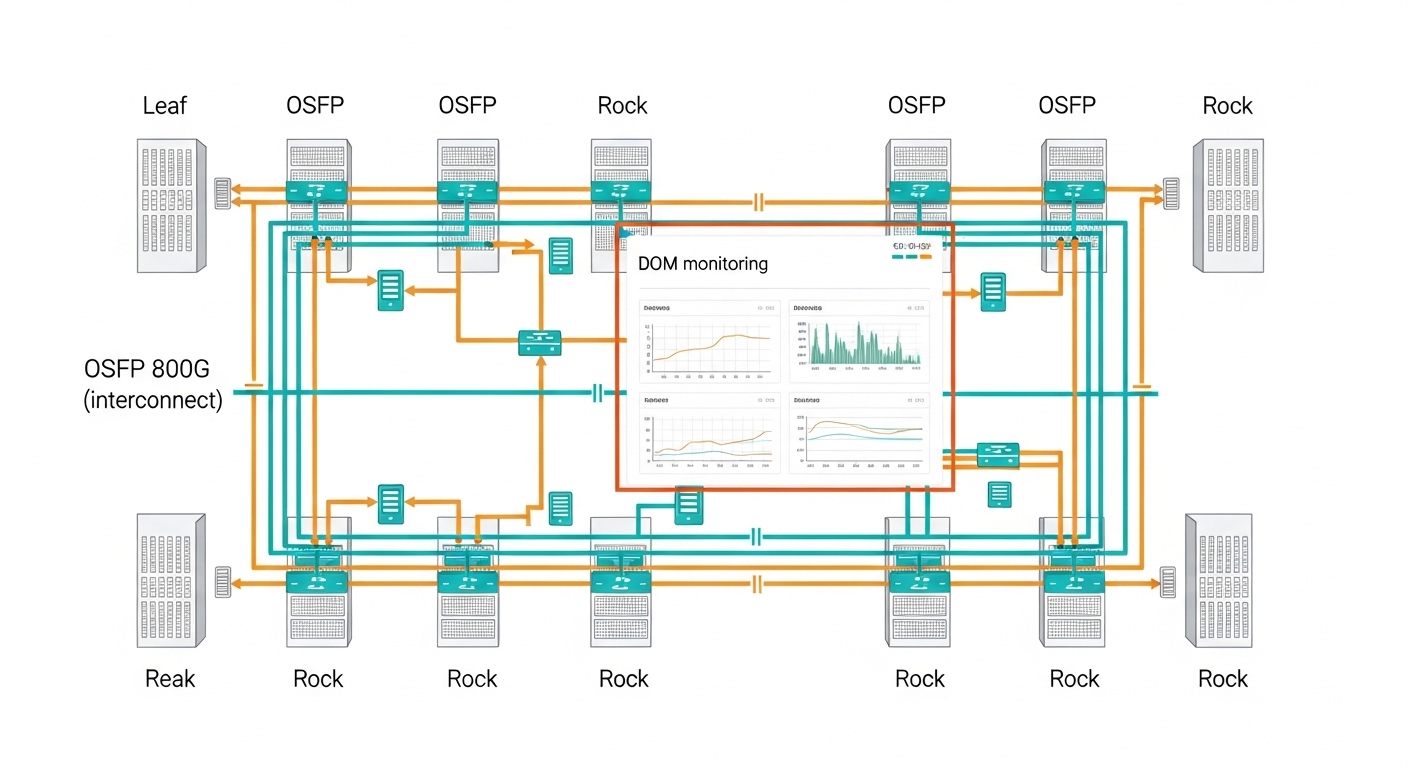
In a 3-tier data center leaf-spine topology with 48-port 800G-capable ToR switches, a hyperscale team deployed OSFP 800G optics between leaf and spine using 2 redundant paths per rack group. Each leaf had 16 uplinks, and the design targeted 40 m to 120 m physical fiber runs including patch panels and slack loops. During commissioning, they validated link health by pulling DOM readings via the switch CLI and confirming optical power stayed within vendor thresholds while traffic ran at sustained load for 2 hours. Two weeks later, a single rack showed CRC bursts; root cause was a partially seated MPO connector during a maintenance window, not a “bad transceiver.”
Selection criteria checklist for OSFP 800G procurement
Procurement should treat this as a risk-managed spec match, not a lowest-unit-cost reflex. Use the checklist below in order, and require evidence for each item before confirming an order.
- Distance and fiber plant loss budget: Use measured insertion loss and connector counts; include patch cord loss and aging assumptions.
- Switch compatibility: Confirm the exact switch model and port type supports the OSFP module; ask for a compatibility matrix or lab results.
- Optical parameters and margin: Demand datasheet link budget details and verify they align with your OM4/OM5 or single-mode connector plan.
- DOM support and alert mapping: Verify DOM fields and alarm thresholds match what your network monitoring expects.
- Operating temperature and airflow: Compare module temperature range with measured bay temperatures and chassis airflow constraints.
- Power and chassis budget: Confirm average power per module and ensure the chassis power/thermal design margin is not tight.
- Lead time and supply chain risk: Evaluate second-source availability, packaging traceability, and whether you can swap vendor families during outages.
- Vendor lock-in risk: Assess whether support tickets require the original OEM optics brand, and whether firmware/DOM quirks can block interoperability.
Compatibility and standards references you should cite internally
- IEEE 802.3 Ethernet physical layer framework for optical interfaces and transceiver behavior: IEEE 802.3
- ANSI/TIA guidance for cabling practices and connector performance fundamentals: TIA standards portal
- Vendor datasheets for the exact OSFP 800G part numbers you are buying (required for reach, power, and DOM sensor definitions).
Common mistakes and troubleshooting that saves your weekend
Here are failure patterns that show up in real 800G AI network rollouts. Each includes the root cause and the fix, so you can triage without playing “transceiver roulette.”
“It negotiated” but traffic still errors
- Root cause: Link is up but optical power margin is too tight; mild loss or dirty connectors cause bursty CRC or FEC errors.
- Solution: Clean MPO/MTP ends, re-seat modules, then verify DOM optical power and alarm thresholds. Re-run link tests with a calibrated optical power meter or tester.
DOM alarms don’t match your monitoring rules
- Root cause: Sensor naming or threshold units differ across vendors; the switch may map alarms differently than your NMS expects.
- Solution: Pull raw DOM values directly from the switch for a known-good link. Update monitoring thresholds based on observed vendor behavior within spec.
Thermal throttling or early aging in dense bays
- Root cause: Module is within datasheet temperature range at the chassis sensor, but the micro-environment around the OSFP cage is hotter due to airflow blockage.
- Solution: Measure inlet/outlet temps per rack bay during peak load. Improve airflow (cable management, fan curve verification) and confirm module case temperature stays within range.
Wrong fiber type or connector strategy used during expansion
- Root cause: A later phase adds patch panels with different fiber grade (OM4 vs OM5) or different connector polish/cleanliness practices.
- Solution: Lock the fiber standard in the change ticket. Before rollout, verify insertion loss and connector end-face cleanliness, and require acceptance testing on new patch segments.
Cost and ROI: what you should expect to pay and why it matters
In many markets, OSFP 800G optics pricing swings based on volume and vendor tier. As a realistic procurement range, plan for roughly $1,500 to $3,500 per module for mainstream OSFP 800G optics, with higher-cost options for longer reach or constrained supply. OEM parts often cost more but can reduce operational drag: fewer compatibility escalations, cleaner warranty pathways, and better DOM predictability. Third-party modules can be cost-effective, but TCO must include validation time, compatibility risk, and higher failure-rate impact during fast deployment cycles.
ROI lens that procurement teams use: estimate failure cost (truck rolls, downtime, labor), validation overhead (lab time, spares), and time-to-repair. If your rollout is “fleet-wide” with tight timelines, the hidden cost is usually not the module price; it is the delay from interoperability issues and the time spent chasing phantom link problems.

FAQ: OSFP 800G for an 800G AI network
Which reach class should we buy for an 800G AI network leaf-spine?
Start with measured fiber lengths plus patch-panel loss, not the nominal reach. If you have 40 m to 120 m with multiple consolidation points, short-reach multimode may work, but verify your insertion loss budget and connector counts using test results.
Do we need DOM support, or can we ignore monitoring?
For an AI fabric, you should require DOM so operations can correlate link errors with optical power, temperature, and bias changes. Ignoring DOM turns troubleshooting into guesswork, especially when only one of many links degrades.
Are third-party OSFP 800G modules safe for hyperscale deployments?
They can be, but only after compatibility validation with your exact switch models and a DOM/alarm mapping check. Procurement should require evidence of switch interoperability and run a pilot with sustained traffic before scaling.
What causes “link up” but high error rates on OSFP 800G?
Common causes include dirty MPO/MTP connectors, marginal optical power budgets, or airflow/thermal issues that push the module out of its comfortable operating margin. Clean, re-seat, verify DOM readings, and re-measure end-to-end loss.
How do lead times and supply chain risk affect module selection?
If your spares strategy is thin, a long lead time can turn a minor failure into a major outage. Prefer sources that offer predictable replenishment, traceability, and second-source options for emergency swaps.
What should we ask vendors during RFQ for OSFP 800G?
Ask for datasheets with reach and link budget details, average power, DOM sensor list, operating temperature range, and any switch compatibility documentation. Also request warranty terms and RMA turnaround expectations for field failures.
If you want the next step, map your fiber plant loss budget and port compatibility matrix, then use this guide’s checklist to shortlist OSFP 800G candidates. For related procurement considerations, see how to build an optics spares strategy for data centers—because “we will fix it later” is how outages become traditions.
Author Bio: I have supported real AI fabric rollouts by validating OSFP 800G optics with DOM telemetry, optical power measurements, and switch compatibility checks under production constraints. I write procurement-ready guidance that field engineers can execute without sacrificing weekends to mystery link errors.