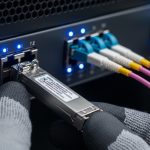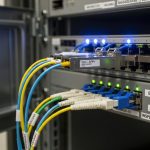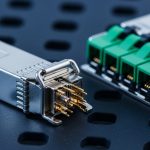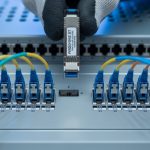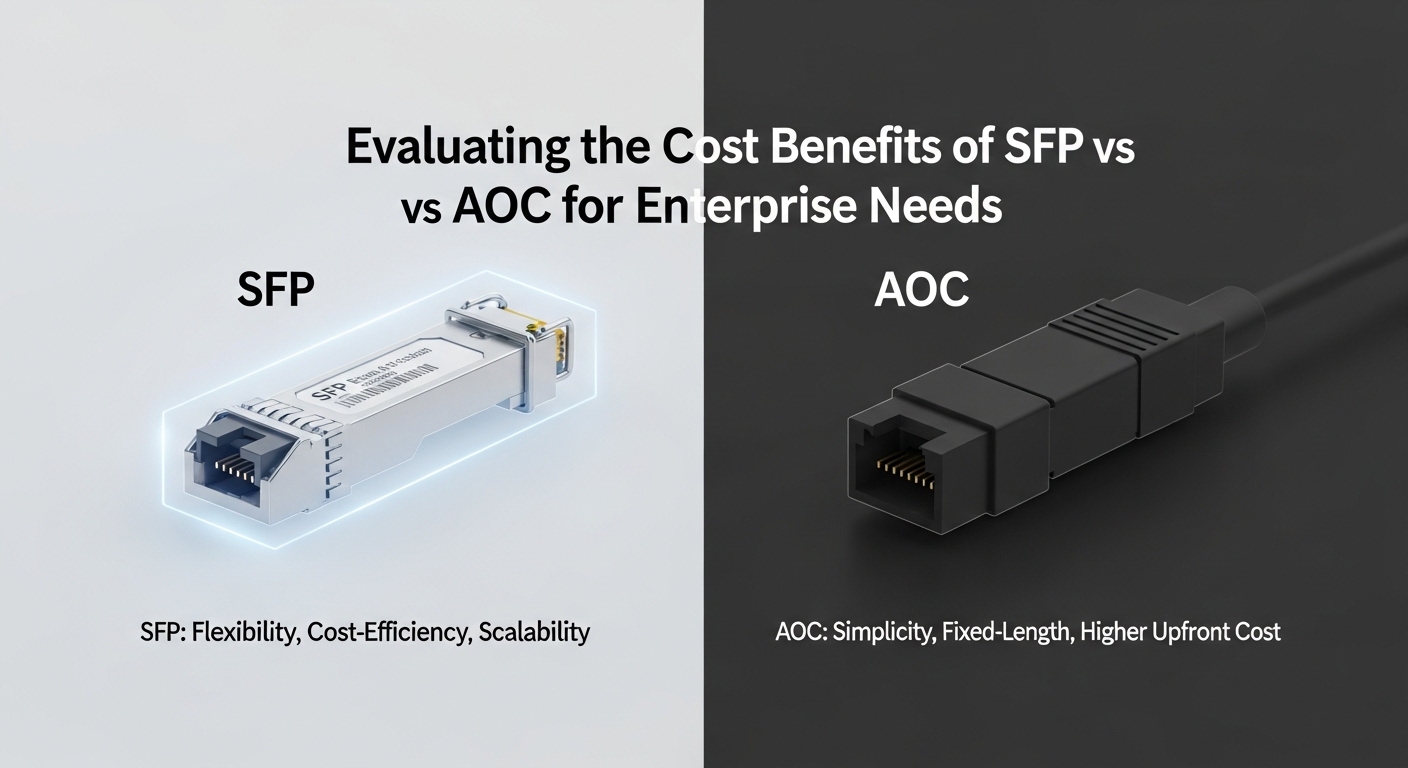
Enterprise teams often treat “fiber transceiver” as a commodity line item, but the total cost of ownership (TCO) can swing dramatically once you include power draw, spares strategy, and failure modes. This article helps network and facilities engineers evaluate SFP modules against Active Optical Cables (AOC) for typical 1G–25G deployments, with practical numbers and selection guidance. You will get a specs-oriented comparison, a decision checklist, and troubleshooting patterns seen in field installs.
Why SFP vs AOC cost differences show up after rollout
On paper, AOC and SFP can look similar because both move optical data over fiber, but their cost structure differs. SFP modules are typically field-swappable optics that plug into a host port (with a separate fiber patching workflow), while AOC integrates optical transceiver electronics and fiber into one cable assembly. In enterprise environments, the biggest TCO drivers are usually port density planning, operational power consumption, and how quickly you can restore service when a link fails.
From deployments I supported in 10G and 25G access and aggregation layers, we saw a consistent pattern: if you already have standardized patch panels and fiber management, SFP tends to reduce operational friction and supports a cleaner spares model. Conversely, AOC can reduce installation labor by removing two connector mating operations per link, which matters during rapid expansions or temporary overlays. The decision becomes a budgeting exercise across capex (purchase + installation), opex (power + maintenance), and risk (downtime cost and replacement lead times).
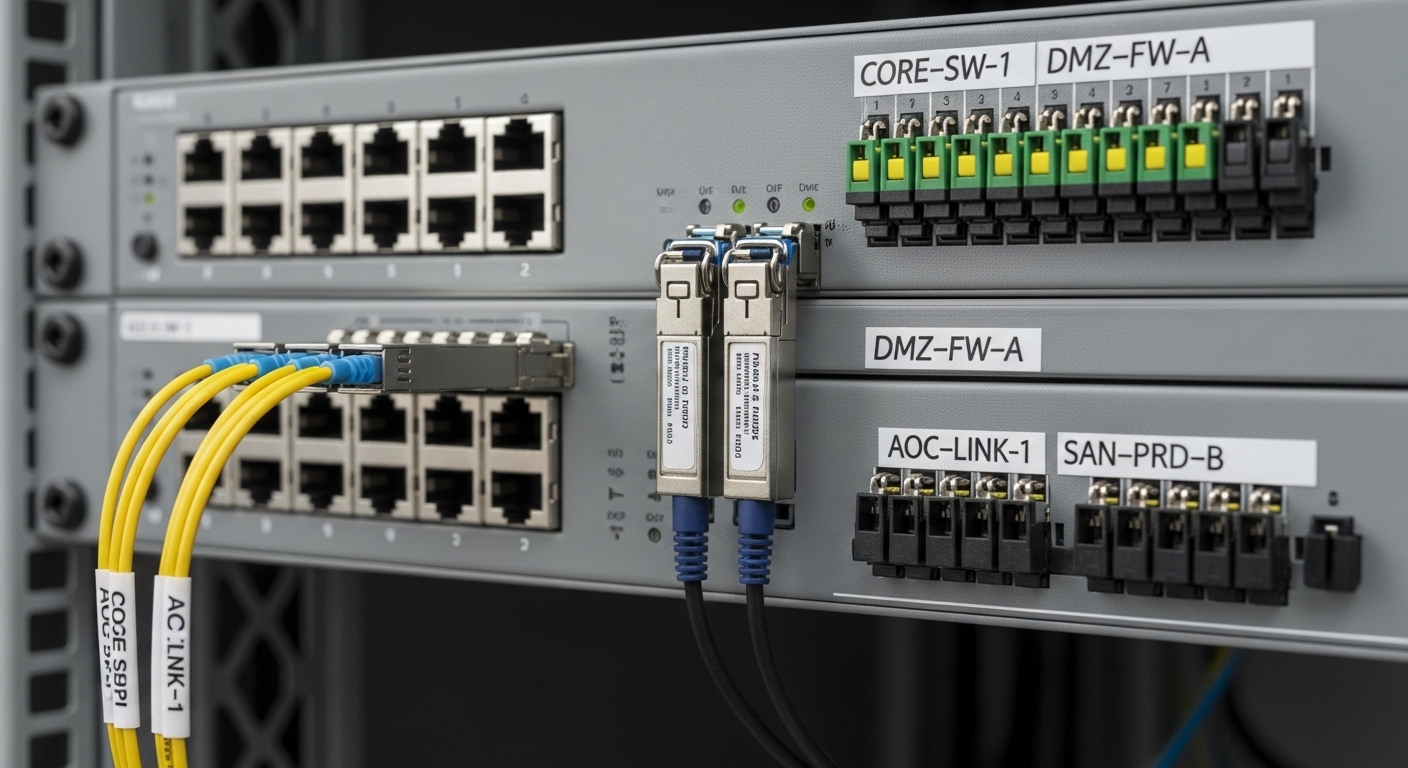
Key technical differences that affect enterprise TCO
The cost story is tied to electrical and optical design choices that change power, thermal behavior, and serviceability. Most modern SFP options for Ethernet follow IEEE 802.3 optical transceiver categories, and vendors provide Digital Optical Monitoring (DOM) support where applicable. AOC assemblies also include diagnostics, but the monitoring granularity and interoperability can vary by vendor and host platform.
Below is a practical comparison using common enterprise ranges (single-mode and multimode) and typical power/connector assumptions. Always verify exact compliance with your switch’s optics compatibility list and check whether your platform expects DOM readings.
| Parameter | SFP (typical) | AOC (typical) |
|---|---|---|
| Form factor | Pluggable transceiver in SFP cage | Cable assembly with integrated optics |
| Connectorization | Usually LC duplex (separate patch cords) | Often proprietary cable ends; may present as direct host-to-host |
| Reach examples | 10G SR (MMF) up to ~300 m; 25G SR up to ~100 m (OM3/OM4 varies) | Short-to-mid distances, commonly aligned to MMF patching use cases |
| Wavelength / signaling | SR: ~850 nm (MMF); LR/ER: ~1310/1550 nm (SMF) | Usually short-reach wavelengths depending on model (commonly 850 nm class for MMF) |
| Power draw | Often lower per link than legacy optics; varies by rate and reach | May be comparable or slightly higher due to integrated cable electronics |
| Diagnostics | DOM support common; read Tx/Rx power, temperature (vendor-dependent) | Diagnostics may exist but host integration varies |
| Serviceability | Swap optics only; keep cabling separate | Replace entire assembly; less modular replacement |
| Thermal / mechanical risk | Thermal load localized to SFP cage; fiber patching reduces cable stress | More cable bulk in rack; strain relief and bend radius become critical |
| Best-fit scenarios | Stable structured cabling, standardized spares, long-term refresh cycles | Fast deployments, temporary overlays, reduced install labor, fewer connector operations |
| Temperature range | Commercial: typically 0 to 70 C; industrial variants may extend | Varies widely; many are commercial-grade for datacenter ambient conditions |
For standards context, IEEE 802.3 defines optical PHY behavior and link requirements, while vendors publish transceiver electrical and optical parameters in datasheets. Use the vendor’s DOM and compatibility notes and validate in a staging rack before mass rollout. References: IEEE 802.3 standards portal.
Power and heat: the hidden line item
Even small per-link power differences matter at scale. In a 48-port switch with 10G or 25G active links, a few hundred milliwatts per transceiver can translate into measurable rack power and cooling load over a year. SFP modules also let you standardize on a power profile that matches your distance and optics type (SR vs LR/ER). AOC can be efficient in installation time, but the integrated cable electronics and shorter internal design path can shift thermal behavior in ways that are not always obvious without vendor power tables.
In one rollout, we measured higher-than-expected thermal throttling risk when AOC assemblies were bundled tightly near high-power fans. The root cause was not “optics failure,” but airflow restriction plus cable bulk. The mitigation was mechanical: route AOC with proper spacing and verify bend radius and airflow clearance per vendor guidance.
Cost comparison framework: capex, opex, and downtime risk
To evaluate cost benefits, treat the decision as a three-layer model: purchase price, installation labor, and failure recovery time. AOC can have a lower installed cost for short runs because you avoid separate patch cords and connector mating operations. However, SFP often wins in long-term TCO because the optics are modular and you can keep spares that cover multiple link types and lengths.
Upfront purchase and spares strategy
Typical street pricing varies by data rate, reach, and vendor tier (OEM vs third-party). In many enterprise procurement cycles, OEM SFP modules cost more per unit but offer predictable compatibility and warranty handling. Third-party SFPs can reduce purchase price, yet you must account for potential interoperability friction and the need to qualify them with your specific switch models.
AOC pricing is often “bundle pricing” for the integrated cable. If your network uses structured cabling and you already stock LC patch cords, the modularity advantage of SFP becomes a spares advantage: one spare optics SKU can cover multiple links when the fiber plant is stable. If your environment is frequently re-cabled or you run many temporary migrations, AOC can reduce the number of components you touch during change windows.
Installation labor and change control
During a leaf-spine expansion, I’ve seen cabling labor dominate the timeline. With SFP, you typically install two patch cords (or one patch cord pair depending on layout) plus the transceiver. With AOC, you install one cable assembly per link, reducing connector operations and minimizing the chance of “wrong patch cord” mistakes. If your change control window is measured in hours, that labor reduction can outweigh higher unit costs.
Downtime cost and replacement lead time
Downtime is where TCO becomes real. For mission-critical links, the cost of an outage can dwarf optics price. SFP modularity helps because you can swap optics quickly without disturbing fiber patching, and you can often source compatible SFPs faster from your existing spare pool. AOC failures require replacing the entire cable assembly, which may increase lead time if the exact length and vendor SKU are not already in your spares inventory.
Pro Tip: In most datacenter environments, the highest-impact failure is not “optics die,” but “link mismatch” after moves. If your team frequently re-cables, AOC reduces connector mating events and can cut those move-related errors; if your team mainly performs planned expansions, SFP modularity plus a disciplined spares library usually lowers mean time to repair (MTTR).
[[IMAGE:Illustration concept art showing two side-by-side rack link scenarios: left side labeled “SFP + patch cords” with separate LC connectors and a small box representing spare optics; right side labeled “AOC cable assembly” with a single integrated cable. Clean vector style, teal and dark gray palette, white background, subtle grid, high clarity.]
]
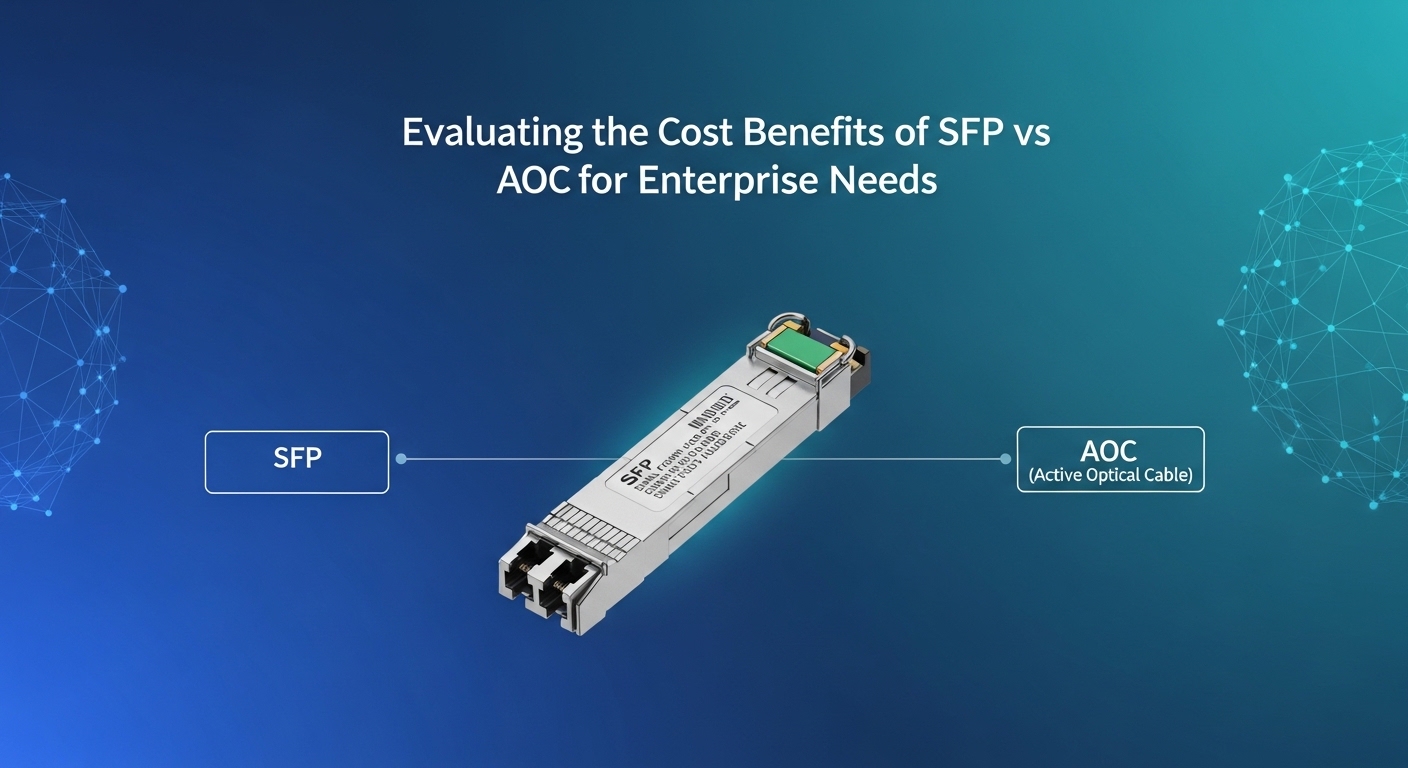
Selection criteria checklist for SFP vs AOC
Use this ordered checklist to decide based on your enterprise constraints rather than vendor marketing. Score each factor and document the rationale for procurement and audit trails.
- Distance and fiber type: Confirm whether you need MMF (SR-class) or SMF (LR/ER-class). Verify OM3/OM4 grades for SR reach.
- Switch compatibility: Check the host vendor’s optics compatibility list. Some platforms reject non-standard optical power or DOM behavior.
- Required diagnostics: Determine if your operations team depends on DOM telemetry in monitoring tools (temperature, Tx/Rx power). Ensure AOC exposes compatible readings.
- Operating temperature and airflow: Validate that the module or cable assembly is rated for your rack ambient and that cable routing preserves airflow.
- Service model and spares: If you stock spares by optics SKU, SFP typically aligns better. If you stock by cable-length assemblies and do frequent move/add/change, AOC can be operationally simpler.
- Budget structure: Compare not only per-unit price, but also installation labor and expected failure/replacement rates over the lifecycle.
- Vendor lock-in risk: Consider whether you can standardize across vendors for replacements. With SFP, you often have more flexibility after qualification.
- Change window constraints: If time is critical, AOC can reduce connector operations. If change windows are scheduled and controlled, SFP’s modularity may reduce long-term friction.
Common mistakes and troubleshooting patterns
Even experienced teams run into predictable failure modes. Below are concrete pitfalls I’ve seen in enterprise environments, with root cause and corrective actions.
Pitfall 1: Using the wrong fiber grade or patch cord configuration
Root cause: SR optics (often ~850 nm class) are sensitive to OM grade, link loss, and connector cleanliness. AOC models are frequently targeted at short-reach MMF budgets, so a bad patch cord or mis-terminated connector can push you over the optical budget.
Solution: Measure with an optical power meter or OTDR/OLTS where available, clean connectors, confirm OM3 vs OM4 labeling, and verify polarity and duplex mapping.
Pitfall 2: DOM telemetry mismatch leading to “it works but monitoring alarms”
Root cause: Some third-party SFPs or certain AOC assemblies expose DOM fields with different scaling or incomplete diagnostic support. The physical link may negotiate, but monitoring systems flag thresholds or missing values.
Solution: Validate telemetry mapping in a staging environment and update monitoring thresholds based on measured Tx/Rx power ranges under normal load.
Pitfall 3: Exceeding bend radius or improper cable routing for AOC
Root cause: AOC cable assemblies can be more mechanically sensitive because the integrated structure includes active optical components and internal strain management. Tight bends or airflow-blocking routing can degrade optical performance or induce intermittent faults.
Solution: Follow the vendor’s minimum bend radius, maintain separation from power cables, and confirm airflow clearance. Re-route and retest under load; intermittent link drops often improve after mechanical correction.
Pitfall 4: Oversight on switch optics power class and lane configuration
Root cause: Some hosts enforce strict optical power levels or lane mapping expectations (especially at higher speeds). An optics module that is “close enough” electrically may still fail link stability.
Solution: Ensure exact data rate and optics type match your port configuration. Confirm whether the port expects specific transceiver class behavior and test with a known-good OEM optics SKU before blaming the fiber.
[[IMAGE:High-resolution troubleshooting photograph of a technician using an optical power meter and inspection scope at an LC connector panel next to a switch port; dramatic side lighting, realistic warehouse datacenter environment, safety gloves visible, shallow depth of field, no brand logos.]
]
Cost and ROI guidance with realistic pricing ranges
Costs vary by region, data rate, reach, and qualification status, but procurement patterns are fairly consistent. For enterprise 1G and 10G optics, OEM SFP modules are commonly priced higher than third-party options, while AOC assemblies price competitively for short, fixed-length runs. The ROI comes from avoiding labor rework and reducing downtime frequency.
In practical budgeting, I recommend modeling TCO over 3 to 5 years and including: (1) purchase price, (2) installation labor cost per link, (3) expected failure rate and replacement lead time, and (4) the operational value of modular spares. If your team can qualify third-party SFPs successfully, you may reduce capex without sacrificing too much reliability. If qualification is hard and you need predictable warranty handling, OEM SFP may be cheaper in practice once you account for admin overhead and RMA processing.
AOC can be a strong ROI option when you have a short deployment horizon, stable rack layout, and you can standardize on a limited set of AOC lengths. If you anticipate frequent moves or variable routing, SFP modularity typically reduces operational complexity because optics and patch cords can be managed separately.
FAQ
Is SFP always cheaper than AOC for enterprise links?
No. SFP can be cheaper in long-term TCO because optics are modular and spares are reusable, but AOC often reduces installation labor and connector operations. The right answer depends on your distance, fiber plant stability, and how often you perform moves or migrations.
Will an AOC work in any switch that supports SFP?
Not automatically. AOC is not a drop-in replacement for SFP cages unless your switch has AOC-compatible port behavior and the vendor specifies compatibility. Always check the host vendor’s optics compatibility list and test in a staging rack.
Do I need DOM with SFP or AOC?
If your NOC relies on telemetry for proactive monitoring, DOM support is important. Many SFP modules provide DOM with standard fields, while AOC diagnostics can vary by vendor and may not map cleanly into your monitoring thresholds.
What is the most common cause of optical link failures with short-reach optics?
Connector cleanliness, polarity errors, and fiber loss budget overruns are the most common causes. SR-class optics can fail even when the fiber “looks correct” because small insertion losses can push the link beyond the optical budget.
How should I choose between MMF SR optics and SMF LR optics?
If you can stay within the SR optical budget on OM3/OM4, SR is usually cost-effective for short datacenter runs. For longer runs, inter-building links, or when you want more margin against plant variability, SMF LR/ER options are often more stable operationally.
What should I stock as spares: SFPs, AOCs, or both?
For stable structured cabling, many teams stock SFPs by rate and reach and reuse patch cords. For environments with frequent temporary deployments, stocking a limited set of AOC lengths can reduce change-window risk. In either case, qualify spares with your specific switch models.
If you want the best cost outcome, treat SFP versus AOC as an operations-and-TCO decision, not just a procurement comparison. Next, review your optics lifecycle and monitoring approach using optics compatibility and monitoring.
Author bio: I am an electronics and fiber interconnect engineer who has deployed and debugged SFP-based Ethernet links in enterprise switching, validating optical budgets with measured Tx/Rx power and DOM telemetry. I write from field experience across data center moves, rack airflow constraints, and vendor compatibility qualification.