If you run dense WDM links, you eventually see it: error bursts that correlate with channel count, launch power, and temperature. This article helps network and optical engineers design and choose transceivers while accounting for the WDM nonlinear effect that can quietly erode reach and raise BER. You will get practical selection criteria, a comparison table of common optical modules, and troubleshooting tips from real deployments.
Why the WDM nonlinear effect shows up in transceiver planning
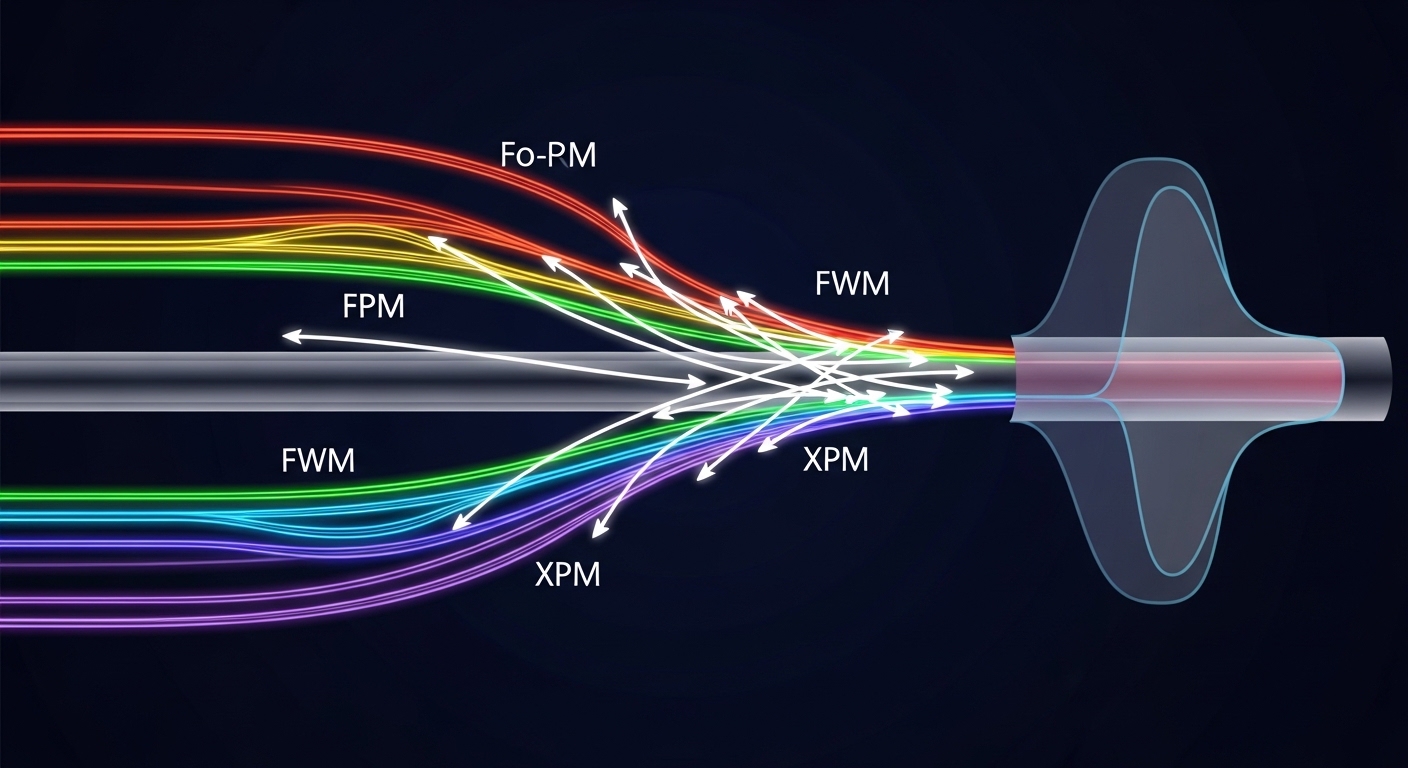
In multi-channel fiber systems, each channel’s optical field can interact with the others through nonlinear processes. The most discussed are four-wave mixing (FWM), cross-phase modulation (XPM), and stimulated Raman scattering (SRS). Even if your transceiver meets its own optical budget on paper, nonlinear penalties can shift the system from “power-limited” to “impairment-limited.” Vendor datasheets often specify sensitivity and output power for back-to-back tests, but they rarely model your exact WDM channel plan, fiber type, and dispersion map.
Practically, nonlinear effects scale strongly with launch power, channel spacing, modulation format, and fiber dispersion. For coherent systems, digital signal processing helps, but it does not fully cancel nonlinear phase noise. For IM/DD systems, the receiver can be more sensitive to amplitude distortions and beating products. The WDM nonlinear effect is also temperature sensitive because it changes transceiver laser characteristics, dispersion, and sometimes link gain in amplifier-based designs.
When you design for high availability, you need to translate these physics into engineering margins: optical launch power targets, permissible channel counts, and receiver sensitivity degradation budgets. That is why transceiver design choices like output power class, spectral width, and DOM telemetry behavior matter as much as the raw link budget.
What engineers actually model (beyond the optical budget)
Most teams start with the simple budget: fiber attenuation, connector/splice loss, and transceiver power and sensitivity. Then they add impairment models for WDM operation: nonlinear interference estimates (often using Gaussian noise approximations), nonlinear phase noise variance, and crosstalk terms. If you use EDFAs or Raman amplification, you also model gain tilt, noise figure, and SRS power transfer across bands. Your transceiver choice influences these inputs because it controls effective launch power and spectral characteristics that drive nonlinear coupling.
Pro Tip: In the field, the biggest “surprise” is that raising launch power to fix margin can worsen the WDM nonlinear effect faster than it improves OSNR. A common mitigation is to cap per-channel power and instead add reach with better FEC, lower-loss optics, or a slightly different channel plan (spacing and band). That usually stabilizes error bursts under channel add/remove events.
Transceiver design knobs that interact with nonlinear penalties
Transceivers are not just transmitters and receivers; they define spectral purity, output power stability, and monitoring behavior. For WDM, the key knobs are laser linewidth and frequency stability, output power control loop performance, and the transmitter’s spectrum (side-mode suppression). On the receive side, bandwidth, filter shapes, and coherent DSP settings determine how nonlinear distortions map into decision metrics.
If you use pluggable optics, confirm whether the device supports DOM telemetry and whether the switch/router platform actually reads it reliably. DOM helps you automate power ramping, alarm thresholds, and link health correlation. In high-availability networks, that correlation is what turns a mystery outage into a controlled rollback: reduce per-channel power, shift channel assignment, or temporarily disable a noisy channel.
Common module categories and where they fit
Below is a practical comparison of typical transceiver types used in WDM-adjacent deployments (from short-reach coherent to longer-reach coherent). Exact parameters vary by vendor and revision, so treat this as a planning baseline and verify with the specific datasheet.
| Module type | Typical data rate | Wavelength | Reach class | Connector | Operating temp | Nonlinear sensitivity notes |
|---|---|---|---|---|---|---|
| CWDM/SFP+ style (IM/DD) | 1G to 10G | 850/1310/1550 nm | Up to tens of km | LC | 0 to 70C (varies) | More sensitive to beating and crosstalk; nonlinear effects still matter in dense channel plans. |
| 10G/25G SFP+/SFP28 (IM/DD) | 10G/25G | 1310/1550 nm | Several to ~80 km (varies) | LC | -5 to 70C (varies) | Launch power and spectral width influence FWM/XPM; FEC margin can help but does not eliminate nonlinear phase noise. |
| Coherent pluggable (e.g., CFP2-DCO/DCO-style) | 100G to 400G per carrier | C-band (often) | 80 km to 200+ km with amplification | LC (often) or custom | -5 to 70C (varies) | DSP mitigates some impairments; nonlinear OSNR still limits max reach and channel count. |
| High-power coherent with amplification | 100G to 800G | DWDM bands | 200 km+ | LC/custom | -5 to 70C | Nonlinear penalties dominate at higher launch power; power capping and channel plan become critical. |
For concrete examples, coherent optics are commonly specified around standardized interfaces, while IM/DD pluggables like Cisco SFP-10G-SR target short reach and are typically not the main nonlinear drivers in long-haul WDM. For longer-haul or WDM-adjacent scenarios, you will more often evaluate coherent transceivers and their DSP/FEC behavior. Still, even “simple” optics can contribute to nonlinear interactions when they sit in dense, amplified channel environments.


Deployment scenario: leaf-spine with WDM add/remove events
Consider a 3-tier data center leaf-spine topology where the aggregation layer uses regional dark fiber routed between two buildings. You run 48-port 10G ToR switches on the access side, but the inter-building transport uses a WDM mux/demux shelf with 16 channels in the C-band. Each channel is provisioned as a coherent 100G carrier in the transport layer, and the operations team adds or removes capacity monthly based on workload spikes.
During a capacity increase, the team initially pushes per-channel launch power to recover a small margin measured on one link. Within days, error counters show bursty degradation only on the links with the highest channel count. The root cause is the WDM nonlinear effect: higher launch power increased nonlinear phase noise and XPM coupling, and the new channel plan moved some carriers into a regime where FWM products interfered more with your receiver filter passband. The fix was operational, not hardware: cap per-channel power, adjust channel assignments to restore a more favorable spacing plan, and rely on FEC margin rather than raw power.
This kind of scenario is why transceiver selection must consider how the module behaves under dynamic channel loading. You want stable output power control, predictable spectral behavior, and actionable DOM telemetry so you can correlate BER/FER spikes with optical parameters during change windows.
Selection guide: a checklist that accounts for nonlinear physics
When engineers choose optics for WDM-heavy environments, they should treat nonlinear penalties as first-class constraints. Use this ordered decision checklist and require evidence from vendor datasheets and, when possible, your own acceptance tests.
- Distance and amplification strategy: Is the path passive, EDFA-amplified, or Raman-amplified? Nonlinear effects become more prominent as gain and launch power increase.
- Channel plan and spacing: How many WDM channels will share the fiber simultaneously, and what is the channel spacing? Nonlinear coupling depends on spacing and band.
- Modulation format and receiver type: IM/DD vs coherent changes how nonlinear distortions map into BER/FER. Coherent DSP can help but does not remove the nonlinear OSNR limit.
- Launch power class and spectral purity: Prefer transceivers with controlled output power and tight spectral characteristics. Avoid “maximum power” operation unless the system nonlinear model supports it.
- Switch and optical chassis compatibility: Confirm the platform supports the transceiver type, including proper laser safety class and vendor-specific calibration expectations.
- DOM support and alarm thresholds: Ensure the host reads power, temperature, and bias telemetry reliably. Set alarms that trigger earlier than your change-control windows.
- Operating temperature range: Laser wavelength drift and output power stability degrade with temperature. Validate performance at the hot spot temperature of the optics cage.
- Vendor lock-in risk and spares strategy: OEM optics can be more predictable in nonlinear environments, but third-party parts can work if they match spectral and power-control behavior. Build a spares qualification plan.
What to ask vendors for (so you do not guess)
Ask for transmitter spectral width, side-mode suppression ratio, output power tolerance vs temperature, and any WDM performance characterization or guidance. For coherent optics, ask about OSNR targets, implementation of FEC, and how the module reports key parameters. Also request whether the vendor provides nonlinear impairment test results or at least modeling assumptions.
Common mistakes and troubleshooting tips
Nonlinear issues are frustrating because they look like random impairments until you correlate them with optical parameters. Here are concrete failure modes that show up in real operations, with root causes and fixes.
“We increased power to fix margin” and BER got worse
Root cause: Raising launch power improved signal power but increased nonlinear phase noise and cross-channel coupling, pushing the system beyond its nonlinear OSNR sweet spot. In WDM, nonlinear penalties can grow faster than linear SNR gains.
Solution: Cap per-channel launch power and rely on FEC margin. Re-run the nonlinear impairment model using your actual channel count, spacing, and fiber dispersion assumptions.
Channel add/remove caused bursty errors only after provisioning
Root cause: The new channel plan changed interference patterns (FWM/XPM) relative to your receiver filter bandwidth. Sometimes the issue appears only when specific channels are present simultaneously.
Solution: Implement change-control that includes optical plan validation: verify spacing, band usage, and any guard bands. Use DOM telemetry to correlate error bursts with per-channel power and temperature.
DOM telemetry looked normal, but the host misread thresholds
Root cause: Some transceivers expose DOM values differently, and some host platforms interpret alarm units or scaling incorrectly. That can delay detection of laser bias drift or power instability.
Solution: Validate telemetry scaling during acceptance testing. Confirm that alarms trigger based on real measured values, not just nominal ranges in the module EEPROM.
You assumed the vendor “optical budget” covers WDM impairments
Root cause: Datasheet link budgets are typically measured for back-to-back or simple single-carrier tests. They rarely include WDM nonlinear effect modeling for your exact system.
Solution: Require WDM-aware system guidance or run your own test plan: loopback with representative channel loading, then measure BER/FER versus launch power.

Cost and ROI: balancing OEM optics, power, and outage risk
Pricing varies widely by data rate and vendor. As a rough planning range, many 10G/25G pluggable optics are often in the tens to low hundreds of dollars per unit, while coherent WDM-capable transceivers can be in the low thousands to several thousands depending on reach and features. OEM modules typically cost more than third-party, but they often deliver tighter power-control behavior and more predictable telemetry, which reduces integration time and operational risk.
TCO is not just purchase price. If the WDM nonlinear effect causes intermittent BER bursts, you may spend more on truck rolls, maintenance windows, and monitoring engineering than you saved on optics. Power capping can also reduce heat load and fan duty. In one real operations pattern, teams that standardized on optics with stable launch power and better DOM alarms reduced mean time to repair because nonlinear-related incidents were caught during controlled power adjustments instead of during peak traffic.
For ROI, consider qualifying a small pilot batch before scaling. Test under representative channel counts and temperatures, and document acceptance criteria that include BER/FER vs launch power. That approach turns nonlinear uncertainty into measurable risk.
FAQ
What is the WDM nonlinear effect in plain terms?
It is the set of optical nonlinear interactions that happen when multiple WDM channels share the same fiber. They can create additional noise and distortions that reduce receiver performance, even when each channel’s simple optical power budget looks fine. The effect depends on launch power, channel count, spacing, and fiber dispersion.
Do coherent transceivers fully eliminate nonlinear penalties?
No. Coherent receivers use DSP and FEC that can tolerate impairments better than IM/DD, but nonlinear OSNR still limits maximum reach and capacity. In many networks, the WDM nonlinear effect becomes the dominant constraint at higher power or dense channel loading.
How can DOM telemetry help with nonlinear troubleshooting?
DOM telemetry provides temperature, bias, and transmit power trends that let you correlate performance drops with physical changes. During add/remove events, you can confirm whether launch power drift or temperature excursions coincide with BER/FER bursts. That correlation is often the fastest path to separating nonlinear effects from mispatching or fiber cleanliness problems.
Should we always run optics at maximum rated transmit power?
Not in WDM-heavy environments. Maximum power can push the system into a worse nonlinear regime, creating more errors than it prevents. Many operations teams cap launch power and use FEC margin and better channel planning instead.
What standards or references should I use when planning WDM optics?
Start with IEEE 802.3 for electrical and link behavior expectations, then rely on vendor datasheets for optical parameters. For optical system design, use ITU-T and common WDM engineering models, and validate with acceptance tests. Relevant background can be found via [Source: IEEE 802.3] [[EXT:https://standards.ieee.org/standard/]] and vendor datasheets for your specific module.
Are third-party transceivers safe for WDM links?
They can be, but you must qualify them. The key risk is mismatch in spectral purity, power-control behavior, or DOM scaling that your host platform expects. If you run a strict acceptance test under representative WDM loading, third-party optics can work and reduce purchase cost without increasing outage risk.
If you want the link to stay stable as channels scale, treat the WDM nonlinear effect as an engineering constraint during transceiver selection and change control. Next, review how to build an optical acceptance test plan to turn nonlinear uncertainty into measurable acceptance criteria.
Author bio: I design and operate high-availability optical networks and have debugged WDM impairment issues using DOM telemetry, BER/FER correlation, and launch-power capping. I also write acceptance test plans for transceiver fleets to reduce outage risk during capacity upgrades.