If your long-haul route is pushing toward the limits of conventional optical amplification, distributed Raman fiber can be the difference between stable reach and field failures. This article helps network and optical engineers—especially those standardizing transceiver types across sites—match transmitter/receiver optics to Raman-amplified spans with fewer surprises. You will get practical pairing criteria, a troubleshooting playbook, and a ranked decision table you can apply during design reviews.
Top 7 transceiver pairing moves for distributed Raman fiber links
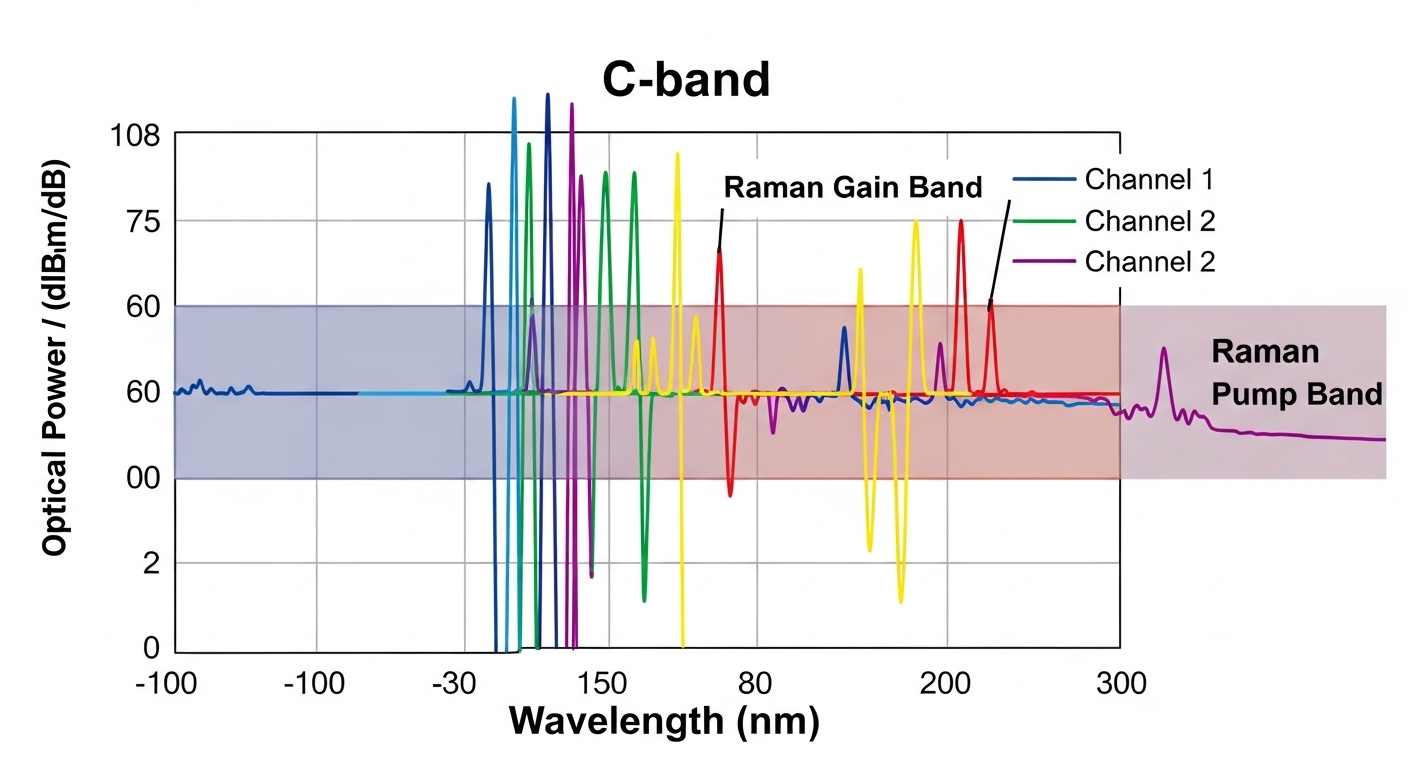
Match wavelength plan to Raman gain band and span strategy
With distributed Raman fiber, the effective gain depends on the pump wavelength, fiber type, and launch conditions. In practice, most long-haul systems use C-band (around 1530–1565 nm) for high channel density; the transceiver optics must align with that plan. If you deploy a mixed portfolio of optics (for example, different vendors or different nominal center wavelengths), you can end up with uneven channel power and receiver margin erosion.
Engineer-level check: confirm the end-to-end optical budget includes Raman gain on the same wavelength grid as the transceivers, and verify that your transceiver wavelengths map to the intended ITU-T grid positions. Raman amplification is not “free power”; it reshapes the power profile across the span, so the transmitter spectral shape and launch power matter.
- Pros: More predictable OSNR when wavelength plan is consistent
- Cons: Requires disciplined wavelength planning across vendors
Use the right transceiver data rate and modulation format for OSNR
Raman systems are typically engineered to preserve OSNR over long distances, but the modulation format determines how sensitive your receiver is to noise and nonlinearities. If you pair a high-sensitivity coherent transceiver with a Raman plan designed for a different modulation format, you can lose margin due to effective penalty changes. For coherent systems, ensure the transceiver’s implementation (DSP, FEC, and receiver bandwidth) is compatible with the expected OSNR and residual dispersion after Raman equalization.
Field reality: in leaf-spine upgrades that later extend to regional metro-to-core hops, teams sometimes standardize on one coherent vendor for optics but reuse Raman parameters from a previous design. That can work in simulation yet fail during acceptance if the actual span loss and connector/patch cord losses differ from assumptions.
- Pros: Better receiver stability and fewer “mystery” outages
- Cons: Requires OSNR-aware design reviews
Pair launch power with Raman pump settings and safety limits
Distributed Raman gain is strongly coupled to pump configuration and the launched signal power distribution. Your transceivers should be set to a target launch power that matches the Raman design—often with an engineered window that avoids excessive nonlinear penalty or insufficient gain utilization. If the transceivers are too hot (too high launch power), you can increase stimulated scattering effects and degrade OSNR; too low, and you may underutilize Raman gain.
Practitioner note: transceiver vendor datasheets often specify maximum launch power and recommended operating range. Your Raman plan may also impose constraints on per-channel power to keep the link within safe nonlinear regimes. Always reconcile both documents before acceptance testing.
- Pros: Improves OSNR consistency across channels
- Cons: Requires careful power budgeting and monitoring
Confirm connector and fiber type assumptions that affect Raman gain profile
Raman amplification is sensitive to real fiber attenuation, splice quality, and any unexpected optical reflections or loss events. If your “as-built” fiber differs from the model—different attenuation slope, different splice loss distribution, or additional connectors—you can shift the gain profile and reduce effective margin. Distributed Raman fiber designs typically assume standard single-mode fiber characteristics; deviations matter more as you push reach.
During commissioning, verify the measured span loss and reflectance behavior against the design basis. Even if the transceivers are perfect, a handful of high-loss connectors can erase the benefit of Raman gain.
- Pros: Reduces acceptance surprises
- Cons: Demands measurement discipline (OTDR/OLTS)
Ensure DOM support and telemetry alignment for commissioning and operations
Most modern transceivers expose Digital Optical Monitoring (DOM) parameters such as received power, laser bias/current, and temperature. For Raman-amplified links, telemetry is your early warning system: if you cannot reliably read per-lane or per-channel optical levels, you lose the ability to detect drift. Pair transceiver types that provide the same DOM fields and scaling so your NMS and alarm thresholds remain valid.
Operational tip: align DOM alarm thresholds with the Raman system’s expected power tilt and seasonal temperature effects. Otherwise, you may generate nuisance alarms during normal gain profile changes or, worse, miss real degradations.
- Pros: Faster fault isolation and safer maintenance windows
- Cons: Cross-vendor DOM mapping can be time-consuming
Design for OSNR, dispersion, and nonlinearities using actual transceiver specs
Distributed Raman fiber changes the effective power distribution, which influences nonlinear penalties and dispersion management. Coherent transceivers have specified requirements for OSNR and allowable power levels; you must incorporate these directly into the link design. Use realistic component models for filters, mux/demux, and any inline optical add/drop elements so the Raman plan is validated end-to-end.
For ITU-T compliant systems, consider how the transceiver’s frequency stability and channel spacing interact with your multiplexing. A misalignment between the transceiver’s intended grid and the actual mux/demux plan can show up as degraded performance that looks like “Raman trouble,” even when the fiber is fine.
- Pros: Higher confidence in commissioning outcomes
- Cons: Needs accurate component inventories
Keep vendor lock-in risk low with documented interoperability constraints
Raman-amplified systems often involve a tight coupling between pump configurations, monitoring, and transceiver settings. To reduce vendor lock-in risk, document which parameters must match: launch power targets, wavelength grid, DOM scaling, optical channel mapping, and FEC/baud rate assumptions. Where possible, use transceiver families that support the same host interface and similar electrical characteristics to simplify replacement.
In real deployments, engineers often standardize on known-good transceiver models such as Cisco SFP-10G-SR, Finisar FTLX8571D3BCL, or FS.com SFP-10GSR-85 for shorter-range contexts; Raman long-haul typically relies on coherent optics, but the lesson is universal: standardize compatibility boundaries early to avoid “works in lab, fails in field” swaps.
- Pros: Faster spares strategy and fewer regression tests
- Cons: Documentation overhead at design time
Pro Tip: In Raman long-haul acceptance tests, measure not only received power but also the power tilt across channels. A distributed Raman fiber can mask total loss while still causing OSNR imbalance; field teams often discover “uneven OSNR” first through specific channel BER/FEC margin drift, not through aggregate power meters.

Specs that matter when pairing transceivers with distributed Raman fiber
Below is a practical comparison of the optical parameters engineers typically align when designing Raman-amplified long-haul links. Exact values depend on system vendor and modulation format, so use this table as a pairing checklist rather than a substitute for the transceiver and Raman pump vendor documentation.
| Parameter | What to align for distributed Raman fiber | Typical target range (engineering) | Where you verify |
|---|---|---|---|
| Wavelength / grid | Transceiver operating wavelength must match Raman gain plan and mux/demux channel plan | 1530–1565 nm (C-band) | Transceiver datasheet + ITU channel map |
| Data rate / modulation | OSNR sensitivity and FEC requirements must match the Raman-designed OSNR budget | Common coherent options (vendor-specific) | Receiver sensitivity and OSNR requirement docs |
| Launch power | Signal power must sit in the Raman window to avoid nonlinear penalties or under-gain | System-dependent; enforce transceiver max | Link budget + transceiver max/typical launch |
| Connector / splice loss | As-built loss changes Raman gain utilization and OSNR balance | Use measured OLTS/OTDR distributions | OTDR/OLTS reports |
| DOM telemetry | Alarm thresholds and monitoring must match what your NMS expects | DOM fields vary by vendor | DOM spec + NMS mapping |
| Operating temperature | Laser drift affects launch power and receiver margin | Constrain to module spec limits | Transceiver environmental rating |
Real-world deployment scenario: 400 km coherent route with Raman assist
Consider a regional network building a 3-span route totaling 400 km of single-mode fiber between a metro aggregation site and a regional core. The design uses distributed Raman fiber to extend reach while maintaining coherent receiver OSNR; engineering sets a target per-channel launch power based on measured span loss. During commissioning, the team verifies actual span loss with OTDR and confirms connector loss is within 0.2 dB of the design basis per major patch point.
In this environment, the transceiver pairing decision is operational: they standardize coherent transceivers with compatible DOM telemetry so alarms for received power and temperature drift are consistent. They also lock the wavelength grid mapping so each channel lands where the Raman gain profile is strongest, reducing channel-to-channel FEC margin variance. The acceptance result is fewer “one channel fails” events, which are common when grid mapping or launch power deviates.
Selection criteria checklist for distributed Raman fiber transceiver pairing
Use this ordered checklist during design and procurement reviews. It reduces rework when you swap optics for spares or when a fiber route changes due to construction constraints.
- Distance and span loss profile: confirm as-built attenuation and splice/connector distribution with OTDR/OLTS.
- Wavelength grid alignment: ensure transceiver wavelengths map to the Raman gain plan and mux/demux channel plan.
- Launch power window: reconcile transceiver max launch with Raman pump design and nonlinear constraints.
- Switch and host compatibility: validate electrical interface, lane mapping, and any transceiver management requirements.
- DOM and telemetry support: confirm required DOM fields and scaling; align NMS alarm thresholds.
- Operating temperature and drift: ensure environmental ratings cover site extremes; plan for drift and seasonal effects.
- Vendor interoperability risk: document pairing constraints so spares swaps do not require full re-commissioning.
Common mistakes and troubleshooting tips for distributed Raman fiber links
Symptom: one or a few channels show higher FEC errors while total received power looks fine
Root cause: channel-to-channel OSNR imbalance from wavelength grid misalignment, filter mismatch, or uneven power tilt. Raman amplification can preserve aggregate power while reshaping OSNR.
Solution: verify channel mapping against the mux/demux plan and validate per-channel received power and FEC margin. If available, compare OSNR estimates per channel rather than relying on total power alone.
Symptom: intermittent receiver loss after maintenance or transceiver replacement
Root cause: launch power and DOM alarm thresholds differ between transceiver models, so the system operates outside the intended Raman window without obvious alarms. Host-side configuration differences can also affect laser bias or power setpoints.
Solution: enforce a standardized transceiver configuration profile (launch power setpoints and monitoring thresholds). During swaps, confirm wavelength and DOM scaling match the original inventory record.
Symptom: link works in the lab but degrades on-site after fiber route changes
Root cause: as-built fiber loss slope or connector/splice losses differ from the design basis, shifting the Raman gain profile and reducing effective margin.
Solution: re-run the link budget using measured span loss and update Raman utilization assumptions. If possible, adjust pump settings per the Raman controller’s supported configuration range and re-validate per-channel performance.
Symptom: unexpected noise or nonlinear behavior at higher-than-planned launch power
Root cause: transceivers set to higher launch power than the Raman design window, increasing nonlinear penalty and degrading OSNR.
Solution: bring launch power into the agreed window and confirm transceiver laser safety limits are not exceeded. Re-check any automatic power control behavior and ensure it is consistent with the Raman plan.
Cost and ROI note: what to expect for distributed Raman fiber pairing
Pricing varies widely by route length, modulation, and whether Raman is deployed as an engineered solution or retrofitted. As a practical range, many teams budget tens of thousands to low six figures for Raman-capable long-haul equipment and integration per route segment, while coherent transceivers often dominate the per-card spares cost. Total cost of ownership depends on commissioning time, spare availability, and the ability to avoid repeated acceptance tests after optic swaps.
Third-party optics can reduce upfront cost, but they increase interoperability risk unless DOM mapping and configuration constraints are tightly controlled. The ROI comes from fewer failed turn-ups, improved reach utilization, and reduced need for additional regeneration sites—benefits that only materialize when pairing criteria are documented and enforced.

Summary ranking: best pairing approach order for distributed Raman fiber
Below is a quick ranking you can paste into a design review agenda. “Best” here means lowest risk of OSNR imbalance and operational drift across channels.