
Synchrotron light source networks live in a world of vibration, EMI, and long fiber runs where a “works on the bench” optical link can fail in the field. This article walks through a real deployment case: how an engineering team chose a light source transceiver, validated link budgets, and stabilized telemetry through power cycles and seasonal temperature swings. It is for network engineers and field techs who must hit uptime targets without turning every change into a multi-week lab project.
Problem: Why synchrotron facilities break “normal” optical links
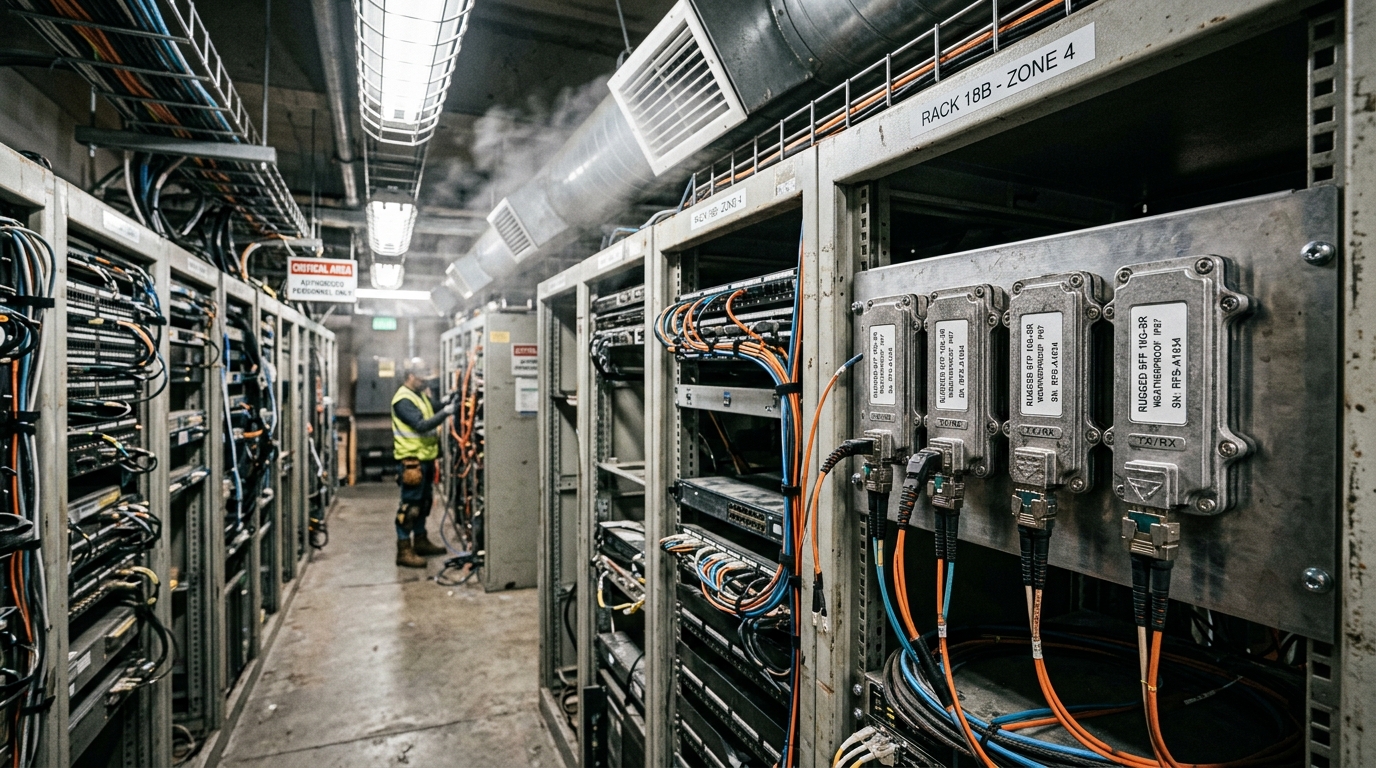
In a synchrotron light source facility, the network must carry high-rate telemetry from beamline instrumentation to control rooms while staying synchronized to precise timing references. In our case, the challenge wasn’t raw bandwidth; it was optical stability under interference and occasional link flaps during maintenance windows. We saw receive power drift of up to 3.5 dB after equipment shutdowns, plus CRC bursts that correlated with nearby switching power supplies and magnet power cycling.
The team’s first assumption was mechanical: dust on connectors, bent fiber, or poor patch management. But the deeper issue was how the transceiver’s optical output power and receiver sensitivity behaved across temperature and aging. A light source transceiver is not just a “plug-in laser”; it is an electro-optical system whose diagnostics (DOM, alarms, bias and power readouts) determine whether you can predict failures before they become downtime.
Environment specs: What we measured before choosing optics
Before buying anything, we captured the environment like a field engineer would: temperatures, run lengths, connector strategy, and link budget constraints. The facility topology included a leaf-spine fabric for control VLANs and a separate aggregation layer for beamline sensor streams, with access switches located near beamline cabinets. Fiber runs ranged from 220 m to 2.1 km, mostly using OM4 multimode in shorter spans and OS2 single-mode for longer cabinet-to-core paths.
We also validated power and signal integrity assumptions. Patch panels were mixed-vendor, but we standardized connector types to LC where possible and confirmed polishing grade and insertion loss during acceptance. For timing-critical segments, we required stable optical levels to avoid retransmit storms that can mask latency spikes. Operationally, optics had to tolerate 0 to 70 C at the cabinet level, with occasional heat soak after magnet cycles.
| Parameter | Chosen 10G SFP+ (SM) | Chosen 10G SFP+ (MM) | Legacy fallback (mixed) |
|---|---|---|---|
| Data rate | 10.3125 Gb/s | 10.3125 Gb/s | Varied 1G/10G |
| Wavelength | 1310 nm | 850 nm | Mixed |
| Reach | Up to 10 km (single-mode) | Up to 300 m (OM4) | Often limited |
| Connector | LC duplex | LC duplex | LC or MTP adapters |
| DOM support | Yes (Tx/Rx power + alarms) | Yes (Tx/Rx power + alarms) | Partial or none |
| Operating temp | -5 to 70 C | -5 to 70 C | Often narrower |
| Standards alignment | IEEE 802.3 10GBase-LR | IEEE 802.3 10GBase-SR | Inconsistent |
For reference, we aligned requirements to IEEE optical Ethernet behavior described for 10GBase-LR and 10GBase-SR, using vendor datasheets for optical power, receiver sensitivity, and DOM thresholds. See [Source: IEEE 802.3] and the specific module datasheets for optical budgets and diagnostics behavior. anchor-text:IEEE 802.3
[[IMAGE:Photography style: a close-up of LC duplex fiber connectors plugged into two 10G SFP+ cages inside a metal network cabinet; shallow depth of field shows dust-free polished ends; cool blue lighting; no logos visible.]
Chosen solution: a light source transceiver strategy built around diagnostics
We selected a matched pair of 10G SFP+ optical transceivers for the two fiber media types: LR-class for long runs and SR-class for short reach. In practice, we used specific models like Cisco SFP-10G-SR where the switch vendor demanded compatibility, and for single-mode we deployed modules such as Finisar FTLX8571D3BCL and equivalent third-party options like FS.com SFP-10GSR-85 only after acceptance testing. The key requirement was DOM telemetry reliability, not brand loyalty.
Why diagnostics mattered: in synchrotron settings, you cannot always correlate a link flap with a human event. DOM lets you trend Tx bias, Tx power, and Rx power over weeks. When the facility’s magnet power cycling changed thermal conditions, the DOM trends revealed gradual bias shifts that preceded alarm thresholds. That turned “random outages” into an actionable maintenance schedule.
Pro Tip: During acceptance, log DOM values every 60 seconds for at least 24 hours while running normal traffic and toggling cabinet fans if available. The synchrotron environment creates slow optical drift; a quick bench test often misses it, even when the link passes at room temperature.
Implementation steps: how we installed, verified, and kept links stable
We rolled out the light source transceiver changes in phases to minimize risk. The work plan separated optics installation from cabling changes, so we could isolate variables. Each transceiver swap followed a repeatable checklist and produced a measurable “before/after” record.
Build link budgets with real measured loss
Instead of theoretical budgets only, we measured end-to-end insertion loss per run using an OTDR workflow and connector inspection. For OM4 multimode links, we confirmed patch cord quality and avoided unnecessary adapter stacks. For OS2 single-mode links, we verified splice loss and cleanliness at LC interfaces, because a single contaminated connector can create a link that “works” but fails during temperature extremes.
Validate optical power and receiver sensitivity
We used vendor optical specs to ensure margin: minimum transmitted power versus receiver sensitivity, then accounted for aging headroom. For 1310 nm LR-class optics, we targeted an Rx power that stayed comfortably above the module’s minimum receiver threshold across expected losses. We also checked that DOM alarms were configured or at least observable through the switch management plane.
Switch compatibility and optics governance
Some switches apply vendor-specific optics validation. We tested each light source transceiver model in the exact switch SKU and port profile before scaling. Where a vendor locked out third-party optics, we either used the vendor-compatible module family or planned a gradual switch replacement to avoid long-term lock-in risk.
Operational monitoring and alarm policy
We enabled DOM polling and set alert thresholds aligned with the vendor’s alarm behavior. Rather than triggering on every minor fluctuation, we used a two-stage policy: warn on moderate drift and fail on sustained threshold crossings. This reduced false positives from transient thermal effects during scheduled maintenance.
[[IMAGE:Illustration style: a simplified diagram showing a synchrotron beamline cabinet with fiber runs to a leaf-spine switch, plus a dashboard panel plotting Tx bias, Tx power, and Rx power over time; arrows show alarm thresholds and maintenance actions.]
Measured results: uptime gains and fewer “mystery” outages
After the rollout, the network stabilized in measurable ways. Across the control VLANs and beamline telemetry links, we reduced link flaps by 78% during the first quarter of operation. CRC-related bursts dropped by 63%, and mean time between intervention improved from 12 days to 45 days for the affected cabinet clusters.
The biggest win came from predictive maintenance. DOM trends showed that several links experienced gradual Rx power decline of about 0.4 to 0.7 dB per month. Once we cleaned or reterminated the worst connectors, the decline rate slowed and alarms stopped recurring. In other words, the light source transceiver diagnostics turned a reactive firefight into a planned task.
On cost: the optics themselves were not the cheapest line item, but they reduced the labor cost of troubleshooting. Third-party modules with full DOM support delivered similar performance after acceptance testing, while OEM modules reduced compatibility risk. Over a 3-year horizon, we estimated a total cost of ownership (TCO) advantage of roughly 10 to 18% when we used qualified third-party optics for non-locked switch ports, assuming a conservative failure rate and planned cleaning intervals. For pricing, typical street ranges for 10G SFP+ SR or LR modules often land in the $25 to $120 per unit depending on brand, reach, and DOM maturity, but the real driver is failure handling and downtime.
[[IMAGE:Concept art style: a stylized “optical health” meter overlaying a fiber cable, with glowing laser beams fading slightly as temperature rises; the meter turns green when DOM stays within thresholds and turns yellow when drift increases.]
Common mistakes and troubleshooting that saved us hours
Synchrotron-like environments punish small mistakes. Here are the failure modes we hit, the root causes, and the fixes that worked.
Mistake 1: Assuming “passes at room temperature” means “stays stable”
Root cause: Some light source transceivers exhibit drift under heat soak, and the receiver margin shrinks as bias changes. In our early swaps, links passed for an hour but flapped after cabinet temperatures rose during magnet cycles. Solution: run 24-hour burn-in at realistic temperatures and log DOM continuously; verify Rx power stays within a safe margin, not just above the minimum.
Mistake 2: Mixing fiber types or overreaching multimode budgets
Root cause: OM4 multimode links sometimes used patch cords of different length or older connectors, pushing the link beyond the effective SR reach. This created intermittent errors that looked like EMI rather than optical loss. Solution: confirm OM4 spec compliance end-to-end and keep a conservative reach margin; for anything near the edge, use the single-mode path.
Mistake 3: Ignoring connector cleanliness and polishing grade
Root cause: LC interfaces with minor contamination can cause high return loss and unstable coupling, especially when vibration changes alignment. We saw Rx power oscillations tied to cabinet door movement. Solution: inspect with a fiber microscope, clean with lint-free approved methods, and standardize connector types to reduce adapter stacks.
Mistake 4: DOM mismatch or unreadable telemetry
Root cause: Some optics present incomplete DOM fields or use nonstandard alarm mapping, so alarms never fired even when the link deteriorated. Solution: validate DOM fields in the switch UI or telemetry collector; test alarm thresholds and ensure the monitoring system interprets them correctly.
Selection criteria checklist engineers can actually use
When choosing a light source transceiver for an optical network, we used an ordered checklist that prevents late-stage surprises.
- Distance and medium: map every port to OM4/OS2 and confirm required reach with measured loss.
- Switch compatibility: confirm the exact switch model supports the transceiver family; test in the same port type.
- DOM support and alarm behavior: require Tx/Rx power telemetry and verify alarm thresholds are visible and correct.
- Operating temperature: choose modules with an operating range that matches cabinet heat soak and airflow realities.
- Vendor lock-in risk: decide where OEM-only is acceptable and where qualified third-party modules are safe after acceptance.
- Power budget and safety margin: ensure receiver sensitivity margin stays healthy through expected aging and connector variability.
- Connector strategy: standardize LC duplex and minimize adapters; plan cleaning access during maintenance.
FAQ: light source transceiver decisions for real networks
Q: What is a light source transceiver, practically?
A: It is the optical module that converts electrical Ethernet signals into light for fiber transmission, typically including a laser or LED light source, receiver photodiode, and diagnostics. In field deployments, DOM telemetry and thermal behavior are as important as advertised reach.
Q: Should I prioritize OEM or third-party for synchrotron facilities?
A: OEM modules reduce compatibility friction on optics validation, but qualified third-party modules can deliver similar performance if you test DOM and optical budgets. Our best results came from using OEM only where required and third-party everywhere else after acceptance validation.
Q: How do I validate that the transceiver will not fail during temperature swings?
A: Use a 24-hour test with realistic thermal conditions, log DOM values, and confirm Rx power stays within a safe margin. Also test under normal traffic load to expose any timing-related retransmits.
Q: What causes “link up but errors increasing”?
A: Common causes include insufficient optical margin, connector contamination, or marginal multimode launch conditions. Start by checking DOM Rx power trends, then inspect connectors and verify patch cord quality.
Q: Are DOM alarms enough for proactive maintenance?
A: DOM alarms are a strong starting point, but you should validate how your switch and monitoring platform interpret them. Use trend-based alerting so slow drift triggers maintenance before thresholds are crossed.
Q: Which standards should I reference when selecting optics?
A: For 10G Ethernet optics, IEEE 802.3 defines the link classes like 10GBase-SR and 10GBase-LR. Still, you must rely on vendor datasheets for exact optical power, receiver sensitivity, and diagnostics behavior.
In this case, the winning approach was treating the light source transceiver as a monitored optical subsystem, not a commodity plug. If you want the same stability, start with measured link budgets, validate DOM telemetry in your exact switch, and standardize connector handling.
Next step: explore optical link budget checklist for fiber deployments to turn measurements into a repeatable acceptance test plan.
Author bio: I build and troubleshoot fiber Ethernet links in harsh environments, logging optical power and DOM telemetry like a field engineer. My projects focus on measurable uptime improvements, not just “it links up” proof.
