If you manage a data center, you have likely watched a “minor” optics failure cascade into stalled uplinks and delayed deployments. This article helps operations, procurement, and field engineers compare spare fiber module options for bulk optical transceiver procurement and spares planning. You will get selection checklists, troubleshooting patterns, and a decision matrix to reduce downtime risk without overspending.
SR vs LR spare fiber module: performance that changes your spares math
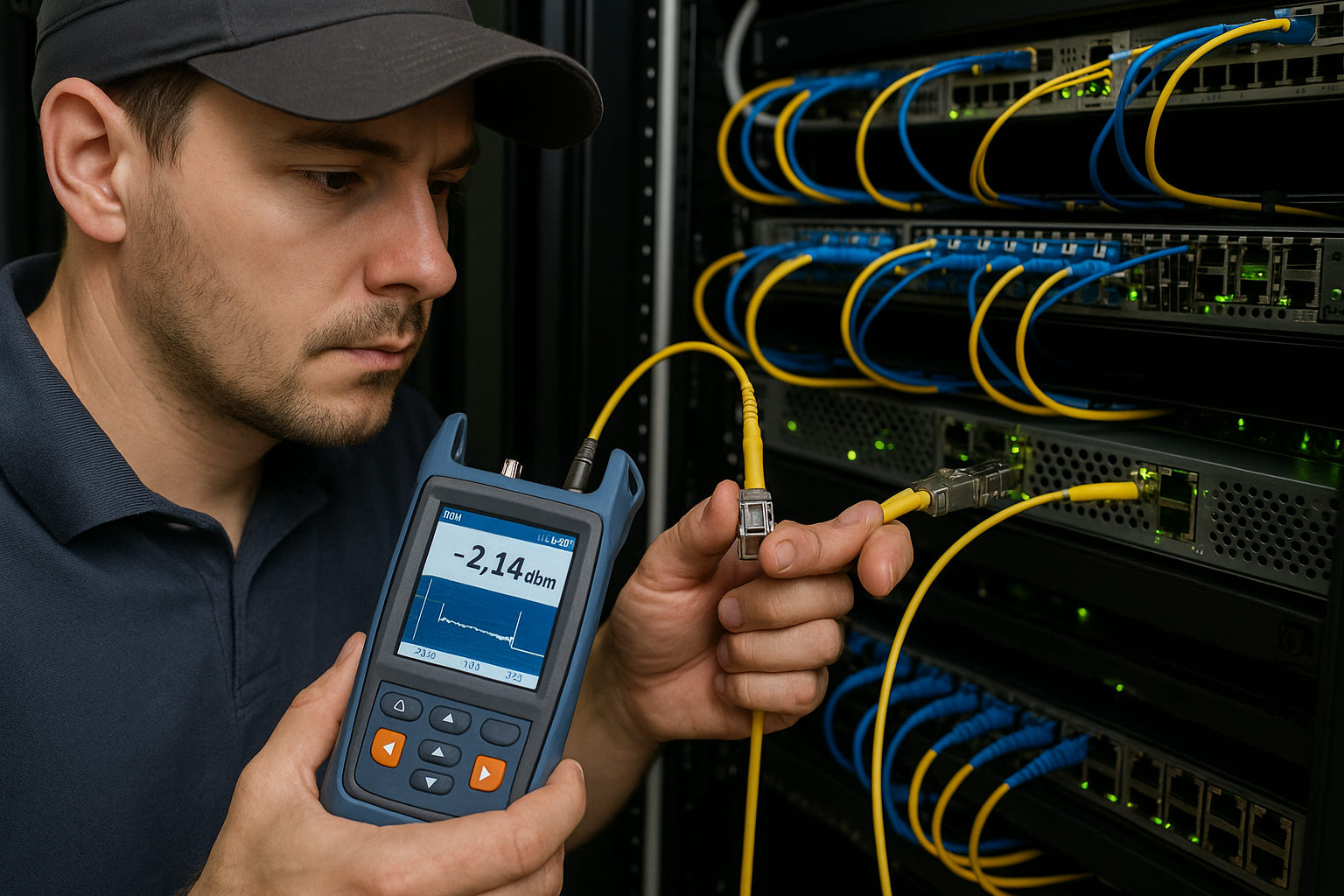
The first head-to-head decision is usually reach. “SR” modules are designed for short reach over multimode fiber (MMF), while “LR” modules target longer distances over single-mode fiber (SMF). In practice, your spares strategy should match the most common link distances in your cable plant, not only the maximum distance in a spreadsheet.
Under IEEE 802.3, 10G Ethernet optics are standardized by reach and fiber type; most “10G-SR” modules follow the 10GBASE-SR optical interface family. Vendor implementations differ in laser type, receiver sensitivity, and diagnostics behavior, which affects field reliability and how quickly you can isolate faults. If your spares are mismatched (for example, SR spares sitting unused while LR spares are the ones failing), your readiness score drops even if the total inventory is large.
Key performance specs engineers compare in the field
When I plan spares, I check wavelength, expected reach, and link budget assumptions. For 10G-SR, typical wavelength is around 850 nm over MMF, while 10G-LR typically uses 1310 nm over SMF. I also verify whether the module is rated for DDM/DOM diagnostics (Digital Optical Monitoring / Diagnostic Monitoring) so that alarms show up in your switch telemetry.
| Spec | 10G SR (Example: Cisco SFP-10G-SR / FS.com SFP-10GSR-85) | 10G LR (Example: Finisar FTLX8571D3BCL / common 10G-LR SFP+) |
|---|---|---|
| Target interface | 10GBASE-SR family | 10GBASE-LR family |
| Wavelength | 850 nm | 1310 nm |
| Fiber type | Multimode (MMF), commonly OM3/OM4 | Single-mode (SMF) |
| Typical reach | 300 m on OM3, 400 m+ on OM4 (varies by vendor) | 10 km (typical LR spec; check datasheet) |
| Connector | LC duplex | LC duplex |
| Data rate / form factor | 10G, SFP+ | 10G, SFP+ |
| Power (typ.) | Often ~1 W to 2 W class depending on vendor | Often ~1 W to 2 W class depending on vendor |
| Operating temp | Commonly 0 to 70 C for commercial; verify for your plant | Commonly -5 to 70 C or 0 to 70 C; verify |
| Diagnostics | DOM/DDM supported on most current models | DOM/DDM supported on most current models |
Reality check: the “reach” number is not a free pass. Your link budget must account for fiber attenuation, patch cord losses, and connector contamination. If you are stocking spares, you want modules that behave predictably with your actual plant (including the last 20 meters of patch cords that most budgets ignore).
For standards context, see IEEE 802.3 for 10GBASE-SR and 10GBASE-LR families. [Source: IEEE 802.3]. For module behavior and diagnostics expectations, also consult vendor datasheets for the exact part numbers you buy. [Source: Cisco SFP-10G-SR datasheet], [Source: Finisar transceiver datasheets].
Pro Tip: In field swaps, I have seen “works in the bench, fails in production” cases caused by patch cord mismatch and dirt, not the module itself. If your spares are SR but your cabinet patch cords drift from OM3 to OM2 over time, the SR link margin collapses and looks like an optics failure—always pair spares planning with a fiber plant audit.
Compatibility and DOM: how to avoid “it clicks in but won’t link”
Compatibility is where spare fiber module programs succeed or quietly fail. Modern switches may require specific transceiver identification fields, and some vendors enforce optics compliance lists. Even if the physical connector is identical, the digital interface (serial ID and diagnostics registers) can differ enough to prevent a link from coming up or to disable DOM telemetry.
What I check before approving a spare fiber module SKU
- Form factor and electrical interface: SFP vs SFP+ vs QSFP; verify host port expects the same electrical standard.
- Vendor compatibility mode: check whether your switch supports third-party optics and whether it logs “unsupported transceiver” events.
- DOM behavior: confirm DDM/DOM is enabled and that your monitoring stack reads thresholds (Tx power, Rx power, temperature, bias current).
- Wavelength and fiber type: SR must match MMF characteristics; LR must match SMF.
- Laser safety class and compliance: confirm it meets your site policy and regulatory requirements.
Switch telemetry is your operational safety net. If DOM is present, you can correlate “link flaps” with rising temperature or falling Tx power. If DOM is missing or partially implemented, you lose that early warning and your spare fiber module becomes a blind swap rather than a diagnostic tool.
Compatibility references: IEEE 802.3 governs electrical/optical behavior at the interface level, while vendor datasheets define transceiver identification and monitoring. [Source: IEEE 802.3]. [Source: Cisco transceiver compatibility documentation].
Cost and ROI: bulk pricing strategies for spares without hidden risk
Procurement teams often ask for “volume pricing” assumptions, but the ROI depends on downtime cost and failure probability. In my experience, the cheapest spare is not the lowest total cost once you include labor time for swaps, incident response, and the risk of repeated failures caused by plant mismatch.
Typical pricing ranges vary by reach, speed, and brand. As a practical planning window for 10G SFP+ optics, OEM-branded modules often cost more than third-party equivalents, while third-party can be substantially cheaper but may carry higher variability in compliance and DOM consistency. For example, a third-party 10G-SR SFP+ from a reputable channel may run in the $40 to $120 range depending on vendor and temperature grade, while OEM-branded parts can be higher. Always confirm with your vendor quotes and your switch’s optics policy.
TCO components engineers should include
- Module unit cost: OEM vs third-party vs refurbished.
- Spare quantity: driven by annualized failure rate and mean time to repair.
- Labor and logistics: truck rolls, receiving delays, and staging time.
- Power and cooling impact: usually small per module, but can matter at scale.
- Compliance and warranty: warranty terms affect replacement cycles.
For ROI, treat spares like insurance with a measurable premium. If your incident response costs $2,000 per hour of downtime and you can cut “time to restore” from 4 hours to 30 minutes using the right spare fiber module, the ROI is immediate—even if the spare is not the absolute cheapest.
Also consider vendor lock-in risk. OEM optics may be more predictable, but if your platform is nearing end-of-life, third-party flexibility can prevent stranded inventory. Conversely, if your switch is strict about transceiver IDs, third-party risk can outweigh savings. The right answer depends on your host platform policy and how aggressively you standardize SKUs across racks.
Use-case comparison: where SR spares win and where LR spares prevent outages
A spare fiber module program should mirror your actual topology and cable layout. If your data center leaf-spine fabric uses short patch runs between ToR and aggregation, SR spares often cover the majority of failures. If you have cross-zone uplinks, long horizontal runs, or campus-style SMF, LR spares reduce your probability of being stuck with “the wrong wavelength and fiber type” during an incident.
Concrete deployment scenario with measurable numbers
In a 3-tier data center leaf-spine topology, imagine 48-port 10G ToR switches feeding dual aggregation switches, with 96 active 10G uplinks per row. Each uplink uses 120 m total MMF patch-and-horizontal cabling in a typical row, plus 2 patch cords per link. Over a year, the team logs an average of 2 transceiver-related incidents and 6 fiber-plant related retrains tied to cleaning and connector wear. In this environment, stocking 10G SR spares sized to cover the most common replacement events yields faster restoration. LR spares may be stored for inter-row SMF trunks, but they are not the primary “first swap” inventory.
When LR spares become the better bet
If your plant includes SMF trunks at 3 km to 8 km for regional aggregation or disaster recovery links, LR spares become your incident “first responder.” During an outage, you cannot substitute an SR module on SMF and expect a link to come up. LR spares also help when your operations team performs staged migrations and temporarily re-patches routes, because the reach requirement remains SMF-centric.
Selection criteria checklist: ordered factors that decide your spare fiber module mix
Engineers rarely choose optics by wavelength alone. The most reliable spare fiber module mix comes from a disciplined checklist that aligns with your switch policy, your fiber plant, and your operational constraints.
- Distance distribution: measure actual link lengths (including patch cords) and categorize by MMF vs SMF.
- Speed and form factor: confirm the exact transceiver type required by the switch (SFP vs SFP+).
- Switch compatibility policy: verify whether your platform allows third-party optics and whether it uses strict transceiver compliance.
- DOM support and monitoring: require DDM/DOM where your NOC alarms depend on Tx/Rx power and threshold flags.
- Operating temperature grade: match your environment; verify commercial vs extended temperature ratings.
- Vendor lock-in risk: evaluate what happens if your OEM lead times spike or your model is discontinued.
- Spare staging and labeling: maintain consistent part-number labeling and fiber-type tags so field swaps are fast and correct.
As you refine your strategy, update it at least quarterly. Cable plants age, patch cord inventory changes, and switch firmware revisions can tighten compatibility behavior.
Decision matrix: SR vs LR vs third-party optics for bulk spares
Use this matrix to decide how many spares to allocate to each option. It is intentionally operational, not theoretical.
| Option | Best fit | Procurement cost trend | Compatibility risk | DOM/telemetry | Typical operational strength |
|---|---|---|---|---|---|
| 10G SR spare fiber module (MMF) | Short in-rack and same-zone patching on OM3/OM4 | Moderate | Low to medium (depends on switch policy) | Usually strong | Fast recovery when failures match MMF reach |
| 10G LR spare fiber module (SMF) | Long trunks, inter-zone links, DR paths on SMF | Moderate to higher | Low to medium | Usually strong | Prevents “no-link” events on long SMF runs |
| Third-party SR/LR (with approved compatibility) | Sites with flexible optics policy and consistent part validation | Lower upfront | Medium if not tested | Variable; verify with DOM tests | Better bulk budget control when validated |
| OEM SR/LR | Strict optics compliance environments, high reliability requirements | Higher upfront | Lowest | Strong and consistent | Predictable restoration with fewer surprises |
Common mistakes and troubleshooting: what actually breaks in production
Below are failure modes I have seen during real spare swaps and audits. Each includes the root cause and a practical fix.
Wrong fiber type substitution (SR on SMF or LR on MMF)
Root cause: The module is mechanically compatible but optically mismatched to the fiber plant. The link may not establish, or it may flap due to severe margin loss.
Solution: Label fiber runs by MMF/SMF and record the intended optics type per link in your inventory system. During incident response, verify cable type before inserting the spare fiber module.
DOM mismatch leading to “silent” failures
Root cause: Some third-party modules may report incomplete or differently scaled diagnostics. Your monitoring may not alarm, so the issue is detected only when traffic drops.
Solution: In pre-deployment testing, validate DOM fields (Tx power, Rx power, temperature, laser bias) against a known-good OEM baseline. Confirm your NOC thresholds and dashboards parse the registers correctly.
Dirty connectors and patch cord contamination masquerading as a bad module
Root cause: Receiver sensitivity can be overwhelmed by connector contamination, especially on short-reach links where margin is tighter than teams expect.
Solution: Use a fiber inspection scope, follow a consistent cleaning workflow, and clean both ends of the patch cords. If you swap a spare fiber module and the link still fails, inspect connectors before assuming the module is defective.
Temperature and power drift after swap in hot aisles
Root cause: Commercial-grade optics can drift outside spec in high-heat zones, leading to higher error rates or intermittent link loss.
Solution: Store and deploy the correct temperature grade for your site. Track incident patterns by aisle or cabinet airflow patterns, not just by part number.
Which option should you choose?
If you manage mostly short in-rack links on OM3/OM4 and you need the fastest restoration with predictable behavior, choose 10G SR spare fiber module as the primary inventory, and keep a smaller LR reserve for SMF trunks. If your network includes long SMF trunks, prioritize 10G LR spares for those routes to eliminate “wrong optics” outage delays. If your platform allows third-party optics and you can validate DOM and compatibility in a staging rack, third-party can reduce bulk procurement spend while keeping service levels—just don’t skip acceptance testing.
For sites with strict optics compliance, high uptime requirements, or limited time for validation, OEM SR/LR spares are the safest operational choice even if unit cost is higher.
FAQ
How many spare fiber module units should we stock per switch?
A practical starting point is based on annualized failures and mean time to repair. Many teams begin with 2 to 4 spares per optics type per switch model, then adjust after you review incident logs for 1 to 2 quarters. If your environment is high churn (frequent patching or migrations), increase spares for the most common link distances.
Can we use third-party spare fiber modules in a strict vendor environment?
Sometimes, but you must test in a staging rack with your exact switch model and firmware. Validate that the switch accepts the module ID and that DOM telemetry is present and accurate. If the switch blocks or disables optics, third-party spares will not help during an outage.
Do spare fiber modules need DOM support?
DOM is strongly recommended when your monitoring relies on Tx/Rx power and threshold alarms. Without DOM, you lose early warning and you may only detect a failing module after errors appear. In field operations, DOM often shortens troubleshooting from hours to minutes.
What is the biggest indicator that our spares are the wrong type?
If incident replacements repeatedly use the “other” optics type than the one you stocked, your spare mix is wrong. Another indicator is frequent cleaning and connector-related issues that correlate with a specific reach category, suggesting your link margin assumptions do not match the plant.
How do we prevent connector dirt from consuming our spare budget?
Implement a fiber inspection and cleaning routine for every swap and for planned patch changes. Keep cleaning tools and inspection scopes at the point of use, not only in a central kit. Track connector cleanliness as a failure contributor, not an afterthought.
Are wavelength and reach labels enough for procurement?
No. Always confirm fiber type (MMF vs SMF), reach assumptions, connector type (typically LC duplex), and temperature grade. Also match your switch’s required transceiver family and validate DOM behavior before scaling bulk procurement.
If you want to refine procurement and spares planning further, review spare transceiver inventory planning for a practical approach to forecasting and staging. With the right SR vs LR mix, validated compatibility, and disciplined troubleshooting, your spare fiber module program can reduce downtime while keeping total cost under control.
Author bio: I design optics and spares workflows for real data center operations, focusing on compatibility, telemetry, and field-safe inventory labeling. I have supported deployments using SFP+ and QSFP optics across production leaf-spine fabrics and migration cutovers.