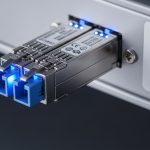
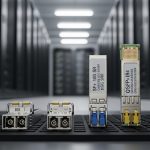
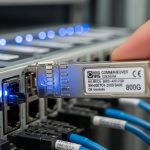
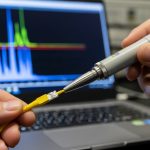
Switch ports fail for many reasons, but pluggable optics are a frequent root cause. This guide helps network leads and field engineers estimate SFP total cost when choosing OEM modules versus third-party equivalents, using operational data points like DOM behavior, DOM polling latency, and typical RMA timelines. You will get a decision checklist, a specs comparison table, and troubleshooting patterns that reduce downtime.
Why “SFP total cost” is more than purchase price
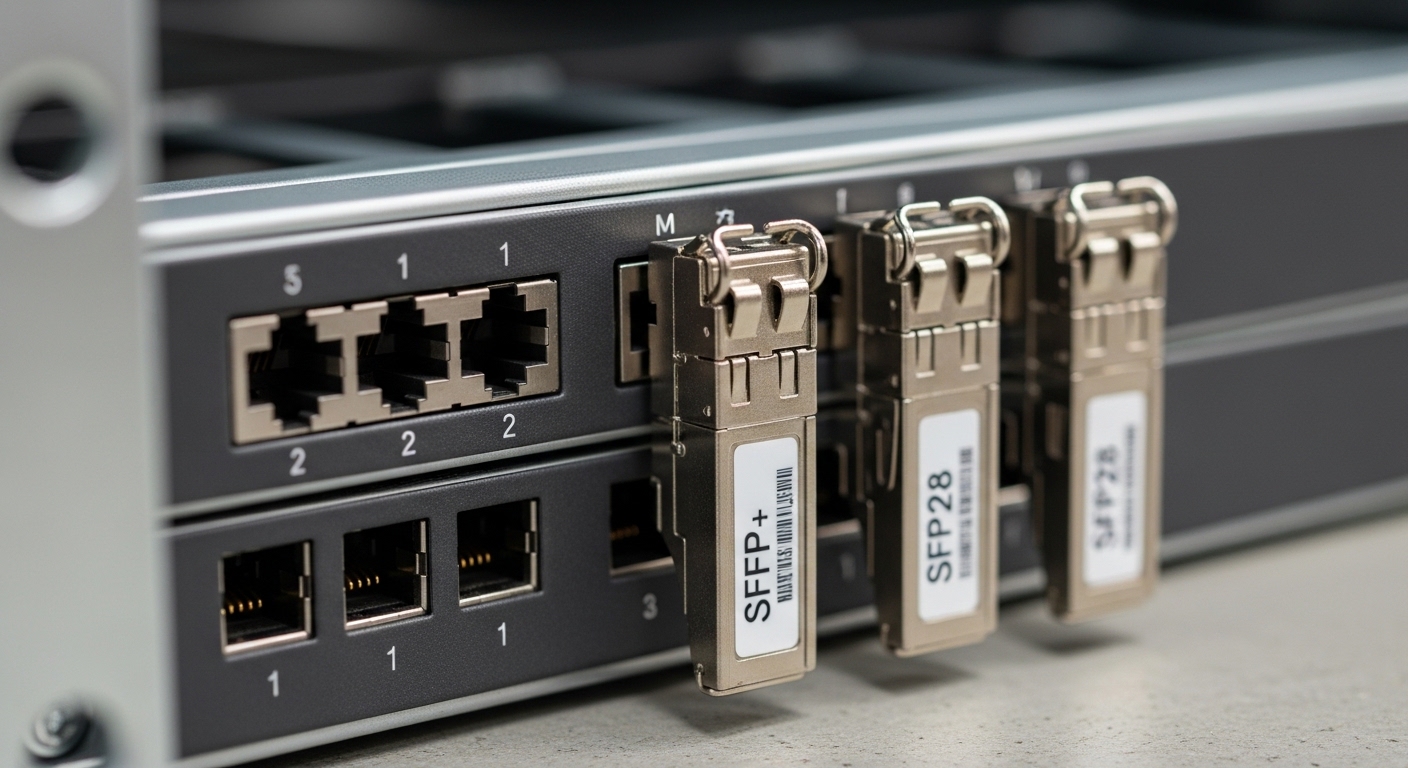
On paper, third-party SFPs often undercut OEM pricing by 20% to 45%. In practice, SFP total cost includes installation labor, optics validation time, power draw, failure probability, and the cost of delayed replacements during supply constraints. For high-density leaf-spine designs, even a small increase in failure rate can translate into more truck rolls and longer mean time to repair. The goal is to model the full operational impact over a typical 3 to 5 year lifecycle.
Cost components engineers actually track
When I quantify costs for optical transceivers, I break them into line items that can be audited during procurement and incident reviews. The categories below are common in data center and campus environments and map well to OEM vs third-party decisions.
- Module unit cost: list price, contract price, and expected discount at volume.
- Validation cost: time spent confirming reach, link stability, and vendor compatibility.
- Downtime cost: outage hours multiplied by business impact; often underestimated.
- Inventory carrying cost: capital tied up in spares and shelf-life risk.
- RMA and logistics: shipping time, replacement turnaround, and cross-compatibility of return policies.
- Power and cooling: small per-port deltas matter at scale (thousands of ports).
Pro Tip: In many switches, the DOM interface is not just “readable telemetry.” Some third-party optics exhibit slower or non-standard alarm thresholds, which can trigger port flaps under temperature swings. Always validate DOM alarm behavior and link stability across your highest-heat and lowest-heat operating points, not just at room temperature.
OEM vs third-party: where the trade-offs show up
OEM optics are typically tuned and validated for a specific switch platform, which reduces surprises in link negotiation and diagnostics. Third-party optics can be cost-effective and widely available, but compatibility depends on the switch vendor’s transceiver policy, the optics vendor’s firmware/EEPROM implementation, and the optical budget for your fiber plant. The most important operational difference is how quickly you can restore service when something goes wrong.
Operational differences you can measure
During field deployments, the gaps between OEM and third-party typically show up in four measurable areas: port bring-up success rate, alarm behavior, RMA lead time, and physical handling reliability. If you are running 10G or 25G links with many spares, the RMA lead time can dominate total cost even when the unit price looks favorable.
- Bring-up success rate: percentage of modules that pass link-up and remain stable for 24 to 72 hours.
- DOM consistency: whether temperature and bias current thresholds align with expected ranges.
- RMA lead time: days from DOA to replacement; OEM contracts may offer faster logistics.
- Return friction: restocking fees, serial matching, and whether the supplier insists on original packaging.
Specs comparison: common 10G SFP+ class example
The table below illustrates how two optics can look similar on paper yet differ in reach, wavelength, and electrical characteristics that influence link margin and stability. Use this as a template; always confirm the exact part number and switch compatibility.
| Parameter | Typical OEM 10G SR SFP+ | Typical Third-Party 10G SR SFP+ |
|---|---|---|
| Data rate | 10.3125 Gbps | 10.3125 Gbps |
| Wavelength | 850 nm | 850 nm |
| Reach (OM3/OM4) | 300 m (OM3), 400-550 m (OM4) | 300 m (OM3), 400-550 m (OM4) |
| Connector | LC duplex | LC duplex |
| DOM support | Yes (per SFF-8472) | Yes (may vary by implementation) |
| Power (typical) | ~0.8 to 1.2 W | ~0.7 to 1.1 W |
| Operating temperature | 0 to 70 C | -5 to 70 C or 0 to 70 C |
| DOM polling behavior | Consistent thresholds | May require validation |
| Examples | Cisco SFP-10G-SR | Finisar FTLX8571D3BCL or FS.com SFP-10GSR-85 |
Sources worth checking include vendor datasheets and standards references such as SFF-8472 for optical transceiver monitoring and IEEE 802.3 for 10GBASE-SR behavior. [Source: IEEE 802.3-2022], [Source: Cisco SFP-10G-SR datasheet], [Source: Finisar/Viavi transceiver datasheet], [Source: FS.com transceiver product pages]. For total cost modeling, treat “spec match” as necessary but not sufficient.
IEEE 802.3 standard reference
Cisco transceiver documentation portal
Selection criteria: a checklist to minimize SFP total cost risk
Use this ordered checklist during vendor qualification. It is designed to reduce the two biggest drivers of hidden SFP total cost: avoidable incompatibility and premature failures due to margin issues.
- Distance and fiber type: confirm OM3 vs OM4, measured link attenuation, and whether you have margin for aging.
- Switch compatibility and transceiver policy: verify the exact switch model and software release; some platforms enforce vendor allowlists.
- Optical budget alignment: compare transmitter power and receiver sensitivity from datasheets; verify worst-case link margin.
- DOM support quality: validate alarm thresholds, presence detection, and any platform-specific diagnostics behavior.
- Operating temperature and airflow: match the transceiver temperature rating to your cabinet thermal profile.
- Vendor lock-in risk: quantify the cost of staying OEM-only versus the cost of qualifying third-party spares.
- RMA and warranty terms: measure replacement turnaround time and whether warranties cover intermittent faults.
- Supply lead time: add buffers for procurement cycles and shipping delays; model peak demand scenarios.
Real-world deployment scenario with numbers
In a 3-tier data center leaf-spine topology with 48-port 10G ToR switches connecting to a spine using 10G SR SFP+, the team planned a refresh of 1,200 transceiver ports. The original OEM BOM price averaged $65 per module, while qualified third-party equivalents were $38 to $45. After qualification testing, they observed a bring-up pass rate of 99.2% for third-party versus 99.8% for OEM, and an average DOA/RMA turnaround of 8 to 14 days for third-party versus 5 to 7 days for OEM. Over a projected 4-year lifecycle, third-party still reduced unit spend by ~30%, but the team reserved 10% spares and standardized DOM validation to prevent port flaps during seasonal thermal peaks.
Cost and ROI modeling: a practical way to compare vendors
To compare OEM vs third-party, model costs per port per year and include probability-weighted downtime. For many enterprises, SFP total cost becomes sensitive to failure rates and RMA lead times more than to the initial price difference.
Typical price ranges and what they imply
Actual market prices fluctuate by region and contract terms, but engineers often see ranges like these for common categories:
- 10G SR SFP+: OEM often $60 to $120; third-party often $25 to $70.
- 25G SR SFP28: OEM often $80 to $200; third-party often $45 to $140.
- Long-reach variants: can be higher due to optics complexity and certification.
For TCO, include the cost of power and cooling deltas. A small per-module power difference (for example, 0.2 to 0.4 W) across thousands of ports can become a measurable annual cost, particularly when multiplied by PUE and local energy tariffs. Also consider that intermittent faults and port flaps can create operational overhead for NOC teams.
Decision rule that works in the field
If third-party meets bring-up pass rate and DOM stability targets in your environment, it usually wins on unit cost. If your environment is sensitive to diagnostics, or you cannot tolerate longer RMA cycles, OEM may win despite higher purchase price. The best approach is often a hybrid: qualify third-party for standard links and keep OEM for critical services with tighter recovery objectives.
Common mistakes and troubleshooting patterns
Even when modules are “spec compatible,” the failure modes differ. Below are concrete pitfalls I have seen during acceptance testing and incident response, including root cause and the fix.
Link up at first, then flaps under load
Root cause: insufficient optical margin due to fiber attenuation, patch panel loss, or connector contamination; third-party modules may run closer to the threshold. Solution: clean connectors, verify insertion loss with an OTDR or certified loss test, and compare measured link margin against datasheet worst-case budgets.
DOM alarms trigger port resets or NOC alerts
Root cause: DOM implementation differences or threshold behavior that does not align with the switch’s expectations; temperature/bias reporting may be slightly out of range. Solution: validate DOM polling and alarm thresholds after installation; if needed, adjust NOC thresholds and confirm the switch software release supports the module class.
“Works in one switch, fails in another”
Root cause: platform-specific transceiver qualification, allowlists, or differences in receiver sensitivity calibration. Solution: qualify per switch model and software version; do not assume that a module validated on one platform will behave identically across another.
Intermittent “No SFP” presence detection
Root cause: mechanical tolerance mismatch, dust on the cage contacts, or a marginal latch; some modules have slightly different insertion force and contact plating. Solution: reseat with consistent insertion technique, inspect cage and module contacts, and implement a cleaning SOP for high-turnover environments.
Temperature out of range after a cabinet airflow change
Root cause: cabinet fan replacement or airflow rebalancing increases local hot spots; third-party modules may only be rated for narrower conditions. Solution: confirm transceiver temperature rating and validate cabinet thermal mapping; add airflow baffles and monitor DOM temperature over a full load cycle.
FAQ
How do I estimate SFP total cost for a planned migration?
Start with unit price and add validation labor, spares inventory cost, and a downtime estimate. Then incorporate RMA lead time and expected failure rate from your acceptance tests. If you cannot measure failure rate, use a conservative assumption and size spares to cover the expected recovery time.
What DOM support gaps should I look for with third-party optics?
Validate presence detection, temperature and bias telemetry stability, and alarm threshold behavior under thermal stress. Also confirm that your switch software reads DOM data without generating port-state inconsistencies. If your NOC depends on DOM alerts, test those alerts in staging.
Is it safe to mix OEM and third-party SFPs in the same chassis?
Often it is safe, but you must qualify on the exact switch model and software release. Mixed vendors can still be acceptable if both optics meet optical budget and DOM expectations. The safest practice is to standardize within a given link group and document tested combinations.
Do third-party optics save money when downtime risk is included?
They can, especially when you have adequate spares and a fast replacement workflow. However, if your operations center cannot tolerate longer RMA cycles or if your environment is highly sensitive to port stability, OEM may be lower risk. Model downtime as probability-weighted outage hours rather than assuming “no impact.”
Which standards or references should procurement and engineering align on?
Align on IEEE 802.3 for the link standard and on SFF-8472 for optical transceiver monitoring and related interfaces. Then require vendor datasheets for transmitter power, receiver sensitivity, and connector loss assumptions. In practice, the datasheet plus your measured fiber loss determines whether you have margin.
What is the best next step if we want to reduce SFP total cost?
Run a controlled qualification: test both OEM and third-party optics on your exact switch models, with your actual fiber plant and worst-case temperatures. Measure bring-up success, DOM stability, and link error behavior over at least 72 hours. Then roll out third-party in batches with defined RMA and escalation paths.
If you want to reduce SFP total cost without increasing operational risk, treat optics as a lifecycle system: qualify, measure, and standardize. Next, review your transceiver validation workflow using transceiver qualification checklist for high-availability networks.
Author bio: I design high-availability data center connectivity and have led optical qualification programs across multi-vendor switches and fiber plants. I focus on measurable reliability outcomes, including DOM behavior, RMA lead times, and link margin validation in production.