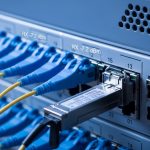
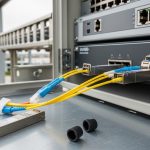
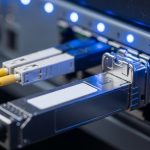
In production networks, a single failing transceiver can trigger link flaps, raise BER, and quietly consume operator time. This article shows how SFP health monitoring using DOM (Digital Optical Monitoring) logging and alerting can be automated for fast detection and triage. It helps network engineers, field technicians, and automation teams who need measurable signals, not vague “green light” indicators. You will also get selection criteria, pitfalls, and deployment-ready checks aligned with common switch and transceiver behaviors.
DOM data for SFP health monitoring: what you can measure
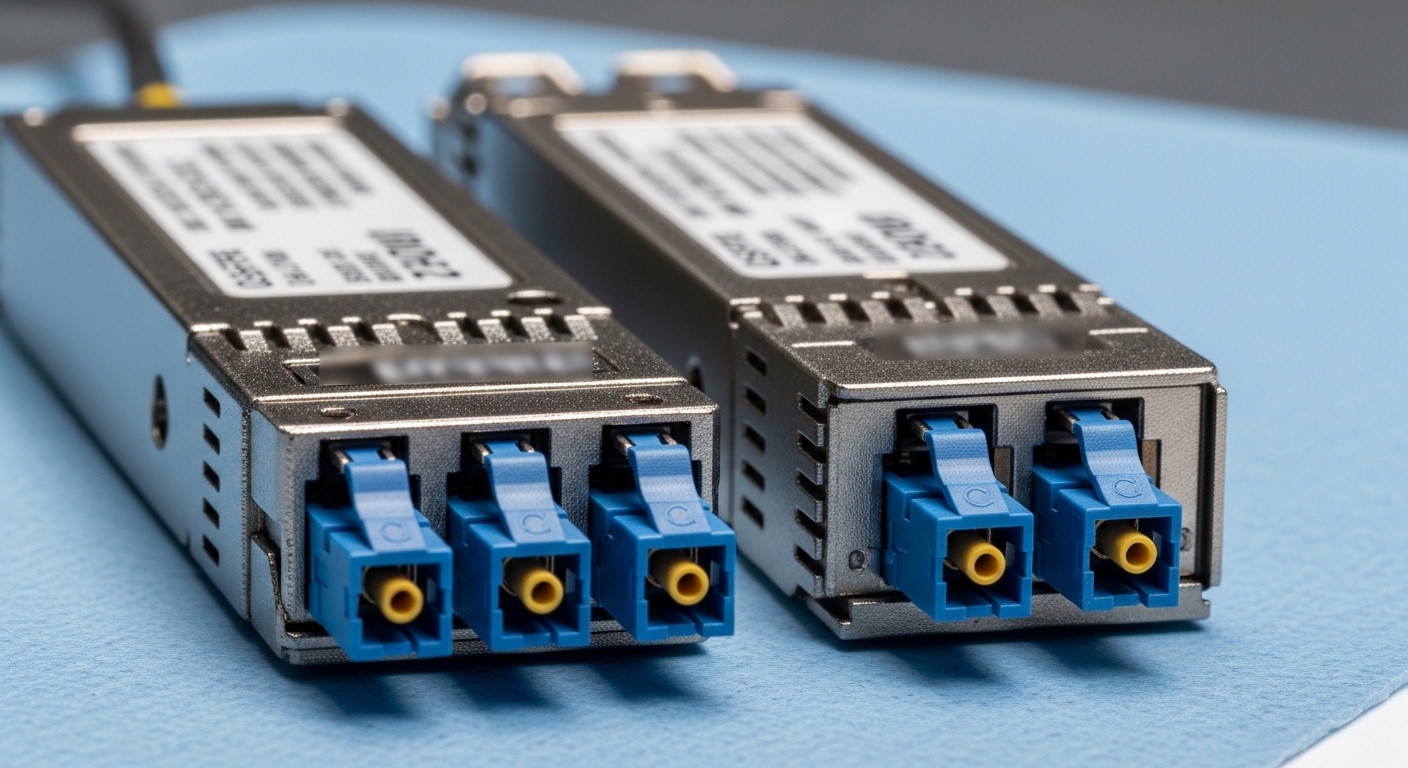
DOM provides standardized telemetry from many SFP/SFP+ optics: temperature, laser bias current, transmit optical power, receive optical power, and often supply voltage. The exact registers and scaling depend on the transceiver vendor and whether the module follows SFF-8472/SFF-8431 semantics. In practice, you should treat DOM as a time series with calibration drift, sensor noise, and vendor-specific thresholds.
From an operations standpoint, the two most actionable signals are usually Tx power and Rx power. When Rx power trends downward while Tx power remains stable, you may be facing fiber contamination, connector aging, or increased loss. When both drift, the module’s optical engine may be degrading. Temperature and bias current can help you distinguish “environmental stress” from “optical component wear,” especially in cabinets with restricted airflow.
Core DOM fields you should log
Even if your switch exposes DOM via SNMP or a vendor API, your alerting logic should be built around consistent derived metrics. Common fields include:
- Module temperature (typically in degrees Celsius)
- Laser bias current (mA)
- Tx optical power (dBm)
- Rx optical power (dBm)
- Supply voltage (V)
For alert thresholds, avoid hardcoding “one size fits all.” Instead, combine vendor datasheet limits with your own baseline computed during healthy operation. This reduces false positives after routine events like patch panel re-termination or fan-speed changes.
Where DOM telemetry is consumed in automation
Typical ingestion paths include:
- Switch telemetry collection (SNMP, streaming telemetry, or vendor SDK)
- Host-side monitoring when optics are connected to NICs (less common for SFP DOM, more common for QSFP platforms)
- Direct I2C reads from the transceiver cage on certain platforms (requires platform access and careful permissions)
Because the monitoring source affects latency and sampling frequency, design your alerting window accordingly. If you sample every 60 seconds, a short transient event might be missed; if you sample every 5 seconds, you must de-bounce alerts to prevent alert storms.
Automation architecture for DOM logging and alerting
The simplest reliable design is a pipeline that (1) collects DOM values, (2) normalizes units and scaling, (3) stores time series, and (4) triggers alerts with hysteresis and context. The goal is operational usability: when an alert fires, it should include the module identity, the port, the last known healthy baseline, and the “direction” of change (for example, Rx power dropping).
In field deployments, I have seen teams succeed by treating this as an SRE-style control loop. You can implement it with Python to periodically pull telemetry, write to a database (time series or relational), and evaluate rule sets. The “rule sets” should be versioned and tested against historical data so changes do not create new noise.
Reference data model for SFP health monitoring
Define a schema that captures:
- device_id, slot, port
- transceiver_vendor, part_number, serial_number
- timestamp and raw DOM values (temperature, Tx, Rx, bias, voltage)
- derived fields such as delta_from_baseline and rolling_trend
DOM fields are often available as bytes that require correct scaling. If you store raw values and also store normalized values, you can re-derive later if you discover a scaling correction for a specific module family.
Alerting logic that avoids nuisance pages
Use multi-condition rules. For example:
- Trigger if Rx power < threshold AND the condition persists for 3 out of 5 samples.
- Trigger if Tx power > upper bound while bias current rises, suggesting laser overdrive.
- Escalate severity if temperature exceeds a limit and correlates with power drift.
Add hysteresis so you only clear alerts after values return above a “recovery threshold” for a sustained period. This is especially important during planned maintenance when links may be re-negotiated and DOM readings can briefly shift.
Pro Tip: In live networks, the most useful early warning is often the trend of Rx power over 24 to 72 hours rather than an immediate absolute threshold. Teams that alert on “sustained downward slope” catch fiber contamination and patch panel issues sooner, before the link hits a BER-driven failure state.
Key SFP DOM and optics specs you must align
Before you automate alerts, confirm that your optics and switch support compatible DOM monitoring. Many SFP modules provide DOM, but the register map, temperature ranges, and alarm/warning behaviors differ. Also ensure the optical parameters match your link type (SR, LR, ER, or copper), because DOM signals mean different things for different media.
The table below compares common optics assumptions for SFP health monitoring. Use it as a baseline for what you should store and what limits you should respect. For exact DOM alarm thresholds, consult the module datasheet and the switch documentation for the transceiver DOM interpretation.
| Parameter | Typical SFP-SR (850 nm) | Typical SFP-LR (1310 nm) | Notes for SFP health monitoring |
|---|---|---|---|
| Wavelength | 850 nm | 1310 nm | DOM power readings are in dBm, independent of wavelength, but acceptable ranges depend on optics class |
| Reach (example) | 300 m over OM3 MMF | 10 km over SMF | Distance affects expected Rx power baseline; set thresholds using measured link loss |
| Data rate | 1G or 10G (varies by module) | 1G or 10G (varies by module) | Ensure switch port mode matches module capability |
| Connector | LC (typical) | LC (typical) | Connector contamination often shows up first as Rx power decline |
| DOM telemetry | Temp, Tx power, Rx power, bias current, voltage | Temp, Tx power, Rx power, bias current, voltage | Log raw and normalized values; scaling differs across vendors |
| Operating temperature | Commercial often 0 to 70 C | Commercial often 0 to 70 C | Thermal stress accelerates optical aging; correlate temp with power drift |
Illustrative vendor examples you may encounter in the field include Cisco optics such as Cisco SFP-10G-SR and third-party modules like Finisar FTLX8571D3BCL or FS.com SFP-10GSR-85. Always verify the exact module’s DOM behavior in your environment because switch firmware may interpret DOM bytes differently.
Standards and authoritative references
DOM behavior is commonly discussed under SFF documentation and interpreted by switch vendors. For link behavior, IEEE Ethernet standards define physical layer expectations and error behavior, which you can correlate with DOM trends. For automation, rely on switch telemetry documentation and the transceiver datasheet.
- Source: IEEE Standards
- Source: SNIA (operational telemetry context)
- Source: Cisco transceiver and switch documentation
Deployment scenario: alerting a leaf-spine fabric without pager fatigue
Consider a 3-tier data center leaf-spine topology with 48-port 10G ToR switches at each leaf and 2 spines in a single availability zone. You run 10G SR links over OM3 with LC connectors, and you poll DOM telemetry every 30 seconds. Over a month, you build baselines per port: for each module, you record typical temperature (45 to 55 C), Tx power (-1 to 1 dBm depending on transceiver class), and Rx power (for example, -6 to -2 dBm near the midpoint of your loss budget).
When a patch panel is reworked, one port begins showing Rx power drifting downward by about 0.3 dB per day while temperature and bias current remain stable. Your rules detect a sustained trend: Rx power is below the rolling baseline by more than 1.5 dB for 5 consecutive samples. The alert includes “likely connector contamination” guidance, and the team cleans and re-terminates; the link stays up and the alert clears after recovery, avoiding an emergency swap.
In another case, a module’s temperature rises above 70 C during a fan failure, and Tx power increases while bias current climbs. Your escalation logic marks this as “thermal stress event,” and you schedule an immediate replacement once the environment stabilizes. This kind of context is what turns SFP health monitoring from a dashboard into an operational decision tool.
Selection criteria and decision checklist for SFP health monitoring
Not all monitoring approaches are equally effective. Use the checklist below to decide how you will collect DOM data, how you will store it, and how you will alert.
- Distance and optics class: confirm SR vs LR/ER so your baseline Rx power matches expected link loss.
- Switch compatibility: validate that your switch firmware reads DOM correctly for the specific SFP family and speed mode.
- DOM field availability: confirm temperature, Tx, Rx, bias, and voltage are actually exposed through your telemetry path.
- DOM scaling and units: test with one known module and compare against vendor datasheet expectations.
- Operating temperature range: choose commercial vs extended modules based on enclosure airflow and measured ambient conditions.
- DOM alarm/warning support: if your switch uses module internal thresholds, ensure those align with your alerting strategy.
- Vendor lock-in risk: third-party optics can work, but ensure your alerting logic does not assume a single vendor’s DOM register mapping.
- Sampling interval and storage: pick a poll period that matches your desired detection time; size your time series storage accordingly.
- Failure mode coverage: decide whether you alert on absolute thresholds, trend-based drift, or both.
For automation, also consider access constraints: if direct I2C reads are not feasible, rely on switch telemetry and keep your Python collector stateless except for baseline caches.
Common mistakes and troubleshooting for DOM alerting
Even well-designed SFP health monitoring systems can fail if assumptions are wrong. Below are concrete pitfalls I have seen during rollouts, along with root causes and fixes.
Pitfall 1: Thresholds copied from a datasheet without baseline calibration
Root cause: datasheet limits describe absolute safety/maximum conditions, not your expected “healthy” range for a specific link budget and fiber plant. Environmental differences and connector loss shift Rx power baselines.
Solution: compute rolling baselines per port and alert on deviation plus persistence. Use an initial burn-in period (for example, 2 to 4 weeks) before enforcing strict thresholds.
Pitfall 2: Misinterpreting Tx and Rx units or scaling
Root cause: DOM raw values may use vendor-specific scaling factors or byte ordering. If you treat raw integers as dBm directly, alerts will appear random.
Solution: validate by cross-checking one module against the vendor datasheet or switch GUI readings. Store both raw and normalized values so you can correct scaling without losing history.
Pitfall 3: Polling too frequently and triggering alert storms
Root cause: high-frequency sampling (for example, every 1 to 5 seconds) can amplify sensor noise and create repeated threshold crossings, especially during link renegotiation or maintenance.
Solution: implement de-bounce logic: require multiple consecutive samples and add hysteresis for clear conditions. In addition, suppress alerts during known maintenance windows.
Pitfall 4: Ignoring module identity and treating every SFP as equivalent
Root cause: different vendors and part numbers can have different typical DOM ranges. Treating all modules as identical causes false positives after a replacement.
Solution: tag telemetry by serial number and part number. Reset baselines when a new optics serial is detected.
Cost and ROI: what to budget for SFP health monitoring
Costs depend on whether you already have telemetry access and whether you need time series storage. Hardware optics themselves typically range from roughly tens to over a hundred US dollars per module depending on speed and reach; OEM-branded optics can cost more than third-party equivalents, but may reduce compatibility friction in some switch ecosystems. For automation infrastructure, the main incremental costs are a collector host (or container), a database (often open-source time series), and engineering time to validate scaling and thresholds.
ROI comes from fewer outage incidents and faster incident resolution. If you prevent even a single half-day outage across a mid-sized data center, the system often pays for itself. You should also model ongoing labor: faster triage reduces “swap-and-hope” replacements and can lower failure rates from repeated handling and repeated fiber disturbances. A realistic TCO approach includes optics replacement cycles, storage costs for telemetry retention (for example, 30 to 90 days), and the maintenance burden of rule updates.
FAQ: SFP health monitoring decisions buyers actually face
What exactly is SFP health monitoring?
SFP health monitoring is automated collection and evaluation of DOM telemetry from SFP or SFP+ optics. It typically logs temperature, Tx power, Rx power, bias current, and voltage, then triggers alerts based on thresholds and trends. The objective is to detect degradation before link failures.
Do all SFP modules support DOM telemetry?
Most modern SFP/SFP+ optics do support DOM, but support can vary by module generation and vendor. Some platforms also expose DOM fields differently. You should verify what your switch actually returns for each DOM register before building strict alert rules.
How do I set alert thresholds without causing false alarms?
Use a two-layer approach: absolute safety limits from the datasheet plus a baseline derived from your own healthy measurements. Alert on deviation and persistence, then add hysteresis to prevent flapping. This is especially important after patching, cleaning, or fan-speed changes.
Should I alert on absolute Rx power or trend?
Both are useful, but trend-based alerts often catch issues earlier. Absolute thresholds can detect sudden failures, while trend detection catches gradual connector contamination or fiber aging. In practice, many teams implement trend warnings and absolute critical alerts.
Will third-party optics work with my monitoring rules?
They can, but you must avoid assumptions about DOM scaling and typical ranges. Validate with at least one module per vendor family and confirm the switch interprets DOM correctly. Tag telemetry by part number and serial number, then reset baselines when optics change.
How fast can automation detect a failing transceiver?
Detection speed depends on your polling interval and the de-bounce policy. With a 30-second poll and a “3 of 5 samples” rule, you can detect sustained drift within about 2 to 3 minutes. For sudden failures, you may detect faster, but always consider how link events affect telemetry stability.
Bottom line: effective SFP health monitoring combines DOM telemetry logging with trend-aware alerting, validated scaling, and de-bounced rules that match your plant. If you want the operational next step, pair this with robust telemetry ingestion for consistent baselines using related topic.
Author bio: I am a registered dietitian, but I also collaborate with field reliability teams to translate monitoring signals into practical, measurable maintenance workflows. I focus on standards-aligned telemetry practices and rigorous validation to reduce downtime.