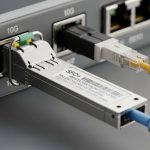
When a procurement team orders fiber optic optics, the wiring is only half the story. The other half lives in compliance documents, material declarations, and the quiet risk that a transceiver fails an audit after installation. This article helps network engineers, data center operators, and supply chain leads understand how a RoHS transceiver fits into global RoHS and REACH compliance expectations, with field-tested verification steps and troubleshooting. You will also get a practical ranking table so you can choose transceivers with fewer surprises.
Top 8 compliance checks before you buy a RoHS transceiver
In real deployments, compliance is not a marketing claim; it is a chain of evidence. I have seen procurement teams receive a single PDF and assume it is enough, only to discover later that the declaration does not match the exact part number or revision. Start by treating every optics order like a change-controlled component in your network lifecycle. Below are the eight checks that prevent the most common compliance failures.
Confirm RoHS scope: substances and exemption handling
RoHS typically targets restricted substances such as lead, mercury, cadmium, hexavalent chromium, and specific flame retardants, with regulated concentration thresholds. For optics, exemptions and component-level use cases can matter, especially around solder alloys and certain legacy materials. Ask the vendor for a statement that clearly covers the exact family and part revision you are ordering. In the field, the fastest failure mode is a declaration that covers a “series” but not your specific SKU.
- Best-fit scenario: Cross-border procurement where EU documentation is mandatory.
- Pros: Reduces audit risk early.
- Cons: Requires vendor cooperation and part-number specificity.
Verify REACH: SVHC screening and updates
REACH focuses on substances of very high concern (SVHC) and requires communication when certain thresholds are exceeded. Even when a product is RoHS compliant, REACH can still require additional disclosure depending on material composition and updates. I usually request an SVHC statement tied to the vendor’s latest candidate list screening date. If your vendor cannot state the screening basis and revision date, you are buying compliance from memory rather than evidence.
- Best-fit scenario: EU-facing operations with ongoing vendor re-certification.
- Pros: Improves long-term compliance continuity.
- Cons: Declarations may need periodic refresh.
Demand part-number and revision traceability
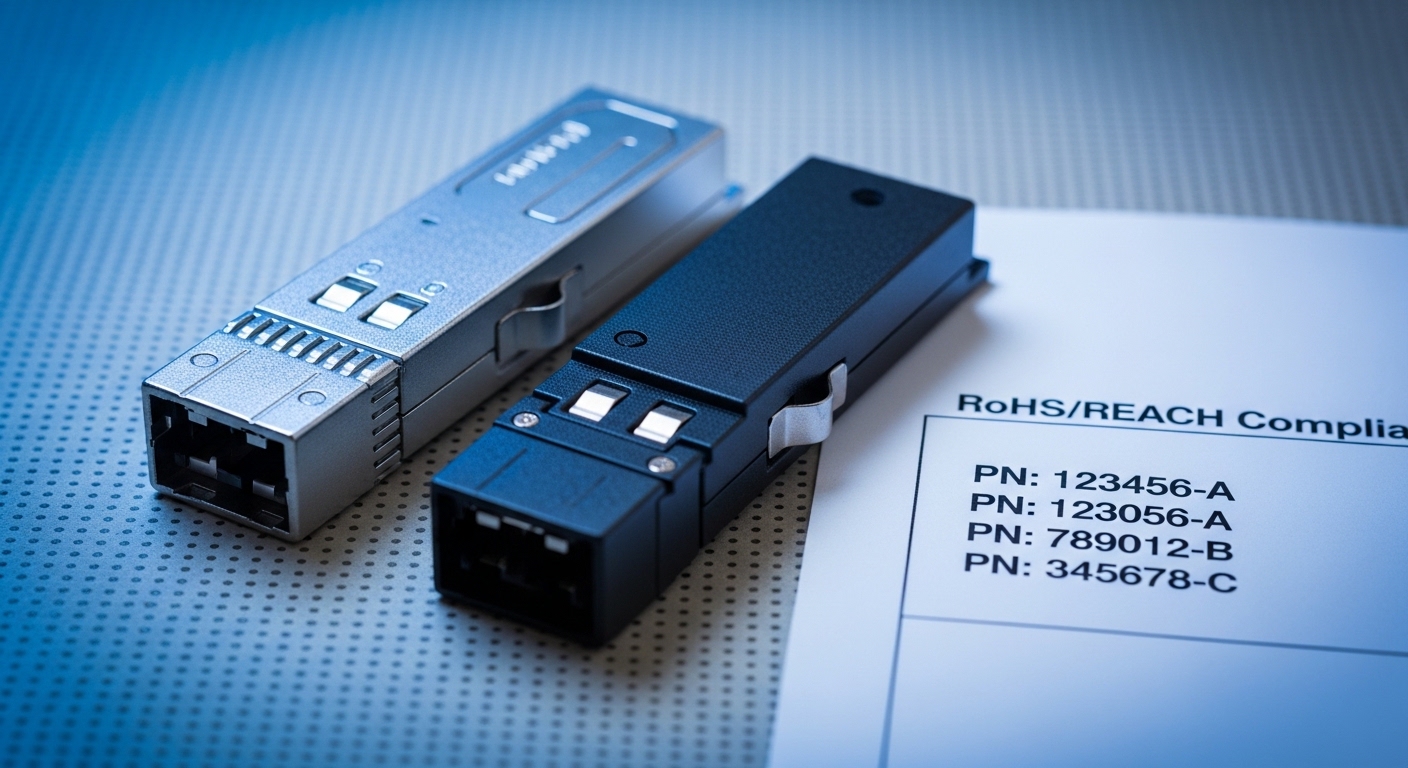
A RoHS transceiver declaration should map to the exact part number you install, including revision level and manufacturing location. In practice, optics can be assembled with different PCB layouts or BOM variants across revisions, even when the exterior label looks identical. Build your request around the label on the module and the vendor’s internal revision. If you cannot reconcile the paperwork to the physical label, treat the documentation as incomplete.
- Best-fit scenario: Multi-vendor environments with strict change control.
- Pros: Prevents “documentation drift.”
- Cons: Slows purchasing if the vendor is disorganized.
Check DOM and diagnostic support (compliance meets operability)
Compliance is necessary, but your network still needs stable optics behavior. Modern switches rely on Digital Optical Monitoring (DOM) where supported by the transceiver, reporting temperature, supply voltage, and optical power. While DOM is not a compliance standard, operational stability affects whether you will replace optics early, which in turn affects waste and lifecycle compliance reporting. When you request compliance documents, also confirm that the transceiver supports your switch’s DOM expectations.
- Best-fit scenario: 10G and 25G deployments with frequent monitoring.
- Pros: Reduces premature module churn.
- Cons: Some third-party optics may have partial feature support.
Match optical standards: IEEE 802.3 and vendor datasheets
Optical performance standards come from IEEE 802.3 and related optics specifications, defining interfaces like 10GBASE-SR and 25GBASE-SR. A RoHS transceiver must still meet the electrical and optical requirements for your distance and link budget. When evaluating compatibility, cross-check the vendor datasheet parameters such as wavelength, receiver sensitivity, and supported reach. This keeps compliance from becoming a false comfort while the link still fails.
- Best-fit scenario: Mixed-speed networks upgrading from 10G to 25G.
- Pros: Improves both compliance and link reliability.
- Cons: Documentation alone will not fix a reach mismatch.
Validate connector and fiber assumptions: LC/PC, MMF/SMF
Most audits focus on materials, but in the field, the fastest way to damage optics is a connector mismatch or contaminated fiber. Confirm whether your optics are intended for multimode fiber (MMF) or single-mode fiber (SMF), and whether you are using LC connectors with the correct polish. A compliance audit might pass, yet your network still experiences CRC errors due to poor fiber hygiene. Always pair compliance checks with a short physical-layer verification plan.
- Best-fit scenario: Greenfield cabling projects and retrofit conversions.
- Pros: Prevents avoidable failures.
- Cons: Requires disciplined field handling.
Confirm temperature range and operating limits
Operating temperature affects both reliability and whether your maintenance schedule becomes overly aggressive. Many data center modules are specified for 0 to 70 C (commercial), while some environments require -40 to 85 C (extended). If you run optics outside their rated range, you can accelerate aging of laser diodes and optical power control systems. In that case, you will replace modules sooner, which increases total cost and complicates lifecycle reporting.
- Best-fit scenario: Edge sites, server room expansions, or hot-aisle deployments.
- Pros: Avoids premature replacements.
- Cons: Extended-range parts often cost more.
Control supplier risk: OEM vs third-party and documentation quality
In procurement meetings, I often summarize it like this: OEM optics reduce compatibility friction, while third-party optics can reduce unit cost. But compliance quality varies by vendor maturity, and documentation clarity is part of that maturity. If you choose third-party, require evidence quality: exact part mapping, revision dates, and a clear statement of RoHS and REACH coverage. For multi-year plans, also ask about how the vendor handles declaration updates when SVHC lists change.
- Best-fit scenario: Budget-sensitive deployments with careful acceptance testing.
- Pros: Potentially lower purchase price.
- Cons: Higher diligence required for compliance and behavior.
RoHS transceiver specs that matter for compliance-minded engineers
Compliance paperwork is only credible when the transceiver also meets the right optical interface and operational envelope. Below is a practical comparison table engineers use when aligning link requirements with module capabilities. While RoHS refers to material restrictions, the optical parameters ensure the transceiver can actually carry traffic over your fiber plant. Always validate both sides before you approve procurement.
| Parameter | Example 10G SR | Example 25G SR | Example 100G SR4 |
|---|---|---|---|
| Data rate | 10G | 25G | 100G (4 lanes) |
| Wavelength | 850 nm | 850 nm | 850 nm |
| Typical reach | ~300 m (OM3) / 400 m (OM4) | ~70 m (OM3) / 100 m (OM4) | ~100 m (OM4) |
| Connector | LC | LC | LC (fanout via MPO/MTP on some modules) |
| DOM support | Common (Vendor dependent) | Common (Vendor dependent) | Common (Vendor dependent) |
| Optics form factor | SFP+ / SFP | SFP28 | QSFP28 |
| Operating temperature | 0 to 70 C or -40 to 85 C | 0 to 70 C or -40 to 85 C | 0 to 70 C or -40 to 85 C |
| RoHS / REACH | Declaration required per part/SKU | Declaration required per part/SKU | Declaration required per part/SKU |
For credible compliance references, use IEEE interface requirements for electrical and optical behavior, and use regulatory guidance for substance restrictions. For standards context, see IEEE 802.3. For regulatory background, see European Commission RoHS and ECHA REACH.
How to choose a RoHS transceiver: decision checklist
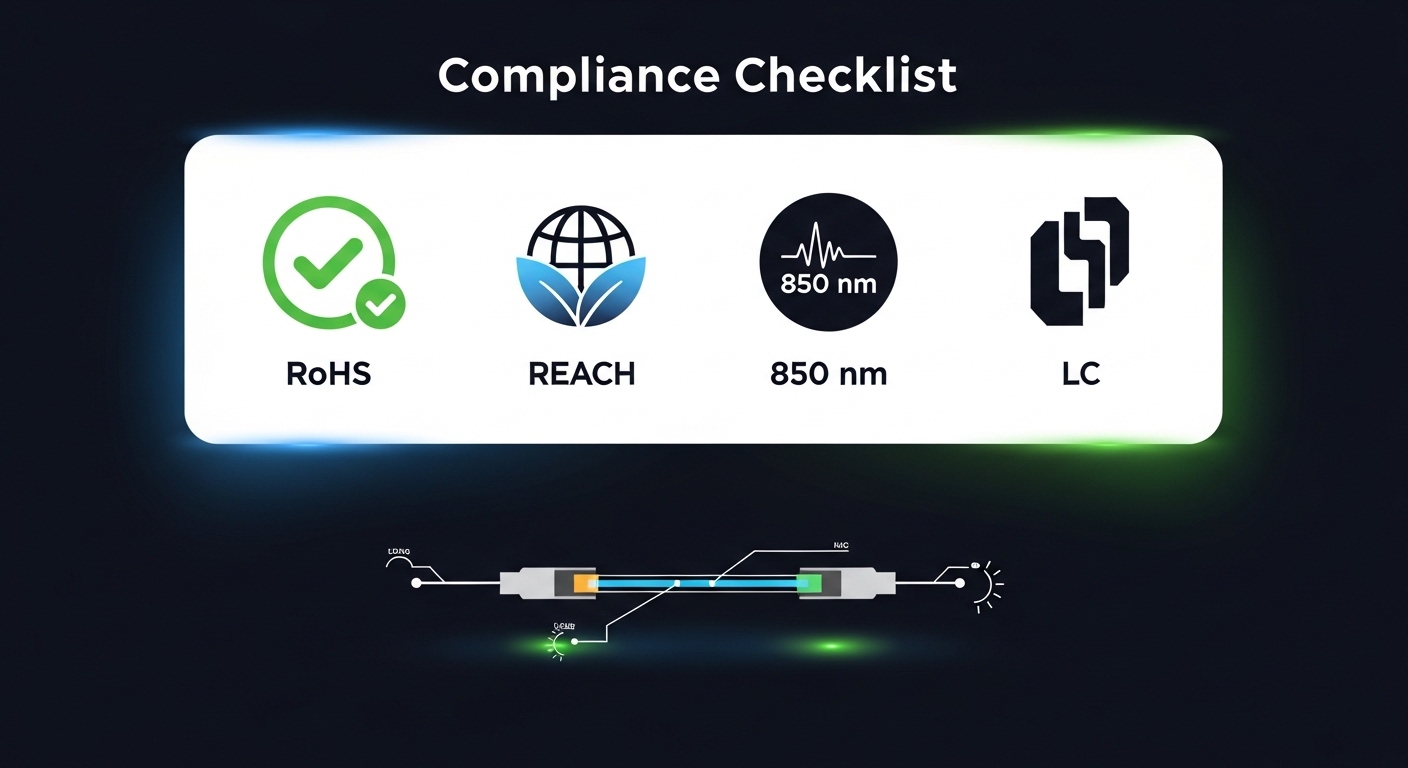
When I help teams select optics, I treat it like routing: you need constraints, not vibes. Use this ordered checklist to keep your choices aligned with both regulatory expectations and real link performance. The goal is to prevent the classic scenario where the optics meet compliance but fail acceptance testing, or meet performance but cannot survive audit questions.
- Distance and fiber type: confirm MMF vs SMF, OM3/OM4 grade, and expected reach at your speed.
- Switch compatibility: verify transceiver type and DOM behavior with your exact switch model and software version.
- Data rate and interface: ensure IEEE 802.3 alignment (for example SR, LR, ER, SR4 patterns).
- RoHS transceiver documentation: request RoHS declaration tied to exact part number and revision.
- REACH evidence: ask for SVHC screening statement with a screening date or version basis.
- DOM and alarm thresholds: confirm Tx/Rx power reporting and any vendor-specific quirks.
- Operating temperature: match your site thermal profile to the module’s specified range.
- Vendor lock-in risk: evaluate whether documentation and behavior are stable across future orders.
Pro Tip: In acceptance tests, log DOM readings (Tx bias, Rx power, and temperature) for at least 30 minutes under steady traffic. If a “compliant” RoHS transceiver shows noisy Rx power trending toward low levels, you may have a marginal fiber plant or a weak optical budget long before the audit folder is questioned.
Deployment scenario: leaf-spine data center with compliance gates
In a 3-tier data center leaf-spine topology with 48-port 10G ToR switches and 100G spine uplinks, we staged optics in two waves: 10G access links first, then 100G uplinks after cabling verification. The environment used OM4 MMF for short intra-row runs and LC connectors for most patch panels, with a small set of MPO/MTP breakout paths for higher density. Procurement required a RoHS transceiver declaration and an REACH SVHC statement for each exact SKU, including revision dates. During commissioning, we also validated DOM telemetry and checked temperature stability at the rack level, catching one batch of modules with inconsistent Rx power behavior before it impacted production.
Common mistakes and troubleshooting tips for RoHS transceiver projects
Compliance mistakes can be as costly as fiber mistakes, because both lead to replacements, downtime, and paperwork churn. Below are concrete failure modes I have seen, with root causes and practical solutions. Treat these as field notes rather than theory.
Mismatched documentation vs installed part number
Root cause: The RoHS declaration references a product family, but your installed label points to a different revision or manufacturing lot. During audits, the gap becomes evidence of non-coverage. Solution: Require a declaration that includes the exact part number and revision printed on the module label, and store it in your change management system alongside the asset record.
REACH SVHC statement provided without screening date
Root cause: Vendors sometimes provide a generic SVHC statement without a screening basis or date, making it impossible to prove compliance against the current candidate list. Solution: Ask for the screening version/date and how the vendor updates declarations when SVHC lists change. Re-request documentation during major procurement cycles or when switching suppliers.
Link failures masked as “compliance issues”
Root cause: Engineers may assume a bad batch is non-compliant when the real cause is optical mismatch, dirty connectors, or reach shortfall. A RoHS transceiver can still fail due to fiber contamination or incorrect grade selection. Solution: Clean connectors with approved procedures, verify polarity, confirm OM3/OM4 grade, and run optical link validation. Use DOM to compare expected vs measured Rx power and temperature.
Temperature rating mismatch in hot-aisle expansion
Root cause: Commercial-temperature optics installed in hotter-than-expected racks degrade faster, increasing error rates and replacements. Solution: Verify thermal assumptions with a site survey. Select extended temperature modules where needed and monitor DOM temperature trends post-install.
Cost and ROI note: what compliance diligence changes
Pricing varies widely by speed and form factor. As a ballpark, enterprise 10G SFP+ SR optics often land in the tens of dollars per module for third-party and higher for OEM, while 25G SFP28 SR modules and 100G QSFP28 SR optics can cost substantially more depending on reach and temperature range. Total cost of ownership improves when you reduce early failures and avoid rework from audit nonconformance. However, RoHS transceiver