In metro and data center links, engineers often blame “fiber quality” when the real limiter is FEC coding gain and how the transceiver implements it. This article helps network and field engineers compare Reed-Solomon FEC against oFEC (optical FEC) to understand how the same optical budget can yield different reach. You will get a practical decision checklist, common failure modes, and a ranking table you can use during procurement or acceptance testing.
Why FEC coding gain is the reach lever on real optics
Optical transceivers convert bits to an electrical signal, modulate a laser, and then recover bits at the receiver. As attenuation, dispersion, and connector/cable reflections increase, the receiver’s measured pre-FEC BER rises, and the link margin collapses unless the forward error correction can correct those errors. FEC coding gain is not a marketing number; it is the effective improvement in required optical signal-to-noise ratio (OSNR) or sensitivity for a target post-FEC BER. In practice, the coding gain determines whether a link meets the IEEE/industry BER target after amplification and equalization.
Engineers usually think in “budget” terms: optical power (dBm), dispersion tolerance (ps/nm), and receiver sensitivity (dBm at a given BER). But once FEC is enabled, the decisive factor becomes whether the transceiver can correct the error distribution produced by OSNR and impairments. That is why two modules that both claim “10G-SR” or “ZR” can behave differently when one uses Reed-Solomon FEC and the other uses oFEC with a different coding gain and operating point. For background on bit error rate targets and link behavior, see IEEE 802.3 requirements [Source: IEEE 802.3].
- Best fit scenario: When you are extending reach using older fibers, marginal patch cords, or additional fan-out loss.
- Pros: Better tolerance to impairments, fewer “it works today” outages.
- Cons: Higher latency and sometimes stricter module/switch compatibility rules.
Pro Tip: Treat FEC gain as an “OSNR-to-POST-FEC-BER translator.” During acceptance tests, capture pre-FEC and post-FEC counters (or vendor-exposed diagnostic fields) across temperature—many field failures are caused by thermal drift that pushes pre-FEC BER beyond the correction knee, even when average received power seems adequate.
Reed-Solomon FEC: classic correction, predictable margin
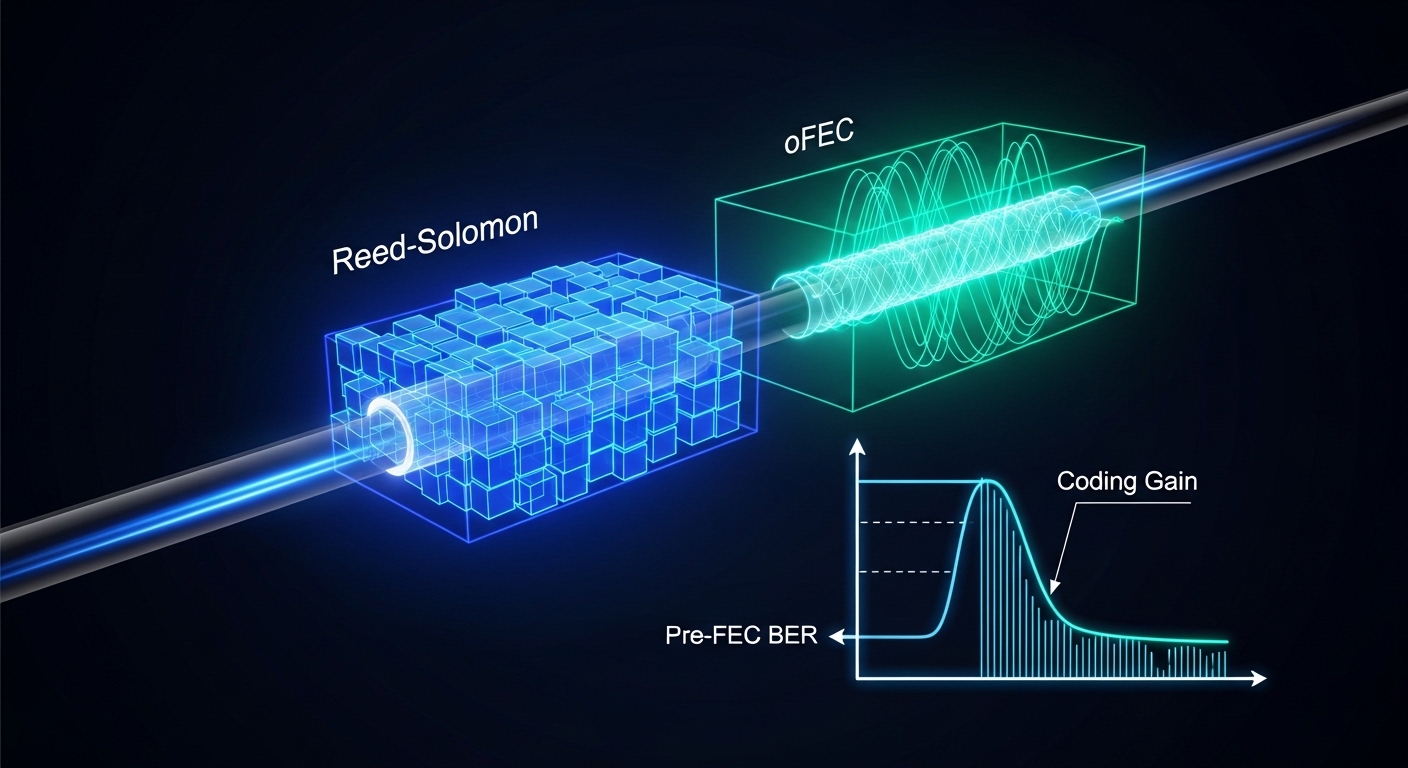
Reed-Solomon FEC is a block-based error-correction scheme widely used in optical transport and Ethernet PHYs. It corrects symbol errors by adding parity symbols, which can provide substantial coding gain when the impairment-induced errors are within the decoder’s assumptions. The key operational detail is that Reed-Solomon FEC is typically configured for a specific frame size, interleaving depth, and code rate, so the coding gain and latency are tightly coupled to the implementation. Field engineers often like Reed-Solomon because it is well understood and appears in many generations of vendor PHYs and transport gear.
In deployment, Reed-Solomon FEC tends to be robust against random errors and moderate burstiness, especially when interleaving spreads errors across a block. However, if the link experiences severe burst errors (for example, from connector intermittency or reflections that create deep fades), the decoder can saturate. That leads to a common symptom: high pre-FEC error counts, then sudden link flaps or loss of lock when the decoder cannot recover.
- Best fit scenario: Links where errors are expected to be mostly random due to noise and moderate dispersion.
- Pros: Predictable behavior; broad vendor support.
- Cons: Limited flexibility across module generations; latency can be non-trivial in some designs.
oFEC (optical FEC): reach extension with modern coding strategies
oFEC is a term you will see in modern coherent and some non-coherent optical systems to indicate forward error correction that is applied at the optical receiver side in a way that improves sensitivity and reach. Compared to older FEC modes, oFEC implementations often integrate with digital signal processing (DSP) and enhanced equalization so the system can operate closer to the correction limit. The practical outcome is that two links with similar raw optical power can show different reach because oFEC can maintain a lower effective post-FEC error rate at a given OSNR.
However, oFEC is not universally “one size fits all.” Code rate, interleaving, and decoder thresholds vary by vendor and by whether the system is designed for specific modulation formats (in coherent systems) or specific Ethernet line rates (in certain pluggables). That means you must verify that both ends of the link support the same FEC mode or compatible negotiation behavior. If the receiver expects oFEC but the transmitter emits a non-matching framing or coding, you can see persistent “link up but no traffic” symptoms or continuous FEC warning events.
- Best fit scenario: Reach extension where you can control both ends (same vendor family or verified interoperability).
- Pros: Often higher effective reach through improved coding and receiver processing.
- Cons: Compatibility constraints; configuration mistakes can cause hard failures.
Comparison: how Reed-Solomon FEC vs oFEC changes reach outcomes
To compare Reed-Solomon FEC and oFEC in a way that maps to procurement decisions, focus on the same measurable chain: receiver sensitivity, coding gain, and the operational OSNR margin at temperature extremes. Vendors do not always publish exact “coding gain in dB” in the public datasheet, but they often provide reach ratings under specific conditions and sometimes list FEC type. When you map those ratings to your actual link impairments, you can estimate whether you have enough margin to survive aging and installation variability.
Below is a practical comparison framework using typical behaviors observed across Ethernet optics families and transport systems. Treat these as engineering heuristics, not universal guarantees, and always validate with vendor documentation and on-site BER testing. For BER and Ethernet optical link behavior, also consult IEEE 802.3 and related transceiver test guidance [Source: IEEE 802.3]. For vendor-specific FEC details, consult the transceiver datasheet and the switch PHY documentation.
| Key spec / behavior | Reed-Solomon FEC | oFEC (optical FEC) |
|---|---|---|
| Typical coding approach | Block-based symbol correction | Optical receiver-integrated FEC (often with DSP) |
| FEC coding gain impact | Improves sensitivity; robust for random/moderate burst errors | Often yields better effective reach near the correction limit |
| Latency | Can be fixed by code block size | Depends on implementation and DSP pipeline |
| Compatibility | Common across many PHY generations; still model-specific | May require matching FEC mode and receiver expectations |
| Failure signature | FEC warnings then sudden instability under intermittent reflections | FEC mismatch or decoder saturation leading to persistent warnings or link drop |
| Operational temperature range | Module-dependent; verify DOM and thermal specs | Module-dependent; verify decoder performance across temperature |
Operational note: In acceptance tests, measure received optical power, confirm DOM values, and monitor FEC counters if exposed. If the platform only shows a binary “FEC enabled/disabled” state, you may need vendor support to interpret the real correction margin.

Selection checklist: choosing the right FEC coding gain for your reach
When you choose between Reed-Solomon FEC and oFEC, you are really choosing an error-correction operating point and a compatibility envelope. Engineers typically work through the same ordered checklist during design and installation planning. This checklist is intentionally practical: it focuses on what causes real link failures after cutover.
- Distance and impairment profile: Estimate not just attenuation but also dispersion and expected reflection events from your patching plan. Longer reach or messy patch panels increase burstiness risk.
- Target BER and post-FEC behavior: Identify the required post-FEC BER target for the PHY and the monitoring counters available on the switch/router. Use IEEE 802.3 as the baseline reference where applicable [Source: IEEE 802.3].
- Transceiver and switch compatibility: Confirm both ends support the same FEC mode or negotiation behavior. Many failures come from “link up” with incompatible coding expectations.
- DOM and diagnostics support: Verify whether the module exposes FEC counters, temperature, bias current, and received optical power. Without visibility, you cannot validate FEC coding gain margins.
- Operating temperature and thermal drift: Validate the module’s temperature range and check that the decoder maintains correction at high case temperature. Field failures often happen near seasonal peaks.
- Vendor lock-in risk: If oFEC is implemented with proprietary thresholds, third-party interoperability may be limited. Plan for spares strategy and replacement lead times.
- Test plan and acceptance measurements: Require BER testing at multiple optical levels, not only “at rated power.” Include worst-case patch cord loss and connector cleaning verification.
- Best fit scenario: Greenfield design where you can specify both ends and enforce acceptance criteria.
- Pros: Reduces surprises and supports faster troubleshooting.
- Cons: Requires more validation work up front.
Common mistakes and troubleshooting: when FEC coding gain does not save the link
Even with strong FEC coding gain, optical links can fail due to physical-layer issues or configuration mismatches. Below are field-proven pitfalls with root causes and corrective actions. Use these during both pre-deployment testing and live incident response.
-
Pitfall 1: Assuming received power alone guarantees reach
Root cause: FEC correction depends on OSNR and error burstiness, not just average power. Dispersion, mode coupling, and reflections can raise pre-FEC BER beyond the decoder knee.
Solution: Perform BER tests at multiple optical levels and inspect patch cord cleanliness, connector end-face condition, and link stability across temperature. -
Pitfall 2: FEC mode mismatch between ends
Root cause: One side expects Reed-Solomon FEC framing while the other uses oFEC (or vice versa), or the platform disables FEC on one side due to configuration policy.
Solution: Verify FEC enablement and mode in both the switch CLI and module diagnostics. If supported, confirm the negotiated coding mode and clear any “FEC off for troubleshooting” flags before cutover. -
Pitfall 3: Underestimating connector and patching reflection events
Root cause: Dirty connectors or marginal polish can create intermittent reflections, producing burst errors that can saturate block decoders.
Solution: Clean with approved fiber cleaning tools, inspect with an optical microscope, and re-test under the same BER profile. Replace suspect patch cords even if power readings look normal. -
Pitfall 4: Ignoring thermal drift and bias current trends
Root cause: Laser bias current and receiver sensitivity shift with temperature; FEC coding gain may not hold at the worst-case operating point.
Solution: Use DOM to trend temperature, bias current, and received power over a full environmental cycle. Validate link stability at the highest expected chassis temperature.
Cost and ROI: coding gain is cheaper than truck rolls, but not free
From a TCO perspective, FEC coding gain can reduce truck rolls and outage time by extending reach and improving robustness. But it can increase module cost and sometimes adds latency or power draw due to more complex DSP/decoding pipelines. Typical street pricing for enterprise pluggable optics varies widely by vendor and market, but in many deployments you may see a meaningful delta between standard FEC-enabled optics and higher-reach modules with advanced oFEC behavior.
For example, OEM and OEM-compatible optics can differ in price by roughly 10% to 40% depending on lead time and platform support policies. Third-party modules can be cost-effective, but the biggest risk is not purchase price; it is interoperability. Plan a spares strategy and require acceptance tests that validate FEC behavior, not just optical power. When the cost of downtime is high (financial trading floors, telecom backhaul, or critical storage replication), the ROI often favors validated optics with the right FEC coding gain margin.
- Pros: Fewer intermittent errors, better survivability over aging fibers.
- Cons: Potentially higher module cost and stricter compatibility.
Summary ranking: which FEC coding gain approach to pick first
The “best” choice depends on whether you control both ends, the impairment profile, and how much diagnostic visibility you have. Use this ranking table as a starting point, then confirm with vendor documentation and BER testing at your actual link loss.
| Use case | Recommended starting point | Why | Primary risk |
|---|---|---|---|
| Controlled environment, mostly random noise | Reed-Solomon FEC | Predictable block correction and broad support | Burst errors from reflections can saturate decoding |
| Reach extension at the edge of sensitivity | oFEC | Often better effective coding performance near limits | Mode mismatch or proprietary thresholds |
| Mixed-vendor optics inventory | Reed-Solomon FEC (verify) | Higher chance of compatibility across platforms | Still model-specific; require DOM and BER validation |
| Strict acceptance testing available | Whichever passes BER at target OSNR | Empirical validation beats assumptions | Insufficient test coverage can miss thermal or burst cases |
If you are standardizing a fleet, the next step is to align FEC mode decisions with your switch PHY policies and your acceptance test methodology. For additional guidance on optical link planning, see fiber optic reach budgeting and link margin analysis.
FAQ
What does FEC coding gain mean in practice?
FEC coding gain is the effective improvement in the receiver’s ability to correct errors, usually expressed as a sensitivity or OSNR margin improvement for a target post-FEC BER. In the field, it determines whether your link stays stable under higher attenuation, dispersion, and installation variability. Always verify with BER testing and, when available, pre-FEC and post-FEC counters.
Is oFEC always better than Reed-Solomon FEC for reach?
Not automatically. oFEC can provide strong effective correction near sensitivity limits, but the outcome depends on the exact implementation, code rate, interleaving, and receiver DSP pipeline. Compatibility between transceiver ends is also a gating factor, so you must confirm interoperability and match FEC modes where required.
How do I confirm which FEC mode a transceiver is using?
Start with the transceiver datasheet and the switch/router documentation for the platform PHY. Then validate operationally via diagnostics: DOM fields, FEC enabled state, and any exposed error counters. If the platform does not expose FEC details, request vendor confirmation or run BER tests that reveal the correction behavior.
Why does my link work at day temperature but fails at night?
Thermal drift can shift laser output power, receiver sensitivity, and equalizer operating points. The decoder’s correction performance may degrade at the worst-case temperature, pushing pre-FEC BER beyond the correction knee. Trend DOM values and run BER testing across the expected environmental cycle.
Can I mix modules with different FEC types on the same link?
Sometimes, but it depends on the platform’s ability to negotiate coding and on the exact framing and decoder expectations. Mixing Reed-Solomon and oFEC is a common cause of persistent FEC warnings or unstable links. Treat interoperability as a testable requirement, not an assumption.
What troubleshooting steps should I take first during a FEC alarm?
First, verify FEC enablement and mode on both ends, then check received optical power and DOM health (temperature, bias current, and error counters). Next, inspect and clean connectors and verify patch cord loss. Finally, if the issue persists, run BER testing at multiple optical levels to determine whether you are dealing with OSNR limitation or burst errors from reflections.
Author bio: I have deployed and validated optical Ethernet links in mixed-vendor data centers and metro networks for 10+ years, with hands-on BER testing and field failure triage. I focus on mapping PHY behavior to operational margins so teams can choose FEC coding gain strategies that actually hold under real impairments.