When your leaf-spine fabric is short on ports or a vendor stops shipping a legacy optic, recertified transceiver modules can look like a fast rescue. But the real question for engineers is operational: will DOM data, link training, optical power, and temperature behavior stay within spec under load? This article helps data center, campus, and ISP teams decide with a field-engineer mindset—what to verify, what can fail, and where ROI actually shows up.
Recertified vs OEM: performance and optical budget tradeoffs
Think of transceivers like rental cars. The model may be identical, but tire age, brake pad material, and alignment can change the real ride. For optics, the “ride quality” is measured as optical power, receiver sensitivity, and link margin versus distance. OEM modules are calibrated and tested to the vendor’s production process; recertified units are typically re-tested and re-labeled after refurbishment, which can still produce excellent results when the recertification is rigorous.
At the PHY layer, both OEM and recertified modules must satisfy the relevant IEEE optical link requirements for the transceiver class you deploy (for example, IEEE 802.3ae for 10GBASE-SR and IEEE 802.3ba for 40G/100G classes). In practice, the biggest difference is traceability: OEMs provide consistent manufacturing history, while recertification varies by supplier and process depth.
Below is a practical comparison for common multimode and single-mode optics you might see in production.
| Spec | OEM Example | Recertified Example | What to verify in the field |
|---|---|---|---|
| Data rate | 10G (SFP+) | 10G (SFP+) | Matches switch port type and speed negotiation policy |
| Wavelength | 850 nm (SR) | 850 nm (SR) | Correct fiber type: OM3 vs OM4 vs OS2 |
| Reach | Up to 300 m (10GBASE-SR typical) | Up to 300 m (typical claim) | Measured link margin; watch for marginal runs over aging MPO trunks |
| Connector | LC duplex | LC duplex | Connector cleanliness and adapter compatibility |
| Power class / limits | Within vendor datasheet | Within recertification report | Transmit power and receive sensitivity from DOM (where supported) |
| DOM support | Digital optical monitoring (I2C) | DOM supported (varies) | DOM readout works on your switch firmware version |
| Operating temperature | 0 to 70 C (typical) | 0 to 70 C or extended (varies) | Check temperature class against your cable plant and airflow pattern |
| Compatibility risk | Low | Moderate to low (supplier-dependent) | Vendor lock-in behavior and strict transceiver validation |
Examples of widely referenced models in the field include OEM-class parts such as Cisco SFP-10G-SR and Finisar FTLX8571D3BCL, plus third-party equivalents like FS.com SFP-10GSR-85. Recertified inventory may map to these, but the exact optical calibration and DOM implementation must be confirmed.

Cost and ROI: when recertification actually pays off
Recertified modules are usually priced below OEM—often enough to matter when you’re buying dozens of ports during a refresh cycle. The key ROI question is total cost of ownership: not just purchase price, but failure rate, downtime risk, and labor to troubleshoot link flaps. In many operations, a single failed optic that triggers a truck roll can erase the savings from several cheaper units.
Typical street pricing varies by speed and reach. A realistic range many teams encounter: OEM 10G SR SFP+ may cost roughly $80 to $200 per unit, while recertified equivalents sometimes land around $40 to $120, depending on brand, DOM support, and whether the supplier provides an optical test report. For 25G/40G/100G, the gap can be larger, but so is the operational consequence of incompatibility.
For TCO math, include: (1) expected module lifespan, (2) spares stocking strategy, and (3) energy and cooling impact is small per port but non-trivial at scale. The bigger lever is failure handling. If your site has strict change windows, the “risk premium” of recertified optics must be budgeted.
Pro Tip: Ask suppliers whether they provide a per-module optical measurement snapshot (TX power, RX power or sensitivity estimate, and eye diagram or equivalent test). Without that, you are buying “it passed once” rather than “it will likely pass your specific link margin.”
Compatibility and DOM behavior: the hidden breaker
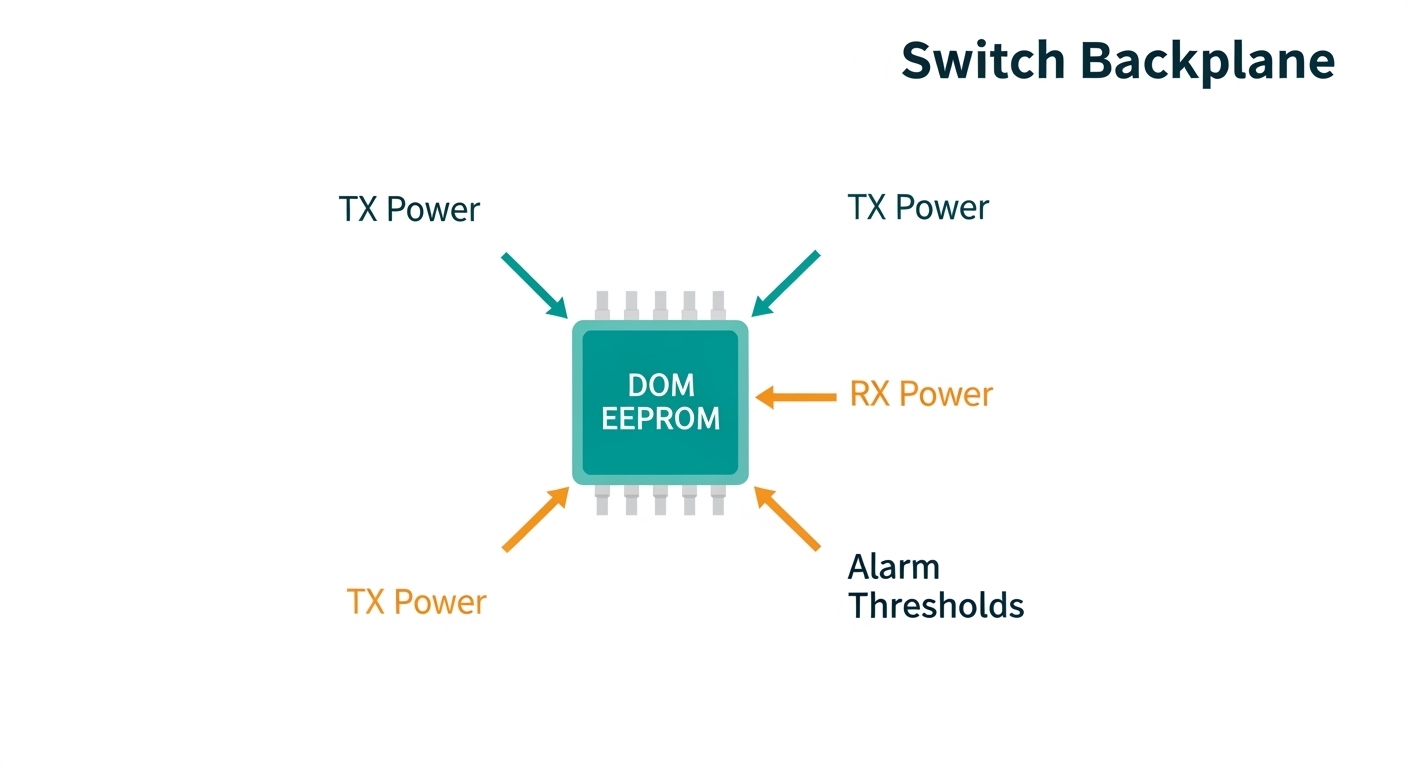
Compatibility is where recertified transceiver modules can surprise you. Many switches enforce transceiver validation using a combination of vendor IDs, part numbers, and DOM thresholds. Even if the optic is electrically capable, a mismatch in EEPROM fields or DOM calibration values can cause “module not recognized,” high BER counters, or frequent link resets.
This is also where IEEE compliance matters indirectly. IEEE defines electrical and optical behavior for classes, but vendor ecosystems add implementation constraints—especially around DOM and alarm thresholds. Before rollout, validate on the exact switch model and firmware you run in production.
Field validation steps that prevent outages
- Read DOM immediately after insertion: verify vendor name, part number, wavelength, and key thresholds.
- Confirm link training: check that the port comes up cleanly and stays stable under traffic.
- Run optical diagnostics: compare TX/RX levels to expected ranges for the fiber run length.
- Test temperature behavior: if the chassis has hot spots, monitor alarms during peak load.
Use-case showdown: data center, campus, and ISP backhaul
In a 3-tier data center leaf-spine topology with 48-port 10G ToR switches, you might deploy 10G SR optics for server uplinks across short OM4 runs. Suppose you have 192 uplinks needing spares during an expansion phase. If the OEM lead time is 6 to 10 weeks, recertified transceivers can reduce deployment time and allow phased commissioning—provided you test them against the specific switch line card.
Campus networks often use fewer transceivers and longer cable runs that can be sensitive to connector cleanliness. Here, the “risk” is less about whether the module can transmit, and more about whether the received power stays within margin after patch panel wear. ISPs and backhaul teams may favor OEM for strict operational assurance, but recertified modules can still work in low-risk segments like maintenance spare pools—again, only after compatibility testing.

Selection criteria checklist: how engineers decide quickly
Use this ordered checklist before purchasing or deploying recertified transceiver modules.
- Distance vs reach: verify the fiber type (OM3, OM4, OS2) and actual patching length, not just the vendor reach claim.
- Switch compatibility: confirm exact switch model and firmware behavior; test one module per batch first.
- DOM and EEPROM correctness: ensure DOM reads properly and thresholds don’t trigger alarms.
- Optical test evidence: prefer suppliers that provide per-module optical measurements, not only “functional test.”
- Operating temperature class: compare module spec to your airflow and cabinet thermal profile.
- Vendor lock-in risk: check whether your platform rejects non-OEM optics or logs “unsupported module” events.
- Warranty and RMA terms: confirm replacement turnaround and whether “failed within spec” is covered.
Common mistakes and troubleshooting tips
Even well-chosen recertified transceiver modules can fail if deployed without the right process. Here are common issues seen in the field, with root causes and fixes.
-
Mistake: Installing recertified optics without confirming DOM compatibility.
Root cause: EEPROM fields or DOM thresholds differ, causing the switch to mark the module unsupported.
Solution: Validate with DOM reads on the target switch firmware; keep one OEM module as a control for comparison. -
Mistake: Assuming reach equals “it will work on your patch panel.”
Root cause: Excess loss from dirty connectors, aged MPO trunks, or higher-than-expected patch loss reduces link margin.
Solution: Clean connectors, verify insertion loss with a meter, and test with a known-good reference module. -
Mistake: Ignoring temperature alarms during peak load.
Root cause: Some recertified batches may not match the thermal behavior you expect, leading to power drift.
Solution: Monitor DOM temperature, optical power, and error counters; improve airflow or relocate ports if needed. -
Mistake: Mixing optics across the same link without consistency.
Root cause: TX power and RX sensitivity can differ across modules, increasing imbalance and triggering intermittent BER.
Solution: Standardize on a single module type per link group; replace both ends consistently when possible.
For standards context, review IEEE transceiver class requirements and vendor datasheets for the specific optics you deploy. Useful references include [Source: IEEE 802.3] and vendor module datasheets from the OEM or major optical vendors like Finisar/II-VI and Cisco documentation.
Which option should you choose?
Choose OEM transceivers when you need maximum assurance, strict platform validation, or you are operating in environments where downtime is expensive. Choose recertified transceiver modules when you can test on your exact switch model, you have optical test evidence from the supplier, and you deploy in segments where fiber loss and thermal variance are well understood.
| Reader type | Main goal | Best fit | Why |
|---|---|---|---|
| Data center ops team | Speed + cost during expansions | Recertified with validation | Test one batch, standardize per link group, keep spares |
| Network engineers on strict platforms | Minimize compatibility surprises | OEM | Lower risk of DOM and part-number enforcement issues |
| Campus network maintainers | Budget control | Recertified for low-risk segments | Connector cleanliness and loss testing can be done proactively |
| ISP backhaul team | Operational certainty | OEM or recertified only with strong test reports | Higher consequence of intermittent BER and link flaps |
FAQ
Are recertified transceiver modules safe to deploy in production?
Yes, if the supplier provides meaningful optical testing evidence and you validate on your exact switch model and firmware. Treat the first batch like a pilot: read DOM, confirm link stability, and monitor error counters under real traffic.
Do recertified modules always support DOM?