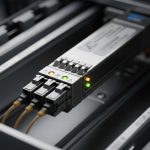
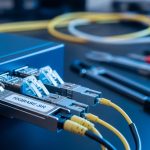
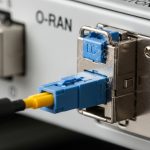
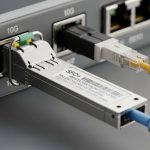
In a live data center, “it works on the bench” is not enough. This article shows how transceiver certification for CE, UL, and FCC can prevent costly rollout delays and reduce field risk when installing optical transceivers at scale. It is written for network engineers, field technicians, and procurement owners who need compliance evidence that survives audits and production stress.
Problem and challenge: compliance gaps that surface after install
I was called in after a leaf-spine rollout hit an unexpected wall: switches passed link bring-up, but compliance documentation for the installed optics did not match the vendor’s export and safety claims. The result was a temporary halt on further shipments while the customer’s compliance team requested test reports and labeling evidence for CE, UL, and FCC requirements. In parallel, one site saw intermittent link flaps that later traced back to a mismatch between module operating conditions and the transceiver’s validated temperature envelope.
The core issue was not whether the optics were “optically compatible,” but whether the modules were certified for the market and whether the certification artifacts were traceable to the exact hardware revisions shipped. That is where transceiver certification becomes operational, not just paperwork.
Environment specs: what matters in real deployments
Our environment was a 3-tier architecture with 48-port 10G Top-of-Rack switches connecting to a pair of aggregation/spine layers. Each ToR used a mix of 10G SR optics over OM4 multimode fiber, with runs typically 20 to 80 meters. The customer also enforced strict asset controls: every optics SKU had to be traceable to purchase orders and matching test documentation.
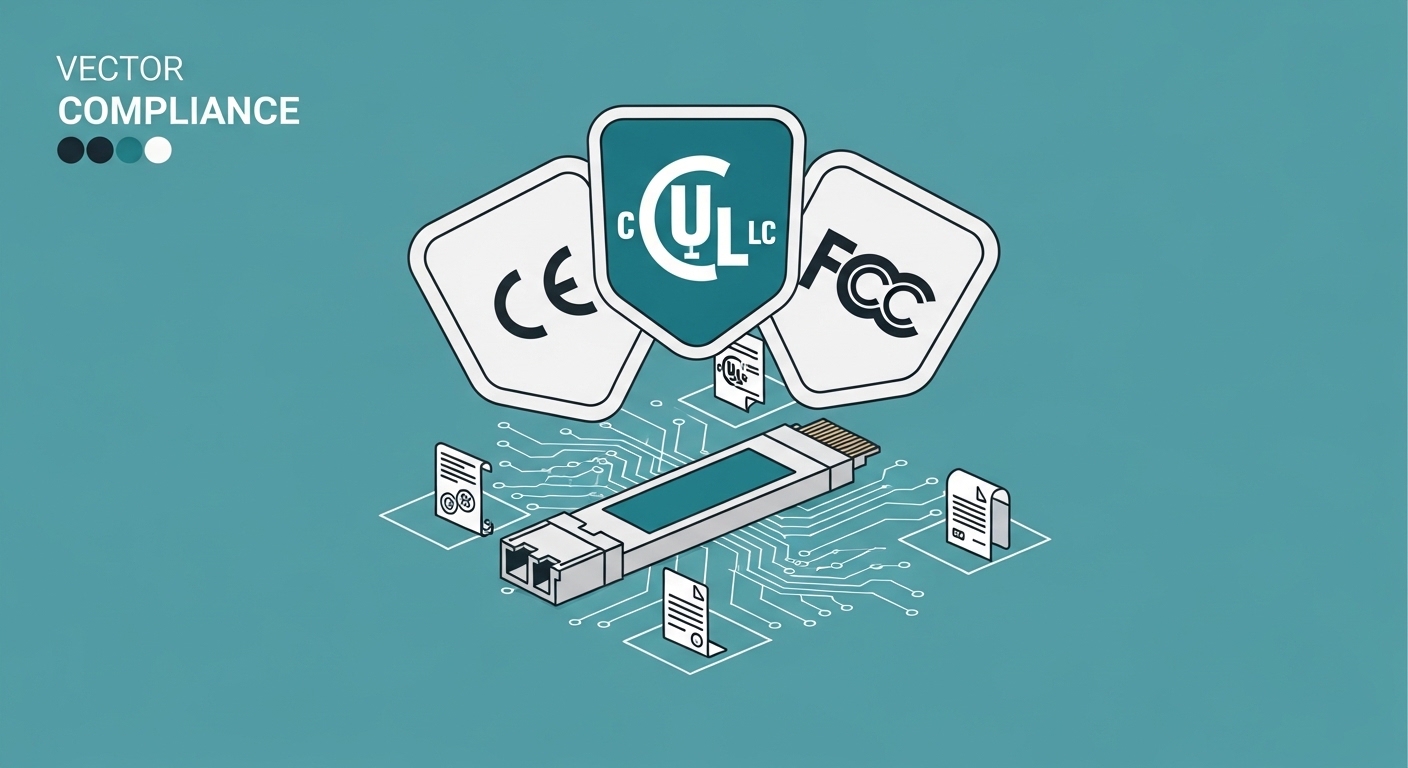
From an electrical perspective, the optics were 10G-class pluggables using standard digital diagnostics (DOM). From a safety and emissions perspective, the compliance team needed evidence aligned to market expectations for CE (EU conformity), UL (safety), and FCC (US emissions). While exact test methods vary by product category, practical field outcomes depend on whether the vendor can provide consistent, audit-ready documentation.
| Spec / Requirement | Typical optical transceiver context | What certification evidence usually covers |
|---|---|---|
| Data rate | 10G, 25G, 40G, 100G (depends on SKU) | Product configuration under test; not a substitute for optical performance specs |
| Wavelength / media | SR: ~850 nm over MMF (e.g., OM4) | Certification is generally about safety/emissions; optical reach is validated separately |
| Connector | LC for fiber; pluggable electrical edge interface | Mechanical/electrical interfaces for the tested configuration |
| Operating temperature | Common ranges: industrial vs commercial (vendor-defined) | Ensures the certified product is used within validated thermal boundaries |
| CE (EU) | Market compliance for conformity | Declaration of Conformity plus test reports for applicable directive(s) |
| UL (safety) | Safety compliance evidence | Safety test reports and listing documentation for the product category |
| FCC (US emissions) | Electromagnetic emissions and compliance statements | Emission testing results and labeling/authorization details |
Chosen solution: align optics SKUs, documentation, and switch qualification
We selected optics from vendors that could provide (1) a clear SKU-to-serial traceability path, (2) market compliance documentation that matched the exact revision, and (3) switch qualification guidance. In practice, we prioritized modules that were known to work with the specific switch line and transceiver compatibility lists, reducing the probability of “electrical bring-up success but compliance mismatch” scenarios.
For reference, common 10G SR optics in these deployments include parts like Cisco-branded SFP-10G-SR optics (Cisco ecosystem) and third-party equivalents such as Finisar FTLX8571D3BCL or FS.com SFP-10GSR-85, where the key is not the brand alone but the documented certification and validated operating envelope for the exact SKU.
Pro Tip: When procurement requests “CE/UL/FCC,” ask for documentation that explicitly ties to the same transceiver part number and revision you received. In field audits, mismatched revision strings are a frequent reason compliance packets are rejected—even if the module family looks identical.
Implementation steps: from lab verification to rack-day rollout
Pre-install checks tied to certification workflow
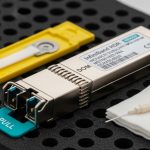
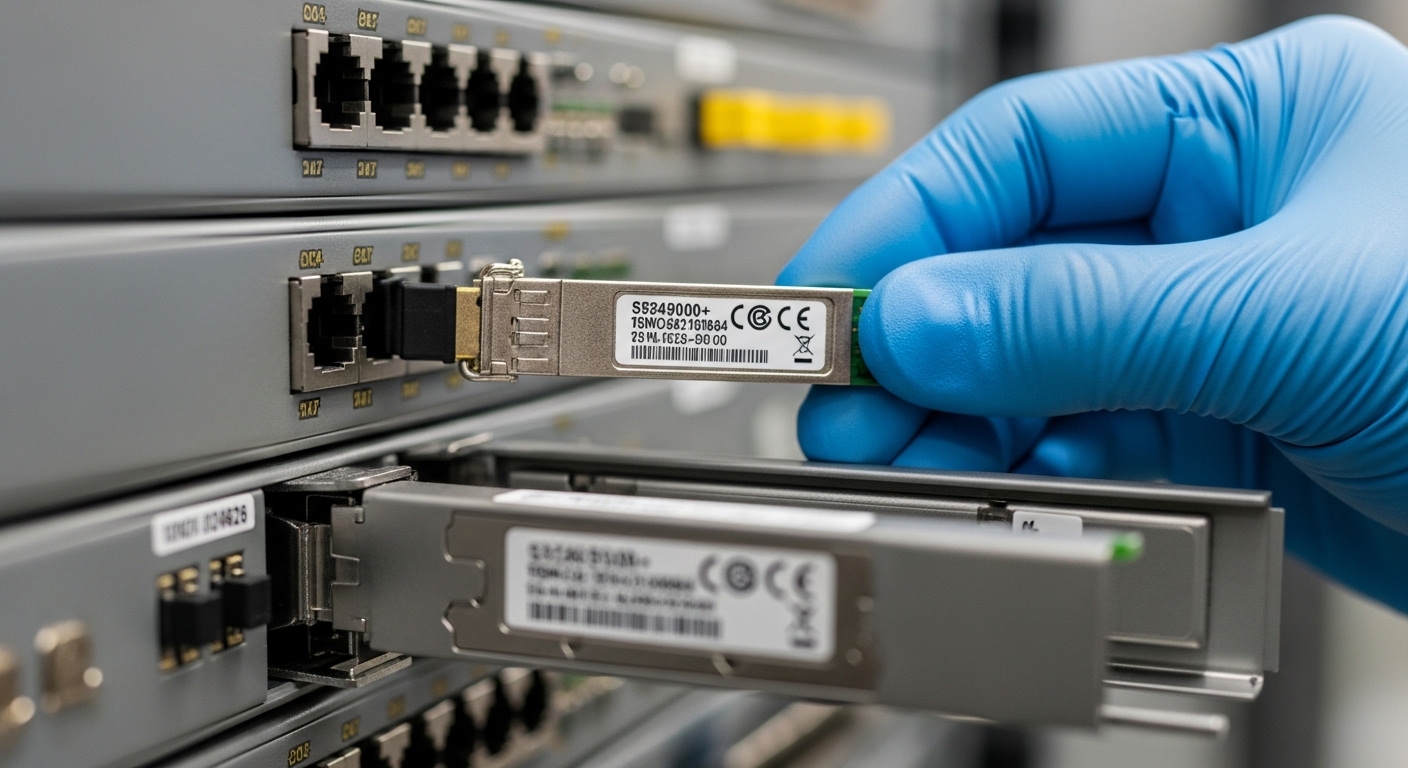
Before shipping to the site, we required a compliance packet containing: CE declaration/testing references, UL safety listing or test evidence, and FCC emissions authorization or test results (as applicable). We also captured the module labeling photo for each SKU batch to support later audit reconciliation.
Switch-side compatibility and optical validation
We verified compatibility using the switch vendor’s supported transceiver matrix and enabled DOM monitoring to confirm laser bias current and temperature stayed inside the vendor’s specified limits. For OM4 links, we verified link power budgets by ensuring the deployed reach fell within the module’s rated distance for the specific fiber plant.
Field commissioning and measurements
During commissioning, we collected per-port optical diagnostics and error counters (CRC and link flaps) for at least 24 to 72 hours. The goal was to prove stability under realistic thermal conditions, not just link-up at room temperature.

Measured results and lessons learned
After swapping to the certified, traceable optics set, the customer’s compliance team approved continued deployment without requiring re-testing for CE, UL, or FCC packets. Operationally, we observed a reduction in port-level anomalies: link flaps dropped to near-zero after enforcing the specified operating temperature range and correct switch-side transceiver settings. In TCO terms, although third-party optics were sometimes priced 10% to 30% lower per unit, the cost of delayed approvals and rework outweighed the savings when traceability was weak.
For engineering teams, the ROI came from two angles: fewer shipment holds during audits and lower mean time to recovery (MTTR) because the certified batch matched what was installed. For procurement, the ROI came from avoiding “paper mismatch” cycles that can add weeks to rollout schedules.
Common mistakes and troubleshooting tips
- Mistake: Using a compliance packet from a “module family” rather than the exact received SKU revision. Root cause: Revision-level differences can invalidate labeling and test applicability. Fix: Require part-number and revision matching before purchase acceptance.
- Mistake: Assuming optical success implies certification readiness. Root cause: Certifications cover safety/emissions; optical reach and thermal behavior are separate engineering validations. Fix: Validate DOM temperature and error counters during commissioning under site airflow conditions.
- Mistake: Ignoring temperature-envelope mismatch between “bench” and “rack.” Root cause: Modules may be rated for a narrower operating range than the actual inlet airflow temperature. Fix: Measure switch inlet and module cage temperatures; enforce vendor temperature limits.
- Mistake: Relying on generic compatibility statements. Root cause: Switch firmware and optics EEPROM programming can change behavior. Fix: Use the switch vendor’s compatibility list and confirm DOM fields populate correctly.
FAQ
What exactly does transceiver certification mean for optical modules?
It typically refers to market compliance evidence for safety and emissions, such as CE for EU conformity, UL for safety-related requirements, and FCC for emissions in the US. It does not replace optical performance validation like link reach or bit error rate testing.
Do CE, UL, and FCC certifications apply to the fiber optics themselves?
The certifications are about the transceiver product as an electronic device and its compliance under applicable directives or standards. The fiber plant (like OM4 MMF) has its own engineering requirements, but it is not what UL/FCC certify.
How can I verify that the certification packet matches what we received?
Match the transceiver part number and revision string, and compare labeling photos from the installed units against the documentation scope. If the vendor cannot provide revision-level traceability, treat it as a procurement risk.
Will a certified transceiver always work with my switch?
No. Certification covers compliance, not switch interoperability. You still need compatibility validation for the specific switch model, firmware, and DOM behavior.
Are third-party optics safe to deploy if they claim CE/UL/FCC?
They can be, but only if the evidence is revision-matched and the vendor provides audit-ready documentation. In practice, teams should also