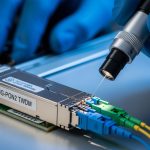
In modern 5G rollouts, fiber transceivers sit at the edge of the radio access network and often determine whether latency goals are met. This guide helps network engineers and field technicians plan the fiber side of a 5G deployment using the right 5G transceiver options, with practical spec checks, compatibility criteria, and failure-mode troubleshooting. You will also see what trends matter in 2025 to 2026: higher port density, tighter optics budgets, and stronger module authentication expectations.
Where 5G transceivers fit in the fiber transport path
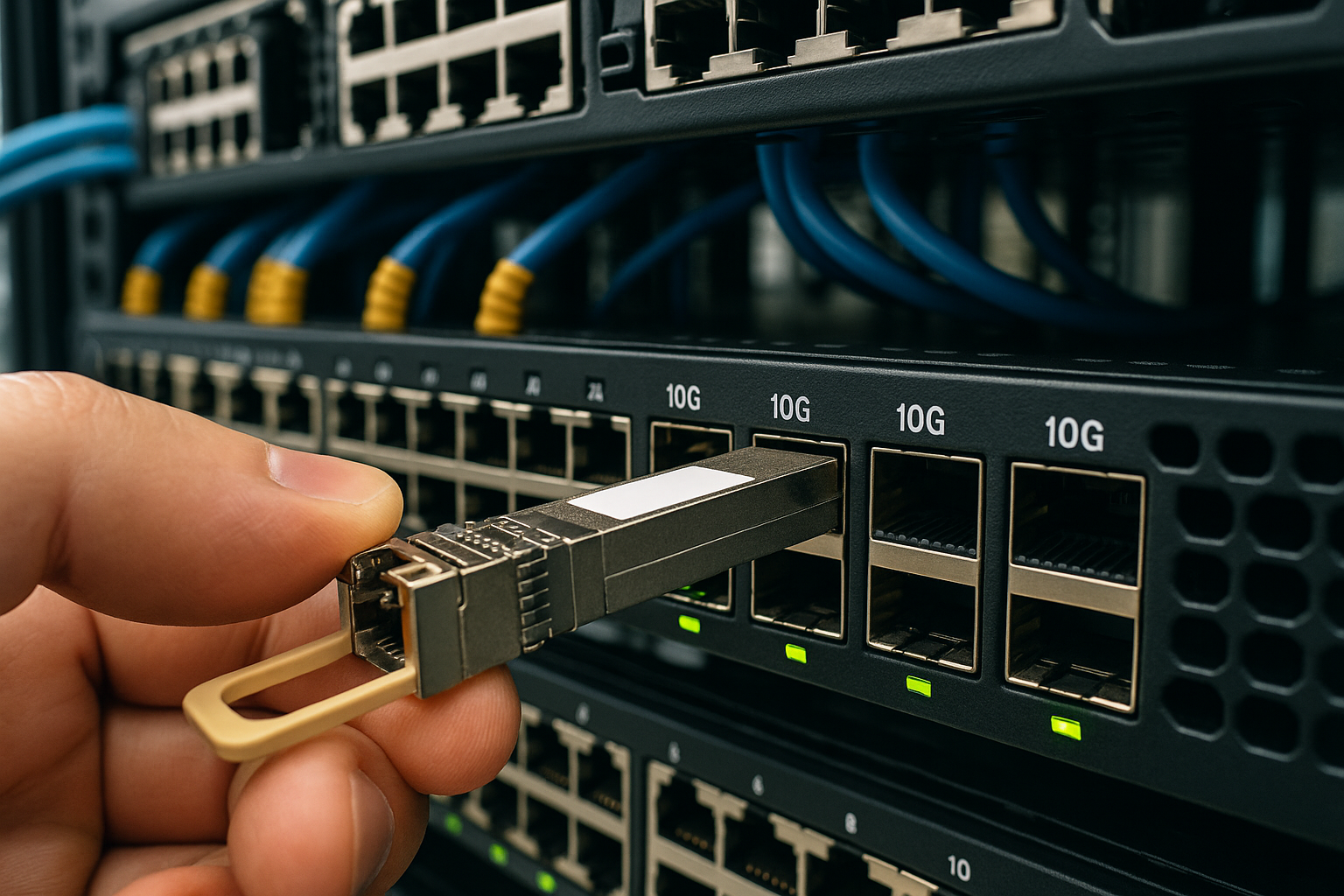
Most 5G sites rely on a fiber backhaul/fronthaul architecture where optics connect baseband equipment to aggregation or transport nodes. In a typical design, you might run 10G, 25G, or 100G Ethernet links from radio units or distributed units into leaf switches, then uplink to aggregation. The 5G transceiver choice affects reach, power consumption, and stability under temperature swings at outdoor cabinets.
IEEE Ethernet optics are commonly aligned to the host’s electrical interface and the optical standard’s wavelength plan. For example, 10GBASE-SR uses multi-mode fiber (MMF) around 850 nm, while 10GBASE-LR uses single-mode fiber (SMF) around 1310 nm. At higher speeds, 25G and 50G modules often leverage SR optics on MMF for short, high-density spans.
In practice, you plan the transceiver as a system: optics budget plus cabling plant plus switch port behavior. Vendor datasheets and standards such as IEEE 802.3 define electrical and optical requirements; switch vendors then publish “supported optics” lists and DOM expectations. If you ignore those, you can see link flaps, higher error rates, or modules rejected by the host.
Key fiber optics specs you must validate before ordering
To select a 5G transceiver, you need a quick “spec triage” that matches the optics to your fiber type, distance, and temperature environment. Start with the optical standard, connector, wavelength, and reach, then validate power and DOM support because many operators standardize on temperature-qualified modules for field reliability.
The table below compares representative module families you may use in 5G transport segments (examples shown with common part numbers). Always confirm exact values in the vendor datasheet for your selected temperature grade and revision.
| Transceiver type (example) | Data rate | Wavelength | Fiber type | Typical reach | Connector | DOM support | Operating temperature |
|---|---|---|---|---|---|---|---|
| Cisco SFP-10G-SR (10GBASE-SR) | 10G | 850 nm | MMF | ~300 m (OM3/OM4 varies) | LC | Yes (vendor-specific) | Usually commercial or industrial grade depending SKU |
| Finisar FTLX8571D3BCL (10GBASE-SR) | 10G | 850 nm | MMF | ~300 m class | LC | Commonly supported | Varies by ordering code |
| FS.com SFP-10GSR-85 (10GBASE-SR) | 10G | 850 nm | MMF | ~300 m class | LC | Often supported | Varies by grade |
| 10GBASE-LR style SFP+ (example: 1310 nm) | 10G | 1310 nm | SMF | ~10 km class | LC | Often supported | Varies by grade |
Practical validation checklist for the ordering phase:
- Distance vs reach: use the optical budget with margin (connector loss, splices, aging).
- Fiber grade: OM3 vs OM4 vs OS2 matters for SR optics; do not rely on “looks like MMF.”
- Connector cleanliness: LC endfaces must be inspected and cleaned; dust can dominate link margins.
- DOM behavior: ensure the switch reads DOM without alarm thresholds that cause port shutdown.
- Temperature grade: outdoor cabinets and shelter walls can exceed indoor assumptions; choose industrial or extended grade.
For standards grounding, review IEEE 802.3 for the Ethernet optical interface requirements, and your switch vendor’s optics compatibility guidance. IEEE 802.3 standard portal
Trends shaping 5G transceiver choices: density, power, and authentication
As 5G networks evolve, the transceiver is increasingly treated as a managed component, not a simple plug-in. Three trends show up repeatedly in field rollouts: higher port density (more optics per rack), tighter power and cooling budgets, and stronger module authentication policies. These trends can influence whether operators choose vendor OEM optics, approved third-party modules, or “compatible but not guaranteed” inventory.
1) Higher density and uplink speeds: leaf and aggregation switches increasingly use higher-speed optics, pushing engineers to standardize on SR for short hops and LR for longer SMF segments. Even when the radio sites still use 10G in many deployments, uplinks often move toward 25G to reduce oversubscription.
2) Power and thermal management: transceiver power varies by temperature grade and optical type. In a cabinet with restricted airflow, a higher-power module can raise cage temperature and trigger thermal alarms. This is why temperature validation and airflow design are part of “optics planning,” not just mechanical planning.
3) Authentication and monitoring: many modern switches use I2C/SFP management and DOM thresholds, and some enforce transceiver compatibility policies. If a module is not recognized or DOM reads outside expected ranges, you can see link down events after warm reboots or during temperature transients.
Pro Tip: In the field, most “bad optics” cases trace back to margin collapse, not the module itself. Measure with an optical power meter or verify link diagnostics, then check connector cleanliness and fiber grade before replacing inventory; a clean LC and correct OM grade can restore stability without swapping hardware.
Selection criteria for engineers: a decision checklist that prevents rework
Use this ordered checklist when selecting a 5G transceiver for a specific site. It is designed to reduce rework during acceptance testing and cut down on “works on bench, fails in cabinet” problems.
- Distance and fiber type: confirm MMF vs SMF, and for MMF confirm OM3/OM4 using test records or validated markings.
- Optical standard fit: match the required Ethernet rate and reach class (SR vs LR) to IEEE 802.3 expectations and switch port capabilities.
- Switch compatibility: check the exact switch model and its supported optics list; do not assume “SFP+ means SFP+” across vendors.
- DOM and alarms: verify DOM is read correctly and that thresholds do not cause port shutdown during normal thermal cycling.
- Operating temperature: choose the temperature grade that fits the enclosure profile; validate worst-case cage temperature and humidity exposure.
- Vendor lock-in risk: if the operator enforces strict authentication, plan approved inventory and lifecycle spares to avoid future procurement delays.
- Return and failure handling: confirm RMA terms and expected failure rates; optics are field-replaceable, but downtime costs are not.
For deployment planning, align your acceptance tests to what the switch reports: link status, error counters, and DOM telemetry (Tx power, Rx power, temperature). If your design includes redundancy (A/B uplinks), verify both paths under load rather than validating only one link.
Deployment scenario: planning a 5G fiber rollout for leaf-spine access
Consider a 3-tier data center leaf-spine topology with 48-port 10G ToR switches at the access tier and 25G uplinks to aggregation. For 5G transport at the edge, you may connect DU equipment to the leaf switches using 10GBASE-SR over OM4 MMF for runs up to 150 m, then uplink to aggregation over SMF using 10GBASE-LR or higher-speed optics depending on the aggregation budget. In this scenario, engineers typically plan optical margin for connector loss and splices, targeting at least a 3 dB operational safety margin for stable operation during cleaning cycles and fiber aging.
During commissioning, technicians run traffic while monitoring DOM telemetry and interface error counters. If an uplink shows intermittent CRC errors only during peak HVAC operation, the root cause is often thermal: a cage temperature rise shifts the optical power and increases BER, or the module reaches a borderline temperature threshold. The fix might be airflow adjustment, module grade change, or re-terminating a patch panel connector.
Common mistakes and troubleshooting tips for 5G transceiver links
Even experienced teams can stumble on optics. Here are concrete failure modes with root causes and fixes that commonly appear in 5G fiber work.
-
Mistake: Ordering SR modules for the wrong fiber grade.
Root cause: OM3 vs OM4 mismatch reduces effective link margin, especially with additional patch cords.
Solution: verify fiber grade in test records; re-run OTDR or at least confirm attenuation class; if needed, switch to LR over SMF for longer spans. -
Mistake: Skipping connector inspection after swapping optics.
Root cause: dust and micro-scratches on LC endfaces cause sudden Rx power collapse and link flaps.
Solution: inspect with a fiber microscope, clean with approved wipes and solvent, and replace damaged patch cords before attributing blame to the module. -
Mistake: Ignoring DOM alarm thresholds and thermal behavior.
Root cause: some optics report Tx/Rx power or temperature differently; the switch may log “module error” or disable the port.
Solution: compare DOM telemetry to vendor guidance; test in the same enclosure conditions; choose a temperature-qualified module grade. -
Mistake: Confusing “compatible form factor” with “compatible electrical behavior.”
Root cause: different vendors may implement management or calibration details differently, causing incompatibility on certain switch firmware.
Solution: validate against the switch model and firmware version; keep a small pilot batch and perform acceptance tests before scaling.
When troubleshooting, capture: port state transitions, DOM values (Tx power, Rx power, temperature), and interface error counters over time. Field teams often find the issue resolves after cleaning and margin re-check, saving unnecessary RMA cycles.
Cost and ROI note: balancing OEM optics, third-party modules, and total downtime
Pricing for a 5G transceiver depends on speed, reach, temperature grade, and whether DOM/authentication is tightly controlled. In many markets, 10G SR optics commonly land in a broad range (roughly tens to low hundreds of dollars per module), while LR and higher-speed optics can cost more. OEM modules may cost more upfront but can reduce commissioning time due to better compatibility with specific switch models.
From a total cost of ownership perspective, the biggest variable is downtime and labor. If third-party optics reduce purchase cost but increase acceptance failures or RMA rates, the savings disappear quickly. A practical approach is to standardize on one or two approved suppliers, maintain a tested spares pool sized to your swap cadence, and require DOM/telemetry verification during receiving.
Cisco optics guidance and compatibility concepts
FAQ
Q1: What fiber types are most common for a 5G transceiver in 5G transport?
Short runs inside buildings or data halls often use MMF with SR optics (commonly around 850 nm). Longer runs between buildings or across sites often use SMF with LR-style optics (commonly around 1310 nm). Your choice depends on measured distance and patch panel losses.
Q2: How do I confirm reach for a 5G transceiver before deployment?
Do not rely only on “typical reach” in marketing tables. Use an optical budget that includes connector insertion loss, splice loss, patch cords, and safety margin. Then validate with switch diagnostics and DOM telemetry during commissioning.
Q3: Will third-party optics work in my switch for a 5G transceiver?
Often they can, but compatibility depends on the exact switch model, firmware version, and DOM/authentication expectations. The safest approach is a pilot test with your switch and temperature conditions, and then lock to approved part numbers.
Q4: Why does a 5G transceiver link flap only when the cabinet warms up?
Thermal stress can push the module toward its temperature or optical power operating limits, increasing error rates and triggering alarms. Check cage airflow, verify module temperature grade, and review DOM values during the warm-up period.
Q5: What should I measure first when a 5G transceiver shows link down?
Start with connector cleanliness and endface inspection, then confirm Rx power levels and DOM status. Next, verify fiber polarity (for some connectors) and confirm the fiber grade and attenuation class match the optics standard.
Q6: What trends should procurement teams plan for when buying 5G transceivers?
Plan for higher density and higher speeds in uplinks, plus stronger authentication and monitoring requirements. Maintain an approved optics list, enforce receiving tests using DOM telemetry, and keep spares sized for your MTTR and swap windows.
If you want a next step, map your site fiber inventory to an optics plan by port speed, distance class, and temperature environment using fiber-optic-transceiver-compatibility-and-dom.
Expert author bio: I have deployed and troubleshot fiber optics in telecom and data center environments, focusing on DOM telemetry, acceptance testing, and failure root-cause analysis. My work emphasizes repeatable field procedures that reduce RMA cycles and downtime for critical network links.