
In modern data centers, you often hit a hard constraint: reach, power, and port density all at once. This guide helps network engineers and field teams decide when a PAM4 modulation optical transceiver is the better fit than an NRZ-based transceiver, with practical compatibility checks and failure-mode troubleshooting. You will also get a quick decision checklist, a specs comparison table, and real-world deployment numbers.
How PAM4 changes the transceiver trade space versus NRZ
NRZ (Non-Return-to-Zero) conveys one bit per symbol; PAM4 (Pulse Amplitude Modulation with 4 levels) conveys two bits per symbol, which can enable higher line rates over the same electrical and optical packaging constraints. In practice, PAM4 transceivers (common in 50G/100G-class Ethernet optics) use tighter signal integrity budgets: more sensitivity to dispersion, bandwidth limits, and receiver linearity. Standards alignment matters: IEEE 802.3 defines optical interfaces and performance requirements for these speeds, while vendor implementations differ in equalization, FEC modes, and DOM behavior. For authoritative baseline requirements, review [Source: IEEE 802.3] [[EXT:https://standards.ieee.org/standard/802_3]]
What engineers notice in the field
With PAM4 optics, you usually see more operational dependence on link design: fiber type, patch cord quality, connector cleanliness, and whether the switch port expects a specific reach/FEC profile. A typical symptom of marginal PAM4 links is intermittent CRC/FEC correction spikes rather than a clean “link down.” NRZ links tend to fail more abruptly when out of spec, making PAM4 both more efficient and sometimes more delicate.
Pro Tip: Before swapping optics, pull live telemetry for receiver power, FEC/BER indicators, and DOM alarms. PAM4 margin issues often show up as rising correction counts even when link stays “up,” so you can prevent repeated truck rolls by trending those values over 24 to 72 hours.
Key specs comparison: PAM4 modulation optical transceiver vs NRZ
Use a direct spec comparison to avoid mixing “marketing reach” with engineering reach. Below is a practical comparison for common data-center optics profiles; actual supported distances depend on vendor calibration, fiber plant, and the host switch’s lane mapping and FEC settings.
| Parameter | NRZ optical transceiver (typical) | PAM4 modulation optical transceiver (typical) |
|---|---|---|
| Bits per symbol | 1 | 2 |
| Common Ethernet speed examples | 25G, 50G NRZ (varies by standard) | 50G PAM4, 100G PAM4-class |
| Receiver sensitivity sensitivity to impairments | Often more tolerant to some bandwidth limits | More sensitive to dispersion, bandwidth, and linearity |
| FEC usage | May be optional depending on interface | Often coupled with PAM4 performance targets |
| DOM/telemetry | Commonly available; vendor-specific thresholds | Commonly available; watch DOM alarms and correction trends |
| Operating temperature | Varies by grade; e.g., commercial vs industrial | Varies by grade; match switch expectations |
| Typical connector types | LC duplex for short reach multimode | LC duplex for most short-reach multimode |
For concrete module examples you may encounter in real deployments: Cisco SFP-10G-SR is NRZ and far lower line rate than PAM4 modules; for PAM4 short-reach use cases, vendors commonly offer 100G SR4 PAM4 optics such as Finisar FTLX8571D3BCL and FS.com SFP-10GSR-85 (availability varies by speed class). Always confirm the exact modulation and electrical interface in the vendor datasheet, not just the speed rating.
Real-world deployment scenario: when PAM4 wins
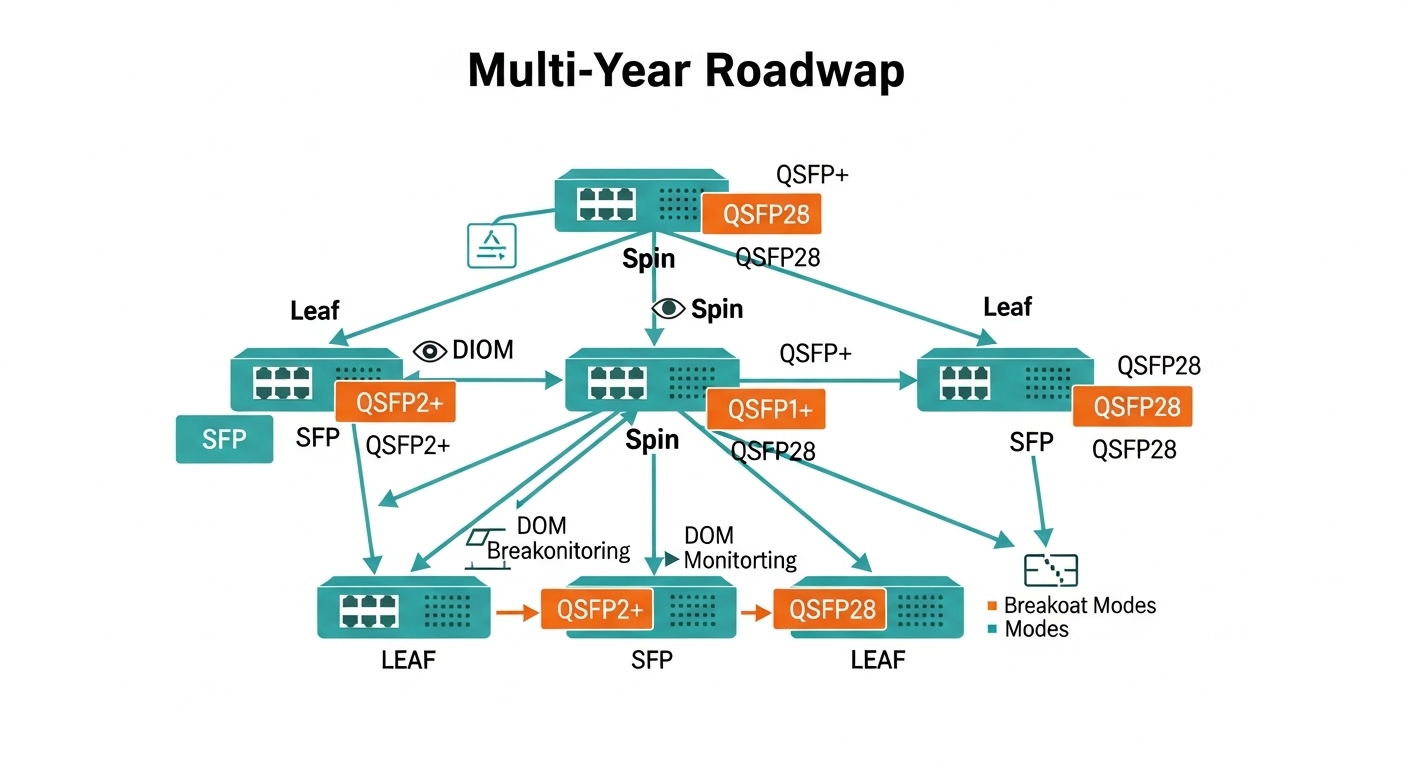
Consider a 3-tier data center leaf-spine topology with 48-port 100G ToR switches. Leaves use 100G links to a spine over OM4 multimode fiber with 80 m average patch-and-cable reach (including two patch cords). The operator needs higher oversubscription headroom but cannot add more copper or increase power budgets. PAM4 modulation optical transceivers are selected because they support 100G-class throughput with compact optics and manageable power per port, while NRZ options at comparable throughput would require different optics formats or higher serializer/deserializer complexity at the host.
Operationally, the team validates receiver optical power and checks that each switch vendor’s optics compatibility list includes the exact module part number and FEC profile. After cutover, they monitor corrected error counters and DOM thresholds; the link design is considered healthy when correction counts remain stable and receiver power stays within the module’s specified range over daily temperature swings.
Selection criteria and decision checklist (engineer-ready)
Use this ordered checklist before purchasing or swapping optics. It reduces “it links but it flakes” events that are common with PAM4.
- Distance and fiber plant: verify OM4/OM5 type, connector count, and total optical budget; PAM4 often needs tighter margins.
- Switch compatibility: confirm the vendor’s supported optics list for the exact port speed mode (e.g., 100G PAM4 vs other profiles).
- FEC and link settings: ensure the transceiver and switch agree on FEC mode; mismatch can break performance even when link is “up.”
- DOM support and telemetry thresholds: check whether your monitoring system expects standard DOM fields and vendor-specific alarm mappings.
- Operating temperature grade: match module grade to ambient conditions; field failures rise when commercial modules run near their upper limits.
- Vendor lock-in risk: evaluate third-party optics policies, warranty terms, and whether your switch enforces part-number whitelisting.
- Connector cleanliness workflow: PAM4 margin can be consumed by dirty ferrules; standardize inspection and cleaning SOPs.
Common pitfalls and troubleshooting tips
Below are frequent failure modes specific to PAM4/NRZ coexistence and short-reach optics in production.
Link stays up but errors spike after a “successful” install
Root cause: insufficient optical/electrical margin (patch cord loss, bend radius issues, or connector contamination) combined with PAM4 equalization limits. Solution: inspect and clean connectors, measure receive power at the switch, verify fiber type, and compare against the module’s datasheet min/max. If available, review FEC correction trend over time.
FEC profile mismatch between switch and transceiver
Root cause: the switch expects one FEC mode while the module advertises another, leading to BER performance collapse. Solution: check the switch CLI for negotiated FEC settings and confirm the transceiver’s interface description; replace with a module explicitly validated for that host/port mode.
Using the wrong reach class for the fiber plant
Root cause: selecting “short reach” PAM4 optics for a link that effectively behaves like a longer reach due to excessive patch cord count, aging plant, or higher-than-expected insertion loss. Solution: recalculate total insertion loss and budget with actual measured values, not assumptions; reduce patch cord count or upgrade to a higher reach SKU.
Thermal drift causing intermittent receiver degradation
Root cause: module operation near upper ambient limits reduces margin for PAM4 receivers. Solution: verify airflow, confirm ambient temperature at the cage, and use the appropriate temperature grade (commercial vs extended). Re-seat optics and check for damaged cages that impair airflow.
Cost and ROI note: what to budget for
In many markets, PAM4 modulation optical transceivers for 100G-class short reach are priced higher than older NRZ optics, but they can reduce total cost by enabling higher density and avoiding additional chassis lanes or alternative cabling strategies. As a rough planning range, third-party 100G PAM4 optics may be priced around $80 to $250 per module, while OEM-branded modules often cost more; your actual TCO depends on failure rates, warranty terms, and whether your switch enforces strict part-number whitelisting. Over a multi-year lifecycle, the ROI usually comes from fewer ports per rack expansion and lower power per delivered throughput, but only if you maintain cleanliness and monitoring discipline to protect PAM4 link margin.
FAQ
Is a PAM4 modulation optical transceiver always better than NRZ?
No. PAM4 can deliver higher throughput per symbol, but it is typically more sensitive to link impairments and requires tighter engineering margins. For very short, clean links, NRZ may be simpler and more forgiving.
What should I verify first when a PAM4 link errors intermittently?
Start with receiver optical power and DOM alarms, then check FEC correction trends and negotiated FEC mode. If correction counts climb after installation, treat connector cleanliness and optical budget as primary suspects.
Can I mix NRZ and PAM4 optics in the same switch?
Often yes at the port level, but each port must be configured for the correct speed mode and each optics must be validated by the switch vendor. Mixing without matching interface expectations can lead to negotiation or performance issues.
Do I need special fiber types for PAM4?
Not necessarily, but reach class must match your fiber plant. For short-reach multimode deployments, OM4 or
