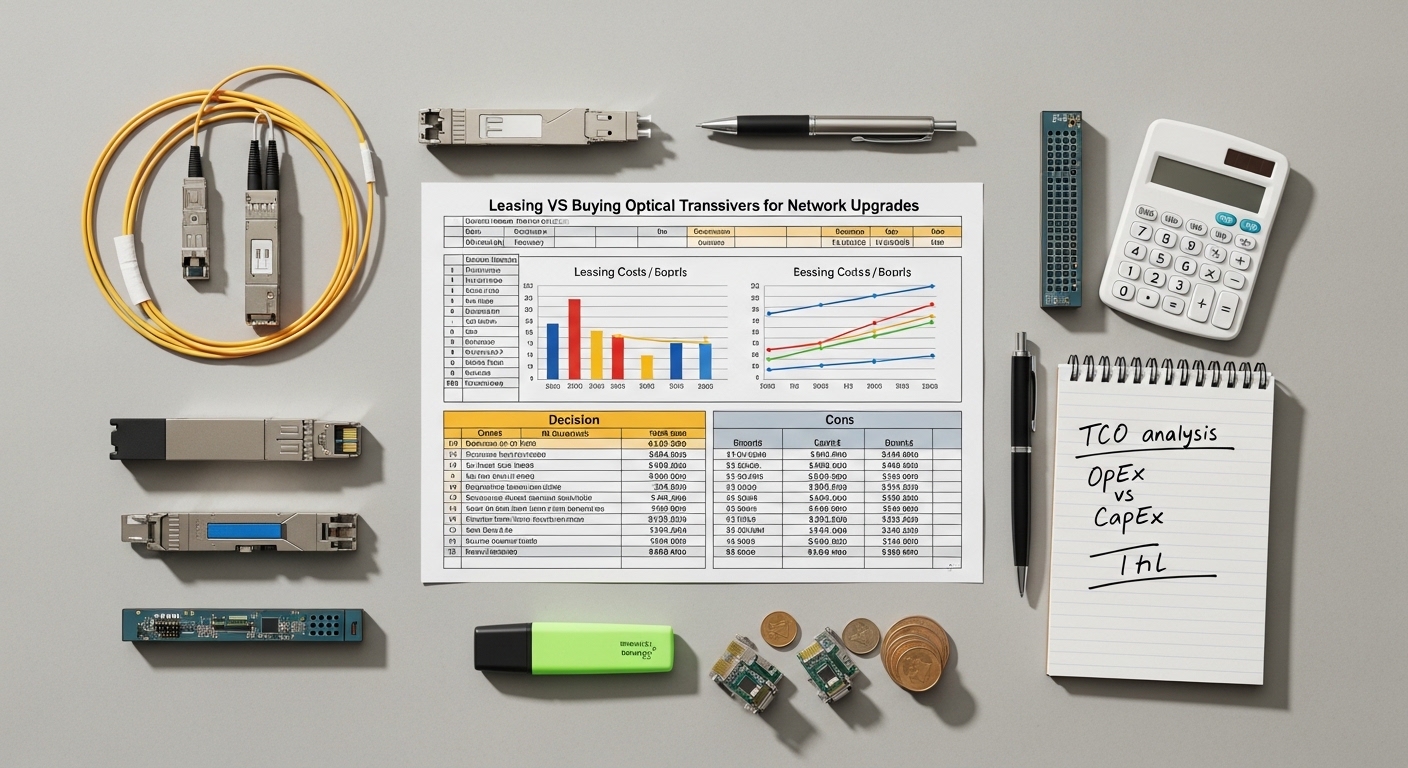
If your data center is scaling from 10G to 25G or 100G, optical transceivers can become both a budget line item and an operational risk. This article helps network and finance teams build an optics financial model to decide whether to lease or buy during upgrades, using real cost drivers like lead time, failure rate, spares strategy, and vendor compatibility. It is written for engineers who must keep links stable while procurement cycles, RMA logistics, and power budgets shift year to year.
Top 7 factors in an optics financial model for transceiver decisions
Start the model by separating cash flow into upfront purchase costs, recurring lease payments, and indirect costs like downtime, truck rolls, and spare inventory carrying costs. In practice, teams often undercount the cost of link bring-up failures when optics are mismatched to switch firmware or fiber plant. A sound model also includes the probability of replacements during the contract term, then estimates the expected value of RMAs and cross-shipping delays.
From an engineering viewpoint, the most sensitive variables are typically annual utilization growth, mean time to failure assumptions, and lead time variance during peak demand. From a finance viewpoint, the biggest lever is whether you can reuse spares across refresh cycles without being forced into expensive “new generation” modules.
- Distance and reach: SR vs LR vs ER determines BOM and power.
- Switch compatibility: vendor lock-in, DOM handling, and optics thresholds.
- Temperature and cooling: impacts derating and failure probability.
- Inventory carrying cost: capital cost + warehouse + obsolescence risk.
- RMA and logistics: downtime cost and shipping time.
- Contract terms: lease end-of-term buyout clauses and swap policies.
- Upgrade cadence: whether optics last beyond the lifecycle of the switch.
Upfront cash vs recurring lease payments: model the cash flow correctly
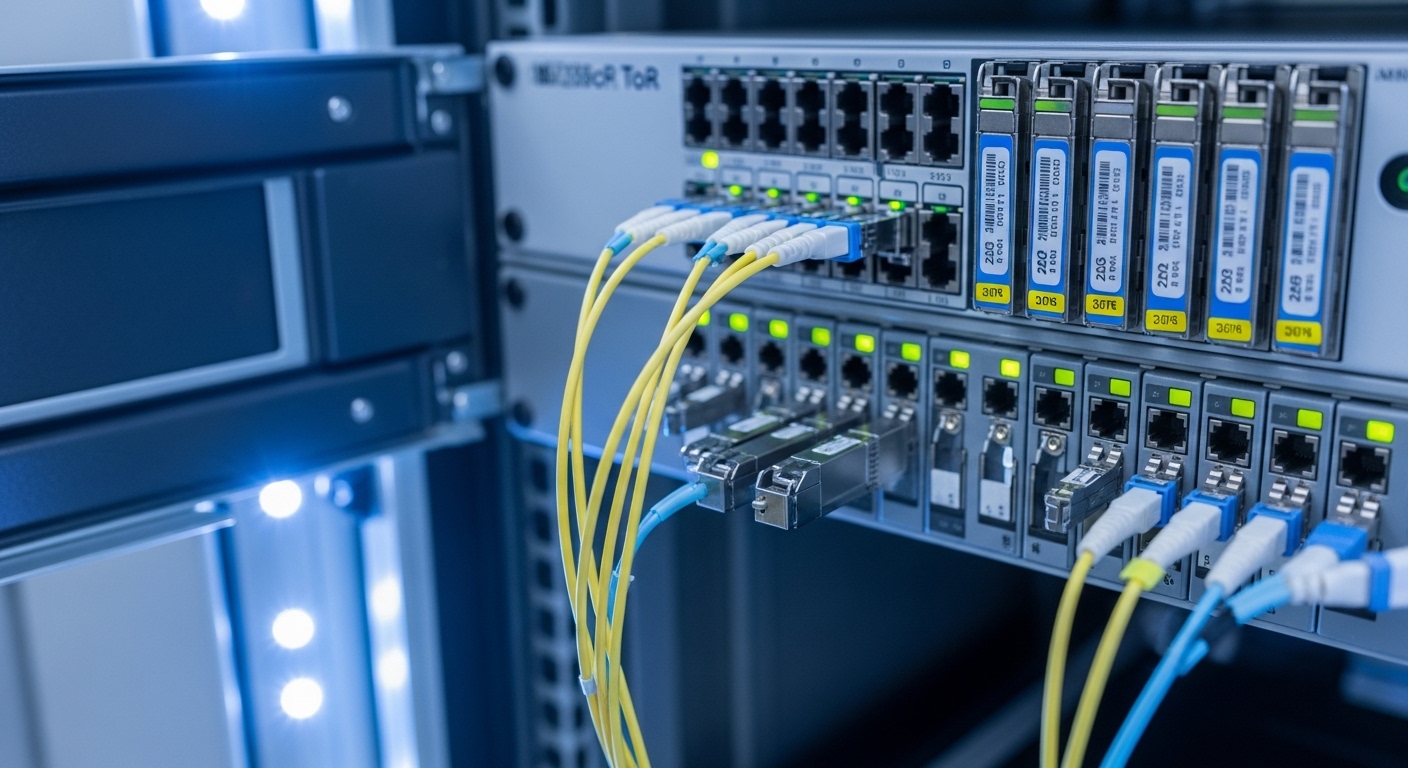
Buying usually creates a large upfront outlay, while leasing converts that into predictable monthly payments. In an optics financial model, you should treat purchase inventory as capital tied up with an annual carrying rate (often using your organization’s weighted average cost of capital plus storage and obsolescence buffers). Leasing can reduce capital pressure, but it may increase total cash paid over time.
Operationally, leasing can also reduce procurement friction when you need optics for a short rollout window. However, you must validate that leased modules meet the switch’s transceiver requirements, including DOM reporting and threshold settings. For many enterprises, this becomes a “test first” exercise: deploy a small batch, measure optical power and BER, then scale.
Best-fit scenario
Use leasing when you have a time-boxed migration (for example, adding 300 ports in 8 weeks) and you face variable supplier lead times. Use buying when your upgrade cadence is stable and you can forecast optics demand with low variance.
Pros: faster access, lower capital strain, swap flexibility. Cons: potentially higher long-term cost, contract constraints, and compatibility validation still required.
Total cost of ownership inputs: power, spares, RMA, and downtime
Whether you lease or buy, your optics financial model must include energy and operational costs. For modern short-reach optics, power draw is often around 0.9 W to 1.7 W per module depending on form factor and speed, plus switch PHY overhead. Multiply by port count and expected duty cycle to estimate incremental energy cost, then include cooling impacts if your facility is near capacity.
Spares and RMA handling can dominate total cost when upgrades are aggressive. A common field pattern: engineers keep a small spare pool per site, but if you are mixing generations (SFP28 alongside SFP+ or QSFP28 alongside QSFP+), spares can become stranded. Leasing can help if the provider guarantees module availability and fast replacements, but only if the contract includes response times and defined swap conditions.
Best-fit scenario
Use buying when you can centralize spares across sites and your RMA turnaround is already well-managed. Use leasing when you cannot tolerate downtime during cutovers or when you lack spare discipline.
Pros: buying enables optimized spares pooling; leasing can reduce downtime risk. Cons: both require accurate failure-rate assumptions and clear RMA workflows.
Compatibility and standards: IEEE and vendor optics behavior
Optical transceivers are governed by IEEE 802.3 specifications for electrical and optical characteristics, but real-world compatibility depends on vendor implementation details like DOM interpretation and link training behavior. For example, 10GBASE-SR and 100GBASE-SR4 have wavelength and modulation requirements defined in IEEE 802.3, but switches may have stricter optics compliance checks than the minimum standard.
Before modeling costs, validate that the intended optics family is supported by your switch models and firmware. Many data center outages tied to optics are not “bad optics” but unsupported optics parameters: incorrect DOM thresholds, marginal optical budgets, or optics that fail vendor-specific qualification. Always check the switch vendor’s optics compatibility matrix and confirm that your monitoring stack can read DOM fields (temperature, TX bias, received power).
Best-fit scenario
Choose buying when you can confidently source modules that are on the approved list and you can test once per platform. Choose leasing when you need flexibility across multiple switch models and you want the provider to manage compatibility.
Pros: standards reduce risk when you use approved optics. Cons: “standards-compliant” does not guarantee “switch-approved.”
Reach, wavelength, and optical budget: the spec-driven cost driver
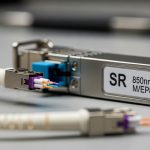
Your model should translate physical fiber constraints into module selection, because reach and wavelength affect both price and power consumption. A typical upgrade path might use SR over OM4 for short distances, while LR/ER is needed for longer runs or higher split ratios. For example, SR optics commonly target 850 nm over multimode fiber, while LR uses 1310 nm over single-mode fiber; ER targets 1550 nm for extended budgets.
| Optics type | Nominal wavelength | Typical reach | Form factor | Connector | Temperature range | Notes for financial model |
|---|---|---|---|---|---|---|
| 10GBASE-SR | 850 nm | ~300 m (OM3) / ~400 m (OM4) | SFP+ | LC | 0 to 70 C (typical) | Often lowest cost per port; sensitive to budget and cleanliness |
| 100GBASE-SR4 | 850 nm | ~100 m (OM4 typical) | QSFP28 | LC (12-fiber MPO) | 0 to 70 C (typical) | Higher module cost; budget quickly consumed by patching |
| 10GBASE-LR | 1310 nm | ~10 km | SFP+ | LC | -5 to 70 C (often) | Single-mode plant costs dominate; lower cleaning sensitivity |
| 100GBASE-LR4 | 1310 nm | ~10 km | QSFP28 | LC | -5 to 70 C (often) | Higher per-module price; best when fiber is already SM |
Best-fit scenario
If your fiber plant is already OM4 and within SR reach, buying can be cost-effective because module prices are relatively stable. If you must add SM fiber or perform major rework, leasing may help during phased deployments where not all links are ready at once.
Pros: spec alignment reduces failure probability. Cons: underestimating patch loss is a common cause of rework costs.
Pro Tip: In the field, the most expensive “surprise” is not the optics price; it is patching loss. Measure end-to-end receive power and BER during the first wave, then bake the observed margin into the optics financial model so later phases stop repeating the same re-cabling work.
Risk and uncertainty: lead times, contract leverage, and obsolescence
Leasing can lower uncertainty when supply chains are volatile, but it introduces contract risk. Your model should include the probability of delayed shipments for purchased optics, then compare it with leasing provider commitments. Also consider the risk of technology churn: if you are moving from 25G to 50G or 100G QSFP28 variants, older optics may become stranded inventory.
Obsolescence should be treated explicitly. If you buy modules for a switch generation that will be replaced within 24 months, your model must include a salvage or reuse assumption; if reuse is low, carrying cost becomes pure loss. Leasing can be attractive when your refresh cadence is unpredictable, but only if the contract allows swaps across compatible platforms.
Best-fit scenario
Use leasing for pilot phases and environments with uncertain expansion timelines. Use buying for steady state where procurement forecasts are reliable and approved optics lists are stable.
Pros: leasing reduces stranded inventory risk. Cons: contract terms can limit future reuse and may still require compatibility tests.
Measured deployment scenario: leaf-spine upgrade with port growth
Consider a 3-tier data center leaf-spine topology with 48-port 25G ToR switches and 2 spine tiers. The team plans to activate 240 new downlinks and 60 uplinks over 10 weeks, using QSFP28 or SFP28 depending on platform. They have OM4 to the rack row, with a measured installed link loss budget averaging 1.8 dB of margin after patching, but with occasional outliers up to 3.0 dB due to dirty connectors and re-terminated jumpers.
In the first wave, they test two optics SKUs: a manufacturer-approved option and a third-party option. BER is verified by running continuous traffic at line rate and checking error counters; they also validate DOM telemetry visibility in the monitoring system. With that evidence, leasing is used only for the first 60 ports because the procurement lead time for the full quantity is unpredictable; buying is used for the remaining 180 ports because stock arrives within the tested time window.
This approach typically improves schedule reliability without overpaying for long-term leases. The optics financial model reflects the blended strategy by weighting lease costs by the fraction of ports delivered late.
Price and ROI: realistic ranges and when each wins
Typical market pricing varies by speed, reach, and connector type, but enterprises often see third-party optics priced at a meaningful discount compared with OEM. As a planning baseline for an optics financial model: a 10GBASE-SR SFP+ might range from tens of dollars to low hundreds depending on brand and certification; a 25G SFP28 SR or QSFP28 100G SR4 can be substantially higher. OEM optics are usually priced higher, with higher confidence in qualification and predictable DOM behavior.
TCO should include expected failures and how quickly you can replace them. If your environment has strict uptime requirements, downtime cost can dwarf price differences. Leasing can pay off when it prevents missed cutovers, but if your supply chain is stable and you have a disciplined spare program, buying often wins on long-term cost.
Best-fit scenario
Lease when schedule risk is high and lead times are uncertain. Buy when you can validate optics once, then standardize across the fleet.
Pros: you can optimize cost by matching strategy to rollout risk. Cons: ROI depends on accurate failure-rate and downtime cost assumptions.
Common mistakes / troubleshooting in transceiver leasing vs buying
1) Mistake: Treating “optics compatible” as binary.
Root cause: DOM threshold handling, vendor-specific optical power expectations, or firmware optics qualification differences. Some switches accept the module electrically but clamp the link due to out-of-range diagnostics.
Solution: Validate with a small pilot using the exact switch model and firmware version; confirm DOM telemetry and link stability under sustained traffic. Reference IEEE 802.3 requirements and the switch vendor optics compatibility list.
2) Mistake: Ignoring fiber cleanliness and patch loss variability.
Root cause: Dirty LC or MPO endfaces and inconsistent patching can reduce optical margin, especially for SR optics where the budget is tight.
Solution: Implement connector inspection and cleaning (including MPO cleaning procedures), verify with OTDR or OLTS where feasible, and record measured receive power to update the optics financial model assumptions.
3) Mistake: Underestimating RMA logistics and spares lead times.
Root cause: Even with fast shipping, replacement optics can be delayed by receiving dock processes, serial number tracking, or missing DOM configuration support.
Solution: Pre-stage spares by site and keep a clear RMA workflow: label inventory by switch, port type, and optics family. For leasing, require contract language specifying replacement SLAs and swap conditions.
4) Mistake: Over-allocating budget to power savings without measuring real utilization.
Root cause: Link speed and traffic patterns vary; power draw at idle vs full load can shift the ROI calculation.
Solution: Use switch telemetry to estimate actual utilization, then calculate energy cost using measured port counts and duty cycles rather than nameplate assumptions.
FAQ
Q: What does an optics financial model include besides the module price?
A: Include cash flow timing, inventory carrying cost, energy cost, spares strategy, RMA probability, and expected downtime cost during cutovers. Also model lead time variance and the risk of stranded inventory if the switch refresh cadence changes.
Q: Does leasing guarantee optics compatibility with my switches?
A: Not automatically. You still must verify that leased modules are accepted by your switch firmware and that DOM telemetry works with your monitoring system. Require a pilot test and insist on documented compatibility for your exact switch models.
Q: When does buying clearly beat leasing?
A: Buying typically wins when your lead times are stable, your upgrade scope is forecastable, and you can standardize optics across the fleet. It also wins when you can pool spares and keep failure handling efficient.
Q: When does leasing become the safer choice?
A: Leasing becomes compelling when schedule risk is high, procurement lead times are unpredictable, or the rollout is phased with uncertain completion dates. It can also help when you expect near-term platform changes and want to reduce stranded inventory risk.
Q: Are third-party optics always cheaper and always acceptable?
A: Third-party optics can be cheaper, but acceptance depends on switch compatibility, DOM behavior, and qualification. Validate with a pilot and check the switch vendor optics matrix before scaling.
Q: How do I validate the optical budget for SR optics during deployment?
A: Measure end-to-end receive power and verify link stability under sustained traffic. If you observe margin shrinkage, update patching practices and re-calculate the margin used in your optics financial model.
For decision-making, treat the optics financial model as a living artifact: update it after the first pilot wave with measured receive power, error counters, and real lead times. Next, standardize your selection process using the internal guidance in transceiver lifecycle planning to keep upgrades predictable and resilient.
Author bio: I design high-availability network systems and have led optics rollout programs across leaf-spine fabrics with measurable BER validation and operational RMA playbooks. I also build TCO models that account for compatibility risk, inventory obsolescence, and deployment schedule variance.
Sources: [Source: IEEE 802.3 Ethernet specifications], [Source: Vendor switch optics compatibility matrices and transceiver electrical/DOM guidance], [Source: ANSI/TIA-568 optical cabling performance considerations], [Source: vendor and third-party SFP28/QSFP28 datasheets]