In modern optical fabrics, an optical switching transceiver is only as reliable as its pairing with the Wavelength Selective Switch (WSS) plan. This helps network teams who are deploying leaf-spine or metro transport, and who need to avoid silent wavelength drift, insertion-loss surprises, and control-plane mismatch. This quick reference focuses on what to verify before you buy, how to validate in the field, and how to estimate total cost of ownership.
How WSS expects your optical switching transceiver to behave
WSS routing is wavelength-selective: it steers specific ITU-T grid wavelengths to specific output ports. In practice, the WSS controller assumes your transmitter lands inside a defined wavelength window and that your receiver sensitivity and OSNR budget align with expected path loss. When the wavelength plan and the transceiver characteristics disagree, you can see channel loss, intermittent errors, or full channel drop.
Key parameters that must match the WSS wavelength plan
- Center wavelength accuracy versus ITU grid (commonly 100 GHz or 50 GHz spacing depending on platform).
- Spectral shape (side-mode suppression, linewidth) which affects cross-talk and WSS filtering margin.
- Output power and expected aging drift; WSS adds insertion loss and may require higher launch power.
- Receiver sensitivity and OSNR requirements at the far end after filtering.
Standards and vendor constraints matter. IEEE 802.3 defines electrical interfaces for pluggables, while optical performance is governed by vendor datasheets and ITU grid practices. For authoritative wavelength grid context, see [Source: ITU-T G.694.1]. For transceiver optical behavior, rely on the specific module vendor datasheet and compliance statements.
ITU-T G.694.1 wavelength grid reference
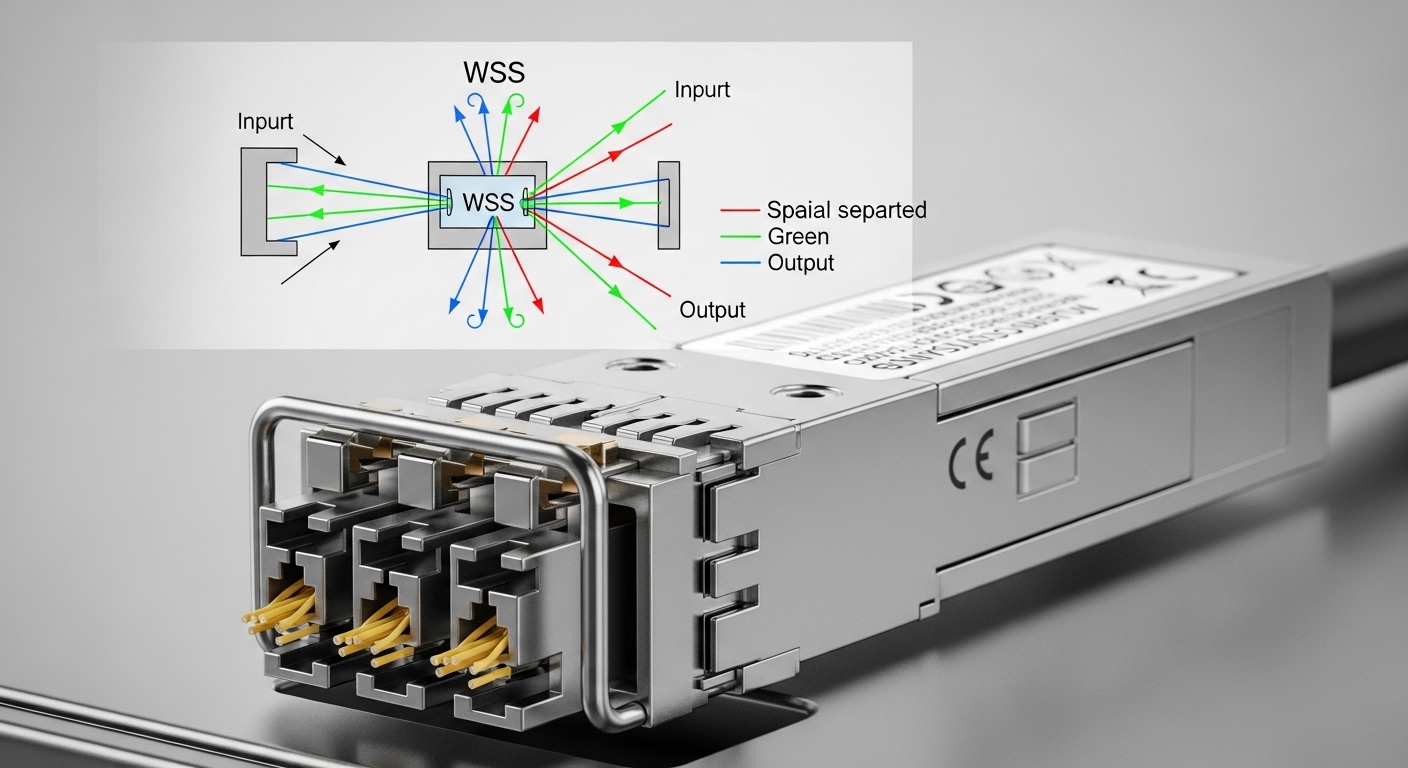
Spec comparison: common transceiver options for WSS fabrics
WSS systems often use grid-aligned coherent or narrow-linewidth optics, but some designs also use fixed-wavelength pluggables with strict wavelength calibration. Below is a practical comparison you can use to sanity-check fit before rollout.
| Parameter | Fixed-wavelength transceiver (example class) | Tunable/narrow-linewidth option (example class) |
|---|---|---|
| Typical use with WSS | Static channel mapping | Dynamic channel assignment |
| Wavelength alignment | Must match ITU grid tightly | Must tune within grid and settle quickly |
| Optical output power | Often ~0 to +2 dBm class (varies by vendor) | Often higher launch capability; confirm exact datasheet |
| Receiver sensitivity | Depends on modulation format; confirm OSNR/BER targets | Depends on coherent DSP; confirm DSP OSNR requirement |
| Connector | LC or MPO depending on form factor | Same; confirm housing and fanout constraints |
| Operating temperature | Commonly commercial or industrial ranges; verify case temp rating | Same; coherent optics may be more sensitive to thermal drift |
| DOM support | Required for monitoring power and diagnostics | Required for wavelength, power, alarms |
When selecting actual parts, match the vendor’s ITU grid claim and DOM fields to what your WSS controller expects. Many teams successfully deploy branded modules such as Cisco SFP-10G-SR only for short-reach SR links; for WSS fabrics you typically need grid-aligned transmitters rather than generic SR optics. For third-party optics, confirm identical wavelength calibration methodology and DOM mapping with your switch and WSS vendor.
Pro Tip: During acceptance testing, do not rely solely on “nominal wavelength” in the label. Pull DOM wavelength and optical power telemetry, then compare it to the WSS channel filter window used by the controller. Field teams often catch a mismatch only after measuring the real center wavelength after warm-up, not at cold start.
Deployment scenario: validating pairing in a metro optical fabric
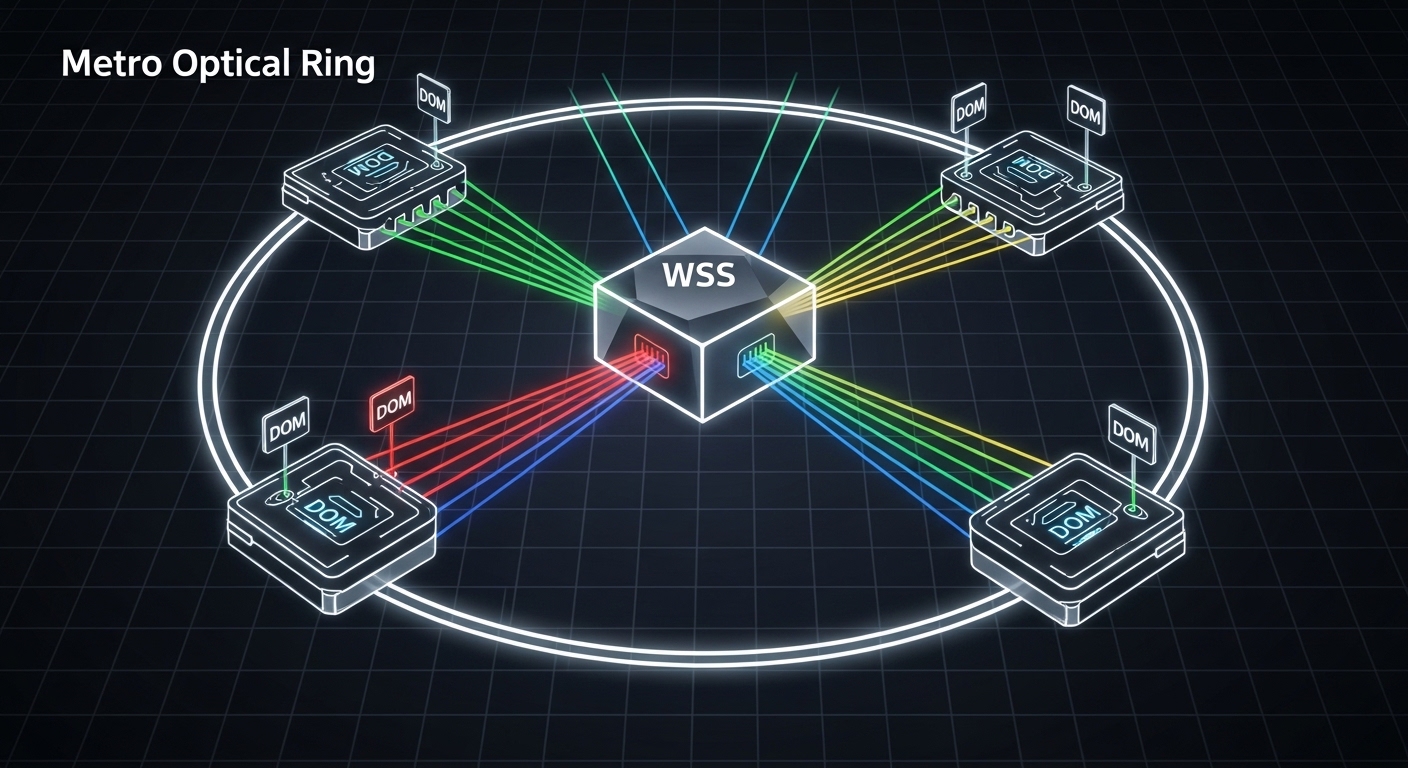
In a 3-tier metro network with 2,048 routed channels, a team deployed an optical switching transceiver set for fixed-channel mapping to reduce control complexity. They used a WSS with a 100 GHz grid and a planned insertion-loss budget of 6 to 9 dB per path after connectors, patch panels, and WSS switching. During staging, they verified each transceiver’s DOM-reported center wavelength after 30 minutes warm-up, then ran BER monitoring at the service layer. The only failures were two channel groups where the transceiver vendor’s wavelength calibration drifted under higher enclosure temperature, causing WSS attenuation peaks and higher error rates.
Selection criteria checklist for WSS pairing decisions
- Distance and optical budget: include WSS insertion loss, aging margin, and worst-case connectors.
- Wavelength plan: confirm ITU grid spacing and the exact center wavelength tolerance required by your WSS controller.
- Switch compatibility: verify the optical switching transceiver is on the switch vendor compatibility list for DOM behavior.
- DOM and alarm mapping: ensure the transceiver exposes wavelength and power fields your operations tooling can ingest.
- Operating temperature: validate enclosure case temperature and expected transmitter drift; plan for warm-up behavior.
- Vendor lock-in risk: assess whether third-party optics will pass the same WSS calibration expectations and support policy.
- Testability: confirm you can measure launch power and wavelength remotely, or at least with repeatable lab procedures.
Common pitfalls and troubleshooting tips
- Pitfall: Channel works at room temperature but degrades after cabinet heat soak. Root cause: wavelength drift outside WSS filter window. Solution: measure DOM wavelength after warm-up and at the target enclosure temperature; add thermal margin or swap to optics with tighter wavelength accuracy.
- Pitfall: Intermittent errors only on specific WSS output ports. Root cause: asymmetric insertion loss or polarization-dependent effects interacting with spectral shape. Solution: compare optical power and OSNR by port; verify fiber polarity and patch panel cleanliness; confirm vendor spectral compliance.
- Pitfall: “Compatible” transceiver passes switch diagnostics but WSS channel drops. Root cause: DOM wavelength/power reporting format mismatch or inaccurate wavelength calibration assumptions. Solution: validate WSS controller logs, confirm DOM field mapping, and run wavelength verification with a calibrated optical spectrum analyzer.
- Pitfall: Power budget failure due to overlooked connector loss. Root cause: extra patch cords or dirty LC/MPO endfaces. Solution: include worst-case connector loss in budget; enforce endface inspection and cleaning SOPs.
Cost and ROI note: budgeting for optics, optics risk, and downtime
Typical enterprise optics pricing varies widely by reach and modulation, but for WSS-linked deployments you should budget for higher-spec optics and acceptance testing time. OEM modules often cost 1.2x to 2.5x third-party pricing, but can reduce integration risk if DOM behavior and wavelength calibration are tightly aligned with the WSS platform. TCO should include spares stocking strategy, failure rate history, and the cost of outage during channel commissioning. A practical ROI lever is to avoid rework: investing in wavelength verification and thermal soak testing can prevent costly “truck-roll” events during cutover.

FAQ
How do I confirm my optical switching transceiver matches the WSS grid?
Use DOM telemetry to capture center wavelength and output power after warm-up, then compare it to the WSS channel filter window and controller configuration. For the final gate, validate with a calibrated optical spectrum analyzer in a controlled test setup.
Do third-party optical switching transceivers work with WSS?
They can, but you must confirm wavelength calibration methodology, DOM field mapping, and spectral compliance. Run a pilot with at least one full channel group and monitor BER and OSNR stability across temperature.
What warm-up time should we plan for before measuring wavelength?
Many deployments see meaningful stabilization within 20 to 45 minutes, but the correct value is vendor-specific. Measure at your enclosure temperature target, not just in the lab at ambient conditions.