
AI training and inference workloads can turn switch fabrics into heat maps of bandwidth demand, packet bursts, and strict latency budgets. This article helps data center and network engineers choose the right optical networking transceivers and optics for AI clusters, from leaf-spine links to storage backplanes. You will compare short-reach and long-reach options, understand compatibility and power tradeoffs, and avoid the most common field failures. Safety note: always follow vendor datasheets and your site fiber handling procedures to reduce eye and connector hazards.
Optical networking role in AI data centers: where links break first
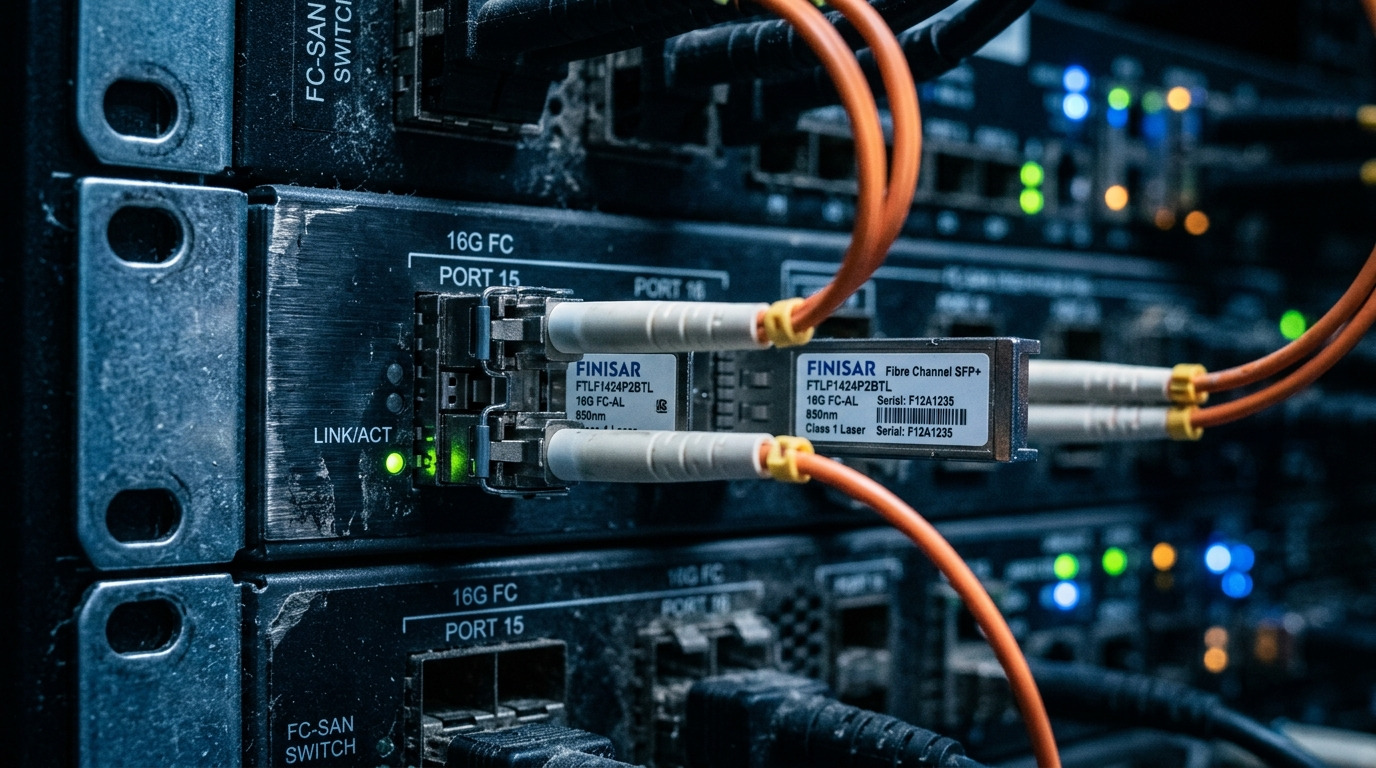
In AI clusters, the dominant traffic pattern is often many-to-many: gradient exchanges during training and high-rate result fan-out during inference. That stresses optical networking in three ways: reach (how far a link must go), latency (how quickly frames traverse the fabric), and power and thermals (how many optics you can run without exceeding switch or rack limits). IEEE 802.3 defines Ethernet PHY behavior for common rates, while your optics must match the transceiver electrical interface and optical budget for the installed fiber plant. [Source: IEEE 802.3]
In practice, failures often appear first at the patch panel and mux/demux sections: a “working” link at low temperature may fail under peak cooling load, or a marginal connector polish can pass BER tests until you increase utilization. Field teams typically validate optics with both link-up checks and BER/eye-related diagnostics where available (DOM plus switch transceiver monitoring). For AI environments with frequent reconfiguration, you also need consistent inventory behavior: standardized part numbers, predictable vendor support, and documented DOM readings.
SR vs LR for optical networking: performance, reach, power
For AI leaf-spine topologies, short-reach optics (SR) cover most intra-row and intra-rack distances, while long-reach optics (LR, typically ER/LR variants depending on vendor) handle inter-row or cross-row spans. The key is optical budget versus installed loss: you must include fiber attenuation plus connector and splice loss. A mismatch can create a link that “shows up” but fails during high traffic due to elevated BER. [Source: ITU-T G.652]
Below is a practical head-to-head comparison for common 10G and 25G Ethernet optics used in optical networking deployments. Exact values vary by vendor and exact part number, so treat this as a planning baseline and confirm with the specific datasheet.
| Option (typical) | Wavelength | Target reach | Connector | DOM support | Typical Tx/Rx power class | Operating temperature | Best fit in AI fabric |
|---|---|---|---|---|---|---|---|
| 10G-SR (e.g., Cisco SFP-10G-SR, Finisar FTLX8571D3BCL) | 850 nm | ~300 m over OM3/OM4 (depends on fiber) | LC | Often supported | Low to moderate | 0 to 70 C (varies) | Leaf-to-spine within the row |
| 10G-LR (10GBASE-LR, e.g., 1310 nm SMF) | 1310 nm | ~10 km on SMF | LC | Often supported | Higher than SR | -5 to 70 C (varies) | Cross-row or longer spine links |
| 25G-SR (e.g., SFP28 25G-SR) | 850 nm | ~100 m over OM4 (varies by vendor) | LC | Common | Moderate | 0 to 70 C (varies) | High-density ToR and aggregation |
| 25G-LR (SFP28 25G-LR, 1310 nm) | 1310 nm | ~10 km on SMF | LC | Common | Higher than SR | -5 to 70 C (varies) | Spine or campus-like segments |
Pro Tip: In AI data centers, the limiting factor is frequently not the nominal reach but the installed optical budget after patch panels. Engineers who measure end-to-end loss with an OTDR (and verify connector cleanliness) prevent “mystery flaps” that only appear after a topology change or seasonal temperature shift.
Compatibility and interoperability: optics that actually deploy
When integrating AI with optical networking, compatibility is a bigger risk than performance specs. Your switch platform may enforce transceiver vendor policies, require specific speed modes, or behave differently with “compatible” third-party modules. Most modern platforms rely on IEEE-compliant electrical interfaces and read DOM via a standard management interface, but the exact behavior of threshold alarms and vendor-specific mappings can differ. [Source: SNIA]
Before rollout, validate the exact module family and ensure DOM is recognized (temperature, voltage, bias current, and optical power). For example, many operators standardize on a small set of part numbers such as FS.com SFP-10GSR-85 or Finisar-branded optics for predictable monitoring. If you use multi-source optics, test them against your switch firmware version and your optics profile: some systems require matching “speed capability” or a configuration toggle for 25G vs 10G fallback behavior.
Field validation checklist (what to test before you trust the link)
- Confirm correct transceiver type: SFP, SFP28, QSFP28, or QSFP-DD must match the switch cage.
- Verify DOM fields in-band: optical power and temperature should remain stable during traffic ramps.
- Run a BER-capable test where supported, or at minimum use sustained traffic with switch error counters monitoring.
- Measure fiber loss and reflectance at install time, not after a production incident.
- Document polarity and MPO/LC mappings for any parallel optics used in higher density AI fabrics.
Cost and ROI: budgeting optics for AI scale-out
Optics pricing depends on rate, form factor, and vendor strategy. In many markets, OEM transceivers cost more per unit but can reduce operational friction: fewer RMA disputes, tighter monitoring integration, and predictable thermal behavior. Third-party optics can lower initial capex, but TCO depends on your failure rate, warranty terms, and how quickly your team can troubleshoot DOM and compatibility issues.
In a typical AI data center scale-out, optics can represent a meaningful share of the link budget for each ToR and spine pair. As a planning range, many teams see third-party 10G-SR modules priced notably below OEM, while long-reach 1310 nm optics often narrow the gap due to laser and optical components. ROI improves when you standardize inventory, reduce changeover time, and avoid downtime during training windows. [Source: IEEE 802 project]
Decision matrix: choose based on your constraints
| Criterion | SR (850 nm) | LR/ER (1310 or longer) | What to do in AI rollouts |
|---|---|---|---|
| Distance certainty | High within rows; depends on OM4/OM3 | High for cross-row spans over SMF | Measure loss and document patch panel routes |
| Power and thermals | Often lower per port | Often higher per port | Check switch PSU and optics thermal envelopes |
| Latency expectations | Comparable within data center spans | Comparable if within fiber distances | Focus on BER stability and correct polarity |
| Compatibility risk | Moderate; still vendor-specific | Moderate to higher due to optics class diversity | Validate with your exact switch firmware |
| Operational overhead | Simpler inventory when distances are short | Fewer “same-row” constraints but more SMF handling | Standardize part numbers and labeling |
Selection criteria checklist for optical networking in AI clusters
- Distance and fiber type: confirm OM3/OM4 for SR or SMF for LR; use measured loss, not cable spec sheet estimates.
- Switch compatibility: match transceiver form factor and verify firmware behavior for speed negotiation and DOM monitoring.
- Optical budget and safety margin: include connector and splice loss; leave headroom for aging and cleaning variability.
- DOM and monitoring requirements: ensure the platform reads optical power and temperature consistently for alerting and automation.
- Operating temperature: validate that transceivers meet your cold aisle/hot aisle envelope and do not exceed vendor thresholds.
- Vendor lock-in risk: assess warranty, RMA turnaround, and whether your team can support third-party DOM differences.
- Change management: plan maintenance windows that do not interrupt training jobs; stage optics in a test loop first.
Common mistakes and troubleshooting for optical networking
AI data centers amplify minor optics issues because utilization spikes quickly and monitoring expectations are high. Below are common failure modes engineers report in the field, with root causes and corrective actions.
-
Mistake: Assuming “it links up” equals “it is healthy” during peak training traffic.
Root cause: Marginal optical budget yields elevated BER that only appears under sustained load.
Solution: Check interface error counters, validate DOM optical power, and re-measure end-to-end loss; clean connectors and reseat optics. -
Mistake: Wrong fiber polarity or MPO-to-LC mapping during patching.
Root cause: Reversed transmit/receive paths can sometimes negotiate but fail intermittently, especially after movement.
Solution: Verify polarity with a continuity tester, correct MPO keying or LC labeling, and document the patch matrix. -
Mistake: Mixing transceiver types across a port group without validating firmware and speed mode.
Root cause: Switch firmware may apply different thresholds or auto-negotiation behaviors for different optics classes.
Solution: Test in staging with the exact firmware; standardize part numbers per distance class. -
Mistake: Using third-party optics without confirming DOM thresholds and alarm behavior.
Root cause: Vendor-specific DOM scaling can cause misleading alerts or suppressed alarms.
Solution: Compare DOM readings against known-good OEM optics and update monitoring thresholds accordingly with documentation.
Which option should you choose?
If your AI fabric is mostly within a row or within predictable intra-rack distances, choose SR for optical networking because it typically offers lower power per port and simpler inventory when your fiber plant is OM4. If you have cross-row, cross-building, or longer spine spans where SMF is already available and loss budgets are tight, choose LR to reduce the risk of marginal BER and rework. For hybrid deployments, many teams standardize on SR for leaf-to-spine and reserve LR for specific spine segments where measured loss requires it.
Next step: align optics selection with your network design by running a fiber loss audit and validating optics with your switch firmware in a staging pod. For a complementary view on how transport choices affect AI traffic engineering, see AI traffic engineering.
FAQ
Q: What is the most important factor when choosing optical networking for AI?
A: Installed optical budget. In AI clusters, link errors that seem rare can become visible during training bursts, so measure end-to-end loss and validate connector cleanliness before scaling up.
Q: Is SR always better than LR for data centers?
A: No. SR is often best for short distances on OM3/OM4, but LR is safer for longer spans over SMF. Choose based on measured loss, not on nominal reach alone.
Q: Can I mix OEM and third-party optics?
A: You can sometimes, but compatibility and monitoring behavior vary by switch platform and firmware. Validate in staging, confirm DOM readings, and keep a consistent part-number strategy per distance class.
Q: What should
