
You are about to light up a fiber link, but the transceiver reports marginal signal or the link never comes up. This article helps network engineers and field technicians calculate an optical loss budget transceiver link budget step by step, then select compatible optics that will actually pass commissioning. You will get a practical method aligned with IEEE Ethernet optics practice and vendor datasheets, plus troubleshooting tactics for the most common failure modes.
We assume you already know your target data rate and interface type (for example, 10GBASE-SR, 25GBASE-LR, or 40GBASE-ER), and you want a rigorous way to decide whether the installed fiber plant can support it. The workflow below also helps you validate transceiver parameters like DOM thresholds, optical power levels, and temperature operating range.
Prerequisites: what you must measure before you calculate loss
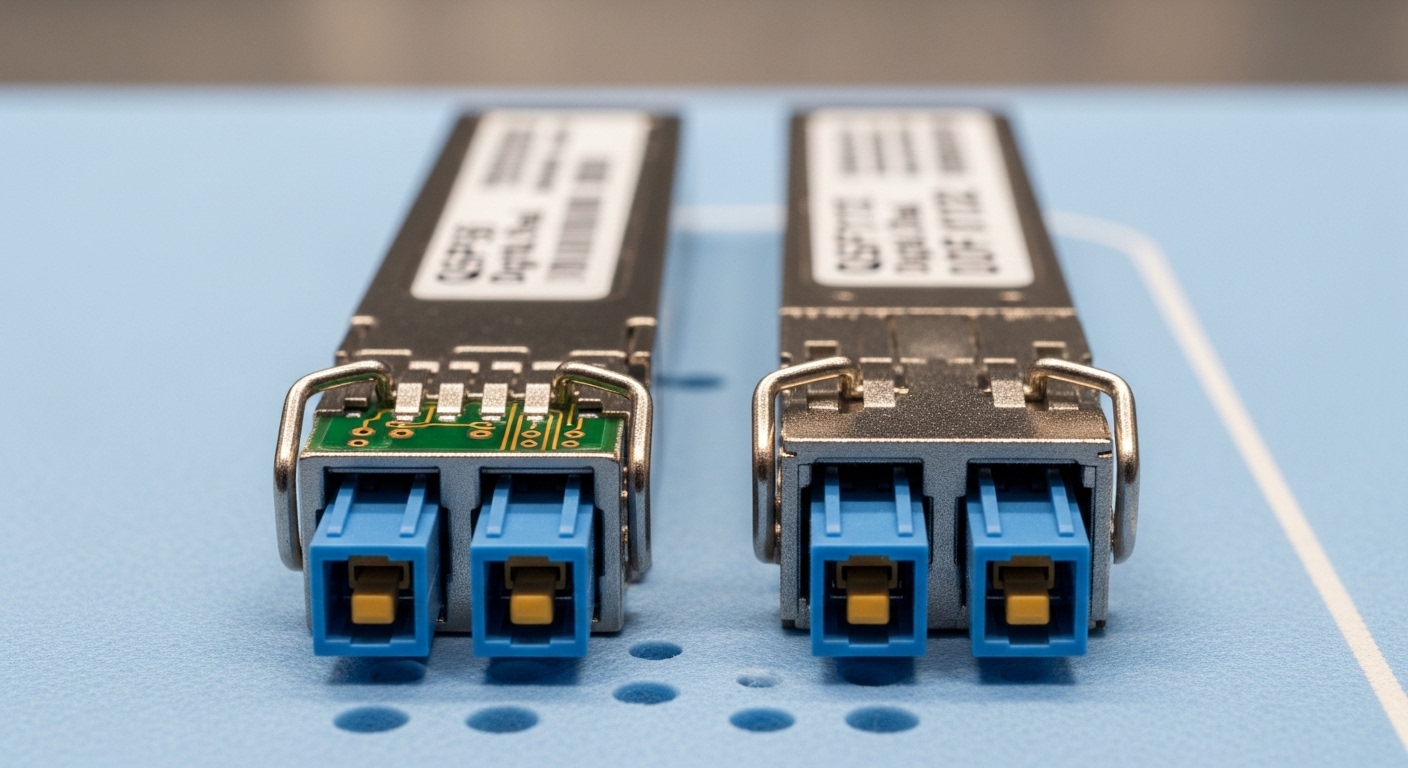
Before any calculation, collect the inputs that define your true loss and your true margins. If you skip measurements, you may incorrectly “approve” a transceiver that fails in the field under worst-case conditions.
- Pick the exact transceiver standard and wavelength: Example targets include 10GBASE-SR (850 nm), 25GBASE-SR (850 nm), 10GBASE-LR (1310 nm), or 40GBASE-ER (1550 nm). Confirm the optics are compatible with your switch/host (part numbers and electrical lane mapping).
- Document fiber type and core/cladding: Typical cases are OM3, OM4, and OS2 single-mode. Confirm connector polish type (UPC vs APC) when applicable.
- Get measured fiber attenuation: Use an OTDR or a calibrated light source and power meter. Record measured dB loss for the specific span you will use, not the cable datasheet nominal.
- List all passive components: Patch panels, splitters (if any), couplers, MTP/MPO trunks, splices, and any inline adapters.
- Record connector and splice counts: Count each end-face connection and each splice event. If you cannot count, you cannot compute an accurate loss budget.
Reference method alignment: link-budget reasoning follows standard optical engineering practice and is consistent with how IEEE 802.3 defines reach and power constraints for optical interfaces (though the exact numeric budgets are published in vendor optics datasheets). For standards context, see IEEE 802.3 and vendor optical module specifications. IEEE 802.3
Step-by-step optical loss budget transceiver calculation
This section turns your measured plant data into a decision: whether a specific optical loss budget transceiver will work with adequate margin. The core concept is: received power must land between the receiver sensitivity limit and the maximum safe input power, after accounting for every loss and every connector interface.
Compute total link loss from measured and component losses
Start with the measured fiber attenuation for the span. Then add insertion losses from connectors, adapters, patch cords, splices, and any passive elements. Use dB as your unit throughout.
- Fiber attenuation (dB): measured span loss from OTDR or power meter.
- Connector loss (dB per mated pair): depends on polish and cleanliness; typical engineering assumptions might be 0.2 dB to 0.5 dB per interface, but you should prefer measured values or vendor test data.
- Adapter/coupler loss (dB): from datasheet or manufacturer characterization.
- Splice loss (dB per splice): often around 0.05 dB to 0.2 dB per splice depending on fusion process and aging assumptions.
- Splitter loss (dB): if applicable, use the splitter specified insertion loss plus excess loss.
Determine the transceiver transmit power and receiver sensitivity
Transceiver datasheets typically provide a nominal transmit power range and a receiver sensitivity range for the target data rate and reach. You must use the worst-case combination for conservative design.
- Transmit power (dBm): use the minimum transmit power across temperature and aging when you want worst-case receive margin.
- Receiver sensitivity (dBm): use the maximum required sensitivity (the least negative value) if the datasheet provides a range.
- Optical power budget (dB): often summarized as “max loss” for the specified reach, but you can compute it directly from power ranges.
For example, a 10GBASE-SR module such as Finisar FTLX8571D3BCL or an equivalent 850 nm SR transceiver will publish a typical transmit power and sensitivity for the lane count and reach. Always use the exact part number you intend to deploy.
Include a margin for aging, cleaning variation, and future rework
Real fiber plants degrade due to contamination, micro-bending, and handling. Engineering practice adds a margin (often 3 dB to 6 dB) on top of calculated insertion losses. The exact margin depends on your operations model: how often patch cords are reworked, how strict your cleaning regimen is, and whether the link will be repeatedly touched during moves/adds/changes.
Validate against both minimum and maximum received power
Most engineers focus on “max loss” and forget the other side: too much received power can saturate or damage optics. Datasheets include a maximum receiver input power. Your computed link loss must keep received power below that limit as well.
Convert the results into an accept/reject decision
Compute:
- Received power (dBm) = Transmit power (dBm) minus total link loss (dB)
- Check: Received power must be greater than or equal to receiver sensitivity and less than or equal to max receiver input.
Worked example template (use your numbers)
Assume a 10GBASE-SR link over OM4 with measured fiber loss of 3.0 dB. Add 4 connectors at 0.35 dB each (patch panel ends and interconnects) for 1.4 dB. Add 6 splices at 0.1 dB for 0.6 dB. Total known loss is 5.0 dB. If the transceiver worst-case budget is, say, 6 dB for max loss at your data rate, you would have 1 dB margin before aging and cleaning variation. If your operations require 3 dB margin, you would likely reject this transceiver choice and either shorten the link or choose a higher-budget optic.
Transceiver specs that determine your optical loss budget transceiver headroom
Not all “same wavelength” optics are interchangeable. The optical loss budget transceiver headroom depends on the transmitter power range, receiver sensitivity, and sometimes lane-to-lane variations. Below is a practical comparison of representative modules and what engineers actually check.
| Parameter | 10GBASE-SR (850 nm, SFP+) | 10GBASE-LR (1310 nm, SFP+) | 40GBASE-ER (1550 nm, QSFP+) |
|---|---|---|---|
| Typical data rate / interface | 10.3125 Gb/s / SFP+ | 10.3125 Gb/s / SFP+ | ~41.2 Gb/s / QSFP+ |
| Wavelength | 850 nm | 1310 nm | 1550 nm |
| Reach class (typical) | ~300 m to 400 m on OM3/OM4 | ~10 km on OS2 | ~40 km class (vendor-dependent) |
| Optical loss budget transceiver concept | Max allowable total loss in dB | Max allowable total loss in dB | Max allowable total loss in dB |
| DOM / monitoring | Common: temperature, bias, TX power, RX power | Common: temperature, bias, TX power, RX power | Common: temperature, bias, TX power, RX power |
| Operating temperature | Commercial or industrial variants (often -5 to 70 C or wider) | Commercial or industrial variants | Commercial or industrial variants |
| Connector type | LC (common) or MPO/MTP on high-density variants | LC (common) | LC (common) or MPO/MTP depending on form factor |
Engineering takeaway: always treat “reach” as a marketing shorthand for a specific optical power budget and a specific fiber model. Your deployment uses your measured loss, not a generic OM4 model. IEEE 802.3 working group
Pro Tip: In commissioning, the most revealing metric is not only whether the link “comes up,” but how close the DOM RX power sits to the vendor’s recommended operating range. If you see RX power consistently within 1 dB to 2 dB of the sensitivity edge across temperature swings, the link may pass now and fail after a few seasonal rework events or a cleaning lapse.
Common calculations for connector-heavy and splice-heavy builds
Loss budget transceiver planning often fails because engineers undercount terminations. Connector-heavy patching and splice-heavy backbone runs can dominate the fiber attenuation term.
Connector-heavy scenario (MPO/MTP patching)
In data centers, it is common to route from top-of-rack switches into structured cabling using MPO/MTP trunks, then break out to LC patch cords. Each mating event adds loss and introduces variability. If your design includes multiple consolidation points, connectors can easily contribute more than 2 dB to total loss even when the fiber itself is low attenuation.
Splice-heavy scenario (backbone in raised floors or conduits)
Backbone routes in facilities sometimes include repeated fusion splicing to manage cable slack and rerouting. Even with good fusion quality, splices add up. If you have 10 splices and assume 0.1 dB each, that is already 1.0 dB before connectors and adapters.
Implementation guide: choose and validate the transceiver with your computed budget
This is a numbered, field-ready workflow you can run during design review and commissioning. It explicitly maps your calculations to the transceiver you will install.
Lock the target optics and verify switch compatibility
Confirm the host switch model and supported optics lists. Many enterprise and carrier switches enforce compatibility via vendor part numbers and sometimes require specific transceiver EEPROM signatures.
Expected outcome: You have an approved transceiver family that your host will recognize reliably.
Gather measured link loss and component counts
Use OTDR or power meter results for fiber attenuation and count connectors/splices precisely. If you cannot measure yet, budget conservatively and schedule measurement before final acceptance.
Expected outcome: You have a total loss estimate with a traceable measurement basis.
Compute worst-case received power
Use the transceiver datasheet minimum transmit power (at the relevant temperature) and receiver sensitivity (for your target mode). Subtract your total measured/component loss and compare against sensitivity.
Expected outcome: You know whether the link is within the optical loss budget transceiver limits with margin.
Check maximum received power and safety limits
Verify that your predicted received power will not exceed the receiver maximum input. This is especially important for short links with very clean fibers and low-loss patching.
Expected outcome: You avoid both under-power and over-power operating regions.
Commission and validate with DOM readings
After installation, read DOM values (TX power and RX power) from the switch interface. Compare against datasheet nominal ranges. Record temperature and take readings at stable link operation.
Expected outcome: Your measured operating point matches the budget assumptions.
Set operational thresholds for alarms and maintenance
Configure alarms for DOM deviations if your platform supports it. Typical operational practice is to alert early when RX power drifts beyond an internal threshold (often 2 dB to 3 dB from a baseline) to catch cleaning or connector aging before link degradation becomes visible.
Expected outcome: You catch problems during the “gray zone,” not after outage.
Selection criteria checklist for optical loss budget transceiver decisions
Use this ordered checklist during design or procurement. It reflects what engineers actually weigh when trading reach, cost, and operational risk.
- Distance and measured loss: use OTDR or power meter results; do not rely solely on nominal fiber attenuation.
- Data rate and modulation format: ensure the transceiver supports your exact Ethernet generation and lane requirements.
- Host switch compatibility: confirm supported transceiver lists and EEPROM signature behavior.
- Optical loss budget headroom: ensure worst-case received power stays above sensitivity with your required margin.
- DOM support and telemetry: verify the platform can read TX/RX power and temperature for operational control.
- Operating temperature range: choose industrial (-40 to 85 C class) where racks see high ambient or airflow restrictions.
- Vendor lock-in risk: OEM optics may reduce risk but increase cost; third-party optics can work but require compatibility testing.
- Connector ecosystem: LC vs MPO/MTP must match your patching hardware and cleaning tools.
- Certification and quality assurance: prefer transceivers with published compliance testing and consistent DOM behavior.
Common pitfalls and troubleshooting tips (top failure modes)
These are the most frequent real-world issues that break optical loss budget transceiver deployments. Each includes root cause and a concrete solution.
Pitfall 1: Counting the wrong number of connectors and adapters
Root cause: Engineers sometimes count only “ends” and forget intermediate patch cords, panel adapters, and consolidation points. The loss budget then comes out optimistic by 1 dB to 3 dB.
Solution: Walk the patch path physically with the cabling map. For MPO trunks, count each mated interface. Re-measure with a power meter after cleaning to confirm.
Pitfall 2: Using nominal fiber attenuation instead of measured results
Root cause: Datasheet attenuation is a typical value at a specific wavelength and condition. Real installed fiber may be higher loss due to handling, micro-bends, or imperfect splicing.
Solution: Use OTDR to locate high-loss events (bends, bad splices, connector reflectance spikes) and measure end-to-end insertion loss for the exact patch cords and connectors in service.
Pitfall 3: Ignoring DOM and assuming “link up” means “budget OK”
Root cause: Some optics can establish link with marginal optical power that later fails under temperature drift or after a maintenance event. Without DOM baseline tracking, the drift goes unnoticed.
Solution: Record RX power and temperature at commissioning. Set alarms if RX power approaches your internal threshold based on the computed margin.
Pitfall 4: Contamination and polarity errors causing apparent high loss
Root cause: Dirty connectors can add loss and increase backscatter, while polarity mistakes (especially with MPO/MTP and ribbon assemblies) can route light to the wrong fiber pair.
Solution: Clean with approved fiber cleaning tools and inspect with microscope. Verify polarity using a continuity tester and confirm mapping against the patch panel labeling.
Cost and ROI note: balancing OEM vs third-party optics
Pricing varies by form factor and reach, but a realistic planning range for deployed optics is often $50 to $200 per 10G SR SFP+ and $150 to $600 per 10G LR, with higher costs for 40G/100G long-reach modules. OEM transceivers may carry a premium, but they often provide more predictable DOM behavior and switch compatibility.
TCO depends on failure rate, maintenance labor, and downtime risk. If a third-party transceiver repeatedly triggers marginal link conditions, the labor cost of repeated cleaning, re-termination, and truck rolls can exceed the initial savings. A budgeted margin of 3 dB to 6 dB can reduce repeat work by preventing “barely passing” installs from becoming recurring incidents.
FAQ
How do I calculate the optical loss budget transceiver max loss?
Use the transceiver datasheet to get minimum transmit power and receiver sensitivity, then compute the allowed total loss as Tx_min minus Rx_sensitivity. Add your operational margin (commonly 3 dB to 6 dB) to account for aging and rework. If the computed received power falls below sensitivity, the link will be unreliable even if it sometimes negotiates.
Should I trust “reach” numbers from the transceiver datasheet?
Only as a starting point. “Reach” is based on a specific fiber model, typical connector assumptions, and worst-case power conditions. Your installed loss depends on patch cords, connectors, splices, and handling, so you should validate with measured insertion loss.
What DOM metrics matter most during commissioning?
Focus on RX power, TX power, and module temperature. Establish a baseline at stable operation and compare it to the computed margin. If RX power is within a couple of dB of sensitivity, treat the link as fragile and schedule remediation (shorten path, change optic, or re-terminate after cleaning).
