
All-flash storage clusters are increasingly bottlenecked not by media latency but by fabric behavior: optics, link training, and power budgets. This article helps storage and network engineers choose an NVMe-oF transceiver for Fiber Channel-based all-flash deployments, focusing on measurable compatibility constraints and operational troubleshooting. You will get a spec comparison, a decision checklist, and field-tested failure modes that commonly surface during rollouts.
Why an NVMe-oF transceiver matters in Fiber Channel all-flash
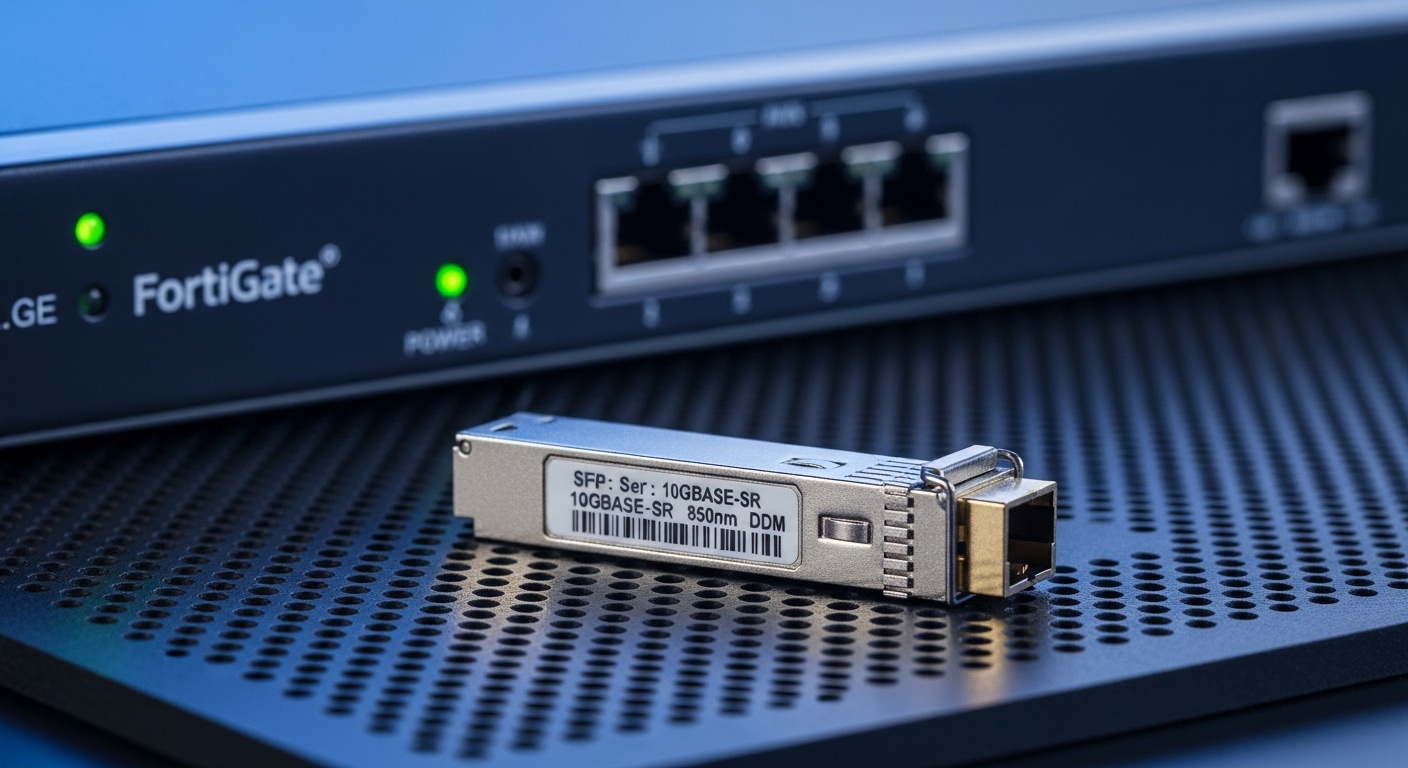
In NVMe-oF designs that carry block traffic over Fiber Channel (often using FC-NVMe or NVMe-oF over FC fabrics), the transceiver governs optical link margin, encoding compliance, and thermal stability under sustained I/O. Even if the controller and target firmware are correct, marginal optics can trigger CRC errors, link resets, or intermittent timeouts that look like storage queue issues. For engineers, the key is to treat the transceiver + optics + switch port as one deterministic subsystem. Standards such as IEEE 802.3 inform electrical/optical interfaces for Ethernet optics, while Fiber Channel optics are governed by vendor implementations aligned with FC optical classes; always verify with the switch and optics interoperability matrices.
Common deployment reality: many all-flash arrays run 24/7 at high utilization, so transceivers must survive sustained temperature and receive power variation from dirty connectors. In a lab, a link may train once and then degrade; in production, you only notice after the first maintenance window when the monitoring graphs show rising error counters and NVMe-oF command retries.
Key specs to verify: wavelength, reach, power, and temperature
For FC all-flash, the most frequent practical options are short-reach multi-mode or long-reach single-mode optics depending on your cabling plant. Engineers should verify wavelength, rated reach, connector type (LC is common), and operating temperature range. Also confirm whether the optics are rated for the switch model and whether the platform enforces Digital Optical Monitoring (DOM) thresholds. If DOM is supported, you can correlate transceiver temperature, laser bias current, and received power with NVMe-oF latency spikes.
When comparing modules, use a like-for-like approach: same nominal data rate class, same fiber type, and same connector standard. Below is a representative comparison for commonly deployed FC optics classes; exact compatibility still depends on your switch and vendor portfolio.
| NVMe-oF Fiber Channel transceiver type | Wavelength | Typical reach | Fiber / connector | DOM | Operating temperature | Notes for all-flash |
|---|---|---|---|---|---|---|
| Short-reach (MM) | ~850 nm | ~100–150 m (typical class) | OM3/OM4, LC | Often supported | 0 to 70 C (common) | Sensitive to dirty LC ends; keep patch cords clean |
| Long-reach (SM) | ~1310 nm | ~2 km (typical class) | Single-mode OS2, LC | Often supported | -5 to 75 C (varies) | More forgiving for distance but requires correct SM plant |
| Extended-reach (SM) | ~1550 nm | ~10 km class (platform-dependent) | Single-mode OS2, LC | Platform-dependent | -5 to 75 C (varies) | Verify budget with vendor optical link calculations |
For vendor-specific modules, examples you may see in networks include Cisco SFP-10G-SR (Ethernet SR) as a familiarity reference for optics form factors, but for FC you should use FC-rated optics from the array or switch vendor, or third-party parts explicitly listed for your exact port speed and switch series. For optical components, consult datasheets for modules such as Finisar-compatible part lines (e.g., FTLX8571D3BCL for 8G-class optics in some ecosystems) and verify that the exact wavelength class and DOM behavior match your requirements. Always cross-check the switch compatibility list and the DOM alarm mapping.
IEEE 802.3 standard Broadcom Fiber Channel overview Cisco support and interoperability resources
Selection checklist engineers use during NVMe-oF Fiber Channel rollouts
Use the following ordered checklist to avoid late-stage surprises. It is optimized for all-flash environments where NVMe-oF command pacing makes storage timeouts visible quickly.
- Distance and fiber type: confirm MM vs SM plant (OM3/OM4 vs OS2), connector cleanliness, and patch cord length.
- Link speed class: match the port speed and FC generation (e.g., 8G/16G classes depending on your fabric).
- Switch compatibility: verify the transceiver is approved for your switch model and port type; do not rely on generic “SFP works” assumptions.
- DOM support and monitoring: confirm the platform reads DOM and that thresholds are mapped correctly for alarms and syslog events.
- Operating temperature and airflow: check the module rating versus your rack inlet temperature and sustained I/O heat load.
- Vendor lock-in risk: decide between OEM optics and third-party optics with explicit compatibility; ensure you can source spares during outages.
- Optical budget validation: use vendor link calculators and include connector loss, patch cord attenuation, and aging margin.
Pro Tip: In FC-NVMe rollouts, many “storage” incidents are actually optical margin issues. If you see correlated spikes in NVMe-oF retries and rising transceiver temperature or falling received power in DOM, treat it as a fiber plant and optics validation problem first, not a host or target configuration problem.
Common pitfalls and troubleshooting tactics
Below are failure modes that repeatedly show up in field deployments. Each includes root cause and a practical fix.
- Pitfall 1: Intermittent link resets under load
Root cause: marginal optical receive power due to dirty LC connectors or damaged patch cords.
Solution: clean with lint-free methods, inspect with an optical microscope, replace patch cords, and compare DOM received power trends before and after changes. - Pitfall 2: Works in one switch but fails in another
Root cause: transceiver firmware/DOM behavior not matching the switch’s port initialization and vendor compatibility constraints.
Solution: use the switch interoperability list; validate with the exact switch model and software release, and confirm DOM alarm handling. - Pitfall 3: Silent performance degradation, not a hard outage
Root cause: excessive bit error rate from insufficient optical budget or aging fiber not captured at commissioning.
Solution: run error counter baselines (CRC/FEC counters if available), verify optical budget with margin, and schedule periodic re-validation for high-traffic arrays. - Pitfall 4: Thermal throttling-like behavior
Root cause: module operating above rated temperature due to restricted airflow or blocked vents.
Solution: measure rack inlet temperature, improve airflow path, and replace optics with higher temperature ratings if your site environment is harsh.
Real-world deployment scenario: leaf-spine fabrics with all-flash NVMe-oF
Consider a 3-tier data center leaf-spine topology with 48-port 16G Fiber Channel ToR switches connected to all-flash NVMe-oF targets via redundant fabrics. Each ToR uses 8 uplinks and 32 server-facing ports; during a migration, engineers install NVMe-oF Fiber Channel transceivers on both A and B fabrics for 16 server connections per leaf. Patch cords are kept within 5–10 m for short-reach MM runs, and the rack inlet temperature is maintained at 22–26 C with front-to-back airflow. Monitoring shows DOM received power averaging within the vendor range at steady state; after one rollout batch, a subset exhibits lower received power and increased CRC counts, traced to a connector cleaning lapse during labeling. The fix was immediate: clean and re-terminate LC ends, then re-baseline error counters before resuming the full host onboarding schedule.
Cost, ROI, and operational tradeoffs
OEM transceivers often cost more, commonly landing in a range of roughly $300–$900 USD per module depending on FC generation and reach class, while third-party compatible optics may be lower but require stricter compatibility validation. TCO should include downtime risk, spares stocking, and the engineering time spent on reconciliation when DOM thresholds or switch firmware behaviors differ. In all-flash NVMe-oF environments, a single prolonged link instability can delay commissioning and create cascading queue timeouts that complicate root-cause analysis. ROI typically favors optics that are explicitly validated for your switch model and that provide reliable DOM telemetry for faster MTTR.
FAQ
What is an NVMe-oF transceiver in a Fiber Channel context?
An NVMe-oF transceiver is the pluggable optical module that provides the physical link for FC-based NVMe-oF connectivity. It controls wavelength, reach, DOM telemetry, and link stability between host initiators and storage targets.
Can I use
