When a high-density rack upgrade goes sideways, the root cause is often not the transceivers but the MPO MTP connector polarity, cleanliness, and compatibility details. This article follows a real rollout in an enterprise data center where engineers had to standardize fiber patching across 10G and 25G optics without increasing downtime. You will get the selection logic, the on-site checks, and the troubleshooting patterns that actually show up during acceptance testing.
Problem and challenge: high-density patching without link flaps
A telecom-adjacent enterprise expanded a leaf-spine fabric from 40G to a mixed 10G/25G topology. The wiring team needed parallel fiber for bandwidth and speed of deployment, but the existing patch panels used mixed connector families (LC for individual drops, SC for legacy runs, and a variety of ribbon/MPO style trunks). During pilot testing, several 25G links showed intermittent CRC errors and a few links failed optical budget checks under colder room conditions. The team suspected connector contamination, polarity mismatches, and inconsistent polarity labeling across patch cords.
Environment specs were typical for a modern facility: two rows of 48-port ToR switches at the top of racks, with 96 core-count ribbon trunks feeding row aggregators. They targeted 25G over OM4 using MPO/MTP trunks between patch panels and then fanned out to LC on the switch side. The acceptance criteria were strict: stable optical power within vendor thresholds, no more than 0.1 dB additional loss budget for patching, and deterministic polarity mapping across every ribbon path.
Environment specs and chosen connector strategy
Engineers aligned the connector plan to IEEE 802.3 physical layer requirements and vendor datasheets for short-reach optics. For 10G/25G, the most common approach is using parallel optics with MPO/MTP on the trunk side and LC on the endpoint side. The team also considered how the MPO MTP connector supports polarity standards used in the field for multi-fiber arrays, and how that interacts with transceiver modules and breakout cables.
| Specification | MPO MTP connector (parallel ribbon) | LC connector (single-fiber) | SC connector (single-fiber) |
|---|---|---|---|
| Typical use in SFP-class optics | 10G/25G parallel trunks, breakout to LC | Endpoint patching to SFP/SFP+ transceivers | Legacy endpoint patching, some transceiver ecosystems |
| Fiber count per ferrule | 8 or 12 (common), sometimes 16 | 1 | 1 |
| Common multimode reach target | OM4: 70 m (25G typical) depending on optics | Varies by transceiver; often similar reach when link budget is met | Varies by transceiver; similar when budget is met |
| Insertion loss (order-of-magnitude) | ~0.2 to 0.6 dB per mated pair (quality dependent) | ~0.1 to 0.5 dB | ~0.1 to 0.5 dB |
| Polarity handling | Critical; requires correct mapping and labeling | Less complex for single-fiber runs | Less complex for single-fiber runs |
| Operating temperature | Typically -10 to +70 C for cabling; verify datasheets | Typically -10 to +70 C (verify) | Typically -10 to +70 C (verify) |
| Cleaning requirement | High; inspect every mating surface | High; inspect every mating surface | High; inspect every mating surface |
Source alignment matters. The team referenced general connector practices and optical link expectations from IEEE 802.3 for link behavior and from vendor cabling and transceiver datasheets for loss and temperature operating ranges. For connector family comparisons, they also used established telecom guidance from IEEE 802.3 working group materials and vendor documentation from major optics/cabling manufacturers like Finisar (now part of Coherent) optics documentation and ANSI/TIA related cabling guidance.

Chosen solution and why it worked
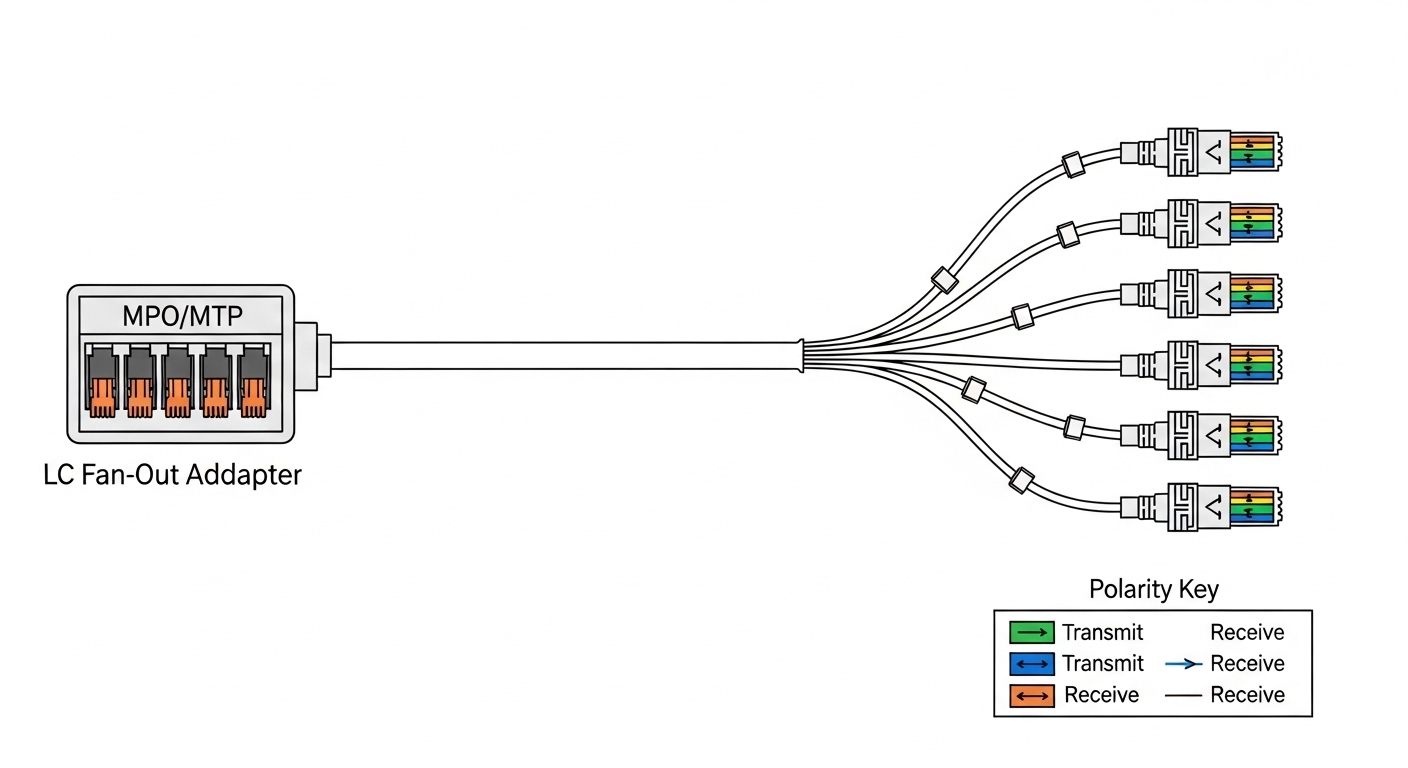
The rollout replaced the pilot patch cords with a standardized trunk-and-breakout design: MPO/MTP 12-fiber trunks between patch panels and LC fan-outs at the switch side. They selected connectors from a single vendor family to reduce variability in ferrule end geometry and to keep polishing and insertion-loss characteristics predictable. They also adopted a strict polarity labeling scheme and ensured that every breakout cable matched the intended transmit/receive mapping for the transceiver lane assignment.
In practice, the team used MTP-style connectors with higher repeatability and consistent mechanical keying. For reference, they validated that the optics being used were compatible with their intended MPO polarity mapping and that the cabling met the required insertion loss targets. Common field-referenced optics include OM4-capable modules such as Cisco SFP-10G-SR for 10G and equivalent enterprise SR optics families; for 25G, similar SR optics exist with MPO-to-LC breakouts depending on switch vendor. Always confirm exact module part numbers and connector requirements in the switch and transceiver datasheets.
Pro Tip: In high-density MPO MTP connector deployments, the biggest avoidable cause of “random” link errors is not bad optics but contaminated ferrule ends. Engineers who implement a consistent inspect-and-clean workflow (scope inspection plus lint-free wipe and approved cleaning tool) typically see the loss distribution tighten by roughly 0.1 to 0.3 dB across acceptance batches, which is often the difference between pass and marginal performance.
Implementation steps: from labeling to acceptance testing
The team ran a controlled cutover with measurable checkpoints. First, they mapped every ribbon trunk to a lane plan and created a polarity matrix that tied patch panel positions to switch ports. Second, they installed MPO MTP connector patch cords only after ferrule end inspection; any connector with visible dust or scratches was re-cleaned or replaced. Third, they conducted OTDR and link loss verification using a calibrated test set and recorded results per channel.
To keep downtime low, they staged patch cord reels by row and pre-verified continuity on the bench. During the live window, they performed a “clean connect” sequence at each panel and then validated link establishment and receive power thresholds on the switch. Finally, they locked the patch labeling and updated the documentation so future moves and adds would not silently violate the polarity matrix.
Measured results and lessons learned
After the standardization, link stability improved noticeably. In the pilot, intermittent CRC errors occurred on 3 of 28 25G links during temperature swings, and two were traced to poor ferrule cleanliness and one to a polarity swap between patch panels. In the production rollout, after enforcing the inspect-and-clean workflow and using a single connector family, the team saw 0 of 64 links fail acceptance loss thresholds and 0 recurrence of CRC spikes over a 30-day monitoring period.
Operationally, they also reduced troubleshooting time. Mean time to restore dropped from roughly 2.5 hours during pilot incidents to under 45 minutes because the polarity matrix and labeling prevented repeated mis-mating. The lesson: MPO MTP connector success is a systems problem involving cabling, optics configuration, documentation discipline, and test tooling.
Selection criteria checklist for MPO MTP connector deployments
- Distance and OM grade: confirm OM4/OM3 assumptions and the transceiver reach budget for your exact optics.
- Budgeted insertion loss: verify connector and patch cord loss per mated pair and ensure you have margin for aging and handling.
- Switch and transceiver compatibility: validate MPO polarity mapping requirements and breakout cable pinout expectations.
- DOM and monitoring needs: if you use transceivers with diagnostics, ensure the transceiver type is compatible with your switch and that fiber mapping aligns with lane assignments.
- Operating temperature and environment: verify cabling temperature ratings and consider cold-room brittleness risk for certain jacket materials.
- Vendor lock-in risk: standardize on connector families and document part numbers to avoid future polarity confusion across vendors.
Common mistakes and troubleshooting tips
1) Polarity mismatch between patch panels and transceiver lanes
Root cause: breakout cables or patch cords were flipped or labeled inconsistently, reversing receive/transmit lane mapping in a parallel system.
Solution: enforce a polarity matrix, use keyed connectors consistently, and verify with a staged test before full deployment.
2) Dirty or micro-scratched ferrule ends
Root cause: dust on ferrule faces or damage from improper handling causes excess insertion loss and intermittent errors under link margin pressure.
Solution: scope-inspect every MPO MTP connector mating surface, replace damaged connectors, and standardize cleaning tools and procedures.
3) Exceeding link budget due to “assumed” patch cord quality
Root cause: mixed third-party patch cords with higher insertion loss silently consume budget, especially when multiple mated pairs exist.
Solution: require per-cord loss test reports, measure end-to-end loss during acceptance, and avoid mixing patch cord brands without validation.
4) Using incompatible connector geometry or keying
Root cause: connector keying differences and inconsistent ferrule end-face geometry can prevent correct alignment or degrade optical coupling.
Solution: use a single standardized connector family per deployment phase and verify mechanical fit before labeling installation.
Cost and ROI note: what to expect in TCO terms
In typical enterprise deployments, third-party MPO/MTP patch cords often cost less upfront than OEM cabling, but the TCO hinge is failure rate and rework labor. As a rough field estimate, a quality MPO/MTP trunk or patch cord set may range from $10 to $40 per cord at small quantities, while OEM-branded equivalents can be higher depending on length, fiber count, and polishing grade. If poor connector quality or inconsistent polarity leads to even one additional day of troubleshooting