If your network spans metro-to-intercity distances, the choice between coherent and non-coherent transceivers can make or break long-haul performance. This article helps network architects, field engineers, and procurement teams compare both approaches using practical deployment constraints like dispersion, OSNR, and switch compatibility. You will get a decision checklist, troubleshooting pitfalls, and a clear recommendation by reader type.
What actually drives long-haul performance: coherent vs non-coherent
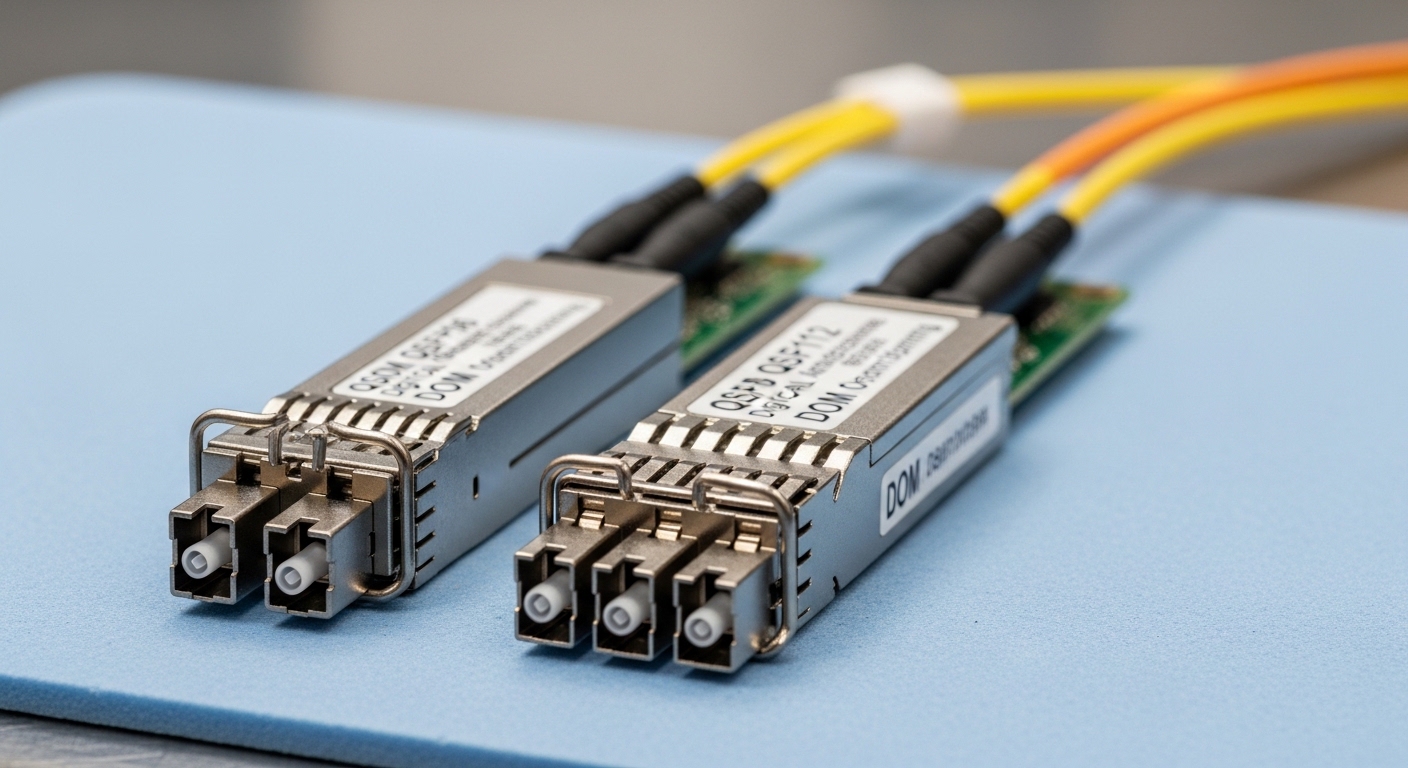
At long distances, fiber impairments accumulate: chromatic dispersion, polarization mode dispersion, nonlinear effects, and component noise. In simplified terms, coherent transceivers use a local oscillator and digital signal processing to recover amplitude and phase, which improves resilience to impairments. Non-coherent systems typically rely on direct detection and simpler DSP, which can be more cost-effective but less tolerant as reach increases. The result is that coherent designs often sustain higher performance margins on marginal fiber, while non-coherent designs can be excellent when the link budget is comfortable.
Key performance metrics engineers compare
- OSNR / SNR at the receiver: coherent receivers often tolerate lower OSNR by using phase-aware detection.
- Reach under real fiber: not just “spec reach,” but reach after aging, splices, and patch cords.
- Format and baud rate: higher-order modulation and higher baud rates can increase capacity but tighten OSNR requirements.
- DSP complexity and latency: coherent DSP can add latency and power draw, which matters in some design targets.
From a field perspective, the practical question is whether your link budget and dispersion map leave enough margin for the installed fiber plant. If you are upgrading an existing backbone with unknown past handling, coherent optics often reduce the risk of “works on the bench, fails in the field.” For newer builds with well-characterized fiber, non-coherent may deliver strong performance with lower total cost.
Head-to-head specs: wavelength, reach, power, and operating envelope
Vendors implement coherent and non-coherent optics in different form factors and with different receiver architectures, so spec sheets can look incomparable at first glance. The table below normalizes the comparison around the items that most strongly affect long-haul performance: data rate, typical wavelength bands, reach classes, connector style, and operating temperature. Always confirm the exact part number with your switch vendor’s compatibility list.
| Parameter | Coherent transceivers (typical) | Non-coherent transceivers (typical) |
|---|---|---|
| Form factors | QSFP-DD coherent, CFP2-DCO, pluggable coherent ROADM modules | SFP/SFP+/SFP28, QSFP+/QSFP28, CXP/others depending on generation |
| Wavelength band | C-band (often), sometimes L-band depending on design | 1310 nm or 1550 nm common for long-haul variants |
| Typical data rates | 50G, 100G, 200G, 400G coherent line rates (varies by module) | 10G, 25G, 40G, 100G direct-detect options (varies by module family) |
| Reach class | Often designed for hundreds to thousands of km with ROADM-aware planning | Often tens to a few hundred km depending on dispersion and receiver sensitivity |
| Connector / physical | LC/UPC or MPO/MTP depending on design; coherent pluggables may use multiple fibers | LC/UPC or MPO/MTP depending on form factor |
| Operating temperature | Commonly industrial ranges (for example -5 C to 70 C) depending on SKU | Often industrial or extended commercial ranges depending on SKU |
| Power draw | Typically higher due to coherent DSP and local oscillator | Typically lower for direct-detect modules |
| Best fit | Long-haul, higher spectral efficiency, impairment-tolerant backbone upgrades | Cost-sensitive long-haul within a comfortable link budget |
For concrete vendor context, coherent modules are frequently deployed with ROADM or transponder systems, while non-coherent modules are commonly used for point-to-point links. Examples you may see in the field include coherent pluggable solutions from major optics vendors and direct-detect long-reach modules such as Finisar FTLX8571D3BCL (10G-class long-reach family) or FS.com SFP-10GSR-85 (short reach over multimode, included here only as an example of how vendor naming differs). The important point is that reach and performance are part-number specific and depend on fiber type, dispersion, and system architecture.
For standards grounding, coherent performance planning is tightly linked to optical system OSNR concepts and digital modulation assumptions, and direct-detect performance is tied to receiver sensitivity and link budget. For the underlying Ethernet physical layer families, consult IEEE 802.3 for electrical and optical interfaces where applicable, and use vendor datasheets for exact optical parameters. Source: IEEE 802.3
Use-case reality check: where each wins in a real backbone
In a 3-tier network with leaf-spine access and a regional backbone, the optics choice often depends on whether you are upgrading an existing dark fiber route or building a new engineered transport path. Consider a scenario: a service provider links two metro sites 420 km apart over C-band with intermediate splices and patching, using a ROADM-capable architecture. The installed fiber has an older dispersion map and occasional high-loss events near splice closures. Engineers target 100G per wavelength channel and need stable performance during seasonal temperature swings.
In this environment, coherent transceivers frequently deliver stronger long-haul performance because their receiver can compensate for impairments with phase-aware DSP, leaving margin when the OSNR drops. Non-coherent options might work if the fiber is exceptionally clean and dispersion is controlled, but the risk increases if the dispersion slope or nonlinear penalties are worse than expected. If you must meet a strict maintenance window and cannot easily re-optimize after installation, coherent optics can reduce the probability of “late-life surprises.”
Cost and ROI: power, failure modes, and lifecycle math
It is tempting to compare only the transceiver unit price, but long-haul performance decisions should account for system-level costs: power consumption, cooling impact, spare inventory, and rework probability. Coherent optics are typically more expensive per module due to local oscillators and DSP, and they may require additional system components or licensing depending on the ecosystem. Non-coherent optics are often cheaper and simpler to operate, with lower power draw and fewer specialized requirements.
A realistic ROI approach for procurement and engineering
- Unit price vs installed risk: coherent can cost more, but it can reduce failed acceptance tests and costly truck rolls.
- Power and cooling: higher power draw can increase rack cooling load; quantify using your facility’s PUE and airflow assumptions.
- Spare strategy: coherent systems may require tighter alignment with the correct modulation format and vendor ecosystem.
- Lifecycle and obsolescence: optics generations change quickly; plan for multi-year compatibility.
In many projects, non-coherent transceivers can be priced at a fraction of coherent optics, but the total cost of ownership (TCO) depends on how often you must replace optics due to link instability or operational drift. A practical rule: if your link budget margins are thin and the fiber plant is uncertain, the ROI often shifts toward coherent because the cost of downtime and rework can exceed the delta in optics price. If your links are engineered with ample margin and you can validate dispersion and loss early, non-coherent can provide strong performance at lower TCO.
For direct-detect versus coherent system comparisons in the broader optical communications context, you can also consult vendor white papers and reputable technical references. Source: IEEE Publications
Selection criteria checklist for long-haul performance
Use this ordered checklist to reduce integration surprises and protect long-haul performance after cutover. Engineers often repeat these steps for each optical path, because the fiber plant and equipment compatibility can vary between routes.
- Distance and loss: confirm fiber attenuation at the actual wavelength band and include splice and connector loss with real measurements.
- Dispersion profile: verify dispersion and dispersion slope; if you cannot obtain a map, plan for additional margin or choose coherent.
- Modulation format and channel plan: ensure your system design matches what the transceiver expects (especially for coherent).
- Switch compatibility: validate transceiver vendor and firmware support with the exact switch model and optics catalog.
- DOM and management: confirm digital optical monitoring fields (for example temperature, bias current, optical power) match your NMS expectations.
- Operating temperature and power: check the module’s temperature range and your rack thermal design; coherent can run hotter.
- Vendor lock-in risk: coherent ecosystems may require specific control-plane behavior; assess interoperability early.
- Acceptance test criteria: define required BER/OSNR targets and measurement methods before installation.
Pro Tip: In the field, the fastest way to avoid long-haul performance issues is to require OSNR or equivalent quality metrics from the installed fiber path during acceptance, not just optical power. Many “it lights up” failures come from dispersion and nonlinear penalties that won’t show up until you measure quality after the system is under realistic load.
Common mistakes and troubleshooting tips
Even experienced teams can stumble when switching between coherent and non-coherent architectures. Below are frequent failure modes, their root causes, and practical fixes.
Link works at low traffic but fails under load
Root cause: impairments such as nonlinear effects or OSNR margins only become critical at full baud rate, full channel power, or after traffic changes. Non-coherent links can be especially sensitive to margin erosion.
Solution: run acceptance tests at the target line rate and modulation/coding settings, then compare measured OSNR/SNR to the transceiver’s requirements. If you cannot measure OSNR directly, use system-level proxies specified by the vendor.
Connector and patch cord loss ignored during budgeting
Root cause: long-haul performance is dominated by cumulative loss and reflectance effects. A single dirty connector can add enough loss or back-reflection to destabilize coherent receivers.
Solution: clean connectors with proper procedures, inspect with a microscope, and remeasure end-to-end power including patch cords. For multi-fiber coherent assemblies, verify that fiber routing matches the vendor pinout and polarity expectations.
Wrong transceiver type for the switch and optics profile
Root cause: some switches require specific optics profiles, firmware interaction, or supported transceiver lists. A mismatch can cause link flaps, training failures, or degraded performance.
Solution: confirm support for the exact model and revision using the switch vendor’s compatibility matrix. Validate DOM visibility and alarm mapping in the NMS before production cutover.
Temperature surprises in coherent deployments
Root cause: coherent modules often draw more power and may have tighter thermal constraints. Poor airflow can increase internal temperature and bias drift, degrading long-haul performance over hours or days.
Solution: measure module temperature in-situ after stabilization, compare to the datasheet range, and adjust airflow baffles or fan speeds. If you see rising temperatures correlated with errors, treat thermal remediation as priority.
Decision matrix: coherent vs non-coherent at a glance
Use this matrix to match your constraints to the likely best choice for long-haul performance. Treat it as a starting point; final confirmation must come from link budget and vendor validation.
| Requirement | Coherent transceivers | Non-coherent transceivers |
|---|---|---|
| Maximizing long-haul performance margin | Often stronger due to phase-aware DSP and impairment tolerance | Good when fiber and dispersion are well-controlled |
| Cost sensitivity | Higher module cost and potentially higher system cost | Lower module cost and simpler integration |
| Power and cooling constraints | Typically higher power draw | Typically lower power draw |
| Operational simplicity | May require tighter system configuration and optical planning | Simpler for point-to-point direct detection |
| Interoperability across vendors | Potential ecosystem constraints; verify control-plane behavior | Often easier if switch supports the direct-detect profile |
| Acceptance testing under realistic conditions | Quality metrics (OSNR/SNR) are critical but often more measurable at system level | Receiver sensitivity and link budget are critical; less phase-aware capability |
Which option should you choose?
If you are engineering for uncertain fiber, strict long-haul performance targets, and minimal operational risk, choose coherent transceivers. They are especially compelling when you expect impairment variability, need higher spectral efficiency, or must survive less-than-perfect dispersion maps.
If your links are engineered with comfortable margins, you want lower power draw, and you are optimizing for predictable point-to-point operation, choose non-coherent transceivers. They can deliver excellent performance when the link budget is well characterized and your acceptance tests confirm the expected sensitivity and loss.
Next step: run a route-by-route link budget and quality plan, then validate with vendor support using your exact switch model and optics part numbers via long-haul optics compatibility checklist.
FAQ
Is coherent always better for long-haul performance?
No. Coherent often provides more impairment tolerance, but it costs more and may require tighter system configuration. If your fiber is well characterized and margins are strong, non-coherent can meet requirements at lower TCO.
What measurements matter most during acceptance testing?
For coherent systems, OSNR or equivalent quality metrics are key, along with BER or system-reported error counts under load. For non-coherent, receiver sensitivity and end-to-end power including connectors and patch cords matter most, but quality can still degrade under full-rate conditions.
Will non-coherent optics work on older backbone fiber with unknown dispersion?
They might, but the risk of margin erosion is higher. If dispersion is unknown or likely to vary, coherent transceivers can provide better long-haul performance resilience because phase-aware DSP can compensate more effectively.
Do I need special switch support for coherent modules?
Often yes. Switches may require specific optics profiles, firmware support, and DOM handling behavior. Always confirm compatibility using the switch vendor’s optics list for the exact transceiver model and revision.
How should I think about DOM and monitoring?
DOM fields like temperature, bias, and received power are used for alarms and trend analysis. Verify that your NMS can read and interpret the fields correctly for the transceiver type you deploy; mismatches can delay detection of degrading long-haul performance.
Are third-party transceivers a good idea?
They can be cost-effective, but you must validate compatibility and performance under your specific operating conditions. From a risk standpoint, ensure the vendor provides reliable datasheets, DOM behavior details, and a clear acceptance testing process.
Disclaimer: This article is for informational purposes only and does not constitute legal advice. For contractual and compliance decisions, consult qualified counsel and rely on the governing datasheets, warranties, and your network equipment terms.
About the author: I have deployed and validated long-haul Ethernet and optical transport links in production networks, including acceptance testing with real attenuation and splicing loss. I focus on practical compatibility checks, measurable performance margins, and operational troubleshooting that prevents outages.