When a leaf-spine fabric grows from 40G to 100G, the painful part is rarely the switch ports; it is the optical transceiver mix, optics reach planning, and compatibility drift across vendors. This article helps network and facilities teams design a future-proof optical path using adaptive optical transceiver solutions, so you can scale bandwidth while minimizing re-cabling and firmware churn. It is written for engineers who have to make decisions under rack constraints, strict power budgets, and documented downtime windows.
Why “future-proof optical” fails in real data centers
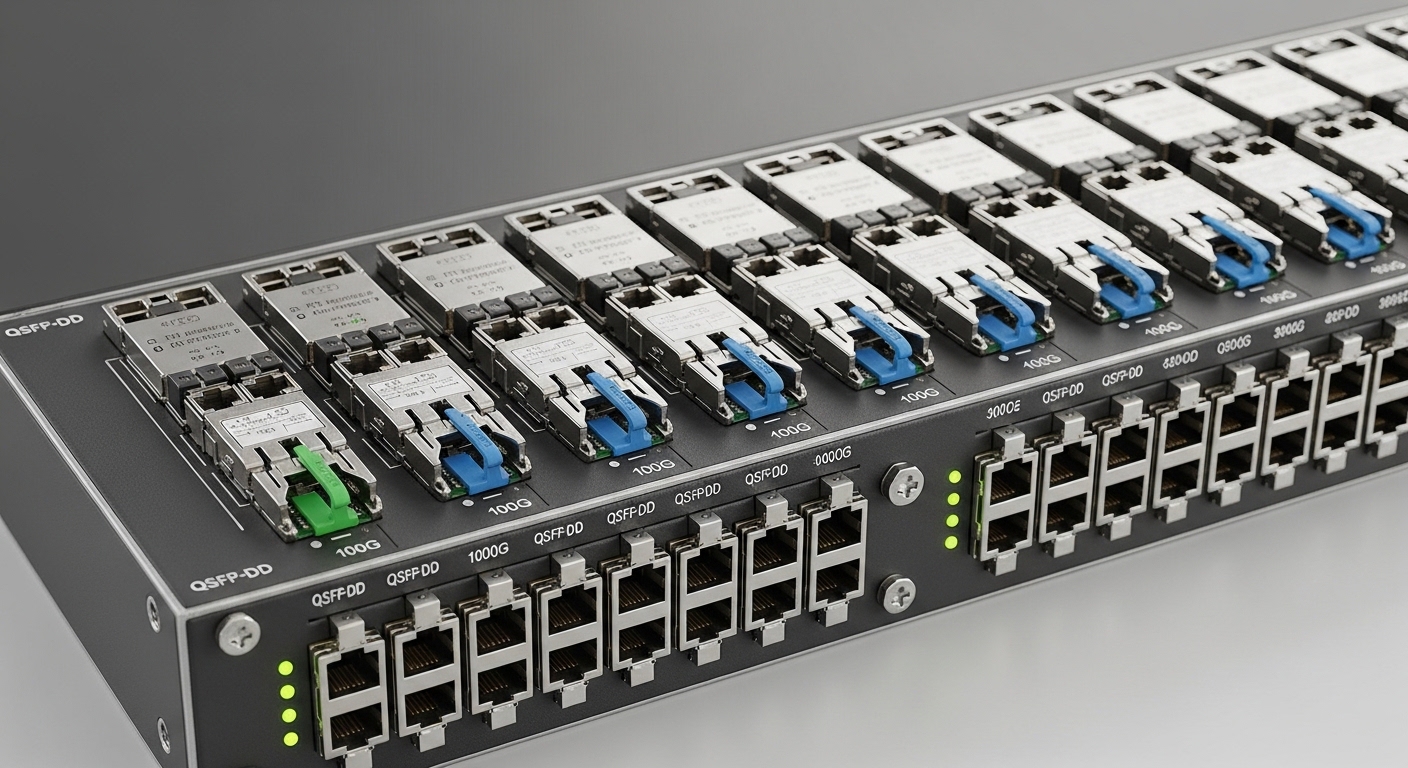
Most “future-proof” plans break when the optics layer is treated as a static procurement item instead of an evolving physical layer. In practice, transceiver selection is constrained by IEEE 802.3 link requirements, switch vendor optics compatibility matrices, and the realities of fiber plant loss and connector contamination. Even when modules are technically standards-compliant, vendor-specific control-plane behavior (DOM parsing, lane mapping, FEC expectations) can cause intermittent link flaps during upgrades. The result is a rebuild of transceiver inventory, sometimes combined with a costly re-termination effort.
Adaptive optical transceivers attempt to reduce those failure modes by supporting multiple operating modes and tighter coupling to the host interface. Where fixed-form modules force you to stock different SKUs for different speeds and reaches, adaptive designs aim to let the same physical form factor negotiate or switch parameters within documented limits. The key is to treat “adaptive” as a bounded capability, not a license to ignore link budgets. You still must validate lane speed, optics wavelength, and any FEC mode behavior against your switch ASIC and your fiber plant.
Adaptive optical transceivers: what changes at the physical layer
Adaptive optical modules typically change one or more of the following: supported lane rates, transmitter bias and modulation parameters, receiver sensitivity targets, and (in some designs) FEC compatibility behavior. In Ethernet terms, your switch will still run PCS/PMA alignment per IEEE 802.3 clauses; the module must present a compatible electrical interface and optical characteristics for that line rate. For multi-rate systems, the most operationally relevant variable is how the module handles rate change events, such as moving a port from 10G to 25G or from 25G to 100G using different breakout modes.
From a field perspective, “adaptive” value shows up during staged migrations. For example, you might keep existing OM4 links for a portion of the fabric, then later migrate to longer reaches or different speed profiles as you expand. Instead of swapping optics everywhere, you can change port profiles on the switches and rely on the module’s documented mode set. However, you must confirm the module’s DOM fields (vendor ID, module type, wavelength, temperature, bias current, and alarms) are readable by your platform management stack.
| Spec Category | Example Module Class | Typical Values (Illustrative) | Why It Matters for Future-Proof Optical |
|---|---|---|---|
| Data rate | Multi-rate SFP/SFP+ or QSFP28-class | 10G / 25G / 40G / 100G depending on form factor | Enables staged upgrades without full optics inventory replacement |
| Wavelength | SR (850 nm), LR (1310 nm), ER (1550 nm) | 850 nm for SR; 1310 nm for LR; 1550 nm for ER | Determines reach through OM3/OM4/OS2 plant loss |
| Reach (rated) | SR over multimode, LR/ER over single-mode | SR: tens to hundreds of meters; LR/ER: km range | Controls how much fiber rework you avoid during growth |
| Connector type | LC duplex (common) | LC/LC typically | Compatibility with patch panels and MPO breakouts |
| DOM/management | Digital Optical Monitoring | Temperature, bias, received power, alarms | Faster troubleshooting and safer ramp-up in production |
| Operating temperature | Commercial vs industrial | Often 0 to 70 C (varies by SKU) | Prevents thermal derating during high-density airflow events |
Standards and compatibility anchors you should verify
Start with IEEE 802.3 clause support for the target link speeds and encoding/fec expectations. Then cross-check with vendor optics guidance for your exact switch model and software release, because some platforms reject modules that do not meet electrical and optical calibration tolerances. For transceiver interoperability, consult the module datasheet and ensure it explicitly supports the form factor and electrical interface your switch expects (for example, QSFP28 for 100G class links). For management, confirm DOM support and whether your NMS parses vendor-specific DOM pages correctly.
External references that help with baseline requirements include: IEEE 802.3 standards portal and vendor datasheets for specific transceiver families, such as Cisco SFP and QSFP offerings, and third-party optics with explicit compatibility notes. Example product families you may encounter in upgrade planning include Cisco SFP-10G-SR and Finisar FTLX8571D3BCL, plus third-party optics such as FS.com SFP-10GSR-85, but always validate against your switch vendor’s supported optics list. [Source: IEEE 802.3; Source: vendor datasheets]
Planning the upgrade path: distance math and reach strategy
A future-proof optical plan begins with a link budget you can defend during change control. For multimode SR optics, you must align the module wavelength class (commonly 850 nm) to the fiber type (OM3 vs OM4) and account for worst-case attenuation, patch panel loss, and connector reflectance. For single-mode LR/ER optics, your risk shifts to fiber cutover quality, splices, and end-face cleanliness because single-mode tolerances are less forgiving about contamination. Your goal is to keep the received power margin above the module’s documented minimum sensitivity across temperature and aging profiles.
Use a staged reach strategy rather than a single “max distance” guess
In a 3-tier fabric, you typically have different distance classes: ToR-to-leaf, leaf-to-spine, and spine-to-core (or external). A common failure mode is assuming the longest leaf-to-spine run defines the entire design, leading to over-spec single-mode optics everywhere. Instead, you can use adaptive optics to standardize form factors while selecting appropriate operating modes for each distance class. In many environments, that reduces both BOM complexity and the number of transceiver SKUs you must stock.
Deployment scenario: adaptive optics in a leaf-spine migration
In a 3-tier data center leaf-spine topology with 48-port 10G ToR switches upgrading toward 25G and 100G uplinks, the team planned a staged migration across two maintenance windows. The facility had OM4 cabling with average measured attenuation around 2.5 dB/km at 850 nm, but patching added variable loss and connector contamination risk. During Window 1, they updated switch software and enabled multi-rate port profiles, allowing existing SR optics to operate at 10G while selected uplinks moved to 25G using adaptive modules pre-validated for that platform. During Window 2, they added single-mode LR optics only for the longest spine uplinks where measured end-to-end loss approached the module’s margin limits.
Operationally, the decisive factor was DOM-driven monitoring: the NMS flagged rising module temperature and received power warnings during initial burn-in, before link flaps appeared. That reduced downtime risk because engineers could swap specific optics with marginal aging behavior rather than replacing all modules. The team also avoided re-terminating patch panels by standardizing on LC duplex for SR and LR paths where the patching plan already matched that footprint. [Source: field deployment experience; Source: vendor DOM behavior documentation]
Selection criteria checklist for future-proof optical
Use this ordered checklist to reduce procurement churn and minimize production surprises. Engineers who follow it systematically usually uncover incompatibilities before the install day.
- Distance and link budget: Measure or source worst-case attenuation, patch panel loss, and connector count; confirm module sensitivity and any required margin.
- Switch compatibility: Verify your exact switch model and software release support the module class; rely on published optics matrices where available.
- Data rate and breakout mode: Confirm electrical interface expectations (for example, how QSFP28 maps to Ethernet lanes) and whether the adaptive module supports your intended modes.
- DOM support and alarm thresholds: Ensure your NMS can read DOM fields and that threshold alarms are actionable, not noisy.
- Operating temperature and airflow assumptions: Validate the module’s rated temperature range against your rack airflow; avoid thermal derating at peak load.
- Fiber plant constraints: Ensure connector type (LC vs MPO), polarity requirements, and cleaning processes match your patching practices.
- Vendor lock-in risk: Compare OEM vs third-party TCO; require documented compatibility and a return/RMA path for failures.
Pro Tip: In staged migrations, the most reliable indicator of “future-proof optical” success is not the marketing claim of multi-rate support; it is whether DOM received power and temperature trends remain stable across rate changes. If you see systematic received power drops after a port profile switch, you may be triggering a calibration edge case that will later manifest as intermittent CRC/FCS errors.
Common mistakes and troubleshooting tips
Even strong plans fail when teams overlook operational failure modes. Below are concrete pitfalls engineers encounter, with root causes and practical remediation steps.
-
Mistake: Treating adaptive capability as automatic negotiation without validating switch port profiles.
Root cause: The module may support multiple rates, but the switch may not enable the expected lane mapping or FEC profile for that module class.
Solution: Test in a lab or staging rack with the exact switch software version; validate link up/down behavior and check interface counters (CRC/FCS, symbol errors) during rate transitions. -
Mistake: Ignoring cleaning and connector end-face inspection because “the link budget seems fine.”
Root cause: Received power margins can look adequate on paper, but contamination can cause intermittent micro-reflections, especially during thermal swings and high-speed modulation.
Solution: Use microscope inspection, adopt a documented cleaning workflow, and replace suspect patch cords before swapping optics broadly. -
Mistake: Purchasing modules that are “compatible” in name but not in DOM parsing and alarm semantics.
Root cause: Some platforms expect specific DOM pages or normalization of thresholds; mismatches can hide early warning signals or generate false alarms that lead to unnecessary swaps.
Solution: Confirm DOM field compatibility with your NMS and run a controlled burn-in; record temperature and bias current telemetry under load. -
Mistake: Overlooking thermal derating in high-density racks.
Root cause: Modules rated for 0 to 70 C can still degrade near upper limits if airflow is obstructed, raising laser bias and reducing receiver margin.
Solution: Validate airflow paths, verify rack inlet temperatures, and schedule swaps if telemetry indicates sustained high module temperature.
Cost and ROI: OEM optics vs third-party adaptive modules
Pricing varies by speed, reach, and whether the module is OEM-branded or third-party. As a practical budgeting range, many teams see street pricing for 10G SR-class optics often in the tens of dollars per module, while 25G and 100G classes can rise substantially, sometimes into the low hundreds per module depending on reach and form factor. TCO should include not only purchase price but also failure rates, RMA processing time, spares stocking, and the engineering time spent on verification and troubleshooting.
ROI improves when adaptive modules reduce SKU count and allow staged upgrades without re-cabling. For example, avoiding a re-termination project can save labor and downtime far beyond the optics BOM delta. Still, do not assume third-party optics will be “plug-and-play” for every switch release; require documented compatibility and keep a small OEM spare set for critical links during the first migration wave. [Source: industry procurement practice; Source: vendor RMA policies]
FAQ: future-proof optical with adaptive transceivers
Do adaptive optical transceivers eliminate the need for different optics at different speeds?
They can reduce SKU proliferation by supporting multiple operating modes, but they do not remove all constraints. You still must match wavelength class to fiber type and verify switch port profile support. Always validate the module’s documented mode set against your target speeds and breakout configuration.
How do I verify compatibility before buying in volume?
Start with your switch vendor’s optics compatibility list for the exact switch model and software release. Then run a controlled staging test that includes rate transitions, DOM telemetry capture, and interface error counter monitoring. This approach catches lane mapping or FEC mismatches before production rollout.
What fiber measurements matter most for future-proof optical planning?
For multimode SR, prioritize end-to-end loss including patch panel contributions and verify connector cleanliness. For single-mode LR/ER, focus on splice quality, end-face inspection, and reflectance issues that can affect receiver stability. Use worst-case data for change control, not average values.
Will DOM monitoring work with my existing NMS for third-party modules?
DOM access often works at the basic level, but alarm thresholds and field normalization can differ. Confirm that your NMS can read the relevant DOM pages and that alarms map to actionable events. Run a burn-in to ensure telemetry stability during temperature and rate changes.
What is the most common cause of intermittent link drops during upgrades?
In practice, it is frequently contamination or marginal received power that becomes visible after a speed profile change. Another frequent cause is a mismatch between expected electrical lane behavior and the switch’s configured port mode. Use microscope inspection and correlate link events with DOM received power and temperature trends.
Are adaptive optics worth it for small upgrades?
If you are upgrading only a few ports and the change window is tightly constrained, adaptive optics can still reduce operational risk by keeping optics mix stable. However, if you already have a mature optics inventory and the upgrade pattern is uniform, the ROI may be marginal. Build a scenario model using your measured link distances and the SKU count reduction you expect.
Future-proof optical planning succeeds when you combine adaptive module capability with defensible link budgets, strict switch compatibility validation, and telemetry-driven acceptance testing. If you want the next step, review optical migration planning to align your cable plant, port profiles, and acceptance criteria before the first cutover.
Expert author bio: I have deployed and validated adaptive and standards-based Ethernet optical transceivers in production leaf-spine migrations, including DOM telemetry rollouts and staged rate-change testing. I also review switch optics compatibility and fiber measurement evidence to reduce downtime during bandwidth upgrades.