AI clusters fail in production less often due to compute than due to the fiber infrastructure around them: wrong reach, overspent optics, or underestimated power and spares. This article helps data-center and network engineers build a cost model that is accurate enough for procurement and agile enough for rapid PMF-style validation. You will map AI traffic patterns to optical reach, quantify module and transceiver options, and estimate total cost of ownership (TCO) across 3 to 5 years. Update date: 2026-04-30.
Prerequisites: what you must measure before you price fiber infrastructure
Before you touch BOMs, collect baseline measurements so your fiber infrastructure cost analysis is grounded in reality, not assumptions. The key is converting AI workload behavior into deterministic link budgeting and procurement quantities. If you skip this, you will repeatedly “fix” cabling and optics after deployment, which is where TCO explodes.
What to collect (minimum viable dataset)
- AI topology: leaf-spine, pod size, oversubscription ratio, and number of ports per ToR/Spine ASIC switch.
- Traffic profile: expected east-west bandwidth per GPU rack, average and peak oversubscription, and burstiness (e.g., training steps with all-reduce).
- Distance map: rack-to-row, row-to-row, and any cross-pod routes. Include connector type and patch panel counts.
- Optical budget inputs: fiber type (OM4/OM5/OS2), worst-case attenuation per meter, and expected insertion loss for patch cords and splitters (if any).
- Environmental constraints: cable management temperature range and any airflow restrictions near optics cages.
Step-by-step implementation: build a fiber infrastructure cost model for AI
This is the process I use when scoping a new AI fabric and validating it against procurement constraints. Each step has an expected outcome so you can iterate without getting stuck in analysis paralysis.
Derive link counts and port utilization from your AI fabric
Compute the number of required links based on switch radix and topology, then layer in redundancy. For example, in a 3-tier style leaf-spine fabric, each leaf may connect to multiple spines, and each rack’s GPU servers attach to the leaf. If you run 48-port 10G ToR or 32-port 100G leaf style gear, the link count drives both transceiver quantity and patch panel labor.
Expected outcome: a spreadsheet with required link count per tier (leaf-to-spine, server-to-leaf, spine-to-core if applicable) and a redundancy factor (e.g., 1+1 paths for critical pods).
Map application traffic to a reach tier, not just a speed tier
Speed alone is not enough. In fiber infrastructure planning, reach tier determines optics class, transceiver price, and power draw. For short rack-to-row runs, you can often standardize on SR multi-mode optics; for longer inter-row or inter-pod, you may need LR or coherent options over OS2.
Practical reach tiering heuristic
- Intra-rack / same row (<= 100 m): OM4/OM5 with SR (e.g., 10G-SR, 25G/40G/100G-SR variants depending on switch ASIC).
- Inter-row / cross-pod (100 m to 2 km): OS2 with LR / ER depending on distance and budget margins.
- Beyond 2 km or strict wavelength planning: consider DWDM/coherent, but only after you validate latency and operational complexity requirements.
Expected outcome: a reach histogram (how many links fall into short, medium, long categories) so your cost model chooses the right optics mix.
Choose fiber type and connector strategy that minimizes rework
Fiber type changes both optical budget and module compatibility. Multi-mode (OM4/OM5) is often cheaper for short-reach AI fabrics, but you must ensure optics support the fiber modal bandwidth requirements and that your patch cords are clean and standardized. Connector strategy affects insertion loss and field failure rate: stick to APC only where required (typical for analog or specific scenarios) and keep endface cleanliness and polarity consistent.
Expected outcome: a fiber standard decision per tier (e.g., OM4 for SR links inside pods, OS2 for LR links between pods) and a connector policy (LC/UPC vs LC/APC) aligned with vendor datasheets.
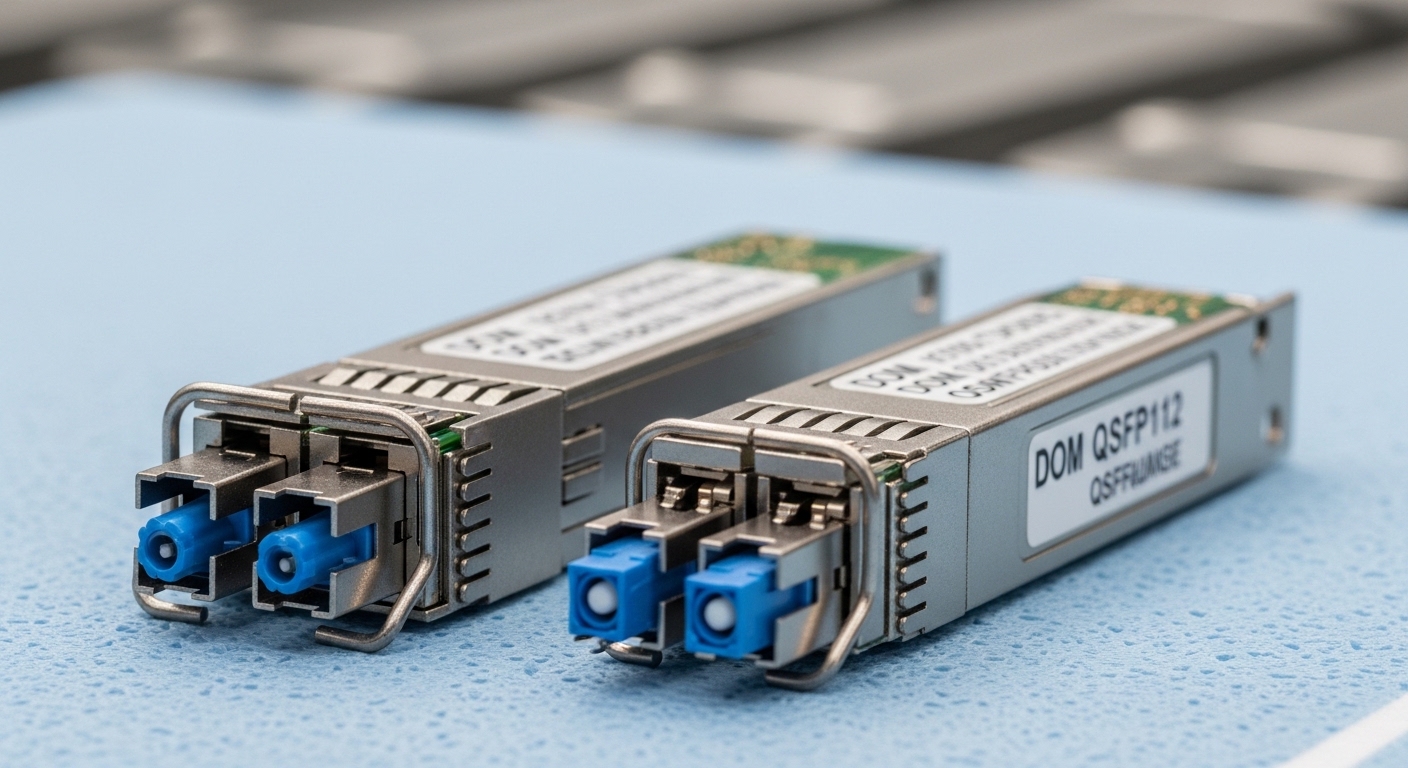
Price optics using real model numbers, DOM support, and power draw
For procurement-grade accuracy, price specific transceiver SKUs, not “generic SR.” Vendors differ in DOM behavior, maximum TX power, receiver sensitivity, and whether they pass switch vendor qualification. In AI fabrics, power matters because optics sit next to hot air exhaust paths and can influence cooling load.
Example candidate optics to model
- 10G-SR multi-mode: Cisco SFP-10G-SR (commonly used in mixed environments) and compatible third-party SR modules.
- 25G/40G/100G SR: Finisar/FS and other vendors offer OM4/OM5 SR variants; check exact part numbers for reach and DOM.
- 10G-LR single-mode: OS2 LR options for longer runs; ensure wavelength and reach match your budget.
| Spec category | 10G-SR (OM4/OM5) | 10G-LR (OS2) | 100G-SR (OM4/OM5, typical) |
|---|---|---|---|
| Nominal wavelength | 850 nm (multi-mode) | 1310 nm (single-mode) | 850 nm (multi-mode, parallel optics) |
| Reach target | Up to 300 m on OM3, 400-500 m on OM4 depending on module class | Up to 10 km class | Often 100 m on OM4; some SKUs extend with OM5 |
| Connector | LC duplex | LC duplex | LC duplex (or MPO/MTP for some implementations) |
| Typical DOM | Supported on most qualified SR/LR modules | Supported on most qualified SR/LR modules | Supported; verify exact DOM implementation with switch |
| Power (order of magnitude) | Low single-digit watts per module | Low single-digit watts per module | Higher than 10G SR, still manageable; verify exact vendor datasheet |
| Operating temperature | Typically industrial or commercial; verify 0 to 70 C vs extended | Typically commercial/industrial; verify range | Verify range based on data-center environment |
Expected outcome: a priced optics mix by tier (short/mid/long) with power per module and DOM compatibility flags, ready for TCO math.
Convert optics and cabling into TCO across 3 to 5 years
TCO is not just purchase price. Include planned spares, field failure probability, port density growth, and power consumption. For fiber infrastructure, labor and rework are often the hidden cost drivers: each failed link adds time for fiber cleaning, endface inspection, and re-termination. If your AI rollout includes rapid scaling (common in early-stage model iteration), you should model an expansion buffer: reserve conduit capacity and patch panel slots so you do not repeat civil work.
Expected outcome: a TCO model with at least these lines: optics BOM, patch cords and trunks, labor, spares pool, and electricity cost from optics power draw.
Pro Tip: In AI fabrics, the “cheapest” SR optics often lose in TCO because of higher field failure rates driven by patch cord cleanliness and MPO/MTP handling. Price the optics, but also budget time for standardized cleaning and inspection tooling; the labor cost frequently dominates the delta between OEM and third-party pricing.
Deployment scenario: AI fabric sizing and fiber infrastructure cost in practice
Consider a deployment in a 3-tier data center leaf-spine topology with 8 pods, each pod containing 16 racks of GPU servers. Each rack connects to a leaf switch with 8 x 100G uplinks (for example, 800G per rack aggregate using multiple 100G ports) and each leaf uplinks to spines with 16 x 100G per spine. Typical distances: 35 m rack-to-row for server-to-leaf and 120 m leaf-to-spine patching. You standardize intra-pod links on 100G-SR over OM4/OM5 and inter-row leaf-to-spine on OS2 100G-LR (or an equivalent class) when you exceed SR reach margins.
In cost modeling, you compute optics quantity: if each rack uses 8 uplinks and you have 16 racks per pod, that is 128 x 100G server-to-leaf optics per pod; multiply by 8 pods. Then you apply reach tiering: for the 120 m leaf-to-spine run, you either accept a higher-loss budget with SR (risking marginal performance) or pay for LR optics with larger optical margin. Engineers often discover that the “distance risk premium” is cheaper than the operational churn caused by marginal links that pass initial tests but fail under thermal drift or connector contamination.
Finally, your spares pool matters. If you allocate 2% spares for optics and patch cords based on historical DOA rates, the spares line can add several percent to the initial BOM but reduces mean time to repair during peak training cycles.
Selection criteria checklist: how to decide optics and cabling for AI
When teams do fiber infrastructure cost analysis for AI applications, they often fail because they select optics in isolation from switch compatibility and operations. Use this ordered checklist to reduce rework and procurement surprises. If any item is uncertain, validate with a pilot link before scaling.
- Distance and link budget: verify worst-case insertion loss across fiber, patch panels, and patch cords; include connector loss and aging margin.
- Switch compatibility: confirm transceiver qualification and DOM behavior with your specific switch model and firmware.
- Data rate and lane mapping: confirm whether the transceiver uses SR over parallel optics (MPO/MTP) vs duplex LC; verify polarity requirements.
- DOM and monitoring strategy: ensure accurate temperature/voltage/bias and receive power reporting; align alerts with your NMS thresholds.
- Operating temperature and airflow: optics in hot aisles can derate; validate with vendor temperature specs and your airflow model.
- Fiber type and connector policy: standardize OM4 vs OM5 and connector style; avoid mixing without explicit budget validation.
- Vendor lock-in risk: quantify risk of OEM-only optics during expansion; evaluate third-party qualification and RMA behavior.
- Spare strategy: decide how many optics you keep on-site based on MTTR and training cycle criticality.
Common mistakes in fiber infrastructure cost analysis (and how to fix them)
Below are the top failure modes I see when teams run cost analysis for fiber infrastructure supporting AI applications. Each includes a root cause and a concrete fix you can apply during validation.
Pitfall 1: Underestimating connector and patch cord loss
Root cause: budgeting only fiber attenuation and ignoring insertion loss from patch panels, adapters, and excessive mated cycles. In multi-mode SR links, this can push you into a marginal receiver sensitivity region even if the link “lights up.”
Solution: build a worst-case link budget spreadsheet using vendor insertion loss figures for adapters and patch cords; then validate with live optical power measurements and error counters under expected thermal conditions.
Pitfall 2: Choosing SR optics for runs that exceed practical reach margins
Root cause: using nominal reach as a target rather than a maximum. Real deployments include patch cord variability, endface quality differences, and cleaning inconsistency.
Solution: define an explicit margin rule (for example, keep your estimated received power comfortably above the vendor minimum sensitivity). If you cannot get margin, standardize on LR/ER for those tiers and reduce operational risk.
Pitfall 3: Ignoring DOM compatibility and monitoring thresholds
Root cause: some third-party optics implement DOM differently or clamp values, causing your NMS to miss early warnings. Teams then discover failures during training surges when error counters spike.
Solution: pilot the exact transceiver SKUs you plan to buy, then verify DOM fields (temperature, bias current, received power) and confirm alert thresholds trigger correctly. Align thresholds with your switch vendor guidance and optical vendor specs.
Cost and ROI note: OEM vs third-party optics and the hidden TCO drivers
In real procurement, OEM optics frequently cost more up front, but they can reduce integration risk and operational churn. Third-party modules can be cheaper per unit, yet total cost can rise if you spend more labor validating compatibility, managing RMA cycles, or troubleshooting marginal links. A realistic pricing range depends on data rate and reach, but for many enterprises, optics can vary by multiples between OEM and qualified third-party sources.
TCO model inputs to include
- Purchase price: OEM often 1.2x to 2.5x third-party for comparable reach, depending on SKU scarcity.
- Power draw: even small per-module differences matter at scale; multiply by optics count and hours of operation.
- Rework labor: failed links can require cleaning, re-termination, and extra testing time; labor often dominates the delta.
- Failure rate and spares: assume a DOA and field failure budget; plan spares to reduce downtime during training windows.
ROI improves when you standardize fiber infrastructure early: consistent connector policies, validated optics SKUs, and a repeatable testing pipeline reduce variance. If your AI workload roadmap is uncertain, you can still optimize by building a modular cost model with tiered optics choices and a validated “expansion lane” plan.
FAQ: fiber infrastructure pricing and planning for AI teams
How do I estimate link budget quickly for fiber infrastructure?
Start with distance-based fiber attenuation plus worst-case insertion loss for connectors, adapters, and patch panels. Then use vendor datasheet parameters for receiver sensitivity and transmitter launch power. Validate with on-site measurements using a power meter and confirm error counters after thermal stabilization. [Source: IEEE 802.3 Ethernet physical layer requirements overview]
Is OM4 or OM5 always better for AI applications?
Not always. OM5 can enable broader bandwidth behavior for certain wavelength-division usage and improve multi-mode performance headroom, but compatibility depends on your exact optics SKUs and switch support. For short AI fabric runs, OM4 is often sufficient if your link budget margin is comfortable. [Source: vendor multi-mode fiber application notes]
Do I need DOM support in a cost model?
Yes, because monitoring changes operational cost. Without reliable DOM telemetry, you lose early warning signals and increase the probability of surprise outages during training. DOM also affects how you automate thresholding and how quickly you can isolate failing optics. [Source: Cisco and vendor transceiver DOM documentation]
What is the biggest hidden cost in fiber infrastructure for AI?
Field troubleshooting labor is usually the biggest hidden cost. It can outweigh optics price differences when connector contamination, polarity issues, or marginal reach cause repeated link failures. Standardizing cleaning, inspection, and polarity handling reduces this dramatically. [Source: industry best practices for fiber endface inspection and cleaning]
Can third-party optics reduce cost without increasing risk?
Yes, but only if you qualify specific SKUs with your switch models and firmware. Treat optics as a controlled dependency: validate DOM behavior, optical power ranges, and error counter stability under realistic conditions. Build an acceptance test checklist for every transceiver batch. [Source: switch vendor optics compatibility guides]
How many spares should we keep for AI link optics?
A common starting point is around 1% to 3% spares for critical links, adjusted by your historical DOA rates and MTTR tolerance. If training downtime is expensive, bias upward and ensure spares are the exact validated part numbers. Track spares usage to recalibrate after the first rollout.
Building a cost model for fiber infrastructure in AI is mostly about converting distance, traffic tiers, and operational constraints into deterministic link budgets and validated optics choices. Next step: run a pilot pod with your chosen optics SKUs, measure received power and error counters, then lock the BOM using fiber-optic-transceiver-selection-checklist.
Author bio: I have deployed and troubleshot multi-mode and single-mode AI fabrics in production, including optics qualification, DOM telemetry validation, and link-budget debugging under thermal stress. I focus on PMF-style iteration: small pilots, hard measurements, and procurement-ready BOMs that minimize rework.
External authorities: IEEE 802.3 Cisco support documentation Finisar product and application resources