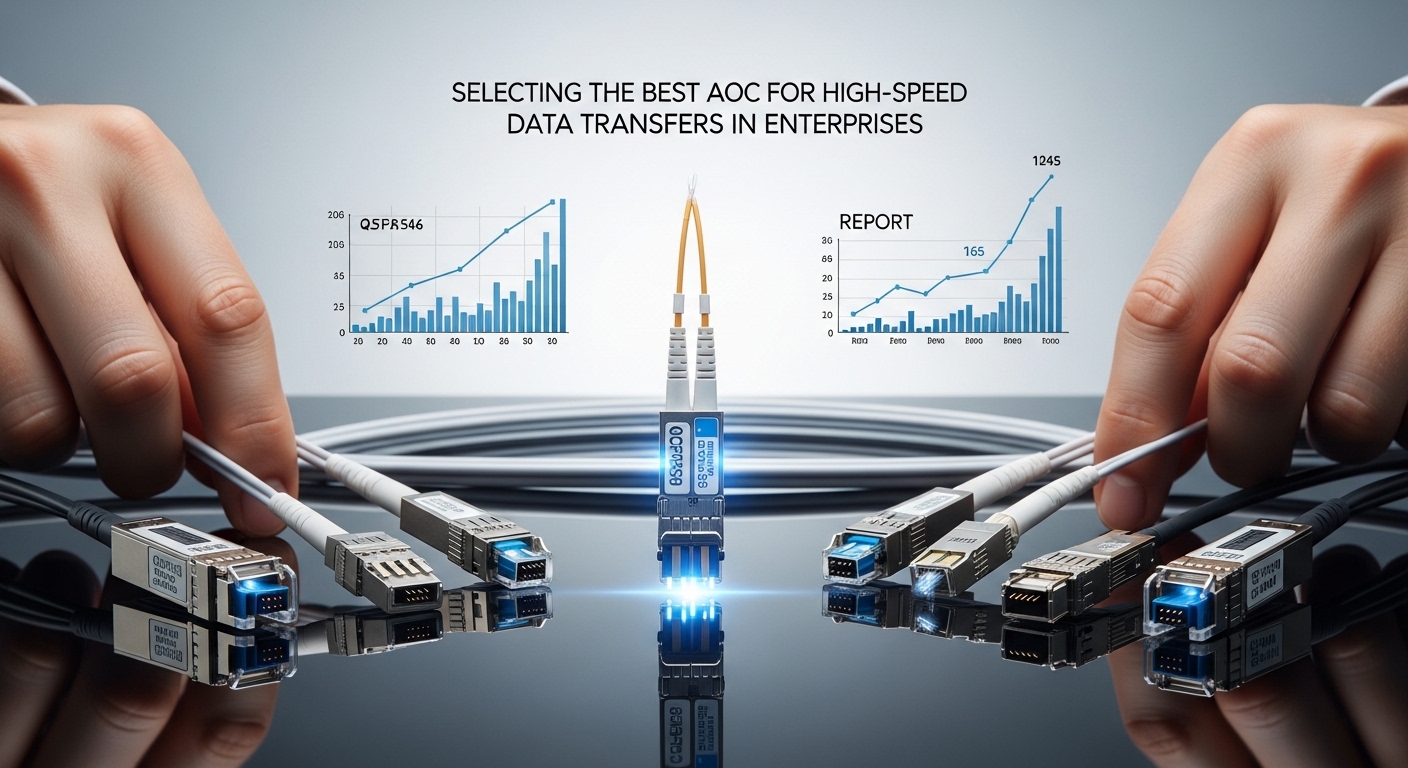
When enterprise data speeds stall, it is often not the application it is the optics. This quick reference helps network and field engineers choose an Active Optical Cable (AOC) that matches switch requirements, fiber plant realities, and thermal constraints. You will get a practical checklist, a spec comparison table, and troubleshooting patterns you can apply during commissioning.
Why AOC modules can boost enterprise data speeds in real deployments
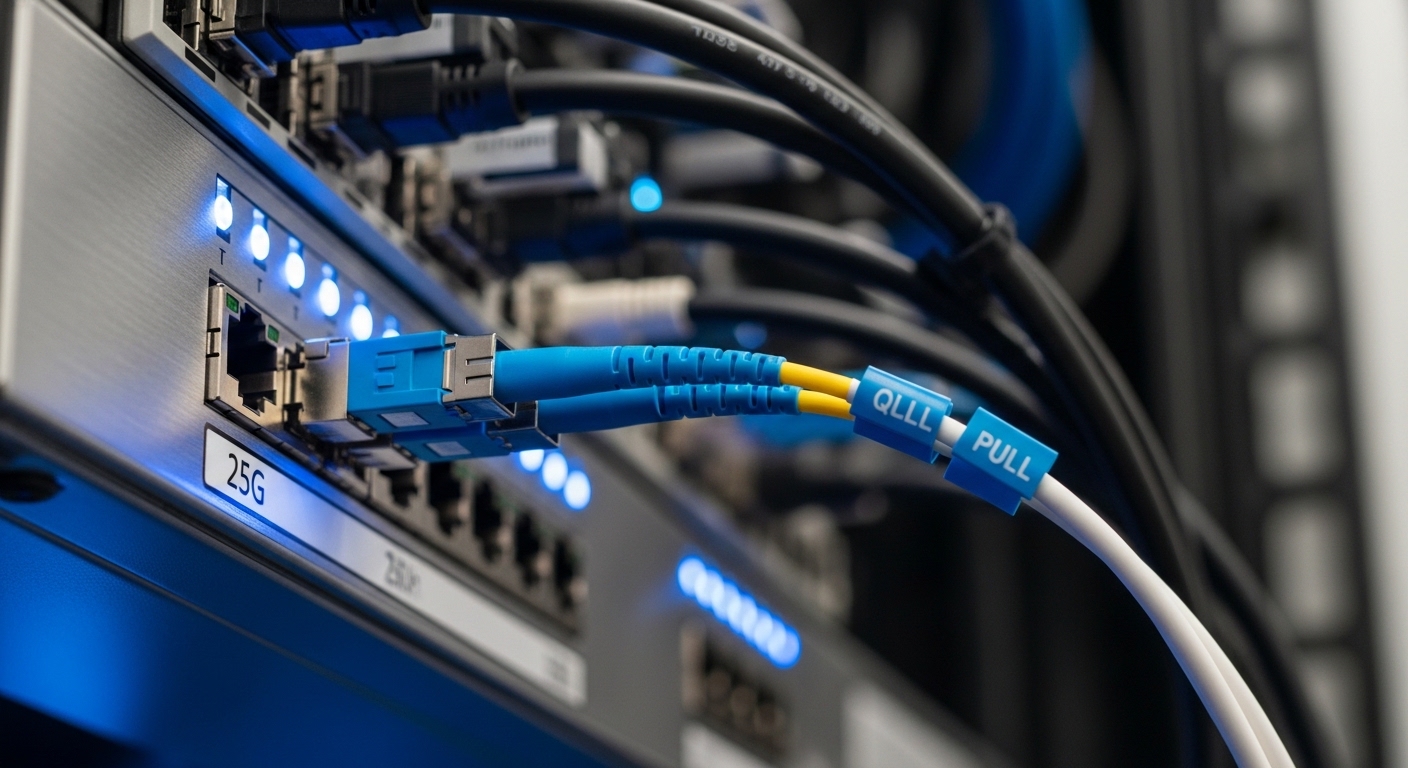
AOC transceivers combine electrical and optical conversion inside a cable assembly, typically designed for short-reach rack-to-rack links. In leaf-spine and spine-fabric environments, they reduce optics sprawl and simplify cabling compared to discrete transceivers plus patch cords. For many enterprise data speeds targets, especially 25G and 100G in constrained distances, AOC can deliver stable performance when the host port and optics profile match.
However, AOC is not universally interchangeable with pluggable optics. You must confirm interface type (QSFP28, SFP28, QSFP56, etc.), supported reach, and whether the module provides DOM telemetry in a way your switch expects. Vendor datasheets and switch optics compatibility guides remain the deciding documents in procurement and field acceptance testing. IEEE 802.3 Overview
Pro Tip: In commissioning, validate link stability with the switch vendor’s supported optics matrix and run a short traffic soak (for example, 30–60 minutes of iperf3 at line rate) before you label the link as “good.” Many “it negotiates” cases still fail under thermal drift or marginal connector conditions, and AOC assemblies can be more sensitive to repeated hot-plug cycles than passive solutions.
Key AOC specs that determine link speed, reach, and compatibility
Use the table below to compare what matters most for enterprise data speeds. Focus on the electrical interface, optical wavelength, reach class, connector/cable assembly, power budget, and the temperature range that matches your cabinet environment. Also verify whether your switch expects digital optical monitoring (DOM) via the standard management channel.
| Parameter | What to check on the AOC | Common values (examples) | Why it impacts enterprise data speeds |
|---|---|---|---|
| Host data rate | Exact line rate and lane mapping | 25G (1x25G or 4x25G options), 100G (4x25G) | Mismatched profiles can downshift to lower speeds or fail link training |
| Optical interface type | QSFP28/QSFP56/SFP28 physical format | QSFP28 for 25G/100G, QSFP56 for 50G/100G depending on SKU | Mechanical fit and electrical mapping must match switch port design |
| Wavelength | Nominal center wavelength(s) | 850 nm for short reach multimode; 1310 nm for longer reach single-mode | Mismatch can cause high BER and link flaps |
| Reach class | Rated distance with margin for your optics | Typical short-reach classes: 1–10 m (multimode AOC variants) | Exceeding reach reduces optical power margin and raises error rate |
| Connector/cable | Built-in ends and any polarity requirements | Often integrated QSFP plug ends; factory-cabled length | Prevents field polarity mistakes; wrong length can force rerouting and stress |
| DOM / monitoring | Supported telemetry and thresholds | DOM temperature, bias current, optical power (vendor dependent) | Switch may block or alert on missing or nonstandard telemetry |
| Power and thermal limits | Module power draw and operating temperature | Operating ranges often extend to 0 to 70 C | Thermal throttling or shutdown reduces link availability |
| Compliance | Vendor claims aligned to IEEE behavior | Form-factor and electrical compliance to host specs | Reduces probability of intermittent errors under load |
Selection criteria checklist before you buy the AOC
In high-speed environments, engineers typically decide in under an hour by cross-checking five documents: switch port spec, optics compatibility matrix, AOC datasheet, fiber plant records, and an acceptance test plan. Use this ordered checklist to avoid rework.
- Distance and topology fit: Confirm the physical path length between ports including slack. AOC is usually intended for short rack-to-rack runs; if you need 20–80 m, plan for fiber with pluggable optics instead.
- Host switch compatibility: Verify the AOC’s form factor (QSFP28/QSFP56) and whether the switch supports that vendor and that specific SKU. Use the switch vendor’s optics matrix when available. Cisco Optics and Compatibility Resources
- Rate and lane mapping: Ensure the AOC supports your target enterprise data speeds (for example 25G or 100G) with the correct lane aggregation mode.
- DOM support and telemetry behavior: Confirm the module provides DOM and that the switch reads it without “unsupported module” alarms. If you rely on monitoring, confirm threshold names and units in your collector.
- Operating temperature and airflow: Match AOC operating range to measured cabinet inlet/outlet temperatures. Many failures present as link flaps during summer peaks.
- Vendor lock-in risk: Prefer AOCs that are listed by the switch OEM or widely validated by independent test reports. Third-party can be cost-effective but validate early to reduce downtime.
- Power and budget impact: Compare module power draw and the switch’s optics power envelope, especially in dense chassis.
Concrete enterprise deployment scenario: AOC in a 3-tier leaf-spine
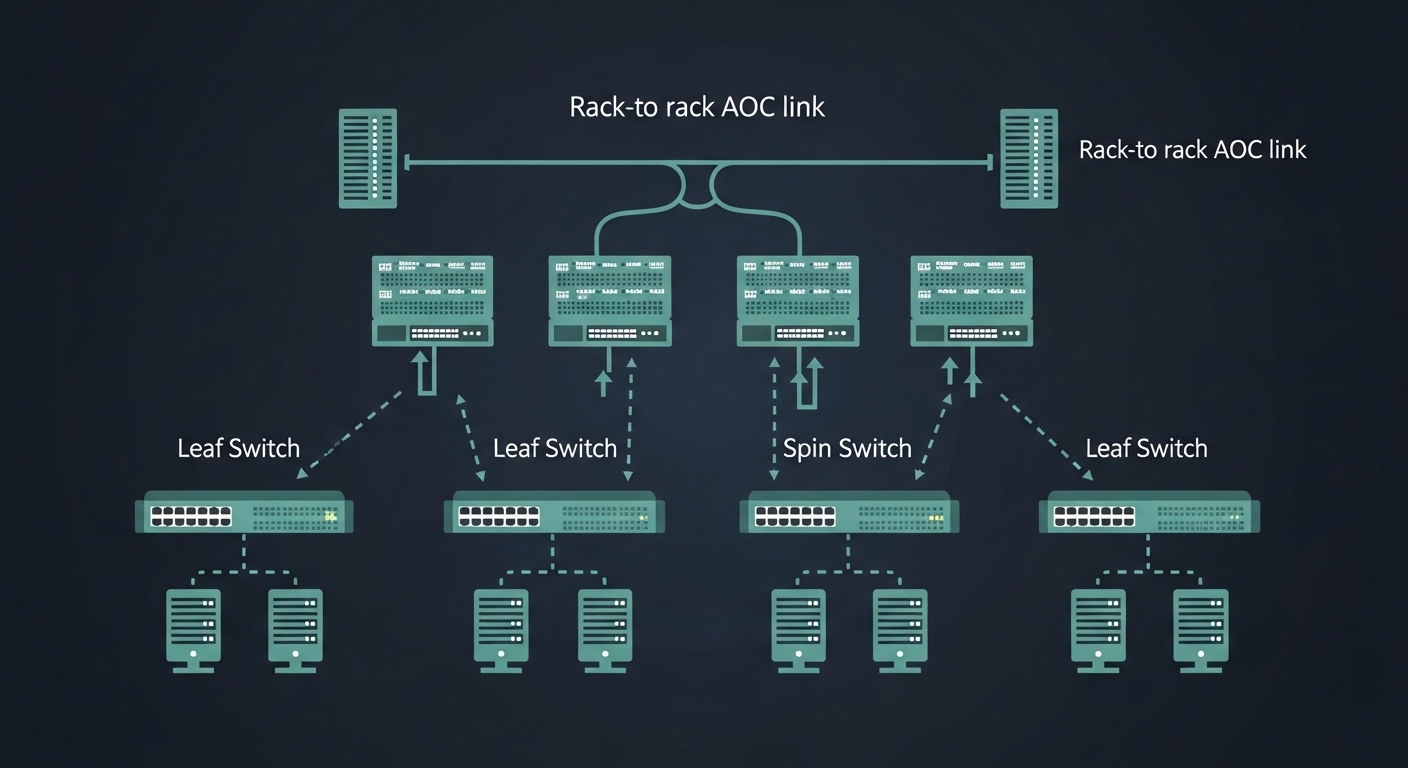
In a 3-tier data center leaf-spine topology with 48-port 25G ToR switches and 96-port 100G spine, a team standardized rack-to-rack links at 3–7 m. They used QSFP28 AOCs for leaf-to-spine uplinks where the patch-panel layout made discrete optics + patch cords error-prone. After installation, they ran a 4-hour soak at sustained throughput near line rate and monitored interface counters and optical telemetry; links that stayed within vendor-recommended optical power thresholds were marked “production ready.”
Field practice matters: they also verified cable bend radius at the rack rails and ensured the AOC was not pinched behind cable management. During a heat-wave test, they logged cabinet inlet temperatures and confirmed the AOC operating range exceeded the measured worst-case by a safety margin. This combination of compatibility checks and thermal validation prevented the intermittent CRC spikes that earlier batches showed when airflow was partially blocked.
Common pitfalls and troubleshooting patterns for AOC links
Most AOC issues show up as link negotiation failures, intermittent CRC errors, or sudden drops under thermal load. Use these concrete failure modes to cut mean time to repair.
-
Pitfall: Link comes up at a lower speed or repeatedly flaps.
Root cause: Incompatible rate profile or lane mapping for the switch port.
Solution: Confirm the AOC SKU supports your exact enterprise data speeds mode (for example 25G vs 100G breakout behavior). Re-seat the module and compare link settings to the switch’s supported optics list. -
Pitfall: High CRC or FEC-related counters increase during peak hours.
Root cause: Marginal optical power budget due to exceeding rated reach or poor handling (tight bends, connector stress).
Solution: Measure the actual run length including slack. Re-route to maintain bend radius and avoid compression. If available, compare DOM optical power readings to vendor thresholds. -
Pitfall: “Unsupported module” or missing DOM telemetry in monitoring.
Root cause: Switch expects a specific DOM behavior or the AOC is not fully compatible with the host’s management implementation.
Solution: Use the OEM compatibility matrix. If you must use third-party, test in a staging rack and confirm telemetry fields populate in your monitoring system. -
Pitfall: Intermittent link drops after maintenance work.
Root cause: Cable snagging or partial retraction during adjacent port work, causing micro-misalignment.
Solution: Inspect latch engagement on both ends, clean up cable slack, and re-run a traffic soak after any physical changes.
Cost and ROI: when AOC is cheaper than it looks
Typical street pricing varies by rate and reach, but in many enterprises, AOC assemblies for short runs can cost roughly 1.2x to 2.5x per end compared with some passive alternatives, depending on OEM vs third-party availability. The ROI often comes from reduced labor and fewer field troubleshooting hours: you avoid separate transceiver inventories, reduce patch-cord handling, and cut time spent on connector polarity and cleaning.
For TCO, include failure rate and spares strategy. AOC is an integrated assembly, so a single damaged cable means replacing the entire unit, while discrete optics might allow cheaper component-level swaps. In practice, many teams keep a small on-hand pool of the most common lengths and rates, and they stage new SKUs in a burn-in rack to reduce downtime risk.
FAQ: enterprise buyers and engineers ask about AOC choices
What enterprise data speeds can AOC support reliably?
Most AOC products target the same core rates as their host form factors, commonly 25G and 100G using QSFP28-class interfaces for short reach. Reliability depends on correct SKU selection, rated reach, and switch compatibility. Always validate with a traffic soak and check DOM optical power thresholds.
How do I confirm switch compatibility without buying multiple samples?
Start with the switch OEM optics compatibility matrix and match by form factor and SKU, not just wavelength or “25G/100G” marketing. If the matrix is incomplete, request a lab test plan from the vendor and perform a staging validation in your rack environment.
Do I still need fiber cleaning and polarity checks with AOC?
AOC typically reduces field cleaning because it is factory-terminated at the ends. Still, you must ensure the module seats fully and that cables are not stressed; for systems that use any mating adapters, treat those connectors as you would any optics interface.
What operating temperature matters most during enterprise data speeds operations?
Use measured cabinet temperatures at the switch inlet and verify the AOC operating range covers your worst-case. Thermal issues often appear as rising error counters or link flaps during hot periods, especially if airflow is blocked by cable bundles.
Can I mix AOC brands across the same switch for uplinks?
It can work, but only if each SKU is validated for your switch model and provides compatible DOM behavior. Mixing unvalidated modules increases the chance of monitoring gaps and intermittent issues that are hard to isolate under load.
When should I choose pluggable optics instead of AOC?
Choose pluggable optics when you need longer reach, flexible routing, or when your physical layout changes frequently. AOC is best for stable, short rack-to-rack distances where the operational simplicity outweighs the integrated replacement cost.
If you want the fastest path to stable enterprise data speeds, start with a compatibility-first checklist, then confirm thermal and optical margin during a traffic soak. Next, compare AOC versus passive fiber approaches using fiber optic transceiver reach planning for enterprises.
Author bio: I have deployed high-speed optics in enterprise data centers, performing port-by-port validation, DOM telemetry checks, and traffic soak acceptance tests under constrained cabinet airflow. I write from field experience, focusing on operational limits and commissioning practices that reduce downtime.