If your digital signage network keeps flapping, desynchronizing, or dropping streams, the root cause is often physical-layer optics rather than software. This article helps integrators and field engineers choose the right display network SFP transceiver for Digital Signage and Digital Out-of-Home (DOOH) deployments. You will get a practical short-list of options, a spec comparison table, and a decision checklist that maps directly to real switch compatibility and fiber conditions.
Top 8 display network SFP options by distance, media type, and connector
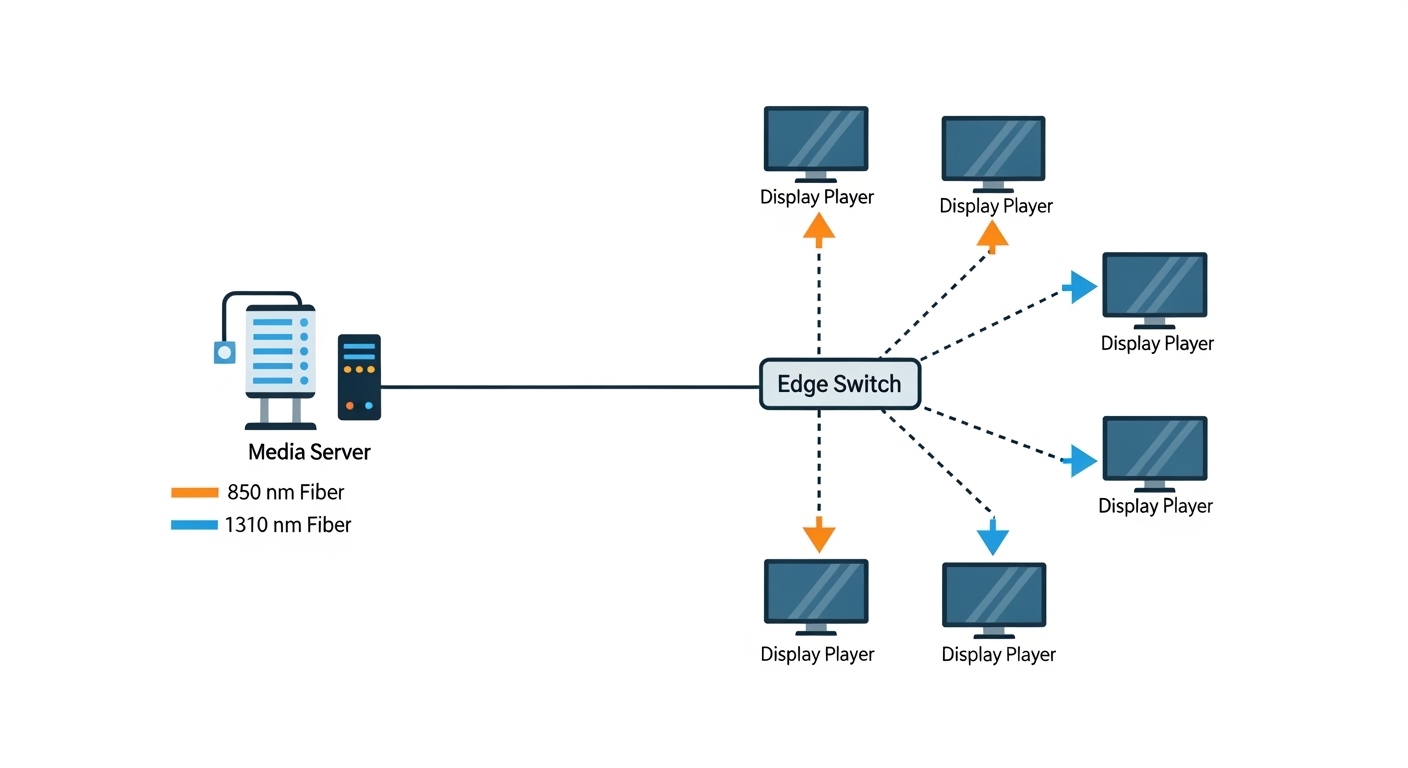
Digital signage and DOOH commonly use point-to-point fiber runs from a central media hub to edge players, sometimes through aggregation switches. The “right” display network SFP depends on reach (meters vs kilometers), fiber type (single-mode vs multi-mode), wavelength, and connector standard (LC vs SC). Below are eight field-proven SFP choices, each with best-fit scenarios and practical pros/cons.
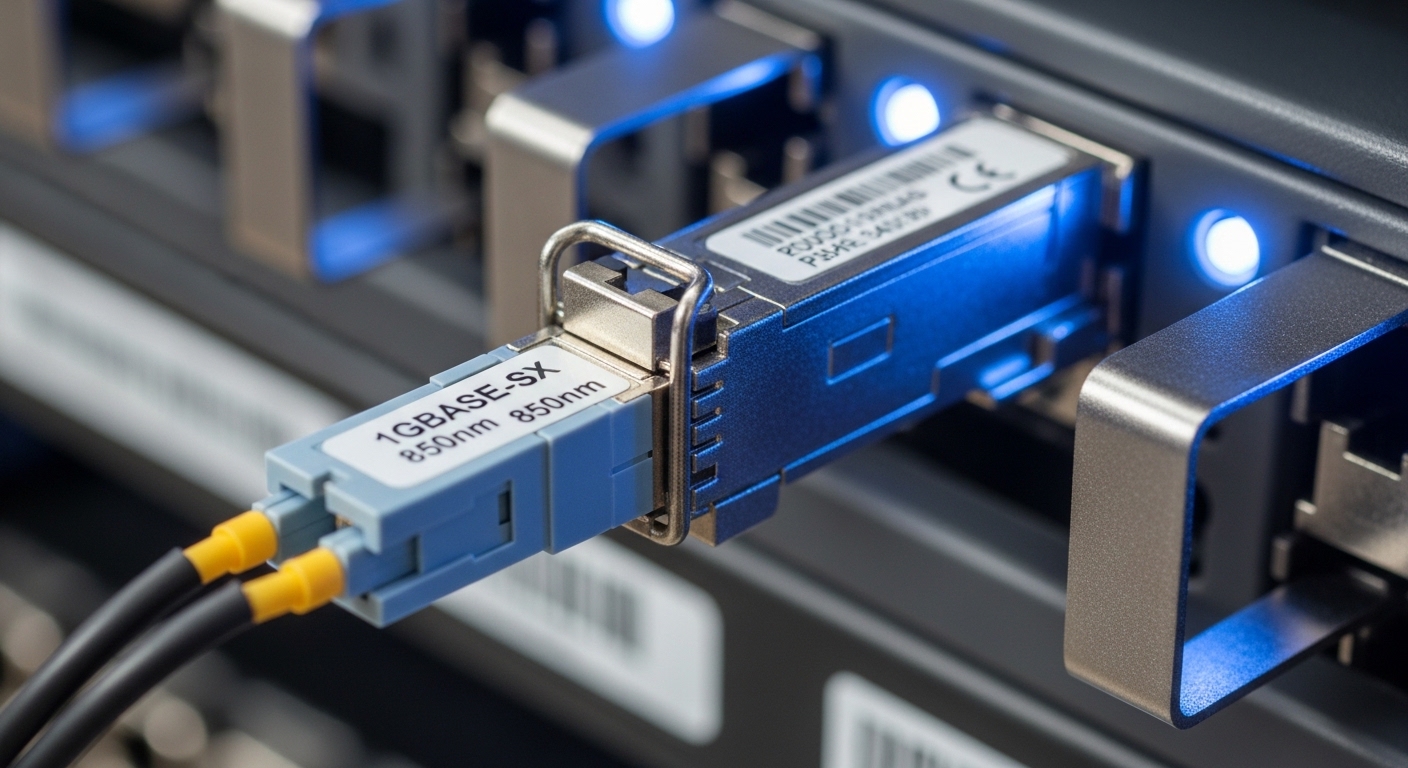
1GBASE-SX SFP: short runs on OM3/OM4 multimode
For indoor corridors, mall backrooms, and warehouse signage halls, 1GBASE-SX SFPs are the classic multimode pick. Typical parts target 850 nm over OM3/OM4 with LC connectors, which keeps optics cost low while providing stable links. In practice, you can often support tens to a few hundred meters depending on patch quality and budgeted loss.
Key specs to look for: 1.25 Gbps line rate, 850 nm, LC, temperature rating compatible with signage cabinets (often 0 to 70 C). Check vendor datasheets for exact reach on OM3 vs OM4.
Best-fit scenario: A retail chain with a central rack feeding 24 player endpoints across a back-of-house corridor using OM4 trunks and LC patch panels.
- Pros: Lower cost optics, easy installation with multimode cabling
- Cons: Limited reach; sensitive to poor termination and dirty optics
1GBASE-LX SFP: longer reach on single-mode
When signage runs extend beyond the building, or you need outdoor-rated pathways between zones, 1GBASE-LX SFPs become attractive. They operate around 1310 nm on single-mode fiber (SMF) with LC connectors, enabling kilometer-class links when budgeted properly. This is common for connecting a site controller to a distant player cluster.
Key specs to look for: 1310 nm, SMF, LC, typical reach often expressed as up to several kilometers depending on power and receiver sensitivity.
Best-fit scenario: A street-furniture DOOH deployment where the media hub in a head office connects to a regional controller rack through a 3 km SMF run.
- Pros: Better reach and fewer multimode-distance constraints
- Cons: Requires SMF buildout; higher optics cost than SX
10GBASE-SR SFP+: 10G on multimode for high-density signage floors
Many operators now push more than one display stream per VLAN and add edge processing, pushing throughput needs upward. 10GBASE-SR SFP+ runs well on multimode at 850 nm, typically with OM3 or OM4. This is a strong choice when you need faster transport for video-heavy signage without redesigning the whole cabling plant.
Key specs to look for: 10.3125 Gbps (10G Ethernet), 850 nm, LC, and explicit reach for your installed OM3/OM4 grade.
Best-fit scenario: A cinema complex where each floor has multiple signage panels and kiosks, aggregated into a ToR switch using 10G uplinks over OM4.
- Pros: Higher bandwidth without SMF conversion
- Cons: Still distance-limited; verify OM4 cleanliness and patch loss
10GBASE-LR SFP+: 10G single-mode for site-to-edge links
For DOOH, you often need to connect a site switch to a remote signage controller at distances where multimode becomes unreliable. 10GBASE-LR SFP+ uses 1310 nm over SMF and is designed for longer reach. If you budget optical power correctly, it can deliver stable high-throughput transport for multiple streams.
Key specs to look for: 1310 nm, SMF, LC, and receiver sensitivity in the datasheet so you can compute link margin.
Best-fit scenario: A three-building campus where each building has signage clusters, connected back to a central distribution switch using 8 km SMF.
- Pros: Strong balance of reach and performance
- Cons: Must verify link budget; check compatibility with switch optics policy
10GBASE-ER SFP+: extra-reach single-mode for long outdoor routes
When you have long outdoor conduits, splice-heavy routes, or you cannot shorten fiber runs, 10GBASE-ER SFP+ is a specialized tool. It typically operates near 1550 nm and supports extended reach over SMF. This option is less about cost minimization and more about ensuring the link survives real-world attenuation and aging.
Key specs to look for: 1550 nm, SMF, LC, and long-haul link budget parameters.
Best-fit scenario: A coastal billboard network where a central controller connects to a remote distribution switch across 20 km of SMF with multiple splices.
- Pros: Extended reach; better tolerance for longer routes
- Cons: Higher cost; ensure your fiber plant is truly optimized for long-haul
25G SFP28 SR: modern upgrade path for new signage aggregations
Newer signage aggregation designs sometimes use 25G uplinks to reduce oversubscription and support synchronized video workflows. 25G SFP28 SR targets 850 nm and is typically used on OM4 multimode in data center-adjacent deployments. If your cabling is already OM4, this can be a clean upgrade without moving to SMF.
Key specs to look for: 25.78125 Gbps, 850 nm, OM4 compatibility, and temperature rating.
Best-fit scenario: A multi-tenant digital signage operator upgrading a head-end switch stack with 25G aggregation while keeping the existing OM4 patching.
- Pros: Future-friendly throughput for dense streams
- Cons: Limited by multimode bandwidth distance; validate your OM4 link performance
25G SFP28 LR: 25G single-mode for regional connectivity
For regional DOOH designs that need 25G without expensive line-of-site fiber rebuilds, 25G SFP28 LR at 1310 nm is a practical middle ground. It supports SMF and is often used when you want higher capacity than 10G but still need manageable optics. This can be ideal for connecting regional head-end to a distribution switch.
Key specs to look for: 1310 nm, SMF support, and explicit reach values under typical link budgets.
Best-fit scenario: A regional hub connecting to a distribution switch across 10 km SMF to support multiple concurrent campaigns.
- Pros: Higher capacity than 10G LR; leverages SMF
- Cons: Compatibility and DOM behavior can vary across vendors
10G or 1G copper-to-fiber boundary SFP strategy: reduce troubleshooting scope
Some signage cabinets sit far from fiber and use copper drops to a local media gateway. While copper SFPs are not the focus, the strategy matters: use fiber SFPs only at aggregation boundaries to limit the number of optics types on site. This reduces “mixed optics” failure modes and makes diagnostics faster during outages.
Key specs to look for: match SFP speed to the switch port (1G vs 10G), and confirm auto-negotiation behavior (SFP fiber typically has no negotiation like copper does).
Best-fit scenario: Media players connected via short copper to a cabinet gateway, then fiber SFP uplinks to the site switch.
- Pros: Faster troubleshooting; fewer optics variants
- Cons: Requires thoughtful cabinet design and consistent speed planning
Specs that actually matter for display network SFP selection
Engineers often compare only wavelength and reach, but signage networks fail for other reasons: connector cleanliness, optical power margin, DOM support, and switch vendor optics policies. Use the table below to compare the most common display network SFP classes used in signage and DOOH.
| Display network SFP type | Data rate | Wavelength | Fiber / connector | Typical reach (order-of-magnitude) | Power / optics notes | Operating temperature |
|---|---|---|---|---|---|---|
| 1GBASE-SX (SFP) | 1.25 Gbps | 850 nm | OM3/OM4 multimode, LC | ~300 m on OM3/OM4 (verify datasheet) | Low-cost multimode; clean LC ends required | Common: 0 to 70 C |
| 1GBASE-LX (SFP) | 1.25 Gbps | 1310 nm | SMF, LC | ~2 to 10 km (verify) | Compute link margin using Rx sensitivity | Common: -5 to 70 C |
| 10GBASE-SR (SFP+) | 10.3125 Gbps | 850 nm | OM3/OM4 multimode, LC | ~300 m on OM3/OM4 (verify) | Higher bandwidth; sensitive to patch loss | Common: 0 to 70 C |
| 10GBASE-LR (SFP+) | 10.3125 Gbps | 1310 nm | SMF, LC | ~10 km (verify) | Link budget critical; check DOM behavior | Common: 0 to 70 C |
| 10GBASE-ER (SFP+) | 10.3125 Gbps | 1550 nm | SMF, LC | ~40 km (verify) | Extended reach; ensure long-haul fiber quality | Common: -5 to 70 C |
| 25G SFP28 SR | 25.78125 Gbps | 850 nm | OM4 multimode, LC | ~70 m (verify) to higher on OM4 (datasheet) | Validate modal bandwidth and patch loss | Common: 0 to 70 C |
| 25G SFP28 LR | 25.78125 Gbps | 1310 nm | SMF, LC | ~10 km (verify) | Compute margin; ensure switch optics support | Common: 0 to 70 C |
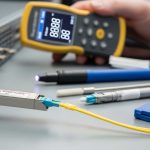
For standards grounding, Ethernet SFP optical classes align to IEEE 802.3 media specifications for corresponding rates and reach classes. For compliance expectations and typical electrical/optical behavior, reference [Source: IEEE 802.3]. For practical DOM and interoperability details, rely on vendor datasheets and switch compatibility matrices. Example reference optics models include Cisco SFP-10G-SR and Finisar FTLX8571D3BCL for SR-class optics, and FS.com SFP-10GSR-85 as a common third-party SR option; always confirm exact wavelength and reach for your fiber grade before deploying.
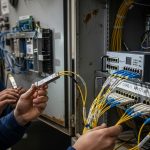
Pro Tip: In signage cabinets, the most common “optics” failure is not the SFP itself but contaminated LC endfaces. Even a light film can create receiver power margin loss that looks like intermittent video drop. Add an endface inspection step and use lint-free wipes plus isopropyl-approved cleaning; then re-check DOM Rx power after cleaning.
Real-world deployment: DOOH edge aggregation with measurable constraints
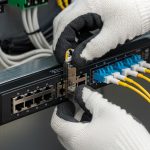
Consider a 3-tier DOOH network: a central media hub connects to regional aggregation switches, which then feed edge distribution switches inside venues. In one rollout, 48-port ToR switches carry 10G uplinks to a core and 1G access to display controllers. Each venue uses OM4 fiber with LC patch panels; the average run from edge switch to controller is 120 m with a measured patch loss budget of 2.5 dB total. Engineers selected 10GBASE-SR SFP+ for uplinks and 1GBASE-SX SFP for shorter controller segments, then validated optical power margin using DOM thresholds. This reduced truck rolls because link issues became measurable (DOM Rx power and error counters) rather than “mystery buffering.”

Selection criteria checklist for display network SFP (engineer order of operations)
Use this ordered checklist during site surveys and purchasing. It is designed to prevent the most expensive mistakes: wrong fiber type, wrong speed class, and insufficient link margin.
- Distance and fiber type: measure run length and confirm SMF vs OM3/OM4. Verify splices and patch panel counts.
- Data rate and port speed: ensure the SFP matches switch port capability (1G vs 10G vs 25G). Do not assume downspeeding will work.
- Connector and patch hardware: confirm LC vs other connector types and check adapter availability.
- Wavelength class: align SX at 850 nm to multimode and LR/LX at 1310 nm to SMF; ER uses 1550 nm.
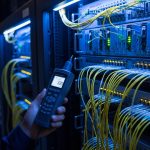
- DOM support and thresholds: verify switch reads DOM fields (Tx power, Rx power, temperature, bias current). Some optics may not expose all fields.
- Operating temperature: signage cabinets can exceed room temperature; pick optics with a suitable range and airflow assumptions.
- Compatibility and lock-in risk: check switch vendor compatibility lists, especially for third-party optics. Confirm whether the switch has “optics warning” or hard refusal behavior.
- Optical link budget: compute using Tx power, receiver sensitivity, fiber