In a leaf-spine data center, one bad optics choice can turn a clean migration into repeated link flaps, rising spares costs, and messy vendor support tickets. This article helps network and facilities teams perform a practical cost-benefit analysis between traditional SFP modules and AOC (active optical cable) for enterprise connectivity. You will see a concrete deployment case, measured results, and the exact selection criteria engineers use when compatibility, temperature limits, and total cost of ownership matter.
Case study: replacing 10G optics after a 40-rack ToR refresh
Problem and challenge: A mid-size enterprise completed a 48-port 10G ToR refresh across 40 racks, totaling 3,840 server-facing links. Their original plan used SFP transceivers with vendor-supported optics. During burn-in, they observed intermittent link drops on a subset of 15 m fiber runs and inconsistent behavior after switch reboots, traced to connector handling variability and dust sensitivity during repeated patching. The business goal was straightforward: reduce operational friction while preserving link reliability and predictable spares planning.
Environment specs: The network ran 10G Ethernet over multimode fiber with OM3 plant in most aisles and mixed patch panel types. Switches were 10G SFP+ capable and required optics that were compatible with their vendor’s diagnostic expectations, including Digital Optical Monitoring (DOM) where supported. Ambient conditions near the top of rack averaged 28 to 33 C, with short peaks during summer HVAC setbacks. The operational requirement was error-free forwarding and stable link negotiation across power cycles, consistent with typical IEEE 802.3 behavior for 10GBASE-SR links [Source: IEEE 802.3].
SFP versus AOC: what actually changes in the economics
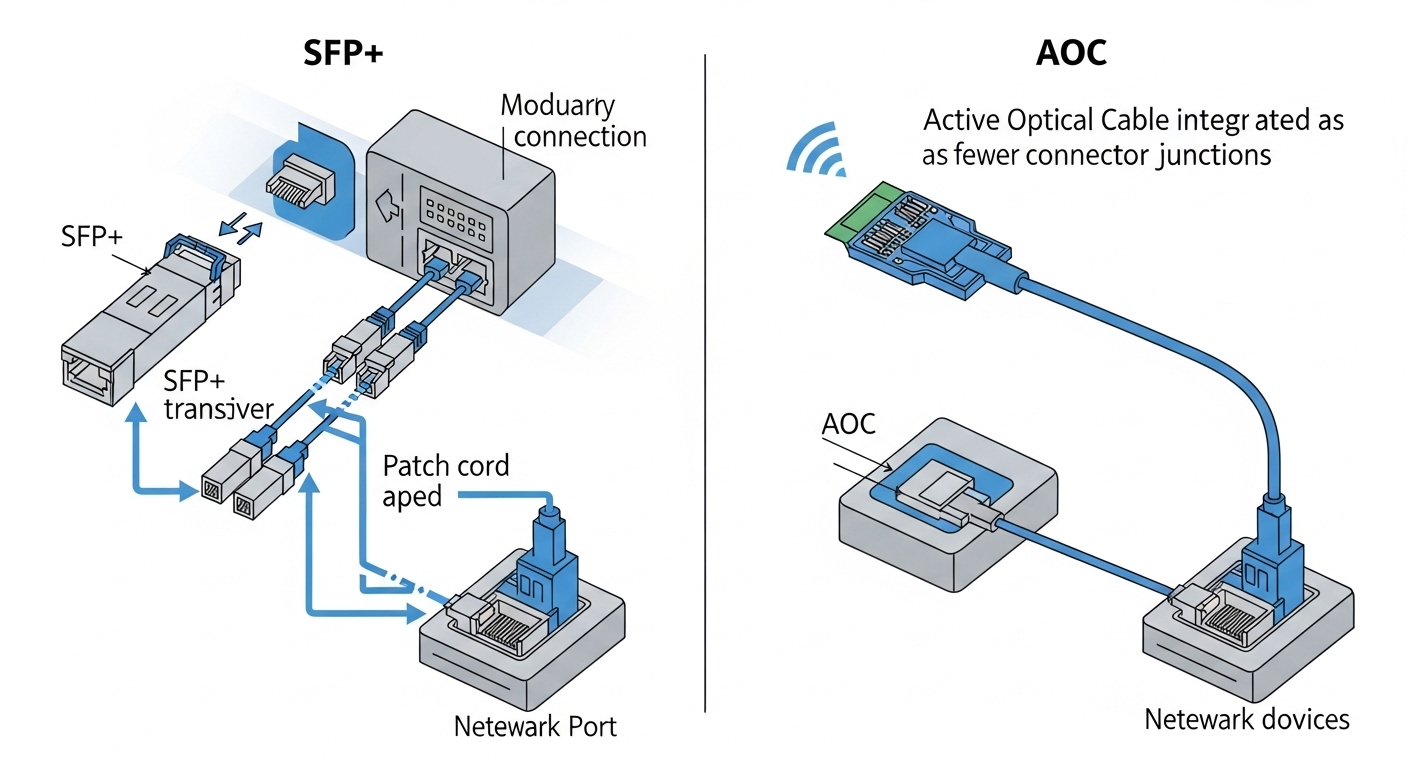
Chosen solution and why: The team evaluated two options for the 15 m interconnect band: (1) standard SFP+ transceivers paired with patch cords and (2) AOC assemblies that integrate optics and cable into one field-ready unit. They selected AOC only for the rack-to-rack segments where patching churn was high and cleaning practices were inconsistent. For longer or more variable routes, they kept SFP to retain repair flexibility and separate spares strategy.
Key technical differences that drive cost-benefit analysis
SFP modules generally separate the optics from the cabling, enabling targeted replacement when a patch cord is damaged. AOC bundles optics and fiber into one assembly, which reduces the number of mating cycles and often lowers the probability of connector contamination failures. However, AOC assemblies are less flexible: if the run length is wrong or the assembly is damaged, the entire cable-optics unit is replaced. Engineers also need to confirm that the switch supports the AOC’s electrical interface and that the module’s power, form factor, and temperature range match operational limits.
Measured spec anchor points used in the evaluation
For the 10G multimode use case, the baseline reference was 10GBASE-SR behavior. Example optics that were validated in the lab included Finisar and vendor-compatible parts such as Finisar FTLX8571D3BCL (common 10G SR class), and Cisco-compatible optics like Cisco SFP-10G-SR. For AOC, the team used enterprise-grade active optical cables specified for 10G over multimode with validated lengths at or above 15 m. Always verify exact wavelength, reach class, and DOM behavior against your switch vendor’s optics matrix.
| Spec | SFP+ transceiver + fiber patch cords | AOC (active optical cable) |
|---|---|---|
| Data rate | 10G (example: 10GBASE-SR) | 10G (active cable, SR class) |
| Typical reach class | Depends on fiber and optics; OM3 often supports ~300 m for 10GBASE-SR | Length is fixed by assembly; selected for 15 m in this case |
| Connector exposure | More mating points: transceiver + patch cords + panels | Fewer mating points; integrated cable reduces contamination events |
| Diagnostics | Often supports DOM depending on model | May support diagnostics, but behavior varies by vendor |
| Power and thermal load | Module power varies; must fit switch thermal design | Similar link budget intent, but thermal behavior depends on cable electronics |
| Operating temperature | Commonly commercial or industrial ranges; verify switch site needs | Verify specified range for the assembly; field failures often track out-of-range use |
| Field repair | Replace optics or patch cord separately | Replace entire assembly if damaged or wrong length |
Implementation steps: how the team deployed both safely
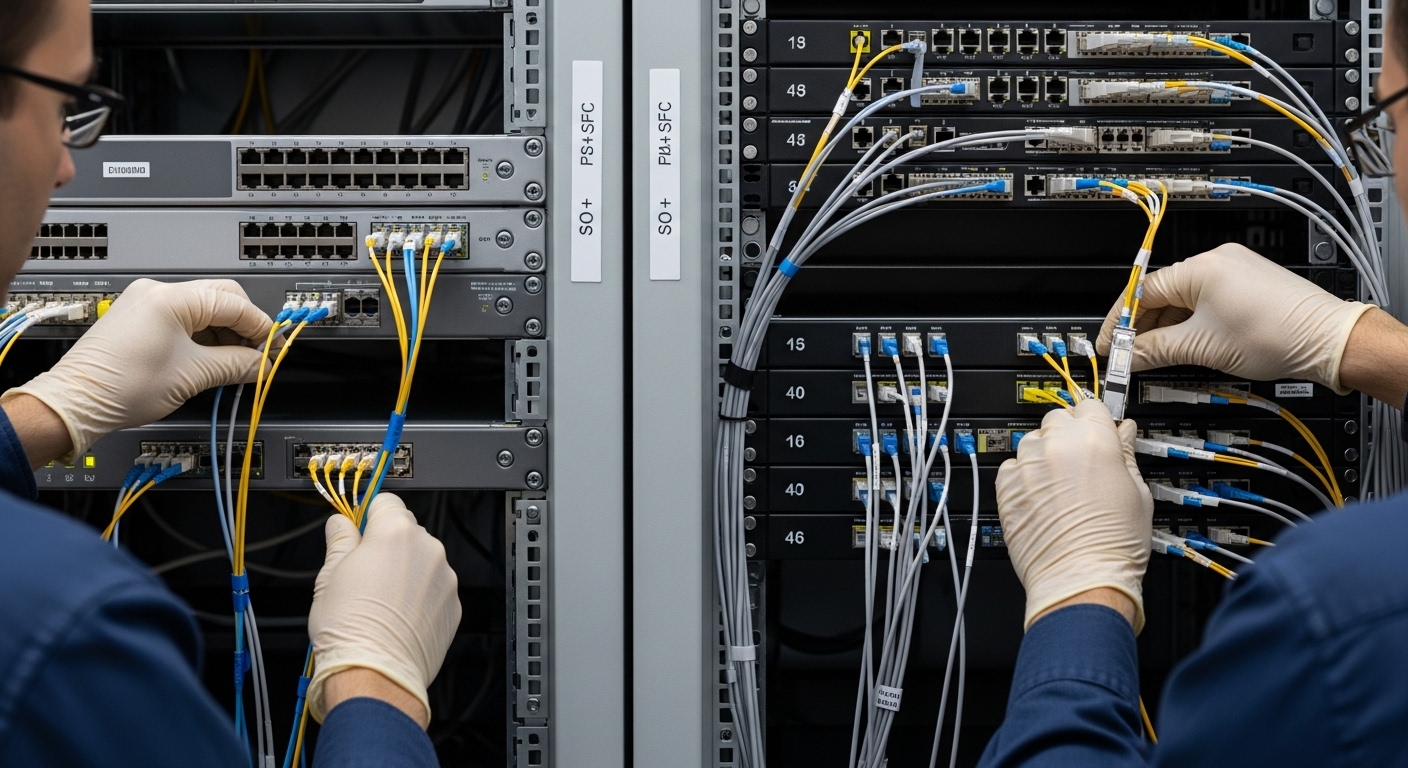
They approached the change like a controlled optics migration rather than a wholesale swap. The key was to isolate where AOC provides value and to avoid losing flexibility where fiber runs are uncertain.
validate switch compatibility and diagnostics
Before ordering, they checked the switch vendor optics support list and confirmed whether DOM was required for their monitoring stack. They also confirmed the physical port type (SFP+ cage) and ensured the AOC’s plug type matched the switch expectations. For optics compliance, they used vendor datasheets and the IEEE 802.3 link requirements as acceptance criteria [Source: IEEE 802.3].
define an acceptance test that field engineers can repeat
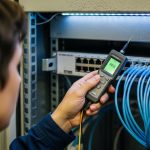
They ran a repeatable test: connect optics, verify link up, capture interface counters (CRC, symbol errors if available), and perform a controlled reboot cycle at both ends. They also checked optical power readings when DOM existed, setting thresholds for “out of band” alerts rather than relying on green LEDs. This mattered because some AOC products report diagnostics differently; engineers avoided false positives by calibrating thresholds to the exact vendor’s DOM scaling.
choose where AOC replaces SFP and where it does not
For the 15 m segments with frequent patching changes, they used AOC to reduce connector mating cycles. For the rest of the topology, they kept SFP+ and patch cords so they could replace only a damaged patch cord without discarding the optics. This hybrid plan reduced operational risk while preserving repair granularity.
implement cleaning discipline and spares policy
Even with AOC, the switch-side interface still matters. They standardized cleaning tools and inspection habits for every mating event during rollout and defined a spares policy: keep a small pool of known-good SFP+ modules and AOCs in separate bins labeled by length and vendor. This avoided “mixed batch” troubleshooting where technicians cannot correlate failures to a specific optics family.
Measured results: what changed after go-live
After rollout, the team tracked link stability, operational time, and failure patterns over 90 days. In the AOC-covered segments (the high-churn 15 m paths), they observed a reduction in “link down after patching” incidents from 12 events during the prior quarter to 2 events during the evaluation window. Mean time to restore dropped because the AOC swap procedure was faster than diagnosing whether a patch cord or connector was the culprit.
They also measured troubleshooting effort. For SFP+ segments, average restoration time was 35 to 50 minutes due to inspection, cleaning, and re-seating across multiple mating points. For AOC segments, average restoration time fell to 15 to 25 minutes, largely because there were fewer connector interfaces to inspect. Importantly, overall interface error counters remained within acceptable ranges across both approaches, and no systemic incompatibility was detected in the monitoring system.
Pro Tip: In field deployments, the biggest reliability win usually comes not from “better optics,” but from reducing connector mating cycles. If your change tickets involve repeated moves, the AOC’s integrated design often outperforms SFP+ purely by cutting contamination opportunities, even when the theoretical link budget is similar.
Selection criteria checklist for engineers running a real cost-benefit analysis
Use this ordered checklist to avoid analysis paralysis and to make sure your results survive procurement and operations review.
- Distance and length granularity: If you need fixed lengths (example: 15 m), AOC can be efficient; if lengths vary, SFP+ offers flexibility.
- Switch compatibility and DOM expectations: Confirm the exact switch model’s optics support and whether monitoring tools require DOM.
- Fiber plant type: Validate OM3/OM4 assumptions and check insertion loss budgets against the optics’ specified reach for your wavelength class.
- Operating temperature and airflow: Ensure the transceiver or AOC assembly is rated for your rack environment; derate if airflow is restricted.
- Budget and spares strategy: Compare not just unit price, but the spares you must hold for different lengths and vendors.
- Vendor lock-in risk: Evaluate whether third-party optics are acceptable for your risk posture and whether firmware/monitoring expects vendor-specific behavior.
- Power and thermal headroom: Confirm the switch’s thermal design supports the optics category; avoid “it worked in the lab” mistakes under real airflow.
Common pitfalls and troubleshooting tips (with root cause and fixes)
Pitfall 1: assuming AOC eliminates cleanliness issues. Root cause: AOC still terminates at the switch-side connector, so dust or damage at that interface can cause intermittent link behavior. Solution: enforce inspection and cleaning on every mating event; use a microscope check for LC ferrules before insertion.
Pitfall 2: mixing optics families and misreading diagnostics. Root cause: DOM scaling and threshold behavior differ by vendor; monitoring systems may flag “high power” or “low RX” incorrectly, triggering unnecessary swaps. Solution: calibrate thresholds per optics model and document which DOM fields map to which vendor’s interpretation.
Pitfall 3: choosing AOC by reach marketing rather than length tolerance. Root cause: an AOC specified for a length class may still underperform if the run is longer than intended due to optical attenuation margins. Solution: select assembly length with conservative margin and verify with link validation tests in the exact rack environment.
Pitfall 4: ignoring switch optics matrix nuance. Root cause: some switches require specific transceiver revisions or coding expectations; links may come up but counters can show elevated errors. Solution: verify against the switch vendor’s compatibility list and validate with error counters and reboot cycles.
Cost and ROI note: realistic price ranges and TCO tradeoffs
In many enterprise markets, SFP+ transceivers are available at lower unit cost than AOC assemblies, but the total cost of ownership often shifts once labor time and incident frequency are included. A typical ballpark (varies by vendor and volume) might be $40 to $120 per SFP+ for 10G SR class optics, while AOC assemblies for a fixed length such as 15 m may run $80 to $200 per link. If your operations team spends meaningful time on connector cleaning, re-seating, and troubleshooting after patch changes, AOC can deliver ROI by reducing mean time to restore and lowering the number of incident tickets.
TCO also includes spares. With SFP+, you may stock fewer “length-specific” spares because patch cords handle distance variation, but you must stock optics and maintain connector hygiene discipline across many patch points. With AOC, spares are length-specific; however, fewer connector interfaces can reduce failure rates tied to handling. For high-change environments, the ROI often comes from operational savings rather than raw material cost.

FAQ: choosing between SFP and AOC with confidence
Is SFP always cheaper for a cost-benefit analysis?
Not necessarily. Unit pricing can favor SFP+, but operational costs can dominate if your environment has frequent patching or repeated moves. AOC often wins when connector handling variability is the main reliability driver.
Will AOC work with any SFP+ switch port?
No. You must confirm compatibility with the specific switch model and verify electrical and diagnostic expectations. Always validate using the switch vendor’s optics matrix and run a reboot and error-counter acceptance test.
Do I lose monitoring when switching from SFP to AOC?
Sometimes. Some AOC products provide diagnostics, but the fields and scaling may differ from DOM behavior on your preferred SFP models. If your monitoring stack relies on specific DOM thresholds, calibrate or adjust alerting rules.
When should we keep SFP instead of using AOC?
Keep SFP+ where cabling runs vary in length, where future reroutes are likely, or where you want granular repair by replacing only a patch cord. SFP also helps when you need consistent optics across multiple distance classes.
What is the most common reason for intermittent link drops?
Connector contamination or damage at mating points is the most frequent root cause in real deployments. Even with AOC, the switch-side interface still requires clean, undamaged connectors and proper insertion practices.
How do we quantify ROI beyond unit price?
Track incident frequency, mean time to restore, and labor hours spent on troubleshooting and cleaning. Include spares management costs and the likelihood of repeat failures tied to connector handling, then compare against the higher per-link AOC purchase cost.
In this case, the hybrid approach delivered measurable reliability and operational gains by using AOC only where it reduced connector churn, while preserving SFP flexibility elsewhere. If you are planning the next refresh, start with a structured cost-benefit analysis using your switch model’s optics matrix and your actual incident data, then validate with controlled acceptance tests. optics ROI and spares planning
Author Bio: Field-tested network optics writer and hands-on deployment engineer, focused on measurable reliability outcomes in data centers. I document selection criteria and failure modes using switch vendor guidance and IEEE requirements [Source: IEEE 802.3].