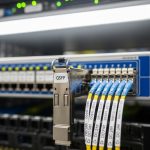
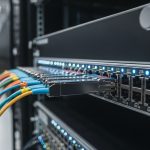
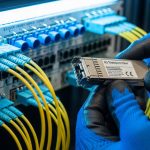
In spine-leaf fabrics, the moment you move from 100G to 400G and beyond, “it should work” becomes “show me the link margin.” This article gives a hands-on framework for selecting Clos network fiber optics—covering reach, wavelength, connector loss, DOM verification, and temperature limits—so engineers can avoid avoidable downtime in production data centers.
Spine-leaf math: translate Clos network fiber distance into an optic choice
Clos fabrics typically run leaf-to-spine and spine-to-spine links with tight budgets: transceiver sensitivity, fiber attenuation, connector/patch loss, and aging margin. Start by measuring the real path, not the cable label: include mated connector loss, patch panel losses, and any splitters (rare in direct spine-leaf, but common in routed campus interconnects).
Distance inputs you should collect before you pick optics
- Fiber type: OM4 (typically 50/125 or 62.5/125), OM5, or OS2 single-mode.
- Measured end-to-end length in meters for each link class (leaf-to-spine A, spine-to-leaf B, etc.).
- Patch/connector count: number of LC/SC mated pairs and any unused jumpers.
- Expected temperature range near the optics (front-to-back airflow changes can matter).
- Switch platform compatibility: vendor optics list and known “supported transceiver” rules.
Pro Tip: For 400G SR4 optics, validate with the vendor’s recommended fiber plant conditions (patch loss and connector cleanliness) even if the datasheet reach “fits.” Many link failures in the field trace back to patch panel cleanliness and underestimated connector insertion loss, not to the transceiver wavelength.
400G and beyond optics: map link speed to standard modules and wavelength
At 400G, common approaches include QSFP-DD (for 400G DR4/FR4/ER4 and coherent variants) and OSFP (for certain 400G/800G deployments). For short-reach multimode in Clos fabrics, the industry often uses SR4-class optics over OM4/OM5, aligning with IEEE Ethernet optical specifications for 400G Ethernet over fiber. For longer reach, you typically step into DR4/FR4/ER4 or coherent transport depending on distance and cost constraints.
Quick spec comparison for typical Clos network fiber use cases
Use this table as a starting filter; always confirm exact compliance with your switch vendor’s “supported optics” matrix and the transceiver datasheet.
| Module family | Typical data rate | Wavelength | Fiber type | Reach (typical) | Connector | DOM | Operating temp |
|---|---|---|---|---|---|---|---|
| Cisco-compatible 400G SR4 (QSFP-DD) | 400G | 850 nm nominal (4x lanes) | OM4 or OM5 | Up to ~100 m (varies by vendor) | LC | Yes (via I2C) | Often 0 to 70 C for standard |
| 400G DR4 (QSFP-DD) | 400G | ~1310 nm (4x lanes) | OS2 SMF | Up to ~500 m (varies) | LC | Yes | Often 0 to 70 C |
| 400G coherent (platform-dependent) | 400G | C-band or tunable bands | OS2 SMF | km-scale (varies) | Varies | Yes | Varies widely |
Concrete model examples engineers actually stock
- Multimode SR4: Finisar/industry SR4 modules such as FTLX8571D3BCL (example family; validate exact SKU for your vendor).
- Enterprise-grade SMF: Cisco-style part numbers like SFP-10G-SR are not 400G, but the same procurement discipline applies: buy the correct speed/form factor and validate DOM behavior.
- Third-party optics: FS.com examples exist across SR/DR families (e.g., FS.com SFP-10GSR-85 for 10G); for 400G, confirm the exact QSFP-DD/OSFP model and compatibility notes.
Because exact SKUs vary by switch generation, treat these as reference patterns for procurement rigor, not a guarantee of compatibility. Always match form factor + speed + wavelength + fiber type.
Selection criteria checklist for Clos network fiber in 400G and beyond
When the fabric is being built under time pressure, the best optics decision is the one you can defend with measurements and platform evidence. Use this ordered checklist like a field ticket.
- Distance and link budget: measured length + patch loss + connector loss; confirm against the transceiver reach specification under realistic conditions.
- Fiber type and bandwidth grade: OM4 vs OM5 affects SR reach; OS2 is required for DR/FR/ER/coherent.
- Switch compatibility: check vendor optics support list; confirm whether the switch enforces “approved optics” policies.
- DOM and telemetry: verify the transceiver reports power levels, temperature, and alarms via the expected interface (commonly I2C on the module).
- Operating temperature: ensure module spec covers the worst-case airflow and ambient near the port.
- Vendor lock-in risk: evaluate whether you can use third-party modules without disruptive resets, link flaps, or unsupported DOM warnings.
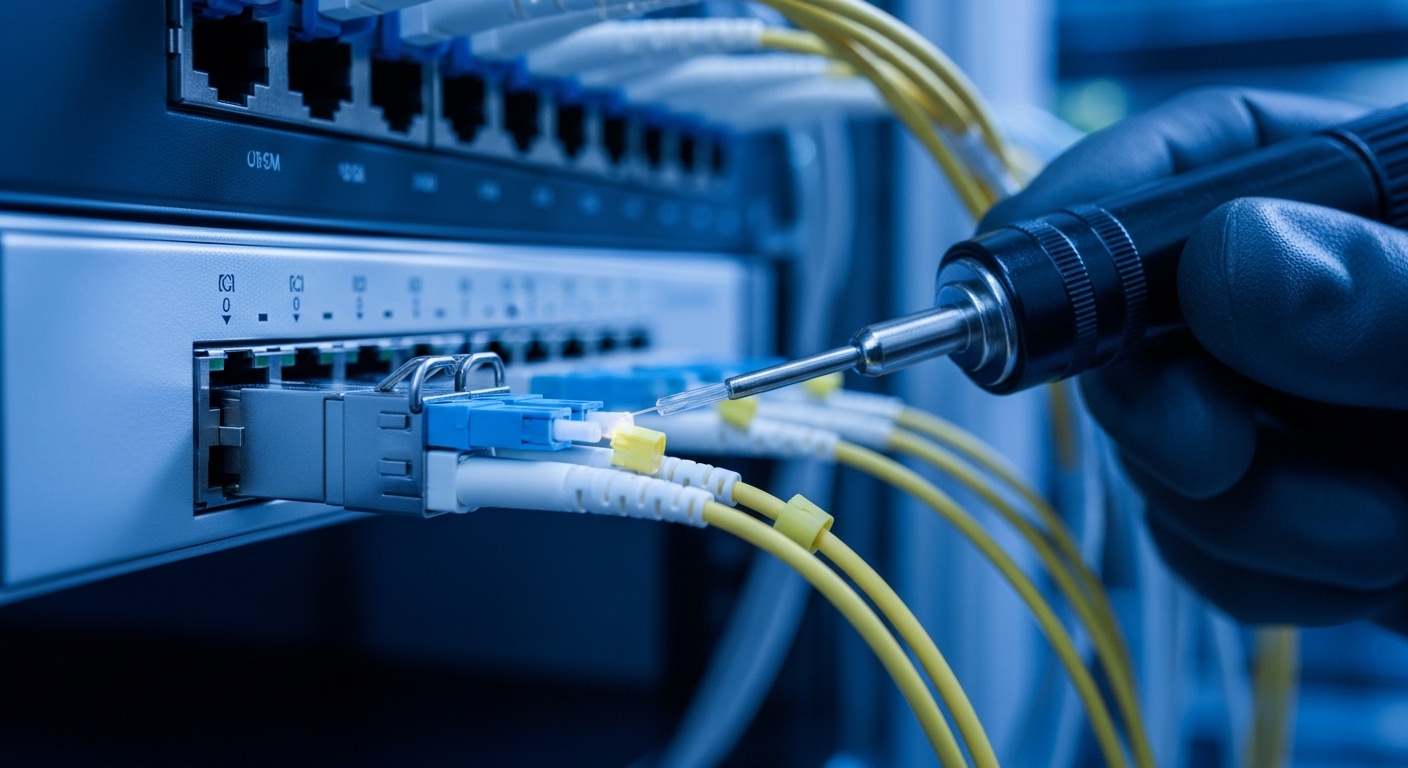
- Connector strategy: choose LC cleanliness tooling and patch panel practices that your team can repeat consistently.
- Spare strategy: keep at least one spare per optic family and validate it in a maintenance window before the roll-out.
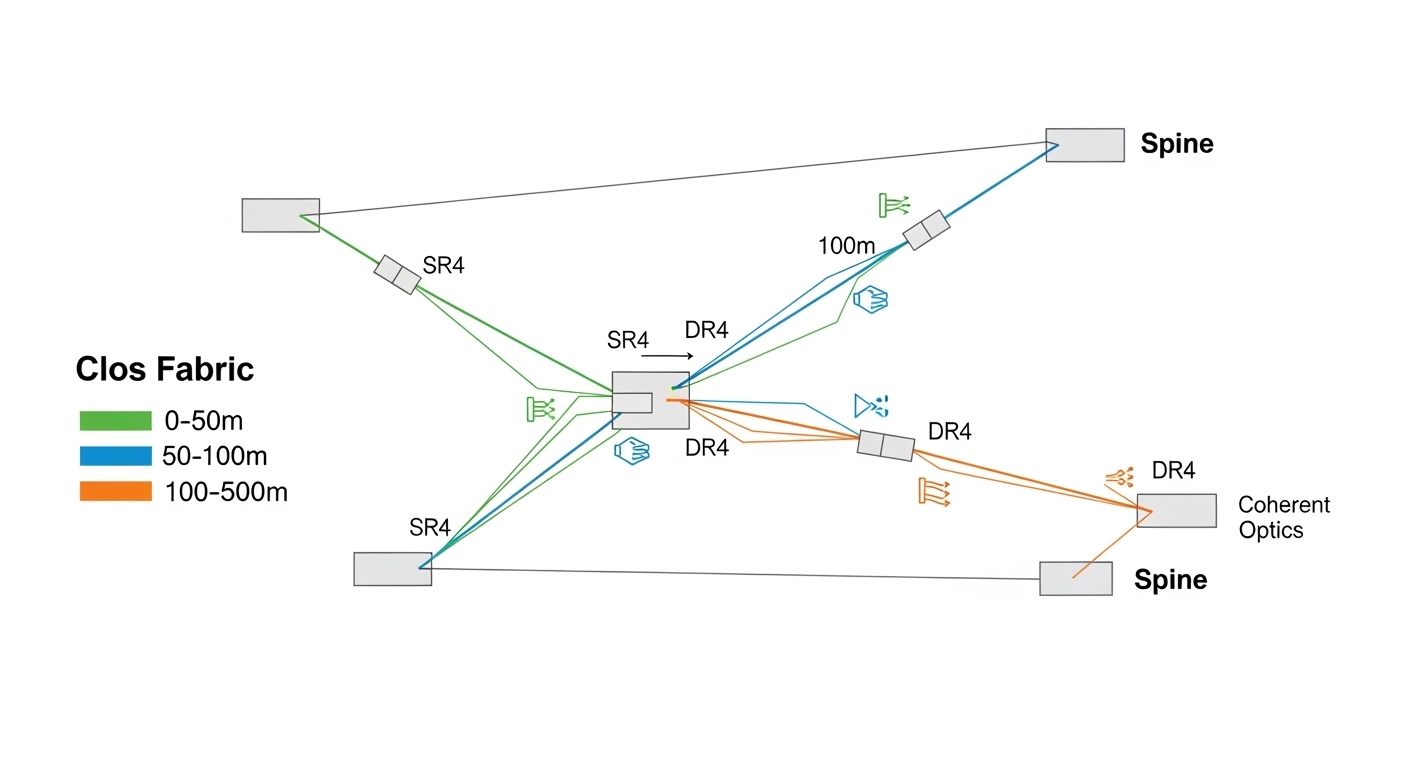
Deployment scenario: 400G Clos with mixed reach and strict uptime
In a 3-tier Clos data center with 48-port 400G ToR-to-spine connectivity, engineers often run two link classes: leaf-to-spine A at 60 m over OM4, and leaf-to-spine B at 220 m over OS2. The build uses 400G SR4 optics for A links and 400G DR4 optics for B links, with patch panels introducing approximately 0.5 dB per mated LC pair in worst-case cleaning conditions (measured during pre-acceptance). During commissioning, the team verifies DOM reported receive power for each lane and correlates any marginal links to specific patch trays.
In practice, the “working” threshold is not just link up; it is stable error performance and alarm-free operation for weeks. Engineers track link CRC/PHY errors and correlate spikes to cleaning events, transceiver swaps, or airflow changes during maintenance windows.
Common mistakes and troubleshooting that actually shows up in the field
Optics failures in Clos network fiber networks are rarely mysterious; they are usually traceable to a repeatable mistake. Below are the most common failure modes, each with a root cause and the fix.
Link comes up then flaps after a day
Root cause: connector contamination or micro-misalignment causing intermittent coupling loss, especially after cable movement or airflow vibration.
Solution: inspect with a fiber microscope, clean with approved methods, re-seat connectors, and verify receive power stability via DOM telemetry.
“Reach should fit” but SR4 fails on OM4
Root cause: underestimated patch loss, too many mated pairs, or using OM4 where the plant behaves closer to a lower effective bandwidth due to aging or incorrect grading.
Solution: measure end-to-end loss, reduce connector count, replace suspect patch cords, and if needed, switch SR4 to a higher-grade strategy (e.g., OM5 where available) or use SMF DR4.
DOM alarms or “unsupported optics” warnings
Root cause: switch enforces an optics compatibility policy, or the third-party transceiver reports DOM fields differently than expected by the platform.
Solution: use the vendor-supported optic list for that exact switch SKU; confirm firmware compatibility; test one module in a spare port before scaling.
Thermal throttling under high-density airflow
Root cause: module operating temperature exceeds spec because of blocked airflow or fan curve drift after maintenance.
Solution: verify ambient and transceiver temperature telemetry; restore airflow pathways; consider modules with a higher temperature rating if your plant runs hot.

Cost and ROI note: how to budget optics without buying tomorrow’s outage
Pricing swings by speed, reach, and vendor. As a practical range, 400G SR4 optics often land in the hundreds of dollars to low thousands per module depending on OEM vs third-party and the exact SKU; DR4/longer-reach options can be higher due to tighter optical performance requirements. TCO is not only the module price: include spares, commissioning time, and the cost of downtime during replacement.
OEM optics tend to reduce compatibility friction and speed up acceptance testing, while third-party optics can lower unit cost but may increase integration effort. A sensible ROI approach is to buy a small pilot batch, validate DOM/telemetry behavior on your switch model, and only then scale procurement.
FAQ: Clos network fiber optics for 400G and beyond
What does “Clos network fiber” mean in optics selection?
It refers to the fiber plant powering a Clos (leaf-spine) fabric, where many links share similar port density and operational constraints. Your optics choice must match the link distance bands and the fiber type used across those bands.
Can I mix SR4 and DR4 optics in the same spine-leaf system?
Yes, as long as each port’s transceiver matches the intended fiber type and the switch supports that optic family. Keep an inventory discipline: label ports by link class and test one optic per family during commissioning.
How do I verify optics quality beyond “link up”?
Use DOM telemetry to confirm receive power, temperature, and any alarm flags. Then monitor PHY and interface error counters over multiple days, not just minutes after insertion.
What fiber type is best for 400G short reach?
For short reach, multimode (OM4 or OM5) is common with SR4-class optics. If your patch loss is high or distances creep upward, SMF with DR4 can be a more robust choice.
Do third-party transceivers work reliably in 400G Clos networks?
Often they do, but reliability depends on exact switch compatibility, firmware behavior, and DOM field mapping. Do a pilot validation on your exact switch SKU before expanding the rollout.
What is the fastest troubleshooting path for a dead 400G link?
Start with compatibility (form factor, supported optics list), then clean and inspect connectors, then check DOM for receive power and temperature alarms. Finally, confirm the fiber path length and patch panel losses against the reach assumptions.
If you treat each Clos network fiber link as a measurable system—distance, loss, optics telemetry, and platform rules—you will ship 400G and beyond with fewer surprises. Next, refine your plant design with fiber patch panel best practices for cleaner connectors and more predictable commissioning.
Author bio: I have deployed and validated Ethernet optics in leaf-spine fabrics, including DOM telemetry checks, fiber acceptance testing, and staged rollouts under maintenance constraints. I write practitioner guidance grounded in vendor datasheets and IEEE Ethernet optics behavior to help teams avoid preventable link failures.