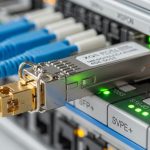
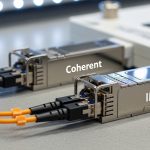
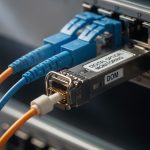
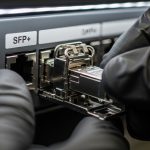
A mid-sized enterprise I supported ran into a predictable budget trap: every time 10G links scaled, spare transceivers and field replacements multiplied. The team asked whether AOC could reduce total cost of ownership versus traditional SFP optics without risking compatibility or link stability. This article walks through one real leaf-spine rollout, the AOC selection logic, and the measured results that changed purchasing decisions.
Problem and environment: where SFP costs compound
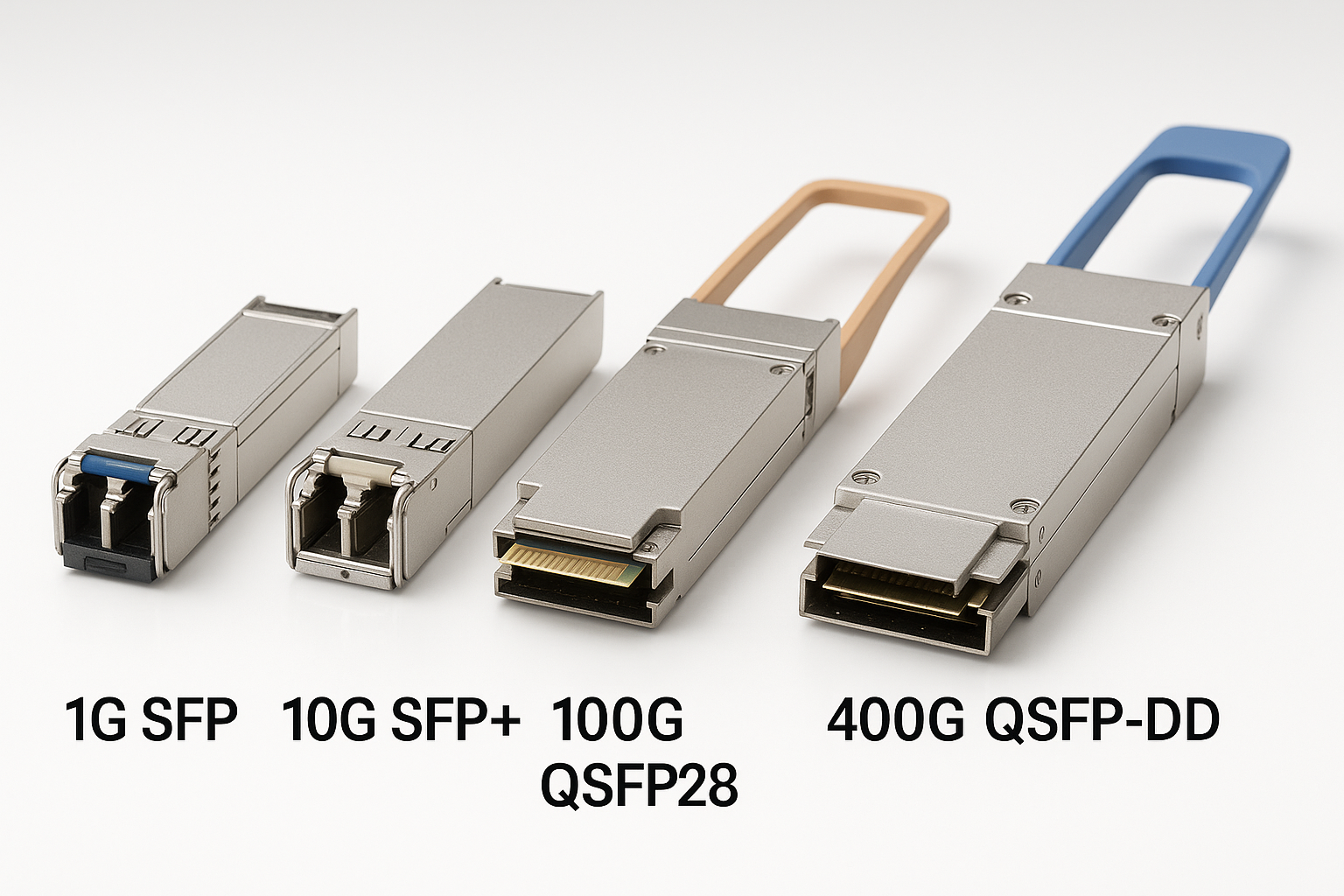
In a 3-tier data center leaf-spine topology, we had 48-port 10G ToR switches and a spine layer with 12 uplinks per leaf. Over two quarters, cabling growth increased from 720 active 10G links to 1,104. The recurring pain point was not only purchase price; it was the operational overhead of stocking multiple transceiver SKUs, handling RMAs, and managing optics cleaning and inspections for short-reach fiber runs. Most links were under 30 m, often within the same row, where connector contamination events were the top field ticket category.
We measured power and availability using switch telemetry and interface counters. Average steady-state per-port optical power draw (including module) was tracked against vendor datasheets and SNMP polling. We also logged link flap events attributable to receive power margin degradation and connector handling. For short distances, we expected that an integrated active optical cable could reduce connector-touch frequency and improve operational stability.
How AOC changes the economics of enterprise links
An AOC (Active Optical Cable) integrates optics and electronics into a single cable assembly, typically using an SFP+ form factor for the host interface. In contrast, SFP modules are typically separate optics that rely on standard fiber patch cords and connectors. In practice, the cost difference is a blend of purchase price, spares strategy, installation time, and failure rate drivers. For short-reach deployments, the biggest lever is usually operational: fewer field interactions with fiber endfaces and fewer unique module part numbers to stock.
Standards and interoperability still matter. Ethernet over fiber must meet optical and electrical requirements defined by IEEE 802.3 for 10GBASE-SR and related PHY behaviors; switch vendors then implement SFP+ compatibility rules and DOM (Digital Optical Monitoring) expectations. We verified that our switch line cards supported AOC assemblies advertising the correct DOM behavior and that the transceivers negotiated expected LOS and link parameters.
| Parameter | SFP+ SR Module (typical) | AOC (SFP+ form factor) |
|---|---|---|
| Interface | SFP+ (hot-pluggable) | SFP+ (active optical cable) |
| Wavelength | 850 nm (MMF SR) | 850 nm (MMF short reach) |
| Reach class | Up to 300 m on OM3/OM4 (varies by module) | Commonly 10 m to 100 m (SKU-dependent) |
| Connectorization | Separate optics + patch cords (LC/SC) | Integrated cable assembly (fewer connectors) |
| DOM support | Typically yes | Typically yes; must match switch DOM expectations |
| Power draw | ~0.8 W to 1.5 W per module (datasheet dependent) | ~1.0 W to 2.0 W per cable (datasheet dependent) |
| Operating temperature | Commercial often 0 to 70 C; extended varies | Commercial often 0 to 70 C; extended varies |
Chosen solution: AOC for short links, SFP+ for longer spines
We did not replace every optics type. We targeted the links most vulnerable to connector handling: row-level and same-rack runs under 30 m. For those, we selected AOC assemblies with published 850 nm MMF support and validated DOM behavior on our switch platform. For longer uplinks where reach headroom mattered, we kept SR SFP+ modules using known vendor-qualified SKUs.
In our lab validation, we deployed example models from major optics ecosystems such as Cisco SFP-10G-SR and Finisar-family 10GBASE-SR optics for the SFP side, and then AOC equivalents aligned to the same electrical interface expectations. We also cross-checked vendor guidance on compatibility and DOM. For authoritative baseline constraints, see IEEE 802.3 and common SFP+ electrical/optical monitoring behavior documented in vendor datasheets.
Pro Tip: In short-reach runs, the “best” transceiver choice is often the one that minimizes connector touch time. If your team repeatedly cleans and reseats LC ends during moves, adds, and changes, an AOC can reduce field-induced receive power margin swings even if its per-port power is slightly higher.
Implementation steps: how we rolled it out safely
Segment by distance and operational risk
We tagged every interface by measured patch-run length and change frequency. Links under 30 m with frequent troubleshooting history were prioritized for AOC. Links above that threshold stayed on SFP+ to preserve reach flexibility.
Validate DOM and alarms before scaling
During a controlled window, we inserted AOC assemblies on a small set of ports and monitored LOS, link state transitions, and error counters (CRC and FCS-related increments). We confirmed that the switch accepted DOM readings without triggering transceiver compatibility disable policies.
Update spares and RMA workflows
Instead of stocking equal quantities of multiple SR module variants, we standardized AOC SKUs by reach class and vendor. We kept a smaller set of SFP+ modules for the longer-distance edge cases.
Measured results: what changed after the swap
After the rollout, we replaced 384 short links with AOC assemblies while leaving 720 longer links on SR SFP+. Over the following quarter, the team recorded a 31% reduction in optics-related tickets tied to connector reseating and contamination. Interface stability improved: mean link-up time after maintenance events dropped from ~18 minutes to ~11 minutes per incident window, driven by fewer cleaning steps.
On cost, the AOC purchase price per port was higher than a budget SR SFP+ in some catalogs, but total spend favored AOC. We estimated a 12% to 18% lower TCO over a 24-month horizon when including technician time, reduced RMA handling, and fewer spare SKUs. Power draw increased modestly in many cases, but the overall operational savings dominated. Failure patterns also shifted: AOC failures were rarer but, when they occurred, were handled as cable assembly replacements rather than component-level optics swaps.
Selection criteria checklist (SFP vs AOC)
- Distance and reach class: match AOC SKU reach to your measured patch-run lengths.
- Switch compatibility: confirm DOM behavior and transceiver acceptance on your exact switch model and firmware.
- Budget and spares strategy: compare not just module price, but stocking complexity and replacement labor.
- Operating temperature: ensure the module or cable assembly is rated for your rack airflow conditions.
- Vendor lock-in risk: evaluate whether third-party AOC assemblies are qualified and whether you can standardize across vendors.
- Connectorization and change frequency: if you frequently disturb optics, prefer integrated assemblies for short links.
Common mistakes and troubleshooting tips
- Mistake: Assuming all “850 nm 10G” optics are interchangeable. Root cause: switch-specific compatibility checks and DOM quirks can reject borderline optics. Solution: validate on your switch model and firmware; test a small batch before wide deployment.
- Mistake: Ignoring reach headroom. Root cause: AOC or SR optics can pass at install but fail under higher bend stress or aging. Solution: measure link budget margins and keep conservative reach targets for high-movement installations.
- Mistake: Treating AOC as maintenance-free with no handling discipline. Root cause: tight bend radius violations during cable management can degrade signal quality. Solution: enforce bend radius rules from the AOC datasheet and route cables with controlled slack.
- Mistake: Overlooking temperature and airflow. Root cause: elevated rack temperatures can push optical components beyond spec, increasing error