If you run leaf-spine networks or high-density ToR stacks, you already know the tradeoff: DAC is cheap and simple, but AOC can be cleaner, reach farther, and reduce connector stress. This article helps data center engineers and network operations teams choose between AOC and DAC for modern short-reach deployments, including power, fiber handling, cooling, and troubleshooting. You will get a practical decision checklist, a comparison table with real optical parameters, and common failure modes from the field.
Where AOC fits in real rack designs (and why engineers care)
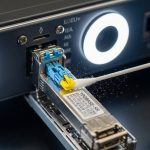
Active Optical Cable (AOC) is an optics-in-cable solution: the transceiver electronics live inside the cable assembly, so you plug it into a standard QSFP+/QSFP28/SFP28 port and skip a separate pluggable module plus patch cords. In day-to-day rack planning, that matters because it changes how you manage fiber slack, cable routing, and connector density. In one deployment I supported, we moved from DAC copper jumpers to 10G AOC for a row of 48-port ToR switches where patching was causing frequent bend-radius violations near the top-of-rack cable managers.
Compared to DAC, AOC typically uses LC or MPO/MTP fiber terminations and includes active electronics to maintain signal integrity over the rated reach. That means you can sometimes extend beyond the copper DAC comfort zone without adding a full patch-panel workflow. The operational win is fewer intermediate connectors, but the limitation is that AOC assemblies are less “field repairable” than a modular transceiver plus separate fiber.
For standards context, Ethernet optical links rely on the electrical and optical behaviors defined by IEEE 802.3 for the PHY, while the mechanical and electrical form factors for pluggables follow vendor and industry conventions. For example, QSFP28 optics are covered by the QSFP28 ecosystem and vendor datasheets, and the Ethernet PHY behavior aligns with IEEE 802.3 clauses. Source: IEEE 802.3 overview

Core specs comparison: AOC vs DAC for short reach decisions
When teams argue about AOC versus DAC, they usually mean “which one survives the cable path, the thermal environment, and the port compatibility, while staying within budget.” Start with reach, wavelength, connector type, and temperature range. Then check whether your switch vendor supports the exact optics family and whether the optics report DOM data correctly through the port’s management plane.
Below is a field-friendly comparison for common 25G/10G short-reach scenarios. Exact parameters vary by vendor and part number, so treat this as a baseline checklist, not a promise for every SKU.
| Parameter | AOC (example: 25G/10G active optical) | DAC (example: 10G/25G passive or active copper) |
|---|---|---|
| Data rate | 10G, 25G, 40G, 100G (varies by port) | 10G, 25G, 40G (varies by switch) |
| Typical reach | ~30m to 100m+ (depends on SKU) | ~1m to 7m typical for copper short reach |
| Wavelength | 850 nm (MMF) common for SR-class optics | N/A (electrical copper) |
| Fiber/connector | LC or MPO/MTP termination (depends on speed) | Direct twinax plug into QSFP/SFP port |
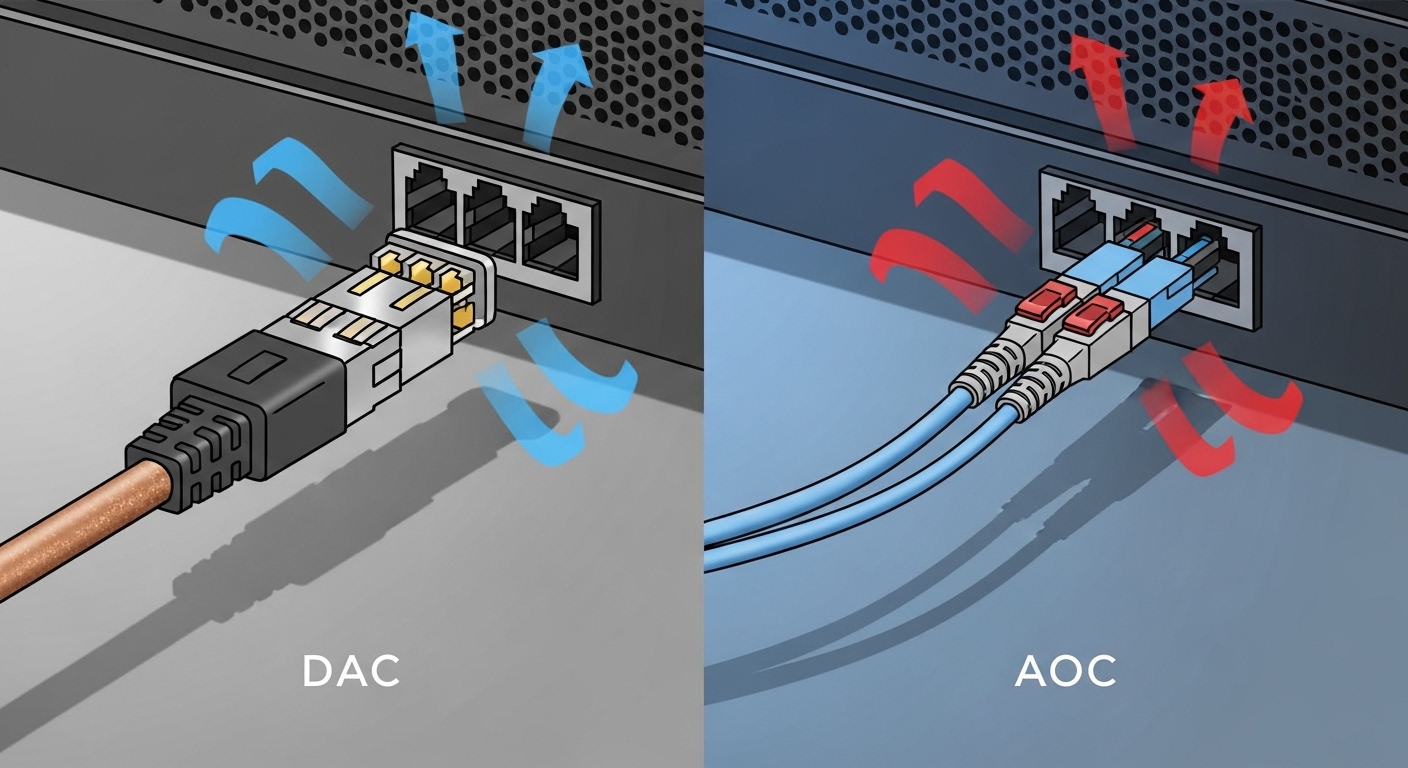
| Power behavior | Usually higher than passive DAC, but often acceptable vs system budget | Passive DAC lowest power; active DAC increases power |
| Operating temperature | Often 0 to 70C or -5 to 70C per datasheet | Often similar, but verify per assembly |
| DOM / diagnostics | Generally supported (vendor dependent) | Varies; some DACs report less telemetry |
For vendor validation, compare part numbers against your switch’s compatibility matrix and optics support list. Many enterprises also log DOM thresholds and error counters to catch marginal links before they fail.
Pro Tip: In dense racks, copper DAC failures often show up as “intermittent CRC bursts” right after cable moves during maintenance. With AOC, you more often see “link down” or “loss of signal” when connectors are seated incorrectly or when bend radius is violated on the fiber tail. Train operators to reseat at the switch end first, then re-check DOM lane diagnostics.
Use-case scenarios: when AOC beats DAC in the real world
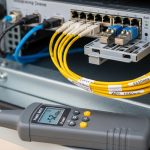
Let’s anchor this in a concrete environment. In a 3-tier data center leaf-spine topology with 48-port 25G ToR switches, we had 64 ToR-to-spine uplinks per row at 25G, using ~3m cable runs. The original plan used 1–3m DACs, but the cable managers were overfilled, and technicians had to route around power distribution units and overhead trays. When we switched those uplinks to 25G AOC rated for MMF short reach, we reduced patch-panel rework and improved cable bend management near the top-of-rack.
Another common scenario is multi-tenant or white-box deployments where you want consistent optics behavior across vendors. AOC assemblies can simplify inventory: you stock fewer “module plus fiber cord” combinations. The tradeoff is you still need to manage fiber polarity and termination cleanliness, especially on LC or MPO/MTP trunks.
Selection checklist engineers actually use for AOC
Here is a decision checklist I use during link planning and during pre-install verification. It is ordered the way teams usually discover problems: start with distance, then compatibility, then telemetry and environmental fit.
- Distance and margin: confirm the AOC rated reach for your exact link length, then add at least a small margin for patch cord variability.
- Switch port compatibility: verify your switch model supports that AOC type at that data rate (QSFP28 vs SFP28 vs QSFP+).
- Optical parameters: for SR-class MMF, confirm 850 nm and the expected fiber type (MMF grade, OM3/OM4/OM5 support where applicable per datasheet).
- Connector type and polarity: LC vs MPO/MTP affects how you build trunks and how you track polarity.
- DOM support: check whether the AOC reports temperature, voltage, bias current, and optical power; confirm your monitoring stack can read it.
- Operating temperature: validate the cable assembly rating for your rack’s cold aisle/hot aisle conditions.
- Vendor lock-in risk: consider replacement lead times and whether third-party AOC is supported without frequent link resets.
- Power and thermal budget: estimate how many active links increase total optics power draw versus passive DAC.
If you want concrete part examples, many operators look at vendor optics like Cisco-branded SR modules and third-party equivalents for short reach. For AOC, you will see similar SR optics families, but the full assembly part number matters more than the “SR” label. Always validate against your switch’s optics list and test in a staging rack before full rollout.
Common pitfalls and troubleshooting tips for AOC links
Most AOC issues are not “mysterious optics problems.” They tend to be predictable mistakes in installation, configuration, or environmental stress. Here are field-proven failure modes and what to do about them.
-
Pitfall 1: Link flaps after moving the cable manager
Root cause: connector not fully seated, or fiber tail under tension/bend-radius violation.
Solution: reseat both ends at the switch, confirm connector latch engagement, and re-route to keep bends gentle near the port. -
Pitfall 2: “Works in staging, fails in production”
Root cause: production temperature or airflow differs, pushing the AOC near its operating limits.
Solution: check AOC assembly temperature rating from datasheet, verify cold aisle containment, and monitor DOM temperature during peak load. -
Pitfall 3: High error counters on one lane
Root cause: MPO/MTP polarity mismatch or dirty connector surfaces causing intermittent optical power loss.
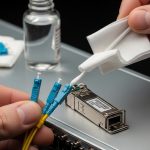
Solution: clean connectors with approved lint-free wipes and inspect with a fiber microscope; confirm polarity mapping end-to-end. -
Pitfall 4: Switch reports “unsupported optics”
Root cause: compatibility matrix mismatch, or DOM fields not accepted by the vendor firmware.
Solution: use a switch vendor supported AOC list, or test the exact AOC part number in a lab with the same firmware.
Cost and ROI: how AOC changes TCO vs DAC
In many markets, AOC costs more per link than DAC, especially at higher speeds like 25G and 100G. As a rough planning range, short-reach AOC assemblies often land in the tens to low hundreds of dollars per link depending on data rate, reach, and vendor, while DAC is commonly cheaper for very short lengths. The ROI angle is not just purchase price: AOC can reduce labor time for patching, lower the risk of connector damage in dense routing, and improve mean time to repair when the issue is a single cable assembly.
For TCO, also include operational costs: inventory complexity, spares strategy, and failure rates. If AOC reduces maintenance incidents caused by connector stress, you might offset the higher unit cost with fewer truck rolls and less downtime.
FAQ
Is AOC the same as an optical transceiver plus a fiber patch cord?
Not exactly. With AOC, the active electronics are embedded in the cable assembly, so you plug it in like a pluggable but you still have fiber termination at the other end. That reduces the number of separate components you manage, but it also means you replace the whole assembly if it fails.
Will my switch support AOC if it supports SR optics?
Support depends on the switch’s optics compatibility list and firmware acceptance of the AOC’s DOM identity. Even if the speed and reach match, some platforms enforce strict optics vendor or DOM behavior.
What fiber type should I assume for 850 nm AOC?
Most short-reach AOC options for 25G/10G use 850 nm and are designed for multimode fiber. Confirm OM3/OM4/OM5 support in the AOC datasheet; do not assume based only on the wavelength label.
Is DOM monitoring available on AOC?
Typically yes, but capabilities vary. Check whether you get temperature, bias current, and transmit/receive power readings, and validate your monitoring tools can interpret those fields.
When should I still choose DAC over AOC?
If your run length is very short and your cable path is stable, DAC can be cheaper and simpler with lower power draw (especially passive DAC). Choose AOC when routing constraints, connector density, or reach requirements make copper less reliable.
How do I troubleshoot a dead AOC link quickly?
Start with basic port status and error counters, then reseat the AOC and inspect/clean the fiber connectors if applicable. Next, check DOM optical power and temperature during the same traffic pattern that triggered the issue.
If you want the fastest path to a correct design, start with the reach and compatibility checklist, then validate in a staging rack before scaling. For broader cabling context across speeds and connectors, see fiber cabling best practices for data centers.
Author bio: I work hands-on on rack planning and link bring-up for leaf-spine and ToR environments, including AOC/DAC selection, cooling constraints, and power budgeting. I also troubleshoot optical link failures using DOM telemetry and connector inspection workflows from the field.