
When a 5G backhaul link goes unstable, it is rarely “mysterious fiber magic.” More often, the root cause is an SFP optics mismatch: wrong wavelength, insufficient reach for the actual plant, or DOM and vendor compatibility quirks. This article helps field engineers, tower integrators, and network planners choose the right 5G backhaul SFP for real fiber transport scenarios.
What a 5G backhaul SFP must accomplish in real networks
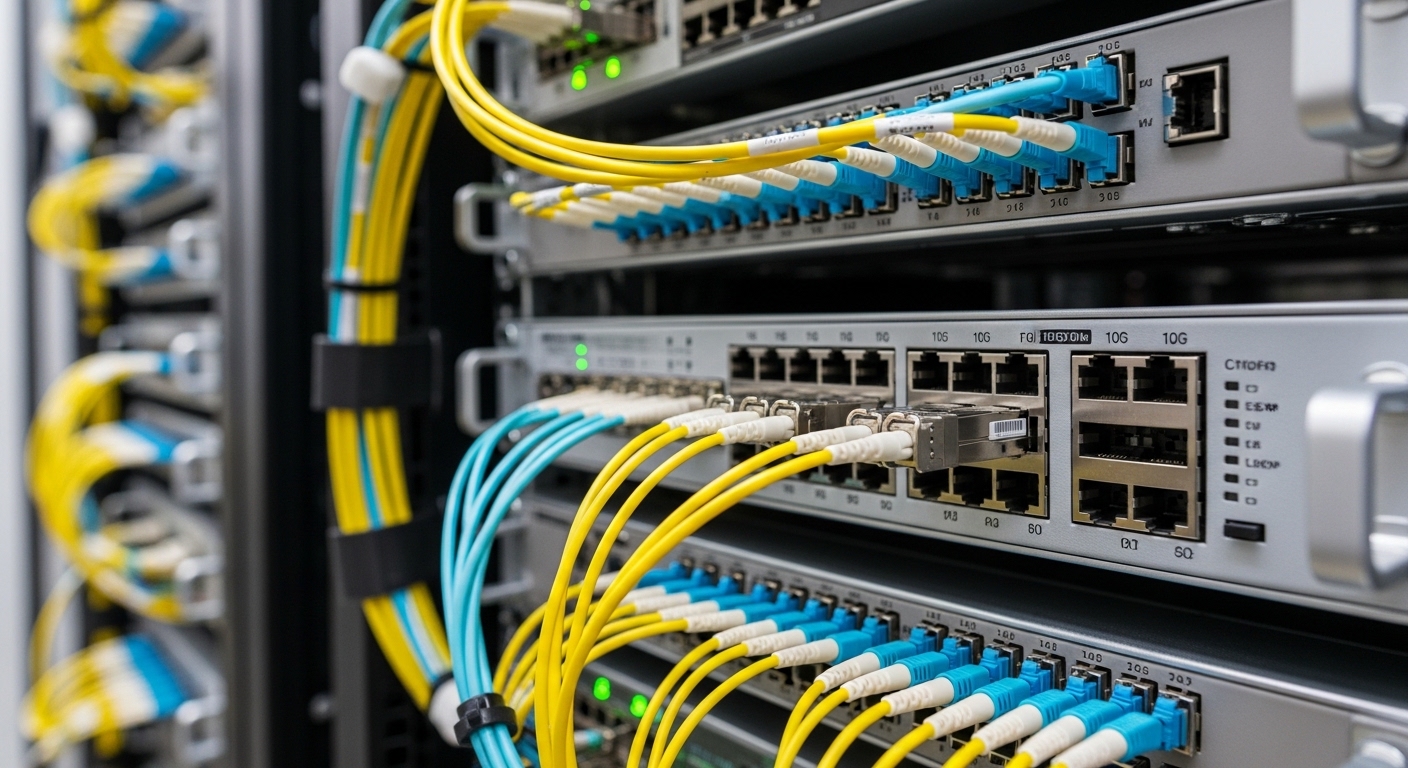
A 5G backhaul SFP is the small, hot-pluggable transceiver that converts electrical Ethernet signals into optical signals for transport across metro and aggregation fiber. In practice, engineers typically deploy 10G Ethernet over SMF (single-mode fiber) using 10G SFP+, or move to 25G SFP28 as capacity grows. The optics must meet the relevant electrical and optical performance targets defined by industry standards and vendor datasheets, including link budget assumptions and receiver sensitivity.
From an operations standpoint, you also need to consider monitoring and manageability. Many deployments rely on Digital Optical Monitoring (DOM) so NOC tools can alert on high laser bias current, low received power, or temperature drift. Standards guidance for Ethernet over fiber is anchored in IEEE 802.3 families, while the physical layer behavior is ultimately validated by each transceiver vendor’s compliance and characterization. anchor-text: IEEE 802.3 family
Core optics specs that decide reach, stability, and interoperability
Think of reach like a flashlight beam: the wavelength chooses where the beam travels well, and the link budget decides how far it still lights up the far receiver. For a 5G backhaul SFP, the key parameters are wavelength, nominal reach, transmitted optical power, receiver sensitivity, and the optical connector type (commonly LC). Temperature range matters too because outdoor cabinets and hut installs can swing widely.
Below is a practical comparison of common module types you will see in backhaul and midhaul transport. Always verify the exact part number against your switch vendor’s compatibility list and the optics requirements of the specific port type.
| Module type (examples) | Data rate | Wavelength | Typical reach | Connector | DOM | Operating temp |
|---|---|---|---|---|---|---|
| Cisco SFP-10G-SR (10G SR) | 10G | 850 nm | ~300 m over OM3 | LC | Varies by vendor | Commercial / sometimes extended |
| Finisar FTLX8571D3BCL (10G SR) | 10G | 850 nm | ~300 m over OM3 | LC | Yes (commonly) | Commercial (check datasheet) |
| FS.com SFP-10GSR-85 (10G SR) | 10G | 850 nm | ~300 m over OM3 | LC | Yes (commonly) | Commercial / extended options |
| Typical 10G LR style (SMF) | 10G | 1310 nm | ~10 km (varies) | LC | Common | Often extended available |
| Typical 25G LR style (SMF) | 25G | 1310 nm | ~10 km (varies) | LC | Common | Often extended available |
Notice that SR modules (850 nm) are often used for shorter spans inside facilities or between nearby cabinets, while LR-class optics (1310 nm) are typical for metro backhaul distances over SMF. If your fiber plant is mostly SMF with splices and patching losses, LR-style or higher-capacity variants are usually the safer bet.
Deployment scenario: choosing the right reach for a leaf-spine backhaul segment
Consider a 3-tier data center and edge aggregation design: 48-port 10G ToR switches feed 2 aggregation switches, then uplink to a regional router. Suppose each ToR connects to aggregation through 8 km of SMF with an estimated 2.5 dB connector and splice loss and an additional 1.0 dB aging margin. If you deploy a backhaul-appropriate 10G LR SFP+ rated for ~10 km, you have room for typical link budget variations, and your NOC can monitor DOM thresholds to catch degradation early.
Field experience matters: I have seen teams replace “marginal” optics that were technically within spec on paper, only to discover that patch panel cleaning and mis-terminated LC connectors were adding hidden loss. In one rollout, swapping to a known-good LR SFP+ and re-polishing the LC endfaces eliminated intermittent CRC errors and link flaps that had been misattributed to switch firmware.
Selection checklist: the factors engineers weigh before buying
Use this ordered decision checklist to avoid rework and avoidable truck rolls when deploying a 5G backhaul SFP.
- Distance and fiber type: confirm SMF vs MMF, then match wavelength (e.g., 1310 nm for LR, 850 nm for SR).
- Link budget math: compare vendor Tx power and Rx sensitivity with measured plant loss (splice, connector, patching). Add a margin for aging.
- Switch compatibility: verify your switch model supports the transceiver type and speed (10G SFP+ vs 25G SFP28).
- DOM support: ensure DOM is enabled and your monitoring stack recognizes thresholds and alarms.
- Operating temperature: require extended range when optics sit in outdoor huts, cabinets, or poorly ventilated sites.
- Vendor lock-in risk: test third-party optics in a staging port group; some platforms enforce optics ID compatibility.
- Connector quality: confirm LC type and polish standard; dirty connectors can dominate performance.
Pro Tip: Many “works on day one” failures come from DOM alarm thresholds being interpreted differently by the switch or monitoring system. Before rolling out hundreds of 5G backhaul SFP units, validate that your NOC alerts trigger on the same DOM parameters you expect (for example, RX power low versus temperature high), using a controlled port test window.
Common mistakes and troubleshooting moves that save hours
1) Wrong wavelength class for the fiber plant
Root cause: installing an SR (850 nm) optics where SMF plant and longer spans require LR-class performance. Symptoms include frequent link renegotiation, elevated CRC errors, or link that only comes up at cooler temperatures. Solution: re-check fiber type, measure end-to-end loss with an OTDR or calibrated light meter, then replace with LR/appropriate variant.
2) Overlooking connector contamination and polishing
Root cause: LC endfaces not cleaned or improperly polished, increasing insertion loss and causing intermittent receiver failure. Symptoms are “works then drops” behavior, often worse with vibration or temperature changes. Solution: inspect with a fiber microscope, clean with proper consumables, re-terminate if needed, then re-measure received power.
3) DOM mismatch and monitoring blind spots
Root cause: DOM is present but thresholds or unit interpretation differs; NOC may not alert early, delaying failure prediction. Symptoms include silent degradation until the link becomes unstable. Solution: confirm DOM field mapping in your telemetry pipeline, set conservative thresholds, and log DOM time series during acceptance testing.
4) Budgeting without connector and patch panel losses
Root cause: using only cable attenuation and forgetting patch cords, patch panels, and splices. Symptoms: marginal links that fail after maintenance changes. Solution: incorporate measured connector loss per interface and include an aging margin; require acceptance tests that include worst-case inventory paths.
Cost and ROI: OEM vs third-party SFP economics for backhaul
Pricing varies by data rate and reach, but a realistic planning range for a single transceiver is often $60 to $250 depending on whether it is SR or LR class, extended temperature, and whether it is OEM-branded. Third-party modules can reduce unit cost, yet they may increase operational risk if your platform rejects optics IDs or if DOM telemetry differs. Over a year, TCO is usually dominated by labor, downtime risk, and replacement logistics more than the initial purchase price.
ROI improves when you standardize optics by distance class and validate compatibility in a staging environment. If your organization performs disciplined acceptance testing (light-level checks, error-rate verification, and DOM alarm validation), third-party procurement can be cost-effective. Without that discipline, OEM optics often win by reducing troubleshooting time and avoiding truck rolls.
FAQ about 5G backhaul SFP selection
Q: What is the most common 5G backhaul SFP data rate?
A: Many deployments still run 10G over SFP+ for backhaul and aggregation. Higher-capacity designs increasingly adopt 25G SFP28 when switch and router backplanes support it.
Q: SR or LR for a 5G backhaul link?
A: Choose based on fiber type and measured distance. SR (850 nm) is typically for shorter MMF spans, while LR (1310 nm) is for longer SMF reaches.
Q: Do I need DOM support for operational monitoring?
A: If your NOC uses optical telemetry for proactive maintenance, yes. DOM helps detect low received power, laser bias drift, and temperature excursions before the link fails.
Q: Will third-party 5G backhaul SFP modules always work?
A: Not always. Some switches enforce optics compatibility rules or expect specific DOM behavior. Validate in a staging port group and run acceptance tests before broad deployment.
Q: What optical measurements should I verify during acceptance testing?
A: Verify received power (and compare against vendor thresholds), confirm error counters remain stable under load, and check DOM alarm behavior. Use a consistent test pattern and document baseline readings.
Q: Where can I check standards and compliance context?
A: Start with IEEE 802.3 for Ethernet over fiber context, then use vendor datasheets for the transceiver’s optical specs and operating limits. anchor-text: IEEE 802.3 overview
Choosing the right 5G backhaul SFP is a disciplined engineering exercise: match wavelength and reach, validate DOM behavior, and confirm compatibility on your exact switch model. Next, explore fiber-optic-link-budget-for-5g-backhaul|fiber link budget planning for 5G backhaul to turn acceptance tests into predictable, repeatable rollouts.
Author bio: I have deployed Ethernet-over-fiber transceivers across metro and edge networks, including acceptance testing with optical power baselines and DOM alarm validation. I write with the same checklists I used in the field to reduce link flaps, CRC spikes, and avoidable truck rolls.
