
If your 40 gigabit transceiver selection is off by even one detail, you can see link flaps, high error counters, or “module not recognized” events during maintenance windows. This article helps network and reliability engineers choose the right 40G QSFP+ transceiver for fiber or DAC needs, validate compatibility, and reduce MTBF risk. It focuses on practical deployment realities in modern leaf-spine and aggregation designs, including DOM handling and environmental constraints. Update date: 2026-04-29.
Top 7 40 gigabit transceiver choices for QSFP+ deployments
40G SR (850 nm) for short-reach fiber links
A 40G QSFP+ SR transceiver is the most common “default” option for intra-rack and top-of-rack to aggregation runs where fiber distances are typically within a few hundred meters. You will usually see 850 nm VCSEL optics paired with an LC duplex connector and multimode fiber (OM3 or OM4). In reliability terms, SR modules tend to be forgiving on budget and easier to standardize across a fleet because many switches support them with similar electrical interfaces.
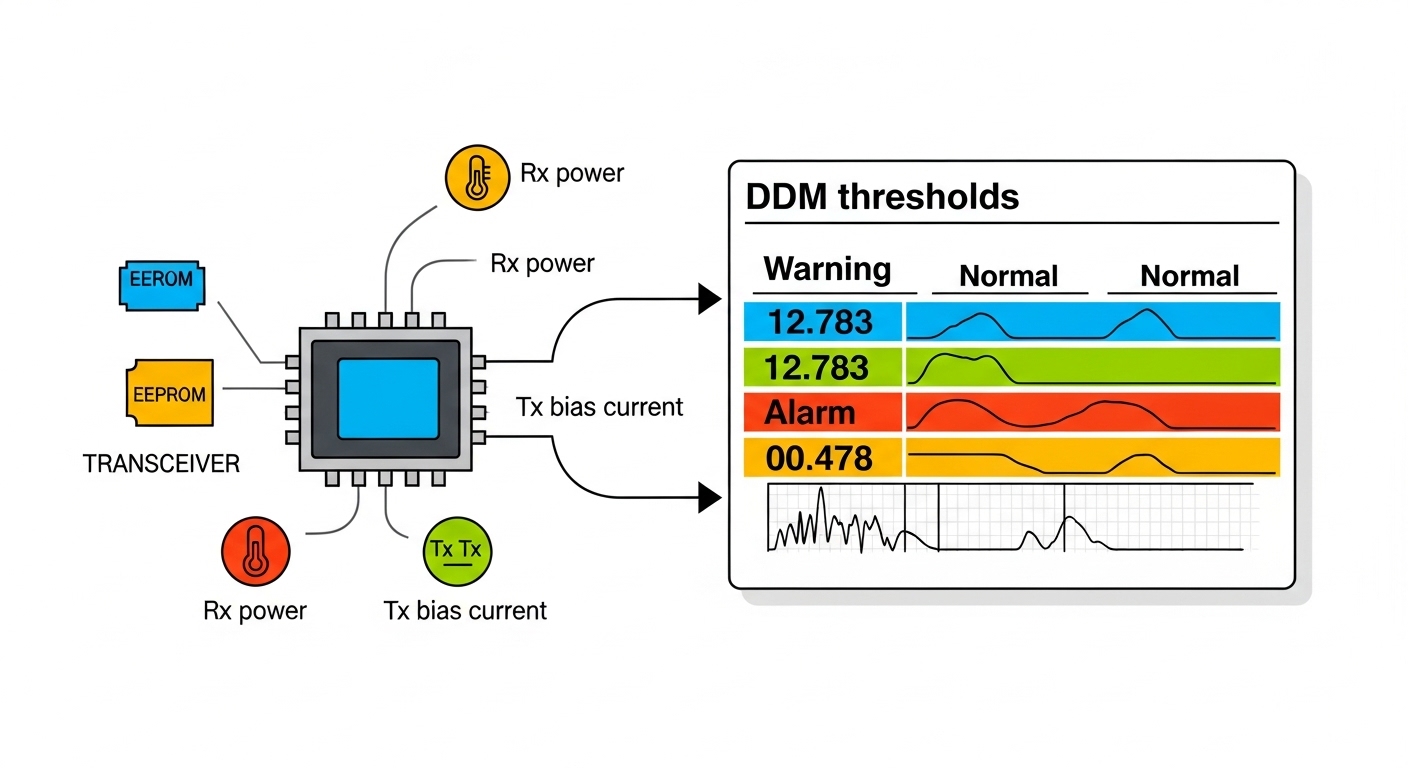
Key specs to verify include wavelength 850 nm, data rate 40.0 Gbps, connector type LC duplex, and supported multimode fiber (OM3 vs OM4). For temperature, confirm an industrial vs commercial grade; many data center parts target 0°C to 70°C operation, while some variants support wider ranges. Also check whether the module is provisioned for DDM/DOM so you can monitor optical power, temperature, and supply voltage.
Best-fit scenario: In a 3-tier data center leaf-spine topology with 48-port 10G ToR switches upgraded via aggregation to 40G uplinks, SR optics commonly connect ToR to aggregation over OM4 patch panels. Typical measured spans are 80 to 220 m depending on rack layout and slack management.
- Pros: High compatibility, lower cost than long-reach optics, easy DOM monitoring.
- Cons: Distance limited to multimode reach; OM3 vs OM4 mismatch can reduce margin.
40G LR (1310 nm) for longer multimode or single-mode reach
A 40G QSFP+ LR transceiver uses 1310 nm optics and is designed for longer distances with single-mode fiber (SMF). Unlike SR, LR optics often extend beyond a few hundred meters with improved link budgets and better reach. If you are standardizing across mixed racks or connecting across rows, LR can reduce the number of intermediate patching points that create maintenance overhead.
Key specs to verify are wavelength 1310 nm, connector type LC duplex, and target reach for your module class (commonly 10 km or 40 km depending on variant). Pay attention to fiber type and expected attenuation; measured SMF losses around 0.30 dB/km at 1310 nm are typical for well-maintained plant, but real deployments can be worse due to connectors and splices.
Best-fit scenario: In a campus aggregation environment with two switch rows separated by a 1.2 km cable run, engineers often use LR QSFP+ plus carefully trained splicing practices. You can keep link margins stable by using pre-terminated SMF jumpers and documenting OTDR results.
- Pros: Larger reach, fewer hops, better for inter-row or inter-building links.
- Cons: Higher cost than SR; requires single-mode discipline and connector hygiene.
40G ER (1550 nm) for maximum reach and harsher attenuation budgets
For networks that need the longest reach, a 40G QSFP+ ER transceiver operating near 1550 nm can be the reliability-friendly choice when link budgets are tight. The 1550 nm window typically supports lower fiber attenuation than 1310 nm, which helps when you have longer runs or more patching. Engineers choose ER when they cannot easily reduce distance or when they must accommodate future growth without re-cabling.
Key specs to verify include wavelength 1550 nm, reach class (often 40 km or similar depending on vendor), and DOM support for optical power and temperature. Also validate the switch’s supported ER optics list; not all platforms treat every vendor’s ER variant identically, especially around transmit power and receiver sensitivity thresholds.
Best-fit scenario: In a regional data center interconnect, a 40G QSFP+ ER module can support 30 to 40 km SMF runs when OTDR confirms end-to-end loss within the module’s specified budget. This is common when using dark fiber leased from a carrier where splice points are fixed.
- Pros: Long reach with better attenuation characteristics at 1550 nm.
- Cons: More expensive; requires strict SMF and connector cleanliness to avoid receiver degradation.
40G PSM4 for efficient 40G scaling over fewer fibers
Some networks need 40G scaling where fiber count is constrained. A 40G QSFP+ PSM4 transceiver uses a parallel optics approach (often four lanes) and can deliver high throughput over limited fibers using specialized wavelength or mode behavior depending on the platform. Practically, PSM4 is chosen when you have existing fiber infrastructure that supports the required signaling and you want to avoid adding new conduits.
Key specs to verify are that the transceiver is truly compatible with your switch’s PSM4 implementation, including wavelength plan and lane mapping. Also confirm connector type and whether your cabling uses the expected fiber core type and patching method. DOM support matters here too, because visibility into transmit power and temperature helps you catch early drift.
Best-fit scenario: In a dense telecom-style aggregation room with limited patch panel real estate, PSM4 can reduce the number of parallel fiber trunks required for 40G transport. Field teams typically validate by running bit error checks and monitoring error counters for at least 24 hours post-install.
- Pros: Better fiber utilization than some alternatives.
- Cons: Compatibility can be narrower; vendor and switch support lists matter.
40G SR4 vs 40G QSFP+ optics variants: avoid “looks similar” traps
Engineers sometimes see “40G” and assume all modules are interchangeable, but QSFP+ optics variants differ in how they map lanes and how the host interprets signaling. If you choose the wrong class (for example, a variant intended for a specific switch generation), the switch may train links but fail under load, or it may refuse to bring the interface up reliably. This is a classic reliability issue: it creates intermittent faults that raise MTTR and can trigger escalations during peak traffic.
Key specs to verify include data rate 40.0 Gbps, compliance to the relevant IEEE 802.3 clauses for 40G Ethernet optics, and whether the module uses the expected lane mapping for your host ASIC. Confirm connector and fiber type, plus DOM behavior. If your platform supports only specific optic part numbers, treat that as a formal constraint rather than a suggestion.
Best-fit scenario: During a phased upgrade from 10G to 40G, a team might stock multiple optic SKUs. A better approach is to standardize on one optics class per distance tier and maintain a tested mapping spreadsheet between switch models, optic vendor, and fiber plant characteristics.
- Pros: Prevents “almost compatible” optics that cause unstable links.
- Cons: Requires more upfront validation work and inventory discipline.
OEM vs third-party 40 gigabit transceiver: reliability and MTBF tradeoffs
OEM optics can reduce compatibility risk because they are validated against the switch vendor’s characterization. Third-party modules can be cost-effective, but you must evaluate them with a reliability lens: optical power stability, DOM accuracy, and host link training behavior across temperature cycling. From an ISO 9001 perspective, you should treat optic selection as a controlled process with acceptance criteria, traceability, and documented test results.
Key specs to verify include DOM compliance (DDM parameters), transmit power nominal and minimum/maximum ranges, receiver sensitivity, and the specified operating temperature. For reliability planning, track field failure rates per batch and compute practical MTBF using Weibull fits if you have enough RMA data. Even without full Weibull modeling, you can compare “failures per 100 modules per year” once you have baseline history.
Best-fit scenario: A cloud provider with thousands of interfaces typically negotiates OEM pricing and uses third-party only after a qualification pilot. Qualification often includes temperature cycling, link stress tests, and DOM sanity checks against the switch telemetry.
- Pros: OEM reduces surprises; third-party can cut CapEx.
- Cons: Third-party requires stronger qualification to avoid hidden incompatibilities.
Budget and environmental grade: temperature, airflow, and DOM visibility
Even a perfect wavelength match can fail if the module runs outside its environmental envelope. In real racks, airflow patterns are uneven: the top of a cabinet can be significantly cooler or warmer than the bottom depending on fan direction and cable loading. A 40 gigabit transceiver that is “spec compliant” on paper may still degrade early if it experiences sustained high module temperature or poor ventilation.
Key specs to verify include operating temperature range (for example, 0°C to 70°C vs extended ranges), maximum ambient condition around the switch, and whether your cooling plan meets the vendor’s airflow recommendations. DOM helps here: monitoring real-time temperature and optical power gives you early indicators before a receiver becomes marginal.
Best-fit scenario: In a hot-aisle design with 30% cable fill and variable fan speeds, teams often add front-to-back baffles and re-balance airflow. After changes, they validate stability by watching DOM temperature and checking interface counters for CRC errors and FEC-related indicators where supported.
- Pros: Better thermal management reduces early-life failures.
- Cons: Requires coordination between network and facilities engineering.
40 gigabit transceiver specifications that actually affect link stability
Before ordering, engineers should confirm that the module’s optical and electrical characteristics align with both the switch and the fiber plant. The most common outages come from mismatched fiber type, insufficient link budget, or DOM behavior that obscures early warnings. Below is a practical comparison for typical 40G QSFP+ fiber options you will encounter in production.
| Module type (40G QSFP+) | Wavelength | Typical reach | Connector | Data rate | Target fiber | Operating temp (common) | DOM support |
|---|---|---|---|---|---|---|---|
| SR (multimode) | 850 nm | ~300 m to 400 m (OM3/OM4 dependent) | LC duplex | 40.0 Gbps | OM3 or OM4 | 0°C to 70°C | DDM/DOM typical |
| LR (single-mode) | 1310 nm | ~10 km (class dependent) | LC duplex | 40.0 Gbps | SMF | 0°C to 70°C | DDM/DOM typical |
| ER (single-mode) | 1550 nm | ~40 km (class dependent) | LC duplex | 40.0 Gbps | SMF | 0°C to 70°C | DDM/DOM typical |
For baseline standards context, validate your Ethernet physical layer choices against IEEE 802.3 relevant 40GBASE optical link definitions. Source: IEEE Standards Association Additionally, vendor datasheets for the specific QSFP+ module you buy should include transmit power ranges, receiver sensitivity, and DOM parameter definitions.
Pro Tip: When you qualify a 40 gigabit transceiver, do not only run link-up tests. Capture DOM telemetry at install time and again after thermal soak (for example, 2 hours with induced ambient change if safe). Field teams learn that optical power drift and temperature coupling show up as rising error counters long before a hard failure.
Selection criteria checklist for a 40 gigabit transceiver
Use this ordered checklist to reduce the chance of late-stage surprises. It is intentionally reliability-focused and aligns with controlled change management practices.
- Distance and fiber type: confirm OM3 vs OM4 for SR, and SMF attenuation for LR/ER using measured loss, not nameplate expectations.
- Switch compatibility: verify QSFP+ optic support lists for your exact switch model and firmware version; treat “works on one port” as insufficient evidence.
- Optics class and reach: match SR/LR/ER and ensure the reach class covers your real route loss plus a margin for patching and aging.
- DOM/DDM behavior: confirm telemetry visibility on the switch, including temperature and optical power thresholds used by your monitoring system.
- Operating temperature and airflow: check the module’s operating range and the switch’s supported ambient conditions; plan for worst-case airflow.
- Vendor lock-in risk: if OEM-only, plan procurement and spares strategy; if third-party, require qualification test evidence and traceability.
- Acceptance testing: define pass/fail criteria (link up, error counters under load, DOM sanity checks) and log results for ISO-style auditability.
Common mistakes and troubleshooting tips for 40G QSFP+ optics
Even experienced teams encounter repeat failure modes. The goal is to diagnose quickly and prevent recurrence through better selection and acceptance testing.
“Link won’t come up” due to fiber polarity or wrong fiber type
Root cause: LC duplex polarity reversal (Tx/Rx swapped) or incorrect fiber type (OM3 vs OM4) can prevent stable receiver training. In SR deployments, mode and bandwidth differences can also reduce optical margin.
Solution: verify polarity using a known-good polarity tester or standardized labeling; confirm OM3/OM4 by documentation and by patch panel records. Re-run link bring-up and watch DOM receive power for expected ranges.
Intermittent CRC errors from marginal optical power or dirty connectors
Root cause: dirty LC endfaces or micro-scratches increase insertion loss, causing the receiver to operate near sensitivity limits. This often shows up as CRC errors or rising error counters under traffic bursts.
Solution: clean connectors with lint-free wipes and an approved fiber cleaning method; inspect with a microscope if errors persist. After cleaning, validate with a traffic generator and confirm error counters return to baseline.
“Module not recognized” or DOM alarms after swapping vendors
Root cause: DOM/DDM parameter formatting differences, firmware compatibility, or a switch that enforces a vendor allowlist can lead to module recognition failures. Sometimes the interface trains but monitoring thresholds become meaningless.
Solution: confirm that the module is listed for your switch model and firmware; test with a small pilot batch before broad rollout. Ensure your monitoring system maps DOM fields correctly and uses thresholds appropriate to the module type.
Early-life failures due to thermal stress
Root cause: insufficient airflow, blocked vents, or high ambient conditions can push the module toward its upper temperature limit. Thermal cycling accelerates aging of optical components and can reduce MTBF.
Solution: check rack airflow paths, confirm baffles are installed, and measure ambient and port temperatures during peak load. Use DOM temperature trends to confirm stability over at least a full operational day.
Cost and ROI note for a 40 gigabit transceiver
Pricing varies widely by reach class and whether you buy OEM or third-party. In many markets, a 40G QSFP+ SR module commonly falls into a mid-range per-port cost band, while LR and ER optics typically cost more due to tighter optical requirements. A realistic TCO model includes not only module unit price but also labor for installation, cleaning consumables, spares stocking, and the cost of downtime during maintenance windows.
From an ROI angle, third-party modules can reduce CapEx, but only if qualification reduces failure risk. Field experience suggests that if you can cut module failure rates through acceptance testing and batch traceability, savings compound over time because MTTR decreases and fewer ports require emergency swaps. For standards baseline and acceptance criteria, align your process with vendor datasheets and switch interoperability guidance; also consider IEEE 802.3 performance expectations for link integrity. Source: IEEE 802 Working Group
Top module examples engineers often validate (for context)
During qualification, teams frequently compare known optics families. For reference, common examples include OEM or compatible optics such as Cisco-branded 40G QSFP+ SR modules and third-party optics from vendors like Finisar and FS.com in SR, LR, and ER classes. Exact part numbers and supported reach depend on the switch model, firmware, and fiber plant; always verify in your lab before bulk ordering.
- Example optics families to check: Cisco QSFP+ 40G SR optics; Finisar 40G QSFP+ optics in SR/LR/ER variants; FS.com QSFP+ 40G SR optics.
Summary ranking table: which 40 gigabit transceiver to choose
Use this table as a quick decision lens. Final selection must still be validated against your switch compatibility list and measured fiber characteristics.
