
When a data center procurement team asks for a REACH compliance SFP, engineering usually needs proof that the transceiver itself, not just the vendor’s marketing page, aligns with REACH obligations. This guide helps network architects, field techs, and vendor managers verify optical SFP compliance for real deployments, including documentation artifacts and operational constraints. You will also get troubleshooting patterns for “compliance claims” that fail during audits or incoming inspection.
What “REACH compliance SFP” should mean in practice
REACH is the European Union chemicals framework that requires manufacturers and importers to manage substances of very high concern and to provide information down the supply chain. For an optical transceiver, compliance is typically expressed through a combination of declaration of substances, SVHC communication, and process controls that cover plastics, adhesives, coatings, and any chemical used in manufacturing. In procurement terms, you should expect a vendor to provide a REACH statement and an SVHC disclosure list tied to the exact part number.
Field reality: many SFPs contain polymer components (housing, strain relief), epoxy (bonding), and metal alloys with plating. Even when the optical performance is perfect, an audit can still fail if the vendor cannot map materials to REACH requirements or refuses traceability for the specific SKU. For reference, the compliance framework is grounded in EU legal requirements and guidance, commonly summarized by major compliance bodies and industry documentation. ECHA: Understanding REACH and ECHA: Candidate List are the primary sources for what must be communicated.
Documentation artifacts you should request
Ask for documents that are versioned and tied to the transceiver model number. At minimum, request:
- REACH Declaration for the specific SFP SKU (not a generic family statement).
- SVHC candidate list disclosure including whether any SVHC substances are present above communication thresholds.
- RoHS compliance statement for electronics packaging and soldering processes (often provided together).
- Revision history showing date and document version, so audit teams can verify recency.
- Contact for compliance who can respond to audit questions with traceability.
Pro Tip: During incoming inspection, compliance failures often trace back to “catalog part numbers” being substituted by “equivalent” variants. Require the vendor to declare that the delivered serials are manufactured under the same BOM and compliance statement version as the procurement record.
Compliance verification steps for optical SFP modules
Engineers rarely have lab capability to run full REACH chemical analysis for every shipment. Instead, you verify through a structured workflow: part-number control, document validation, and consistency checks against RoHS and manufacturing statements. This approach reduces audit risk while keeping operations moving.
Start with the electrical and optical requirements so you do not reject a compliant module for the wrong reason. Then validate compliance artifacts and cross-check them with the module’s physical build and vendor packaging labels.
Step-by-step checklist
- Lock the exact SKU: record manufacturer, ordering code, and any “compatibility” notes from your switch vendor.
- Match serial/label to documentation: confirm the module label aligns with the part number on the REACH declaration.
- Validate document scope: ensure the REACH statement explicitly covers the delivered product, not only manufacturing sites.
- Check SVHC disclosure: confirm whether any listed SVHC substances are present above thresholds and whether the vendor provides any required communication details.
- Confirm RoHS linkage: many vendors bundle RoHS and REACH; ensure both are current and versioned.
- Run functional acceptance: verify link training, DOM telemetry readability, and correct wavelength/reach behavior before storing inventory.
In the lab workflow, the goal is to ensure the physical instance you receive is the same SKU described in compliance paperwork. If the label shows a different ordering code than the declaration, treat it as a compliance mismatch until resolved.
REACH compliance vs optical performance: the specs that still matter
Even when compliance is verified, you still need the right optical parameters for your link budget and environmental constraints. REACH obligations do not change the IEEE optical layer requirements, and they do not compensate for connector contamination or temperature drift. For SFP, match the data rate, wavelength, reach class, and connector type to your switch port and fiber plant.
The table below compares common SFP classes engineers encounter while sourcing compliant modules. Use it as a selection baseline; then apply the compliance verification steps above to ensure the chosen SKU can pass an audit.
| Parameter | 10G SR SFP | 10G LR SFP | 1G SX SFP |
|---|---|---|---|
| Typical wavelength | 850 nm | 1310 nm | 850 nm |
| Reach (typical) | 300 m on OM3 / 400 m on OM4 | 10 km on SMF | 550 m on OM2 / 850 m on OM3 |
| Data rate | 10.3125 Gbps | 10.3125 Gbps | 1.25 Gbps |
| Connector | LC (duplex) | LC (duplex) | LC (duplex) |
| DOM / monitoring | Often supported (I2C, Digital Optical Monitoring) | Often supported | Often supported |
| Operating temperature | 0 to 70 C typical (some offer -40 to 85 C) | 0 to 70 C typical | 0 to 70 C typical |
| Power class | Low power, typically under a few watts | Low power, typically under a few watts | Low power |
Examples of optics that appear in procurement lists include Cisco SFP-10G-SR, Finisar FTLX8571D3BCL, and FS.com SFP-10GSR-85, but your exact part numbers must align with your switch vendor’s compatibility guidance. For electrical and optical behavior, rely on IEEE 802.3 specifications for 10GBASE-SR/LR and the SFF standard for the pluggable form factor. IEEE 802.3 Standards and vendor datasheets are the authoritative sources for reach and interface timing.
Compatibility caveat: “works electrically” is not “works operationally”
Switches may enforce thresholds for received optical power, LOS behavior, and DOM parameter ranges. A module can meet IEEE optical metrics yet still be rejected if DOM calibration or vendor-specific safety margins differ. When you verify REACH compliance, also confirm functional acceptance using your switch’s diagnostics and optical power readings.
Selection criteria for REACH compliance SFP procurement
Procurement and engineering should share a single decision checklist to avoid late-stage rework. Use this ordered guide so compliance and technical fit are assessed together.
- Distance and fiber type: confirm OM grade for multimode (OM2/OM3/OM4) or SMF for long reach, then map to the module’s stated reach.
- Switch compatibility: verify the switch supports that SFP class and that DOM telemetry is accepted by the platform.
- Wavelength and connector: ensure wavelength matches the intended fiber plant and connector is LC duplex for standard SFP optics.
- Operating temperature: choose -40 to 85 C variants if you have hot aisles, direct airflow constraints, or outdoor/CO location exposure.
- DOM support: ensure the module provides DOM and that your monitoring stack can ingest it reliably (polling intervals, thresholds).
- REACH documentation quality: require a versioned declaration tied to the exact ordering code and include SVHC disclosure.
- Vendor lock-in risk: evaluate whether you can standardize on third-party optics without repeated compatibility exceptions.
Real-world deployment scenario: leaf-spine data center with audit pressure
In a 3-tier data center leaf-spine topology with 48-port 10G ToR switches, a network team provisions 10G SR SFPs for leaf-to-spine fanout and 10G LR for cross-row links. Each leaf has 40 uplinks and 8 downlinks, resulting in roughly 80 uplink SFPs per leaf when you count spares for planned maintenance. They source optics in batches of 200 modules and require REACH documentation at the SKU level because the facility is under a regional supplier-audit program.
During rollout, field engineers validate link health using switch telemetry: optical receive power, link state, and DOM temperature readings. If a compliance declaration is updated mid-quarter, the team requests a re-issued REACH statement covering the new batch, then confirms that the delivered label ordering code matches the updated document scope. This prevents a scenario where a shipment passes optical acceptance but fails procurement audit due to documentation mismatch.
Common mistakes and troubleshooting tips for REACH compliance SFP
These are the failure modes engineers and procurement teams see most often. Treat them as early detection targets before you scale inventory.
Wrong SKU referenced in compliance paperwork
Root cause: vendor provides a REACH statement for a “series,” while the delivered module is a different ordering code or revision. Sometimes the physical label differs due to region-specific sourcing.
Solution: require the vendor to list the exact ordering code on the REACH declaration and ensure the declaration revision date matches your purchase order timeframe.
Substitution during fulfillment
Root cause: backorder or supply constraints lead to an equivalent module being shipped without an updated compliance declaration. Optical parts can be “functionally identical” but differ in materials and BOM.
Solution: include a contract clause requiring notification and documentation updates before substitutions; verify the module label against the PO line item during receiving.
DOM pass in the lab, fail in production
Root cause: some optics have DOM parameter ranges that cause switch alarms or monitoring pipeline errors. Engineers may misattribute the issue to compliance when it is an interoperability problem.
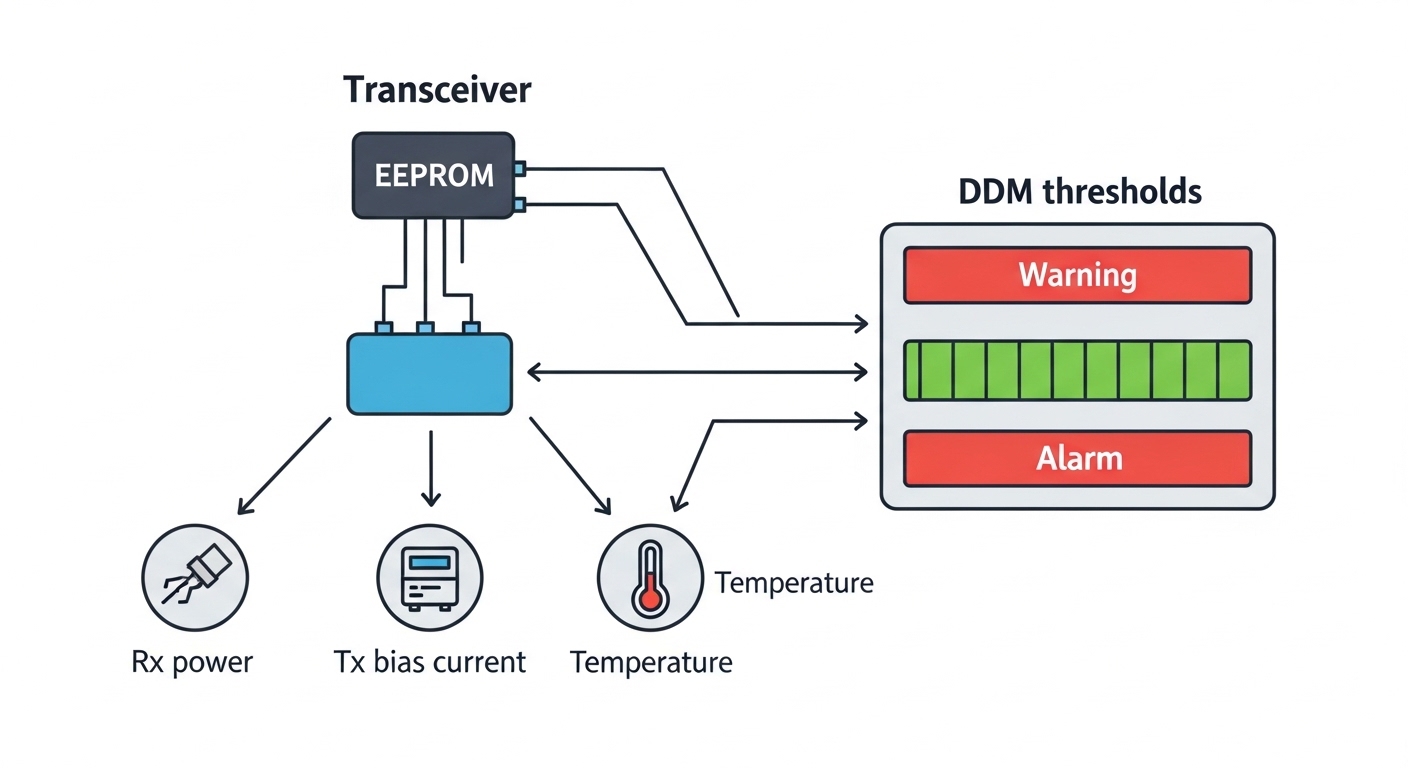
Solution: run a pilot with the exact switch model, confirm DOM readouts (temperature, bias current, received power), and validate monitoring thresholds. Use the switch vendor’s optics compatibility list as the primary gating criterion.
Environmental mismatch despite “standard” temperature ratings
Root cause: optics rated 0 to 70 C are deployed in hot aisles with insufficient airflow or in enclosures with thermal hotspots. This can cause link flaps and perceived “defective batch” claims.
Solution: measure cage temperature and choose -40 to 85 C optics where needed; confirm with vendor datasheets and your facility thermal model.
Cost and ROI note: compliance reduces audit risk, not just paperwork
Typical SFP pricing varies widely by reach class and temperature grade. In many enterprise and mid-market environments, third-party 10G SR SFPs often land in a rough $20 to $60 per module range, while OEM-branded equivalents can be materially higher, sometimes $60 to $150+ depending on vendor and contract terms. Long-reach and higher-grade temperature optics (or parts with tighter DOM behavior guarantees) can cost more.
From a TCO standpoint, the ROI of doing REACH compliance correctly is avoiding shipment holds, audit remediation, and rework during installation. If a compliance declaration mismatch triggers a vendor dispute, the operational cost can exceed the module price due to downtime, expedited shipping, and engineering time. REACH documentation also supports broader governance programs alongside RoHS and supplier quality processes, reducing repeat audit cycles.
FAQ
How do I confirm REACH compliance for a specific REACH compliance SFP part number?
Request a versioned REACH declaration tied to the exact ordering code and verify it includes SVHC disclosure. Then match the module label on the received unit to the same part number on the document.
Is REACH compliance the same as RoHS compliance for optical transceivers?
No. RoHS targets specific restricted substances in electrical and electronic equipment, while REACH focuses on chemicals management and SVHC communication. Many vendors provide both statements, but you must evaluate them separately.
What if the vendor provides a generic REACH statement for the product family?
That is a common audit weakness. For high-risk procurement, require SKU-level declarations and SVHC disclosure tied to the ordering code delivered on your purchase order.
Can a non-compliant REACH claim still pass optical performance tests?
Yes. Optical performance depends on laser/receiver specs and link budget, not the chemical substance disclosures. Audit failure can occur even when the link is stable, so you must treat compliance as a separate acceptance criterion.
Do I need to test chemicals myself for REACH compliance SFP verification?
Usually not. Most organizations rely on vendor declarations plus receiving controls and, where necessary, occasional third-party analysis for disputed shipments. The practical goal is documented traceability and audit readiness.
What should I do if a compliance document revision changes mid-project?
Ask the vendor to confirm whether the BOM or materials used in your SKU changed. If there is any material change, request the updated REACH declaration that covers the batch you will receive.
To operationalize REACH compliance SFP procurement, combine SKU-level documentation validation with standard optical acceptance testing and strict receiving controls. Next, align your optics strategy with interoperability guidance via optical transceiver compatibility checklist.
Author bio: I have deployed and validated SFP and transceiver fleets in enterprise and colocation environments, focusing on DOM telemetry, optical power margins, and audit-ready documentation. My work connects procurement compliance artifacts to field acceptance so teams avoid both link outages and supplier audit holds.
