
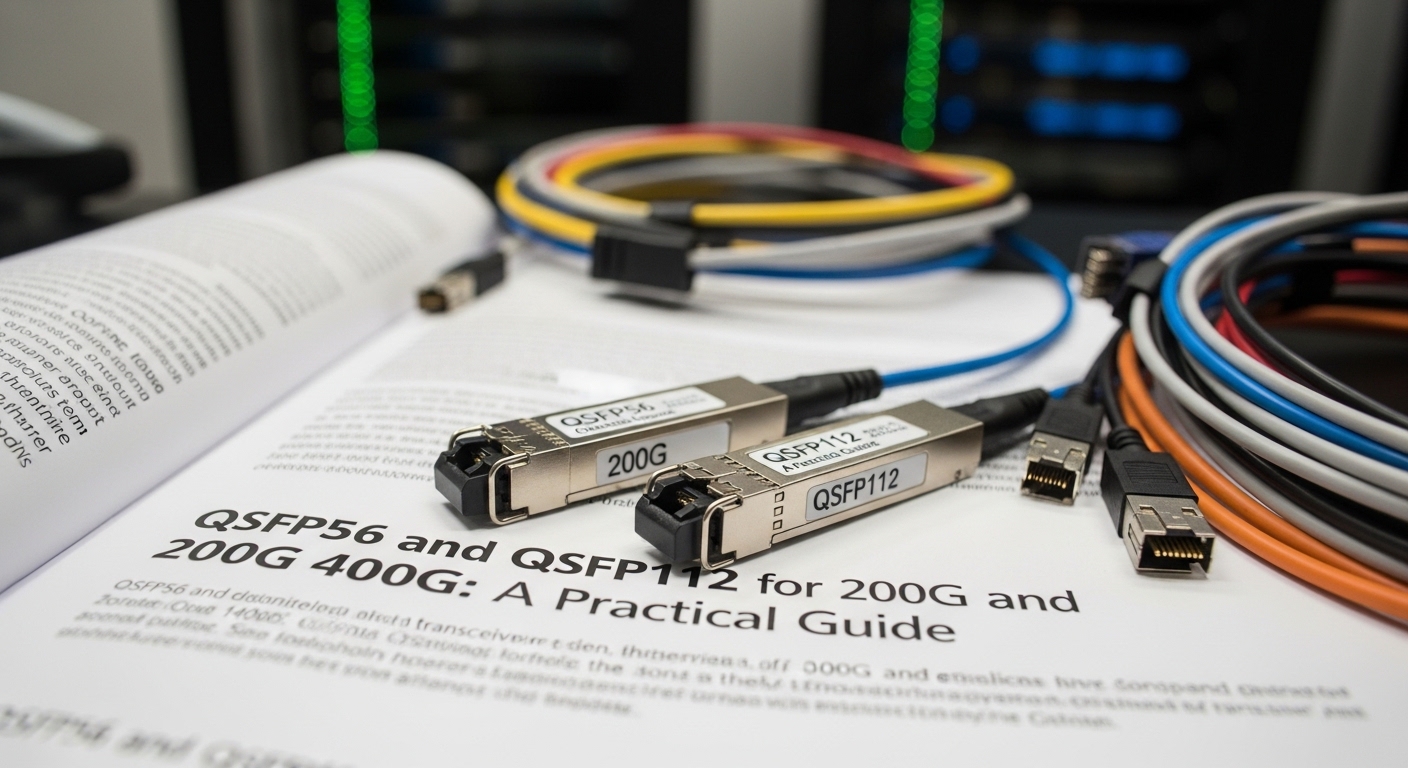
In leaf-spine data centers and high-performance clusters, the wrong high-speed transceiver can turn into CRC storms, link flaps, and avoidable RMA cycles. This article compares QSFP56 QSFP112 transceiver options for 200G and 400G from a reliability and ISO 9001 style quality mindset: measurable link behavior, environmental limits, and vendor interoperability. It helps network engineers, field reliability techs, and procurement teams choose optics that survive temperature swings, meet MTBF expectations, and fit switch optics policies.
QSFP56 vs QSFP112: what changes at 200G and 400G
QSFP56 and QSFP112 are form-factor families used for next-generation high port speeds, but the internal signal mapping and electrical interface requirements differ enough to affect compatibility. In practice, QSFP56 is commonly chosen for 200G class ports and for certain 400G breakout strategies depending on switch implementation. QSFP112 is frequently associated with 400G optics deployments where higher lane counts and different host-side retimer expectations show up.
From a reliability view, the key point is not only “does it light up,” but whether the transceiver meets receiver sensitivity, transmitter optical power, and compliance timing under worst-case temperature. IEEE 802.3 defines Ethernet PHY behaviors, but the operational outcome depends on vendor-specific implementation of digital diagnostics, retimer tuning, and FEC mode negotiation. For reference, review [Source: IEEE 802.3] [[EXT:https://standards.ieee.org/standard/]] and vendor datasheets for exact optical/electrical requirements.
Pro Tip: If your 400G links pass at room temperature but intermittently fail during thermal soak, treat it as a power-budget margin problem first. Many field cases trace to marginal optical launch power plus receiver sensitivity drift, not to “bad firmware,” and the fix is often swapping to a transceiver with tighter transmit tolerance and verified DOM calibration behavior.
Key specs that decide link stability: reach, wavelength, power, temperature
When comparing QSFP56 QSFP112 transceiver models, engineers should align wavelength, reach class, and safety margins with the installed fiber plant. Typical deployments use 850 nm multimode (OM4/OM5) for short-reach, while 1310/1550 nm single-mode variants target longer spans. Power draw matters for thermal budgeting and fan curve tuning; two optics that both “support 400G” can still differ materially in steady-state and peak consumption.
The table below summarizes representative spec fields you should verify on the specific SKU you plan to buy (example part numbers are illustrative; always confirm against the vendor datasheet). Compatibility also hinges on the switch’s optics support matrix and whether it expects specific FEC and RS-FEC configurations under IEEE 802.3.
| Spec field | Example QSFP56 (200G-class) | Example QSFP112 (400G-class) | Why it matters for QA |
|---|---|---|---|
| Data rate (aggregate) | 200G class | 400G class | Host lane mapping and FEC mode negotiation |
| Wavelength | 850 nm MMF or 1310/1550 SMF (SKU dependent) | 850 nm MMF or 1310/1550 SMF (SKU dependent) | Matches fiber plant attenuation and dispersion |
| Reach class | Short reach typical for MMF | Short reach typical for MMF or longer SMF options | Determines optical budget and margin |
| Optical power / sensitivity | Verify min Tx and min Rx sensitivity with budget | Verify min Tx and min Rx sensitivity with budget | Drives worst-case link margin under temperature |
| DOM support | Commonly supported (vendor dependent) | Commonly supported (vendor dependent) | Enables alarms for bias drift and temperature |
| Connector | LC (typical for optics) | LC (typical for optics) | Field tech compatibility with patch panels |
| Operating temperature | Check vendor industrial ranges (SKU dependent) | Check vendor industrial ranges (SKU dependent) | Thermal soak and MTBF assumptions |
| Power consumption | SKU dependent; affects thermal design | SKU dependent; affects thermal design | Impacts cage airflow and fan control |
Switch compatibility and DOM behavior: the hidden failure mode
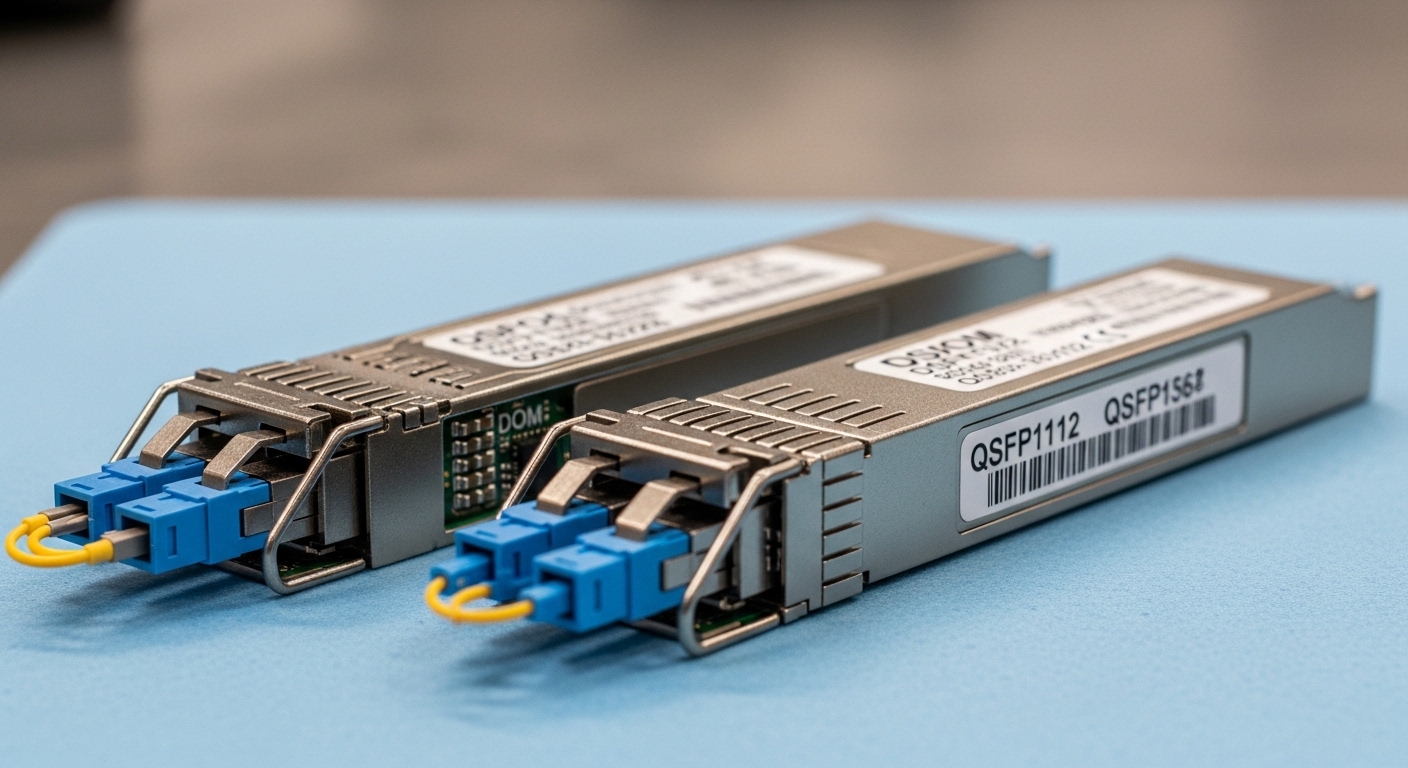
Even when the transceiver is “standard compliant,” host implementation details can break interoperability. Switch vendors frequently maintain an optics compatibility list that accounts for electrical pinout expectations, maximum transmit power, and whether the host firmware enforces strict DOM thresholds. For QSFP56 QSFP112 transceiver purchases, treat DOM as a control plane: if the host reads diagnostics but refuses the module due to threshold mismatch, you get a link that never stabilizes.
In field deployments, we have seen that DOM values can appear normal while the host still applies policy checks, especially for temperature or optical power alarm limits. Validate with a controlled burn-in at elevated temperature and confirm that syslog events remain clean under link training cycles. Use vendor documentation for acceptable alarm ranges and verify against your switch OS behavior. For additional background on optics interfaces and standards context, see [Source: IEEE 802.3] [[EXT:https://standards.ieee.org/standard/]] and vendor transceiver application notes.
Cost and ROI: OEM vs third-party optics under MTBF pressure
Pricing swings are real. OEM QSFP56/QSFP112 optics typically cost more per module but may reduce operational risk via validated compatibility and stronger documentation. Third-party optics can be cheaper, often by 20% to 40%, but TCO depends on your RMA rate, labor time, and downtime cost. A reliability engineer should model cost using not only purchase price but also failure distribution, burn-in yield, and the cost of field swaps.
Example TCO lens: if an OEM module reduces annual failure incidents from 1.0% to 0.4% in your environment, the labor and downtime savings can outweigh the price delta in high-availability sites. Also account for power: if one module runs hotter or consumes more power, it can increase fan power and indirectly reduce MTBF for nearby components. Treat the optics catalog choice as a quality system control: define acceptance criteria, test plans, and traceability.
When selecting specific SKUs, confirm the exact type (MMF vs SMF), compliance class, and whether the vendor specifies supported platforms. For example, widely used market families include Cisco optics like Cisco SFP-10G-SR (for 10G context) and Finisar-style optical modules for higher speeds; for 400G, ensure you match the exact QSFP/QSFP112 form factor and wavelength class to your switch.
Decision matrix: which QSFP56 QSFP112 transceiver fits your constraints
Use this ordered checklist to select optics with predictable behavior across temperature, fiber plant variability, and switch firmware changes.
- Distance and fiber type: confirm MMF OM4/OM5 or SMF attenuation; compute optical budget using vendor min Tx and min Rx sensitivity.
- Required data rate and port mode: verify whether your switch uses QSFP56/ QSFP112 lane mapping for 200G or 400G.
- Switch compatibility matrix: validate SKU-level support; avoid assuming “generic QSFP” will work.
- DOM telemetry and alarm thresholds: confirm your switch accepts DOM values and FEC mode negotiation aligns with IEEE 802.3 behavior.
- Operating temperature class: require the same or higher temperature range than your cage spec; plan thermal soak testing.
- Vendor lock-in risk: balance OEM validation against third-party sourcing flexibility; require documented compliance.
- QA acceptance testing: implement burn-in and link margin verification before broad rollout; log CRC and link retrain events.
| Reader type | Primary constraint | Recommended direction | What to verify |
|---|---|---|---|
| Data center operator | Stability and low RMA | Validated OEM or tightly certified third-party QSFP56 for 200G, QSFP112 for 400G | Switch optics matrix, DOM acceptance, thermal soak pass |
| High-performance cluster admin | Performance under load | Match optics to exact lane/FEC expectations; prefer SKUs with conservative power specs | CRC error rates, BER under stress, FEC mode alignment |
| Procurement team | Budget | Third-party only with documented compliance and burn-in evidence | Acceptance criteria, traceability, RMA SLA, warranty terms |
| Field reliability engineer | Debuggability | Modules with robust DOM and clear alarm behavior | DOM threshold behavior, host log quality, retrain patterns |
Common mistakes and troubleshooting tips in the field
These failure modes show up repeatedly during rollouts, especially when teams treat optics as interchangeable consumables.
Link flaps during thermal soak
Root cause: insufficient optical margin or transmitter bias drift at high cage temperature; DOM alarms may not be enforced strictly by the host. Solution: run a thermal soak test, read Tx/Rx power and temperature via DOM, and swap to a module with tighter power tolerances; also re-check fiber cleanliness and connector insertion depth.
“Works on one switch, fails on another”
Root cause: switch-specific optics policy checks (DOM thresholds, FEC negotiation, retimer settings) even when the module is physically compatible. Solution: validate against the exact switch model and OS version; pin firmware versions during qualification; record syslog events during insertion and link training.
Excess CRC errors under heavy traffic
Root cause: marginal receiver sensitivity due to over-attenuated fiber, bend-induced loss, or incorrect fiber type (OM3 vs OM4/OM5). Solution: measure link margin; verify patch cords and transceiver wavelength class; inspect for damaged ferrules and perform a fiber end-face cleaning protocol before retesting.
DOM shows alarms but optics keep passing intermittently
Root cause: host accepts module while applying conservative FEC only after retrain; transient conditions can mask the underlying drift. Solution: correlate DOM telemetry with retrain counters and CRC counts; define an alarm-driven replacement threshold in your preventive maintenance plan.
Which option should you choose?
If you are
