
If you are wiring a leaf-spine fabric or upgrading a core router, the fastest way to lose a week is picking the wrong optical form factor and then discovering incompatibility after install. This guide helps network engineers and field technicians choose the right QSFP56 QSFP112 transceiver for 200G and 400G deployments, with real-world checks, troubleshooting patterns, and a selection checklist you can apply on-site.
What “QSFP56 QSFP112 transceiver” means in day-to-day installs
In practice, “QSFP56 QSFP112 transceiver” is shorthand for a family of pluggable optics that target higher port densities and higher aggregate rates, typically used in modern switches and routers supporting 200G and 400G. You will see these modules in data centers where rack space is tight and cable management must be predictable. The key is not just the shape; it is the electrical interface lane mapping, optics wavelength band, and the vendor’s supported feature set (DOM, FEC expectations, and compliance behavior). Before you order, confirm the exact switch port speed mode and the transceiver compatibility list.
Quick mental model: “same plug, different lane math”
Think of the transceiver as a multi-lane “data zipper.” Two modules may both be physically QSFP, but the internal lane grouping can differ. If your switch expects a certain lane mapping for 200G or 400G, the link will fail training or will negotiate at the wrong speed. That is why engineers treat “form factor” and “rate mode” as separate selection steps.
Standards and compliance anchors you will run into
- IEEE 802.3 Ethernet physical layer definitions for 200G/400G break down into specific PCS/PMA expectations. Review the relevant 200GBASE and 400GBASE clauses for signaling behavior. [Source: IEEE 802.3]
- Vendor datasheets define supported speed modes, receiver sensitivity, transmitter launch power, and DOM behavior. [Source: Cisco/Fujitsu/Arista/Broadcom vendor optics datasheets]
- Optical safety and performance targets matter for real fiber plants: wavelength, link budgets, and dispersion limits are specified in module documentation. [Source: ANSI/TIA fiber cabling overview and module vendor docs]
[[IMAGE:Macro photography of a QSFP56 optical transceiver module on a workbench, angled three-quarter view, visible metal cage and LC duplex connector interface, shallow depth of field, cool studio lighting, ultra-realistic detail, high resolution, no branding text readable.]
Specs that decide reach and compatibility (wavelength, lane rate, power)
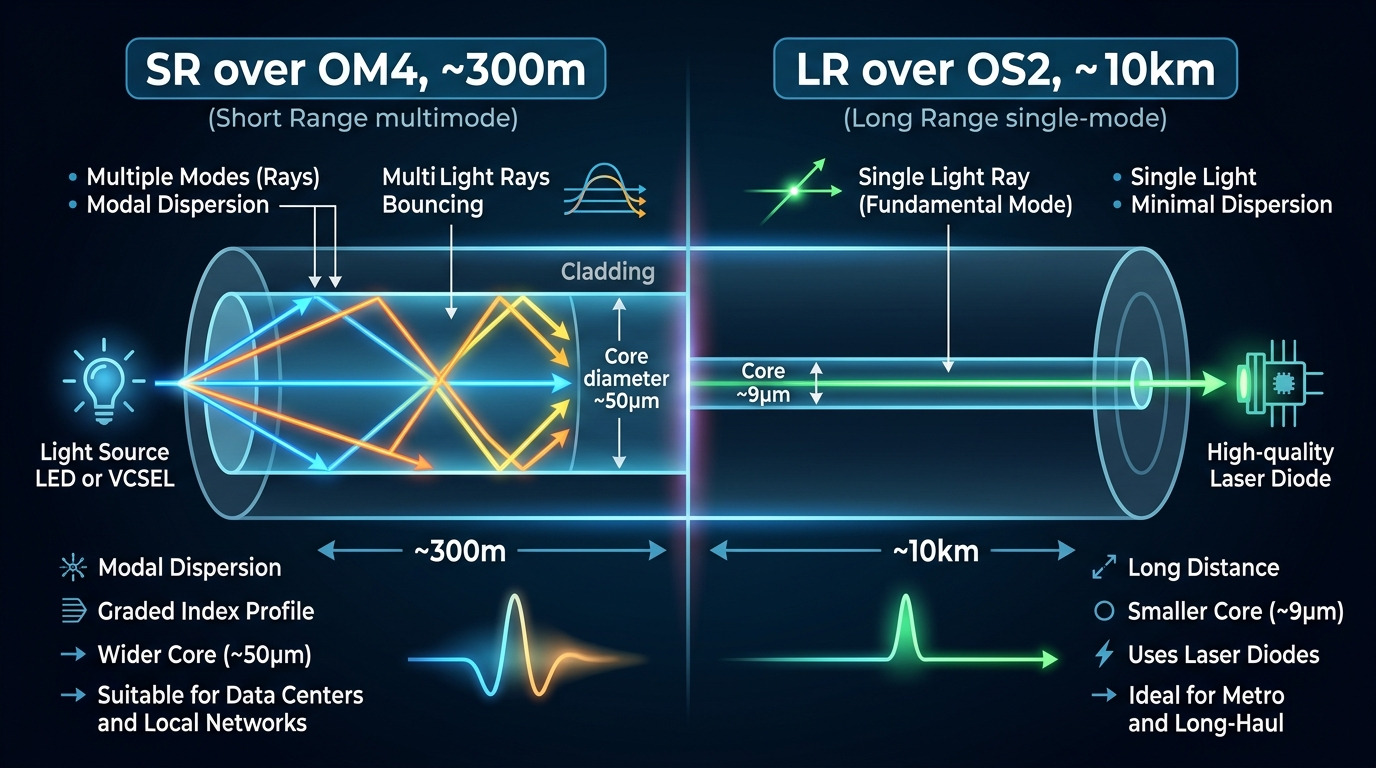
When you compare QSFP56 and QSFP112 optics for 200G and 400G, you should focus on the parameters that affect link budget and training. For short-reach, typical wavelengths are in the 850 nm band for multimode fiber (MMF), while long-reach uses 1310 nm or 1550 nm depending on the standard and reach class. You also need to check the module’s transmit power, receiver sensitivity, and whether it is designed for MMF OM3/OM4 or for single-mode fiber (SMF). Finally, confirm the transceiver’s operating temperature range for your enclosure and airflow profile.
Reference comparison table (typical, verify with your exact part number)
Below is a practical comparison of common short-reach configurations you might encounter when choosing a QSFP56 QSFP112 transceiver for 200G and 400G. Always verify exact values from the module datasheet and the host switch compatibility list.
| Parameter | Common 200G SR (QSFP56 class) | Common 400G SR (QSFP112 class) | Notes for field use |
|---|---|---|---|
| Target data rate | 200G | 400G | Rate mode must match the switch port profile |
| Wavelength | 850 nm (MMF) | 850 nm (MMF) | Different bands require different fiber types |
| Fiber type | MMF (OM3/OM4 typical) | MMF (OM3/OM4 typical) | Check OM rating and link distance spec |
| Reach class (typical) | Up to 100 m class on OM4 | Up to 100 m class on OM4 | Exact reach depends on launch/sensitivity and budget |
| Connector | LC duplex | LC duplex | Confirm polarity and cleaning requirements |
| DOM support | Temperature/voltage/power (vendor-specific) | Temperature/voltage/power (vendor-specific) | Host may require DOM for monitoring |
| Operating temperature | Typically 0 to 70 C or -10 to 70 C | Typically 0 to 70 C or -10 to 70 C | Match to switch line-card and room conditions |
| Power (typical range) | ~3 to 6 W | ~6 to 10 W | Use for thermal budgeting in dense racks |
Deployment reality: how you verify link budget before the first patch
Before you patch fibers, pull the planned route length and confirm the fiber grade (OM3 vs OM4, or specific SMF type). Then compare against the module’s specified reach and the switch vendor’s recommended maximum loss for the connector and patch cords. In the field, you often validate with an OTDR or at least a certified loss test report. If you are using third-party optics, confirm whether the host expects specific FEC settings or link training behavior at 200G/400G modes.
Pro Tip: Many intermittent “link flaps” on 200G/400G MMF links trace back to dirty LC connectors or high-loss patch cords, not the transceiver itself. Clean with lint-free wipes and approved IPA, then re-check optical power/DOM thresholds after reseating; a marginal launch/sensitivity combination can fail training only under certain temperature swings.
[[IMAGE:Illustration concept art showing a simplified “lane zipper” inside a QSFP module, with colored lanes labeled for 200G vs 400G, arrows indicating lane mapping mismatch leading to link failure, clean vector style, white background, high contrast, diagram-like clarity.]
Choosing the right module for 200G vs 400G: decision checklist
Engineers typically decide in five minutes, but it only takes one missing detail to cause a bad install. Use this ordered checklist to select a compatible QSFP56 QSFP112 transceiver for your speed mode and fiber plant.
- Distance and fiber type: confirm MMF OM3/OM4 or SMF type, then match to the module’s specified wavelength and reach class.
- Switch port speed mode: verify whether the port is configured for 200G or 400G and whether it supports the exact module form factor.
- Compatibility list and firmware behavior: check the host switch vendor’s optics compatibility matrix and ensure your switch software version supports that module family.
- DOM and telemetry requirements: confirm that the module exposes temperature, voltage, and optical power via DOM in a way your monitoring stack expects.
- Operating temperature and airflow: compare module operating range to the line-card airflow and verify that your rack does not exceed thermal limits.
- Operating power and thermal budget: estimate total optics power per chassis and ensure fan curves and thermal sensors stay within spec.
- Vendor lock-in risk: if you plan to use OEM vs third-party, evaluate support model, warranty terms, and whether the host blocks unknown optics.
Real-world selection examples you can reuse
- 200G leaf-to-spine with short MMF runs: choose a QSFP56 SR module in the 850 nm band targeting the OM4 reach class for your measured patch cord length and patch loss.
- 400G spine uplinks with dense front panels: choose a QSFP112 SR module designed for 400G operation and confirm the switch line-card supports QSFP112 at that port.
- Mixed vendor optics strategy: if you must mix OEM and third-party, standardize on one module family where possible and validate with a pilot link plus monitoring dashboards.
[[VIDEO:Short training-style video showing an engineer inspecting DOM readings on a switch CLI, cleaning LC connectors, and reseating a QSFP transceiver while monitoring link status and optical power.]
Common pitfalls and troubleshooting patterns (with root causes)
Even experienced teams run into predictable failure modes. Here are the ones that show up most often when deploying QSFP56 QSFP112 transceiver optics for 200G and 400G.
Pitfall 1: “It fits, so it must work” port-mode mismatch
Root cause: The host port expects a specific speed profile and lane mapping for 200G or 400G, but the installed module negotiates differently or is not supported in that mode.
Symptoms: Link stays down, or comes up briefly then drops; logs show training failures or unsupported transceiver type.
Solution: Verify port configuration (speed, breakout mode, and lane assignment). Update switch firmware if the vendor notes that new optics are supported only after a specific release. Confirm the transceiver part number and whether it is rated for your exact speed mode.
Pitfall 2: Connector contamination and marginal optical budget
Root cause: Dirty LC connectors, damaged ferrules, or high-loss patch cords reduce received optical power below sensitivity thresholds.
Symptoms: Link flaps under load, increased CRC or FEC correction counts, or intermittent “signal detect” behavior.
Solution: Clean connectors using approved procedures, inspect with a fiber scope, replace patch cords with certified low-loss cables, and re-check DOM optical power and temperature after reseating.
Pitfall 3: Thermal throttling or temperature out of range
Root cause: Overheated optics due to insufficient airflow, blocked vents, or operation outside the module’s temperature specification.
Symptoms: Errors rise gradually over hours; the module may reset, or the switch may report high temperature alarms.
Solution: Validate rack airflow, confirm fan operation, ensure correct blanking panels, and compare module temperature to its datasheet operating range. If the site is warm, choose modules rated for the required extended range where available.
Pitfall 4: DOM incompatibility with monitoring stack
Root cause: The module provides DOM data, but the host or your telemetry collector interprets fields differently, causing false alarms or missing thresholds.
Symptoms: “Unknown transceiver” warnings in monitoring, even when the link is stable.
Solution: Align monitoring rules with the switch vendor’s documented DOM schema. Confirm that your telemetry collector supports that specific vendor’s DOM mapping and module type.
Cost, ROI, and choosing OEM vs third-party optics
Pricing varies by reach class, vendor, and whether the module is OEM or third-party. In many enterprise and data center procurement cycles, short-reach 200G and 400G optics tend to fall into a broad range where the “cheapest” option can increase downtime risk if compatibility validation is skipped. A realistic approach is to compare total cost of ownership (TCO): purchase price, spares inventory, expected failure rate, warranty terms, and the engineering time spent on troubleshooting.
Typical field guidance on budgeting:
- OEM optics: often higher unit price, but smoother compatibility with the specific switch model and firmware line.
- Third-party optics: can reduce upfront cost, but you must test against the host compatibility list and validate DOM and link training in a pilot rack.
- Spare strategy: if you run many 400G ports, keep a small pool of known-good optics to reduce mean time to repair (MTTR).
For measurable ROI, run a pilot: deploy the chosen QSFP56 QSFP112 transceiver modules on 2 to 4 links, monitor link stability and optical power for at least one full traffic cycle, and compare operational alerts versus your baseline. This is often cheaper than a full roll-out that later requires a swap due to host policy or firmware incompatibility.
FAQ
Which switch models support QSFP56 QSFP112 transceiver modules for 200G and 400G?
Support depends on the exact line-card and port mode, not just the module family. Check the switch vendor’s optics compatibility list for your model number and firmware version, then match the required speed mode (200G vs 400G) and MMF or SMF requirement. [Source: Switch vendor optics compatibility matrix]
Can I use the same fiber type for both 200G and 400G short-reach optics?
Often yes for MMF short reach, typically in the 850 nm band, but you must still match OM3 vs OM4 and the module’s specified reach and power budget. If your patch cords and connectors are out of spec, 400G links are more likely to show errors first.
How do I confirm the transceiver is training correctly after installation?
Use the switch diagnostics to check link status, error counters (CRC/FEC corrected), and DOM-reported optical power and temperature. If the link is unstable, clean and reseat LC connectors, then confirm you are meeting the certified loss budget of the fiber plant.
Are third-party QSFP56 QSFP112 transceiver modules reliable in production?
They can be reliable, but only after compatibility validation. Run a pilot deployment, verify DOM telemetry, and monitor for link flaps and error trends. Also confirm warranty coverage and whether the host blocks unsupported optics.
What are the most common reasons 400G MMF links fail but 200G links work?
400G is less forgiving of marginal optical budgets. Typical causes include slightly dirty connectors, higher-than-expected patch cord loss, or a lane mapping mismatch in the port speed profile.
Where should I look for official performance limits before ordering?
Start with the optics datasheet for wavelength, reach, launch power, receiver sensitivity, and operating temperature range. Then cross-check the switch vendor’s compatibility and recommended max loss for the specific port type. [Source: Vendor transceiver datasheets and switch documentation]
To move fast and avoid rework, treat QSFP56 vs QSFP112 as a speed-and-compatibility decision, then validate fiber loss, DOM behavior, and thermal conditions before the full rollout. Next, review How to verify DOM readings and optical power to tighten your on-site acceptance checks.
Author bio: I have deployed 200G and 400G optics in multi-vendor data centers, including MMF reach validation and DOM-based acceptance testing for field teams. I write operator-focused guides based on switch diagnostics, transceiver datasheets, and real troubleshooting patterns from production rollouts.
