
A leaf-spine data center migration can fail quietly: latency rises, BER drifts, and ports flap after “successful” optics bring-up. This article walks through a real deployment where engineers replaced NRZ optics with a PAM4 modulation optical transceiver to stabilize 100G links under tight power and cooling constraints. If you manage 25G/50G/100G transceiver fleets, you will get practical selection criteria, measured results, and troubleshooting patterns.
Problem and challenge: NRZ optics looked fine until BER climbed
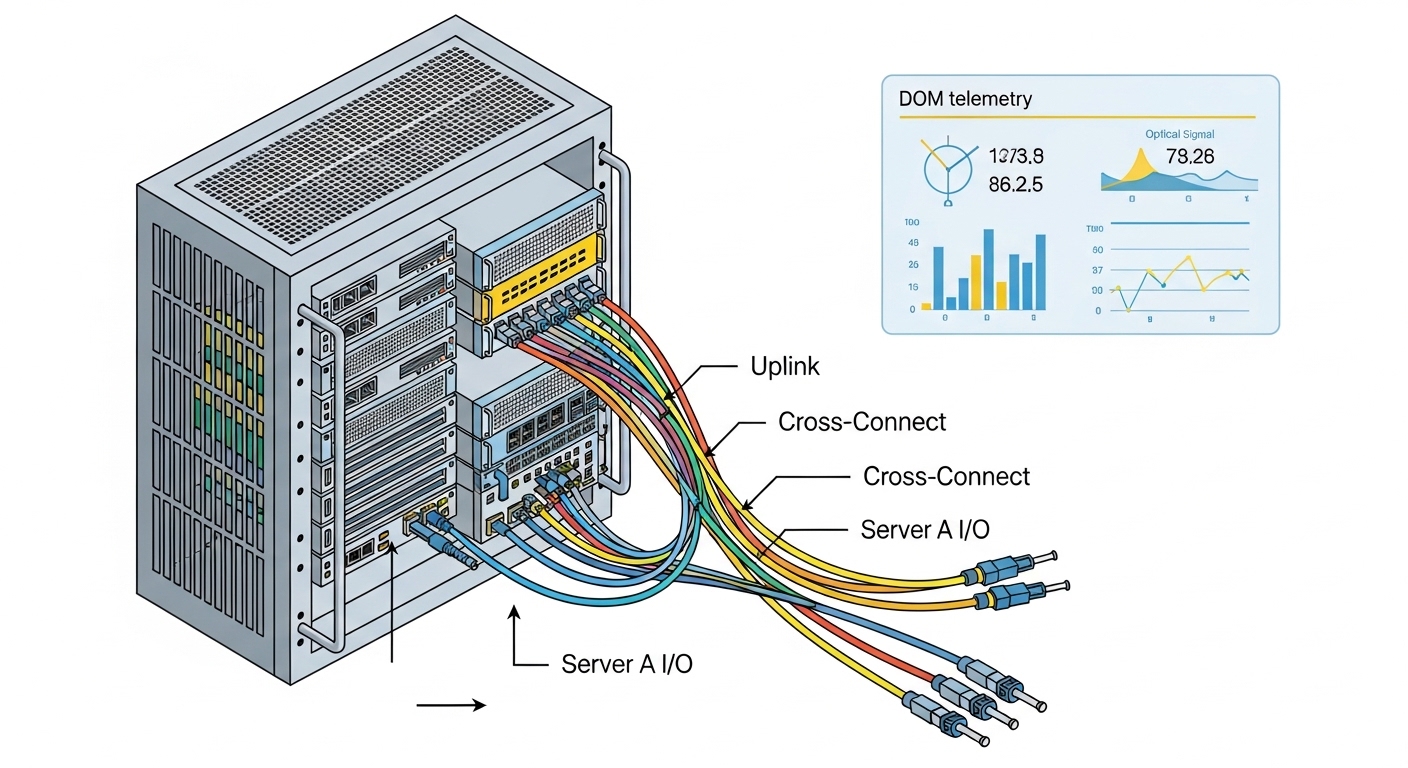
In a 3-tier data center leaf-spine topology, a customer consolidated server-to-ToR traffic from 25G to 100G using breakout and aggregation. The environment used a mix of QSFP28 and breakout optics on OM4 and SMF segments, with strict thermal limits in top-of-rack (ToR) cages. During the first cutover, engineers observed CRC errors increasing and a gradual rise in optical receiver power margin after link partners were swapped for maintenance. The optics passed initial vendor diagnostics, but the system-level BER trend worsened under peak utilization.
NRZ modulation helped earlier generations because the signaling margin was forgiving at lower baud rates. However, at higher data rates, NRZ requires higher analog bandwidth and tighter equalization, which can reduce tolerance to fiber plant impairments and vendor-to-vendor module variations. Engineers needed a modulation approach that could carry more bits per symbol while keeping thermal and power within the same rack budget.
Environment specs: what the link had to survive
The migration targeted 100G per port across leaf-spine uplinks with constrained airflow. The plant included OM4 multimode for short reach and single-mode for longer spine hops. Key constraints were module power draw, transceiver operating temperature, and optical budget headroom to avoid over-driving older patch panels.
Engineers also required Digital Optical Monitoring (DOM) telemetry for alarms, plus consistent management behavior across switch vendors. They validated against IEEE 802.3 link requirements and module electrical characteristics while monitoring real receiver sensitivity and error counters.
| Parameter | Typical NRZ 100G optics | PAM4 modulation optical transceiver (100G) |
|---|---|---|
| Modulation | NRZ (2 levels) | PAM4 (4 levels) |
| Symbol rate behavior | Higher baud for same bit rate | Lower baud for same bit rate |
| Optical reach (examples) | Often limited on OM4 at 100G | Often better reach at same constraints (when designed for PAM4) |
| Receiver sensitivity | Varies by standard and coding | Varies by PAM4 receiver design; needs equalization |
| Connector style | LC (MMF/SMF common) | LC (MMF/SMF common) |
| DOM support | Often supported via I2C | Often supported via I2C; alarms critical |
| Operating temperature | Varies (commonly 0 to 70C or wider) | Varies; confirm with vendor datasheet |
Pro Tip: In the field, PAM4 links can appear “stable” during bring-up yet degrade faster when thermal gradients change. Always log DOM temperature, bias current, and received optical power over at least 24 hours, not just during the first link training window.
Chosen solution and why: PAM4 for higher throughput under the same rack limits
Engineers selected a PAM4 modulation optical transceiver designed for 100G Ethernet operation over the targeted reach classes, using vendor datasheets that specify receiver sensitivity, transmitter average power, and DOM alarm thresholds. In practice, they prioritized modules with well-documented compliance to IEEE 802.3 requirements and clean equalization behavior with the switch ASIC’s DSP settings.
Instead of treating PAM4 as a “swap and hope” change, the team aligned three things: (1) switch optics compatibility matrix, (2) fiber plant loss budget including patch panel aging, and (3) DOM configuration so alarms triggered before error counters spiked. This reduced the “NRZ worked at first, then drifted” failure mode that showed up during peak loads.
Implementation steps that reduced risk
- Baseline NRZ performance: capture per-port BER/CRC and DOM trends for 48 hours at typical and peak utilization.
- Verify switch DSP settings: ensure the switch supports PAM4 optics profile and does not force incompatible FEC or lane mapping.
- Validate fiber plant: measure end-to-end optical power and check connector cleanliness; re-terminate the worst-performing patch cords.
- Rollout in pairs: replace links in small batches to isolate whether issues come from optics, fiber, or switch configuration.
- Set early alarms: configure thresholds on received power and temperature so maintenance triggers before BER climbs.
Measured results: error stability improved and power stayed within budget
After the PAM4 rollout, engineers measured a clear improvement in link health. On the busiest leaf-spine uplinks, CRC error rate dropped to near-zero during peak scheduling, and the number of “soft reset” events fell because receiver margin remained stable. DOM logs showed that received optical power stayed within the expected window even as ambient cage temperature varied.
Operationally, the team also saw reduced maintenance churn: technicians spent fewer hours swapping patch cords and re-seating LC connectors because the PAM4 receiver equalization tolerated small plant variations better. While PAM4 requires careful receiver design and sometimes tighter equalization settings, the right module plus correct configuration produced a net reliability gain.
Common mistakes and troubleshooting patterns
Even strong designs can fail if teams skip the practical checks. Here are the most common PAM4 vs NRZ pitfalls engineers encounter, with root causes and fixes.
- Mistake: Mixing optics without validating switch compatibility.
Root cause: switch DSP profiles and lane mapping can differ, causing marginal equalization.
Solution: use the switch vendor’s approved optics list and confirm FEC mode and optics type selection. - Mistake: Ignoring thermal gradients in dense cages.
Root cause: PAM4 transmitter bias and receiver sensitivity drift with temperature faster than expected.
Solution: monitor DOM temperature and received power for 24 hours; improve airflow or move ports to better-cooled banks. - Mistake: Overlooking fiber connector cleanliness during “known good” swaps.
Root cause: PAM4 is more sensitive to impairment and can turn small contamination into measurable BER growth.
Solution: clean LC connectors with certified wipes, then re-measure optical power and BER. - Mistake: Confusing DOM alarms with real BER health.
Root cause: some modules report thresholds that do not match your switch’s error reporting granularity.
Solution: correlate DOM trends with CRC/BER counters and set alarms based on observed system behavior.
Cost and ROI note: where the money and risk actually land
In many deployments, a PAM4 modulation optical transceiver costs more than older NRZ modules, especially when bundled with robust DOM and tighter compliance testing. Typical street pricing varies by vendor and reach class, but teams often see a 10% to 40% module cost premium for PAM4-capable 100G optics versus simpler NRZ options. The ROI comes from fewer field interventions, lower downtime risk, and reduced rework on fiber patch panels.
TCO is also affected by failure rates and warranty terms. In practice, choosing third-party optics can work well, but engineers should mitigate lock-in risk by validating compatibility, DOM behavior, and documented compliance before scaling.
FAQ
Q: Is a PAM4 modulation optical transceiver always better than NRZ?
A: Not always. PAM4 is advantageous for high data rates under bandwidth constraints, but it can be more sensitive to impairments and configuration mismatches. If your NRZ links have comfortable margin, NRZ may remain the lower-risk choice.
Q: What specs should I compare first when selecting PAM4 optics?
A: Start with wavelength and reach class, transmitter average power and receiver sensitivity, connector type (often LC), DOM support, and operating temperature range. Then verify switch compatibility and confirm the intended FEC mode matches IEEE 802.3 behavior. [Source: IEEE 802.3 Ethernet Working Group].
Q: Can I mix PAM4 and NRZ optics in the same switch?
A: You can often mix them, but you must ensure each port is configured for the correct optics type and coding/FEC profile. Avoid mixing optics that share the same physical form factor but differ in electrical lane mapping or DOM alarm thresholds. [Source: Cisco and vendor module datasheets].
Q: How do I troubleshoot rising errors after a PAM4 upgrade?
A: Correlate CRC/BER counters with DOM trends (temperature, bias, received power). Re-clean and re-measure fiber links, then confirm
