
You have a long-haul fiber route, a clear target bitrate, and a hard distance limit that keeps breaking your budget or your timeline. This guide helps network engineers and field technicians pair an EDFA optical amplifier transceiver with the right optics so your signal reaches the far end with stable power and low error rates. You will get a step-by-step implementation plan, a practical selection checklist, and troubleshooting paths for the three most common failure points.
Prerequisites: what you must measure before you touch the optics
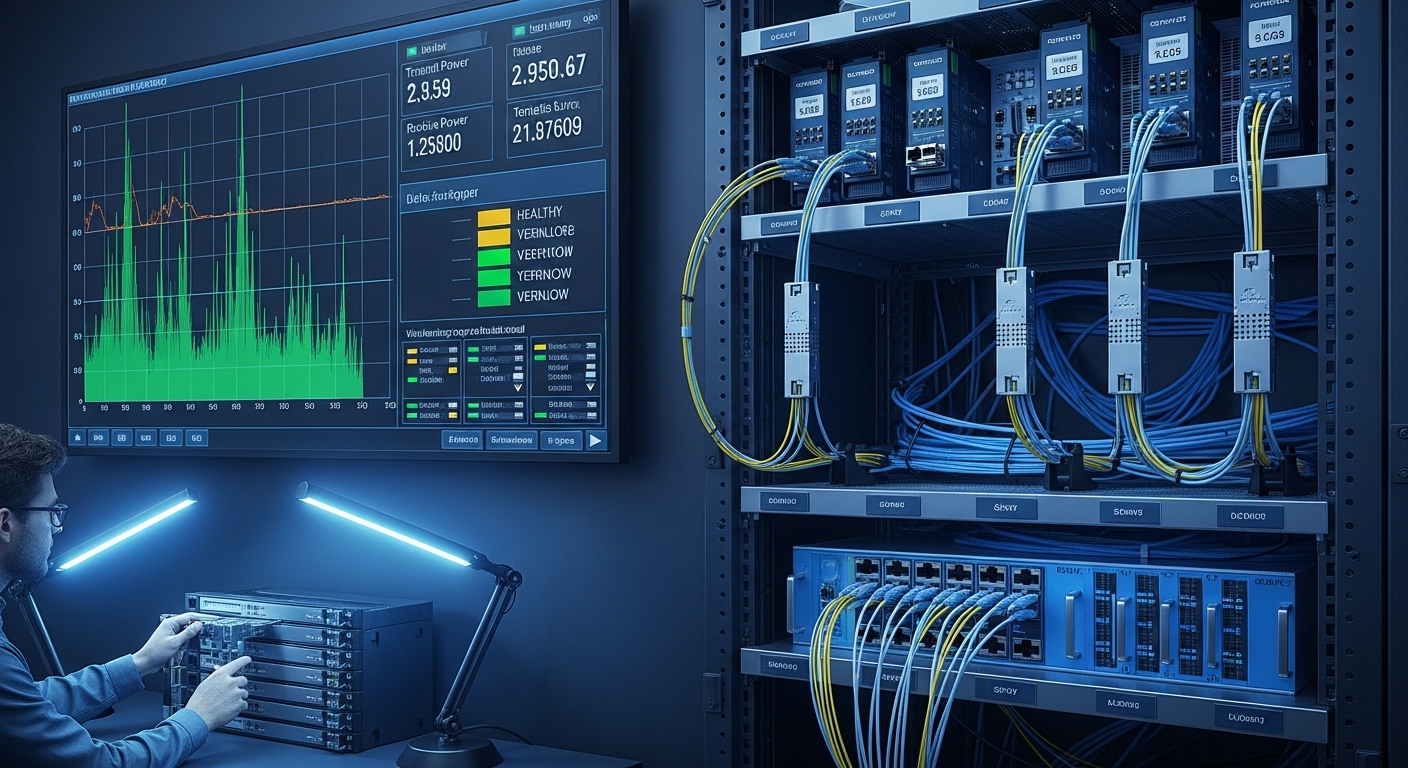
Before selecting an EDFA optical amplifier transceiver, confirm the link budget and the actual fiber plant. In the field, the fastest way to avoid rework is to measure end-to-end attenuation and connector loss, then verify the wavelength plan and interface type on both sides. If your carrier or transport vendor specified a specific wavelength grid, treat it as a hard constraint.
Tools and test items to stage
Bring a calibrated optical power meter, a stable light source or swept source/OTDR workflow, and the vendor’s transceiver compatibility notes. For deployment safety, also stage proper fiber cleaning supplies and a way to verify connector cleanliness under magnification. If you are working with DWDM, ensure you have the channel plan (grid spacing, center wavelengths) and an optical spectrum analyzer (OSA) if available.
For operational readiness, confirm whether your transport system expects an amplifier in-line or an externally managed amplifier with a supervisory channel. Many systems also require that the EDFA gain mode and target output power align with the receiver sensitivity and any downstream Raman/EDFAs in the chain.
Step-by-step: implement EDFA optical amplifier transceiver pairing for long-haul
This section is written as a numbered implementation guide you can follow during a real change window. Each step includes expected outcomes so you can verify progress without guessing.
Lock the wavelength and modulation format
Determine the wavelength band and modulation format your transceiver and network transport support. Most EDFA use cases for long-haul rely on the C-band around 1530–1565 nm, but the exact center wavelength matters when DWDM and filters are present. Verify the transceiver’s optical interface standard against the switch/router optics spec; for Ethernet transport, IEEE 802.3 links typically map to well-defined optical parameters even when the physical layer is implemented with pluggables.
Expected outcome: You confirm the exact wavelength window and ensure the EDFA optical amplifier transceiver is designed for that band and launch conditions.
Build a link budget with measured fiber loss
Use OTDR or measured attenuation to compute end-to-end loss, including splice and connector losses. In long-haul deployments, a typical fiber route can include 0.20 dB/km to 0.25 dB/km attenuation plus discrete losses from splices and patching; your actual numbers may differ by region and fiber age. Then add your transceiver launch power and receiver sensitivity to determine whether you need EDFA gain and how much.
Expected outcome: You produce a budget that shows the required amplifier gain and target output power at the receiver.
Choose EDFA gain mode and target output power
EDFA behavior depends on gain mode (fixed gain vs automatic gain control) and whether the system uses APC/ATC power management. If your system uses supervisory control, configure gain to achieve the receiver’s required optical input power while avoiding receiver overdrive. A common operational target is to land near the receiver’s sensitivity plus margin, but the exact number comes from your datasheets and measured link loss.
Expected outcome: The amplifier is configured to maintain stable output power across temperature and aging, not just at commissioning.
Verify transceiver compatibility and DOM support
Many pluggable optics include Digital Optical Monitoring (DOM). Confirm that the DOM parameters your switch expects (for example, vendor-specific monitoring thresholds and alarms) are supported by the transceiver and amplifier control plane. For example, Cisco-compatible 10G/40G/100G optical modules often require correct EEPROM and DOM behavior; mismatches can cause alarms or link flaps even when optical power looks fine.
Expected outcome: Your network elements accept the module without “unsupported” alarms and with stable threshold reporting.
Pair connector type, wavelength filter plan, and launch power
Match the connector type (common long-haul options include LC or SC depending on platform) and ensure the EDFA optical amplifier transceiver’s output power does not exceed downstream filter or receiver limits. If your design includes ROADM or mux/demux stages, confirm the EDFA output aligns with the channel plan so that filters do not create excessive penalty.
Expected outcome: You prevent silent performance loss caused by channel misalignment and connector or fiber interface mismatches.
Clean, install, and validate with measured optical power
Clean fiber ends using appropriate alcohol-free cleaning methods and verify with a scope. Then install modules with correct orientation, close latches, and confirm link state at the transport layer. Validate with optical power measurements at test points (or via system telemetry) and confirm the amplifier is operating in the intended mode.
Expected outcome: Link comes up cleanly, BER/packet error counters stay within expected ranges, and optical monitoring shows stable power.
Commission for stability across temperature and time
Long-haul links are often sensitive to temperature drift and aging in both the amplifier and optics. Perform a follow-up check after the first operational window, then compare measured receiver power and error counters to your baseline. If the system supports it, monitor EDFA gain, output power, and alarms such as ASE noise rise, input power out of range, or pump laser aging indicators.
Expected outcome: You confirm the link remains stable beyond initial bring-up, not just during the change window.
EDFA vs transceiver: what to match for long-haul performance
An EDFA optical amplifier transceiver pairing is not just “amp + optics.” You are aligning wavelength, output power, noise figure impact, and receiver operating range. In long-haul spans, the amplifier’s ASE noise can raise the noise floor, so your receiver sensitivity and modulation format determine whether you can tolerate the additional noise.
From a standards perspective, the electrical side typically follows Ethernet or transport requirements under IEEE 802.3 for many Ethernet physical layers, while the optical parameters are governed by vendor datasheets and optical subsystem design. For compliance and planning, use manufacturer documents for the EDFA gain curve, recommended operating temperature range, and maximum input/output power limits. For optical networks, also consult guidance from ITU-T on DWDM channelization when applicable.
Key specifications that actually matter
The table below compares representative long-haul optics and amplifier-related parameters you should verify. Exact numbers vary by vendor and model, but these are the fields that drive real link behavior.
| Parameter | What to verify | Typical target (C-band) | Why it matters |
|---|---|---|---|
| Wavelength | Center wavelength and band | 1530–1565 nm | Filters and mux/demux match loss |
| Reach | Specified long-haul reach and system design | Span-dependent; often tens to hundreds km | Determines required gain and power margin |
| Output optical power | Launch and amplifier output constraints | Within receiver linear range | Prevents receiver overdrive and clipping |
| Noise impact | EDFA noise figure, ASE management | Keep noise margin intact | Controls BER and Q-factor degradation |
| Connector | LC/SC and mating compatibility | Match platform patching | Connector loss and reflections |
| Data rate / interface | Transceiver standard and electrical interface | Match switch/transport optics | Prevents link incompatibility |
| Operating temperature | EDFA and transceiver ranges | Use worst-case site range | Affects gain drift and monitoring thresholds |
If you want concrete reference models for planning: long-haul optics examples include Finisar FTLX8571D3BCL (10G long-haul C-band class) and Cisco SFP-10G-SR (short-reach as a compatibility contrast), while FS.com offers a range of C-band and DWDM-capable optics such as SFP-10GSR-85 variants for specific reach classes. Always treat these as starting points; your EDFA gain and system architecture determine the final outcome.
IEEE 802.3 standard overview
Finisar optics datasheets portal
FS.com optics product pages and specifications
Pro Tip: In the field, the fastest way to catch a bad EDFA optical amplifier transceiver pairing is to watch receiver power stability during pump-up and temperature swings. If you only check “link up” once, you can miss a gain-mode mismatch that shows up as rising BER after thermal equilibrium.
Selection criteria checklist: decide in the order engineers trust
Use this ordered checklist during procurement and engineering review. The order matters because early mistakes become expensive retrofit work.
- Distance and span loss profile: confirm fiber attenuation, splice loss density, and any bends or aging hotspots.
- Wavelength plan and channel alignment: match EDFA band to the transceiver and any DWDM filters.
- Switch or transport compatibility: confirm optical interface type, DOM behavior, and supported transceiver lists.
- DOM and telemetry support: ensure monitoring alarms map correctly and do not trigger false shutdowns.
- Operating temperature range: include worst-case rack inlet and amplifier ambient; verify gain drift and monitoring thresholds.
- Power margins and safety limits: ensure EDFA output stays within receiver linear range and does not saturate downstream optics.
- Vendor lock-in risk and warranty path: evaluate OEM vs third-party optics and the warranty terms for amplifier/transceiver combinations.
Common mistakes and troubleshooting: three failure modes you can prevent
Even with correct specs on paper, field reality introduces failure modes. Below are the top issues I have seen during long-haul commissioning, with root causes and solutions.
Failure mode 1: Link flaps or stays down despite “correct wavelength”
Root cause: DOM or EEPROM compatibility mismatch can cause the switch to reject the module or misread thresholds. Another cause is a transceiver electrical interface incompatibility (for example, expecting a different lane mapping or management mode).
Solution: verify the module’s DOM support with the platform vendor’s compatibility list, check alarm logs, and confirm optical power at the receiver is within the expected range. Re-seat modules and re-verify connector cleanliness under magnification.
Failure mode 2: High BER after initial bring-up
Root cause: EDFA gain mode mismatch or incorrect target output power can push the receiver near saturation or reduce the noise margin. Misalignment with DWDM filters can also increase insertion loss and degrade Q-factor.
Solution: adjust EDFA gain (fixed vs automatic) to land receiver power within the recommended operating window. If DWDM is involved, confirm channel center wavelengths and filter settings; then re-run BER/packet loss validation over at least one full thermal cycle.
Failure mode 3: Works intermittently with “mystery” alarms
Root cause: connector contamination or micro-bending in patch cords creates reflections and variable loss, which becomes more obvious when amplification increases the effective noise floor.
Solution: clean and inspect both ends, replace patch cords with known-good inventory, and check for bend radius violations. Confirm that any inline attenuators or isolators are correctly oriented and within spec.
Cost and ROI note: where budgets really move
Pricing varies widely by bitrate, connector type, wavelength plan, and whether the EDFA is integrated into a managed module. In many markets, OEM long-haul optics plus amplifier management can cost more upfront, but they often reduce downtime risk through validated compatibility. Third-party transceivers can cut unit cost, yet they may increase integration time and the chance of DOM or alarm mismatch.
For realistic planning, expect optics and EDFA-related components to represent a meaningful fraction of the transport bill of materials, and the total cost of ownership often hinges on failure rates and spares strategy. A practical ROI approach is to compare expected downtime cost (labor plus outage impact) against the incremental purchase price difference, then include the cost of additional test time required for third-party validation.
FAQ
What is an EDFA optical amplifier transceiver in practical terms?
It is an optical module approach where amplification needs to align with the transmitter/receiver behavior across a long-haul span. In practice, you pair an amplifier solution with an optical transceiver so the received power, noise impact, and wavelength plan remain within spec.
Which wavelength band should I plan for long-haul EDFA links?
Most long-haul EDFA deployments target the C-band (roughly 1530–1565 nm). If your network uses DWDM, you must match the exact center wavelengths to the channel plan and filter characteristics.
Do I need DOM support for an EDFA optical amplifier transceiver pairing?
DOM is strongly recommended because it enables monitoring of optical power, temperature, and alarm states. Without DOM alignment, some platforms can mis-handle thresholds or produce false alarms, which complicates troubleshooting and may trigger operational safeguards.
Can I mix OEM and third-party optics with the same EDFA?
You can often mix, but compatibility is not guaranteed. Validate EEPROM/DOM behavior, optical power limits, and any supervisory control expectations; otherwise you may see link flaps or elevated BER even when optical power seems correct.
What is the fastest way to confirm the pairing is correct?
After installation and cleaning, measure receiver optical power and monitor BER/packet errors over a thermal stabilization period. If you have OSA access, verify spectral alignment with the channel plan to catch filter mismatch early.
Where do IEEE 802.3 and optical datasheets fit in?
IEEE 802.3 focuses on Ethernet physical-layer requirements, while optical datasheets define wavelength, power, and monitoring parameters for specific modules. For EDFA systems, vendor documentation for gain mode, noise figure, and operating limits is essential for accurate commissioning.
Bottom line: pairing an EDFA optical amplifier transceiver is a system exercise—wavelength plan, power margins, DOM behavior, and noise impact all have to align. If you want the next step, review Long-haul optical link budget planning to lock your margins before you order hardware.
Author bio: I am a field-focused photographer-turned-network engineer who documents optical installs with the same rigor used on live deployments. I have performed rack-level bring-up, DOM validation, and spectrum checks for long-haul links under real change-window constraints.
