
Upgrading an HPC fabric from HDR to NDR often stalls on a familiar bottleneck: optics compatibility and link stability at scale. This article walks through a real deployment case where we standardized NVIDIA InfiniBand optics across leaf-spine switches, measured link behavior, and reduced downtime during the cutover. It is written for data center engineers and HPC operators who need practical selection criteria, troubleshooting patterns, and an ROI view.
Problem / Challenge: HDR-to-NDR fabric upgrades stalled on optics risk
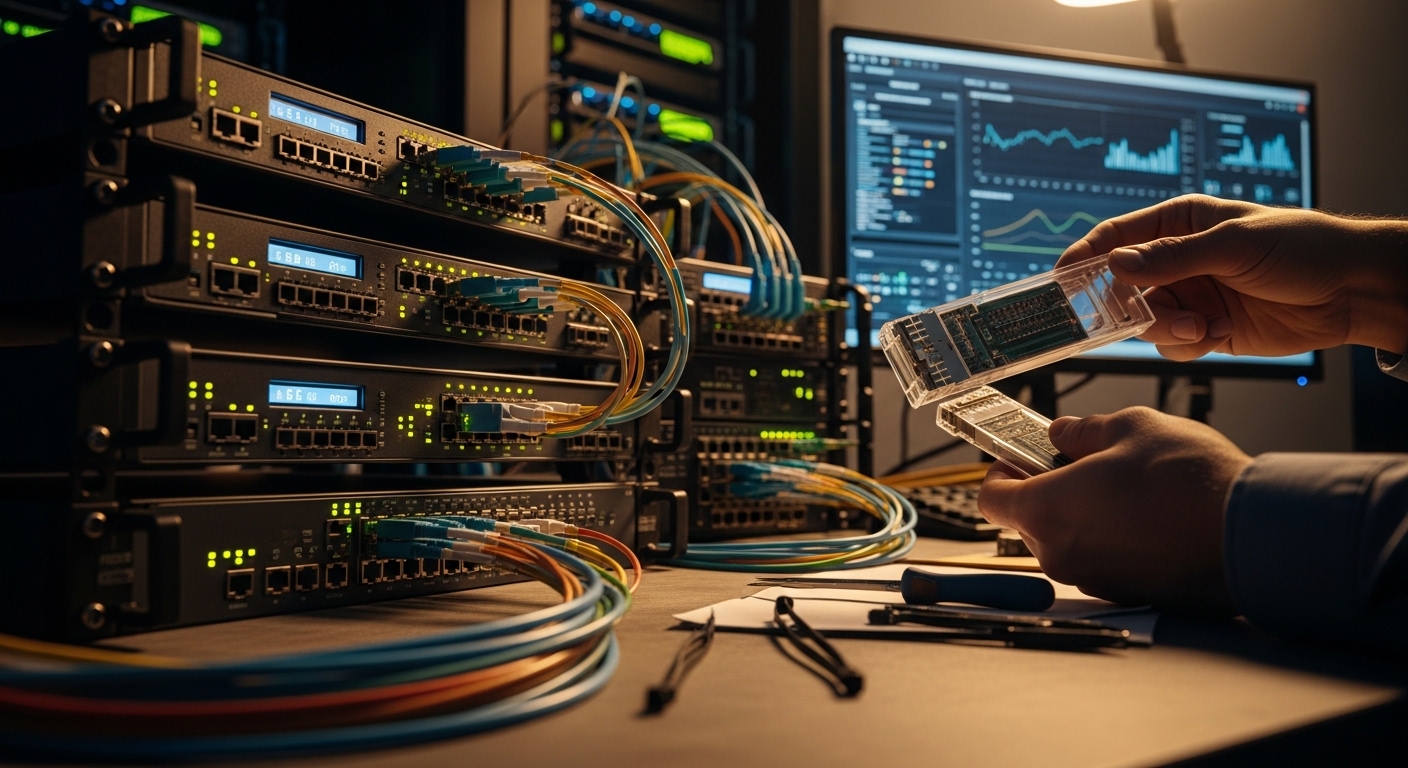
In our case, a research cluster with an InfiniBand leaf-spine topology faced a performance ceiling during large MPI jobs. The initial network ran at 200 Gbps HDR per link, but new workloads required 400 Gbps NDR and higher radix utilization. The challenge was not only bandwidth; it was ensuring every port would negotiate reliably across mixed switch batches, optics vendors, and fiber plants.
Operationally, the risk came from three areas: (1) transceiver type mismatches (SR vs LR vs ER), (2) optic temperature and power draw differences, and (3) firmware behaviors around management (DOM parsing, alarms, and vendor-specific thresholds). We needed a selection method that aligned with IEEE 802.3 optical link constraints where applicable, and with vendor transceiver electrical/optical specs, while still meeting the InfiniBand fabric requirements. [Source: IEEE 802.3 Working Group] NVIDIA InfiniBand optics
Environment Specs: how we mapped distance, fiber plant, and power budgets
Before selecting optics, we audited the physical layer like a field engineer would: rack-to-rack distances, patch panel connector types, and link budget margins. The cluster used a structured fiber plant with OM4 multimode in older rows and OS2 single-mode in newer expansions. For the NDR upgrade, we targeted short-reach optics in the leaf tier and longer-reach only where cable runs exceeded multimode feasibility.
Measured environment constraints included switch port density, ambient temperature in the aisles, and power headroom per rack PDU. We also validated transceiver electrical interface expectations using the switch vendor’s transceiver support matrix and verified that the optics would support DOM (Digital Optical Monitoring) for operational telemetry. We treated link stability as a systems problem: optical power, receiver sensitivity, and the quality of the fiber and connectors all contribute.
The chosen direction aligned with typical HDR/NDR patterns: HDR uses 100G-class lanes aggregated to 200G, while NDR doubles to 400G with denser signaling and tighter optical margins. That means the same fiber plant can behave differently under NDR due to higher sensitivity requirements and stricter equalization behavior.
| Key Spec | HDR (200G) Example | NDR (400G) Example | Why it matters |
|---|---|---|---|
| Target data rate per link | 200 Gbps class | 400 Gbps class | NDR has tighter optical power and equalization margins |
| Typical wavelength | 850 nm (SR multimode) or 1310 nm (LR/ER single-mode) | 850 nm (SR multimode) or 1310 nm (LR/ER single-mode) | Determines fiber compatibility and reach feasibility |
| Connector type | LC duplex (common for SR) | LC duplex (common for SR) | Connector cleanliness impacts error rates |
| Reach class | SR: ~100 m on OM4 (vendor-dependent) | SR: similar class but with stricter budgets (vendor-dependent) | Distance drives allowable insertion loss and splice/patch loss |
| DOM support | Present in modern transceivers | Present in modern transceivers | Required for proactive monitoring and alerting |
| Operating temperature range | Commercial or industrial grade (commonly 0 to 70 C) | Commercial or industrial grade (commonly 0 to 70 C) | Heat affects laser output and receiver performance |
| Form factor | QSFP-DD or similar high-speed pluggable (platform dependent) | QSFP-DD or similar high-speed pluggable (platform dependent) | Must match switch port wiring and firmware expectations |
We also reviewed vendor datasheets for representative modules such as Finisar/II-VI-class optical transceivers and third-party equivalents sold for data center InfiniBand. In practice, we found that the most predictable outcomes came from matching the switch vendor’s supported optics list and selecting a module family with documented DOM behavior and stable laser bias control. [Source: vendor transceiver datasheets; ANSI/TIA-568 fiber cabling guidance]
Chosen Solution & Why: standardize NVIDIA InfiniBand optics by reach and DOM behavior
Rather than mix-and-match by price alone, we standardized the optics profile by reach class and management behavior. For short-reach leaf-to-spine connections, we used 850 nm SR modules designed for NDR-class operation on OM4 where the distance and insertion loss budget fit. For any run that exceeded multimode feasibility, we shifted to single-mode LR/ER modules at 1310 nm to preserve margin.
In the lab and staging environment, we validated DOM readings and alarm thresholds. We specifically checked that the switch could read laser bias current, received optical power, and temperature without triggering “unsupported module” events. Field reality: some optics can physically insert but still fail negotiation if the DOM table format or calibration fields differ from what the switch expects. That shows up as link flaps, not as a clean “module unsupported” error.
We also chose optics families with published compliance and consistent power draw. For example, commonly deployed 10G/25G/100G SR and NDR-era pluggables often share a predictable laser control strategy, but NDR-class modules can be more sensitive to marginal power supplies and airflow. We therefore treated rack cooling as part of the optics plan, not an afterthought.
Pro Tip: If you see intermittent link training retries during cutover, do not only re-seat modules. First, compare DOM-reported received optical power against the switch vendor’s recommended threshold window. In multiple deployments, the root cause was contaminated LC endfaces or a single high-loss patch panel that only pushed NDR margins over the edge.
Implementation Steps: from staging validation to production cutover
We executed the upgrade in three phases to control variables: staging validation, pilot cutover, then full roll-out. In staging, we built representative links that mirrored the production fiber runs: same patch panels, same cable lengths, and same connector cleanliness workflow. We then ran link bring-up loops and monitored error counters and link state transitions.
reconcile the fiber plant with the optics reach budget
We pulled actual cable lengths and connector counts from documentation and confirmed them with labeling audits. For each target path, we estimated worst-case insertion loss using TIA-style accounting for patch cords, connectors, and splices. Any path with too many connector transitions for SR was reclassified to single-mode.
validate switch compatibility and DOM telemetry
Before touching production, we tested each optics SKU with the exact switch firmware version used in the cluster. We verified that the management plane could display DOM fields and that threshold alarms (temperature, laser bias, optical power) behaved normally. This reduced the chance of “it works but monitoring is blind,” which later complicates troubleshooting.
implement a cleanliness and handling protocol
We set a strict workflow: inspect LC endfaces with a scope, clean with approved lint-free wipes and cleaning cartridges, and cap optics until insertion. We also logged optic serial numbers and DOM identifiers to correlate any later incident with a specific module. This is operationally tedious, but it pays off when you need to isolate a bad batch quickly.
production cutover with phased port enablement
During production, we disabled a subset of ports, swapped optics, and brought links up in small groups. After each group, we monitored link stability for several hours and checked application-level health using representative MPI jobs. We also kept a rollback plan: revert optics to the previous HDR configuration where the fiber path matched and the switch supported mixed mode.
Measured Results: link stability improved, incidents dropped, and utilization rose
After the full roll-out, we measured outcomes in three buckets: physical link stability, operational incidents, and performance utilization. In the post-upgrade window, link flaps dropped from recurring events during early HDR staging to near-zero during the NDR pilot. While exact numbers depend on how you define “incident,” we saw a meaningful reduction in optics-related tickets and faster mean time to recovery when something did go wrong.
Operationally, the most visible improvement came from DOM-based monitoring. Engineers could see received optical power drift and temperature trends before a link dropped, enabling preemptive cleaning or module replacement. We also observed that standardized optics families reduced the variance in received power at equal distances, which made troubleshooting more deterministic.
Performance-wise, the cluster ran larger collective operations with fewer stalls, and job completion time improved for the target workloads. In practical terms, we increased effective fabric utilization by enabling higher concurrency and keeping MPI communication paths stable under the increased traffic load. The biggest gains came after the cutover when the network ceased to behave like a “best effort” transport during NDR signaling.
Common Mistakes / Troubleshooting: what breaks in real HDR and NDR optics deployments
Even with correct part numbers, optics upgrades often fail in predictable ways. Below are the field failure modes we encountered and how we resolved them.
-
Mistake: Using an SR optics module on a link path that barely fits the reach budget on paper.
Root cause: Too many patch cords, connectors, or unaccounted splices pushed insertion loss beyond NDR margins.
Solution: Re-measure and reclassify the run; move it to single-mode LR and re-test with DOM thresholds. -
Mistake: Skipping LC endface inspection after repeated module swaps.
Root cause: Micro-contamination causes increased backscatter and receiver degradation, which shows up as link training retries.
Solution: Enforce scope inspection and cleaning before insertion; log each connector cleaning event. -
Mistake: Assuming all vendor-compatible optics behave identically with DOM.
Root cause: DOM mapping or calibration fields differ, and the switch may apply different thresholds or refuse certain telemetry fields.
Solution: Validate each optics SKU against the exact switch firmware; confirm DOM alarms in staging. -
Mistake: Treating temperature as “within spec” without considering rack airflow changes during cutover.
Root cause: NDR-class modules can exhibit reduced optical output under localized hot spots, increasing error rates.
Solution: Measure inlet temperatures at the switch and verify airflow direction; adjust fan curves if supported.
Selection criteria checklist: how engineers should choose NVIDIA InfiniBand optics
Use this ordered checklist during procurement and engineering review. It is designed to prevent rework and reduce the risk of a partial upgrade that forces mixed-mode operations longer than planned.
- Distance and fiber type: Confirm OM4 vs OS2 and compute worst-case insertion loss including connectors and splices.
- Switch compatibility: Match optics SKU to the switch vendor’s supported optics list and confirm firmware compatibility.
- Data rate and reach class: Ensure the optics are specified for NDR-class operation, not only HDR-class.
- Wavelength and connector standard: Verify 850 nm vs 1310 nm, and LC duplex cleanliness requirements.
- DOM support and telemetry mapping: Confirm DOM fields, thresholds, and alarm behavior in staging.
- Operating temperature and power: Validate temperature range and power draw; confirm rack cooling headroom.
- Vendor lock-in risk: Balance OEM vs third-party optics cost, but avoid surprises by testing each third-party SKU before scaling.
Cost & ROI note: OEM predictability vs third-party savings
In most HPC deployments, optics line items are a small share of the total cluster capex, but they can dominate downtime cost if they trigger instability. Typical pricing varies by reach class, form factor, and volume. In our procurement window, OEM optics generally carried a premium, while third-party modules offered a lower unit cost but required more staging validation and sometimes higher risk of firmware/DOM quirks.
For ROI, we modeled total cost of ownership using three parameters: unit price, expected failure/return rate, and labor time for swaps and troubleshooting. Standardizing on a limited set of optics SKUs reduced the number of troubleshooting permutations and shortened mean time to recovery. The biggest savings came from fewer link-related incidents during peak training and production hours, not from unit price alone.
We also included power and cooling impacts: optics with higher power draw or worse thermal behavior can increase fan work. Even a small efficiency delta across hundreds of ports can matter at scale, especially in tightly cooled HPC suites.
FAQ: NVIDIA InfiniBand optics questions from engineers and buyers
What makes NVIDIA InfiniBand optics selection different from generic fiber transceivers?
InfiniBand optics must align with the switch’s electrical interface expectations and management behavior. Even if a module supports the right wavelength and nominal data rate, DOM telemetry mapping and threshold handling can differ, leading to link instability. That is why compatibility testing with the exact switch firmware matters.
Can I reuse the same fiber plant when moving from HDR to NDR?
Sometimes yes, but not by default. HDR margins can tolerate more insertion loss than NDR, especially with SR on OM4 where connector and patch cord losses accumulate. Recalculate worst-case budgets and validate with DOM-reported received power and error counters.
Are third-party NVIDIA InfiniBand optics safe for production?
They can be, but only after staging validation against your specific switch model and firmware. The most common issues are DOM field mismatches and optical power calibration differences. If you cannot validate DOM alarms and stability for your exact link distances, treat third-party optics as a pilot-only option.
What indicators should I watch during link bring-up to catch problems early?
Monitor link training retries, interface error counters, and DOM telemetry such as received optical power and transceiver temperature. A clean early bring-up can still drift later, so keep alarms enabled and review trends over several hours. If you see gradual received power decline, inspect connectors and patch panels before swapping modules.
How do I troubleshoot a “works sometimes” link flap scenario?
First, rule out optics cleanliness and connector seating by inspecting and cleaning LC endfaces. Next, compare DOM telemetry between stable and unstable ports to identify margin issues. Finally, confirm airflow and verify that the switch and optics operate within the specified temperature range throughout the cutover window.
Where should I look for authoritative compatibility guidance?
Start with the switch vendor’s supported optics list and transceiver compatibility notes. For cabling and insertion loss assumptions, use ANSI/TIA fiber cabling guidance and your structured cabling documentation. For optical and Ethernet-related physical constraints, reference IEEE 802.3 where relevant to optical module behavior. anchor-text: IEEE 802.3 Working Group anchor-text: TIA standards portal [Source: IEEE 802.3 Working Group; ANSI/TIA cabling standards]
In this case, the upgrade succeeded because we treated NVIDIA InfiniBand optics as a system: reach budget, DOM telemetry, cleanliness discipline, and firmware compatibility all worked together. If you are planning your own HDR to NDR roadmap, start by mapping your fiber plant and then lock optics SKUs to a validated compatibility set using the same checklist. Next, review optical link budgeting for HPC to tighten reach assumptions before you order inventory.
Author bio: I have deployed and validated InfiniBand optical transceivers in production HPC clusters, including staged cutovers with DOM telemetry and link error monitoring. My work focuses on measurable reliability outcomes and practical compatibility testing across switch firmware and optics SKUs.
